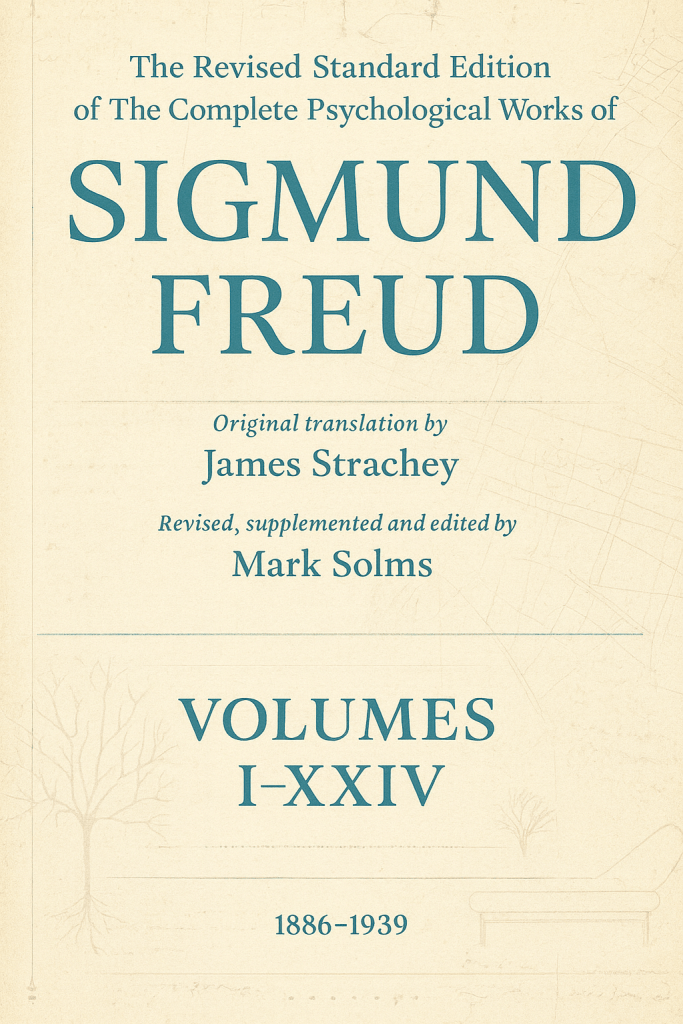
The Revised Standard Edition of the Complete Psychological Works of Sigmund Freud is a scholarly instrument designed to recalibrate access to Freud’s corpus by bringing the textual surface, the editorial scaffolding, and the translation choices into a single evidential field. Its distinctive contribution is to render visible, and therefore testable, the minute places where Freud’s formulations and Strachey’s English diverge or converge, and to fold newly recovered or previously excluded items into the chronological texture of the work. The aim is not to rewrite Freud but to refine the conditions under which his arguments can be reconstructed, compared across editions, and situated within their metapsychological sequence. As a result, the Edition becomes an apparatus for thinking with Freud under modern constraints of philology, clinical ethics, and conceptual precision.
The Edition’s outer frame is methodological before it is doctrinal. First, it commits to the Strachey base edition while systemically revising it; second, it makes the revisions legible in the very body of the text through light emphases that disclose all differences between the historic SE and the RSE; third, it moves the technical discussion of translation policy and term-choice into a consolidated editorial locus, so that the reasoning behind interventions can be followed and tested. This yields a text whose readability is inseparable from its auditability. In practice, the Edition shows where Strachey’s language is retained, where it is adjusted, and why, while marking in the margins the old SE pagination to keep the dialogue with the tradition practically open. The guiding premise is conservative in its form and exacting in its execution: retain Strachey as the canonical medium of Freud in English, but bind that medium to an explicit record of its own variances.
That frame is not an aesthetic choice; it is an epistemic wager about psychoanalytic language. The translational decision on Trieb moves from instinct to drive, and the editorial apparatus treats this less as a triumph of terminology than as a carefully argued correction, recognized as delicate because it affects the metapsychological grammar of action, aim, and object across the work. The Edition makes the rationale public, classifies the correction as an error worth debating, and folds the debate into the annotations where the chain of consequences can be followed text by text. Such choices clarify that the RSE is neither a wholesale modernization nor a neutral reproduction; it is a controlled displacement of certain English signs so that Freud’s conceptual economy—especially where motoric cathexis, representation, and regulation are at stake—regains its coherence across volumes. The suppression of archaisms such as psycho-analysis and to-day belongs to the same logic of readability without conceptual dilution.
Editorial method becomes visible in three further ways. First, by indexing and annotating at two scales—the general notes on technical terms and the punctual “t”-flagged comments on specific contentious renderings—the Edition supplies a map of controversies that readers can traverse with the relevant textual nodes at hand. Second, by light-underscoring every non-trivial difference, it establishes a reversible path between any RSE reading and its SE antecedent, minimizing the risk of silent drift. Third, by relocating certain materials, expanding indexes, and consolidating bibliographical tools, it converts Volume 24 into a meta-instrument for the entire set. The overall effect is to literalize the Edition’s claim that it is a revision and not a replacement: where the text changes, it says so; where it does not, it shows why added scaffolding is still needed for understanding.
A decisive mark of scholarly seriousness is the integration of fifty-six items absent from the original SE, inserted at their chronological junctures and therefore allowed to perturb established narratives of development. The restitution of a draft of the missing metapsychological paper, Overview of the Transference Neuroses, is especially consequential, because it rebalances the internal economy of 1915, a year in which Freud’s theoretical architecture for conflict, defence, and transformation thickens and complicates. The Edition thereby demonstrates its thesis that editorial completeness is not indulgence but an instrument for discerning concept-formation within the very pressure that generated it.
The Edition’s ethical posture intersects with its philology. It keeps the anonymity of patients as a principle, even though scholarship has sometimes reconstructed identities, on the argument that analytic confidentiality is not a dispensable courtesy but a condition for the possibility of analysis itself. It also retains Freud’s period language concerning sexuality, race, and culture, while identifying its prejudice as historical fact and refusing to sanitize the record. Here, the Edition insists that interpretation must be undertaken on the rough ground of the source, which includes the tone and blind spots of the author’s time. The result is to conserve the object of study in its full strangeness and to require that criticism proceed with evidence rather than euphemism.
Within this frame, the Edition’s inner argument is Freud’s own, reconstructed through a sequence that moves from prepsychoanalytic neurology to clinical technique, and then into the metapsychology where economy, representation, and value are related. A salient advantage of the RSE is that it allows the reader to watch concepts migrate, in the strong sense: initiated in neuro-energetic hypotheses, reworked under the pressure of clinical failures and resistances, and then re-inscribed as general functions in the later architecture of mind. This migration is sharply visible in the early Project for a Scientific Psychology, which articulates an aim-governed traversal of facilitated pathways, a struggle between established facilitations and variable cathexes, and a twofold economy of thought in which reproductive activity (“travelling” cathexes seeking an identity) is distinguished from judging (a dissection of complex perceptual cathexes that stabilizes what counts as the nucleus and the predicate). The Edition’s notes let one hear the later metapsychological undertones without anachronism, by pointing to the places where Freud’s handwritten substitutions—cathexis crossed out for current—already betray the tension between metaphor and mechanism. The early text becomes legible as an experiment in conceptual engineering, where Qη is not a fetish of physiology but a variable needed to think how wish, perception, and belief become commensurable.
This early economy already stages the problem to which the clinical writings will return: how to move a complex organization of memory-traces and resistances through the narrow defile of consciousness, one fragment at a time, without destroying the organization one hopes to reconstruct. The RSE’s rendering of the Psychotherapy of Hysteria clarifies the operational consequences: one cannot “extirpate” a pathogenic nucleus because the pathogenic is not a detachable foreign body; it is an infiltrate continuous with the ego’s ordinary tissue. The therapist’s task, then, is to melt resistances so that circulation can be re-established, to allow a segmented procession of memories through the “defile” and then to recompose in analysis what could only appear piecemeal at the surface. The Edition’s notes underscore that Freud knows he is working by simile and that these similes are mutually incompatible; this explicit reflexivity is itself methodological, an early admission that metapsychology must proceed by successive approximations and cross-correcting images.
A parallel methodological lesson is drawn from the Screen Memories analysis: there is no guarantee that what presents itself as an origin is not a composite deputation, retrofitted to bear the weight of later wishes and necessities. Here the Edition’s faithful reporting of Freud’s dialogical style and his minimal glossing of technical terms lets one reconstruct the logic of the inference, from the symbolic adhesion of colors and objects to the convergence of two life-projects into one childhood vignette. The emphasis is less on debunking memory than on delimiting its evidential status: the memory can be genuine and still be selected because it efficiently represents later phantasy-complexes. The Edition thereby supplies a worked example of how the “construction” of the past in analysis is constrained by associative links and by the distribution of affective value, without collapsing into arbitrary montage.
The same logic of displacement under constraint obtains in the Psychopathology of Everyday Life. The Edition’s rendering of the Signorelli forgetting presents the core claim without embroidery: forgetting is not simply weakness of memory for proper names; it is the outcome of motivated diversion along associative paths that can be reconstructed. Substitute names intrude because they lie on pathways adjacent to what has been set aside by repression; their obstinacy in consciousness reveals the lawfulness of the displacement. The Edition’s apparatus preserves both the clinical tact of Freud’s self-observation and the theoretical wager that Verdrängung can be read at the surface as a structured error. This is precisely the kind of place where the choice of drive over instinct protects the intelligibility of a system in which affective economy and representational pathways co-determine what is sayable.
In Jokes and Their Relation to the Unconscious, the Edition’s careful cross-referencing helps trace an argument that binds technique to economy. Condensation and displacement are not mere literary devices; they are modes of achieving a yield of pleasure under censorship by harnessing infantile modes of thought which persist in the unconscious. The Edition makes it easier to hold together the two “views” that Freud himself worries might seem incompatible—the view of jokes as constructed to produce localized economies in the use of material, and the view that their conditions of production arise automatically in unconscious thought. The reconciliation is exact: the plunge into the unconscious is the tactical exploitation of a place where pleasure-yielding condensations arise easily because the infantile remains the source-form of thinking. The Edition amplifies the point by indexing the consequent analogy to dreams and the distinct route jokes must take in navigating inhibition, thus exhibiting how a clinical metapsychology becomes a general grammar of forms.
The Three Essays on the Theory of Sexuality occupy a privileged position in the Edition’s narrative, and here the RSE’s editorial decision to display, with dates, all substantive alterations across editions is not a convenience but a method. The 1915 additions—the sections on infantile sexual theories, pregenital organizations, and the libido theory—are historically reinserted into the text’s evolution, allowing the reader to experience the 1905 matrix without losing the later conceptual apparatus that came to dominate readings. The Edition thereby reopens the question of composition: how much of the architecture was present at the start, and where do the later structures change the load-bearing lines of the original edifice? The answer is distributed across the footnoted cancellations and revisions: the chemical insistence survives even after paratextual updates; bisexuality and erotogenic zones have an incipit in the mid-1890s and are folded into the analytic treatment of neuroses; the keystone that will reorganize the field—infantile sexuality as a general developmental principle—emerges only as the seduction model yields to a more complex economy of endogenous drives and phases. This layered presentation is the Edition doing theory: it lets the reader watch the text become theory under the stress of its own clinical commitments.
The case material that anchors these constructions is treated with the same editorial care. In the Little Hans analysis, the Edition preserves the father’s inquisitorial notebook tone and the child’s performative answers, allowing the reader to perceive how the phobia disperses across horses, harnesses, bites, and falls, and how this dispersion is the surface of a transposition in which paternal rivalry and identification reconfigure the field of fear. The Edition’s notes make explicit that “transference” in this context is broader than its later technical sense: it is a general mechanism of reallocation by which an originally father-referent anxiety finds new objects properly adapted to symbolic substitutions. The child’s play, his biting and neighing, is evidence not of mere imitation but of the circuit in which identification and wish conflict crystallize into symptom, a circuit that the Edition keeps intelligible by retaining the period lexicon and supplying just enough editorial gloss to reveal the method at work.
So too in the essays on love and object choice, the Edition’s fidelity to Freud’s argumentative texture helps exhibit a logic that would otherwise be obscured by later doctrinal tags. The series of conditions—an attachment to the already-attached woman, the oscillation between mother and whore, the insistence on rescue—are not typologies for their own sake; they are reconstructions of how infantile fixation on the mother stamps the later series of surrogates. The Edition’s rendering respects the deliberately clinical rhetoric—examples, analogies drawn from obstetrics, and the mapping of conscious repudiations to unconscious unities—and thereby shows why the conceptual tension between idealization and seriality is intrinsic to love life as Freud conceives it. The Edition’s philological restraint is, again, theoretical precision: it lets the text show that the split between mother and whore in conscious valuation has an unconscious antecedent in unity, so that the later oscillation is the symptom of a prior unresolved constellation.
What, then, is the Edition’s inner logic once these domains are seen together? It is to make Freud’s constructive method—of moving between clinical impasse, metapsychological hypothesis, and textual re-articulation—legible as a continuous operation rather than as a series of isolated treatises. The early Project already equates thinking with a traversal that seeks identity conditions under ego-inhibition; the clinical technique elaborates how to carry a segmented, resistant formation through consciousness and how to rebuild it without the defensive cement that held it in place; the psychopathology of slips and jokes exhibits the same economy at the surface, where censorship and pleasure are two sides of one mechanism; the developmental essays and cases outline how object-choice and symptom-formation are constituted by the relay between infantile fixation and later substitutions. The Edition’s textual policy—its emphases, its term-notes, its inserted essays—works as a metapsychology of the archive: it tracks how the work’s own facilitations and resistances have to be handled so that a coherent identity can be attained in reading, without mistaking partial coincidences for total identity.
A corollary follows for contemporary use. Because the RSE keeps the SE legible within itself, it enacts the interpretive discipline it recommends. One may work with the revised drive terminology while checking local semantic gradients; one may read the 1905 Three Essays in their first articulation while inspecting the 1915 supplements as marked layers; one may follow a clinical notion through successive redefinitions without losing sight of the footnotes where a cancelled line returns as editorial evidence. The Edition does not eliminate the labour of interpretation; it disciplines it, by making the necessary moves explicit and recoverable. In that sense, the Edition is performatively psychoanalytic: it assumes that understanding proceeds by bringing resistances to speech and by reconnecting fragments to their context without annihilating their differences.
This is clearest where the Edition refuses two temptations. It refuses to normalize Freud’s contested lexicon into present consensus, because the very contest reveals how the concepts work. And it refuses to “out” patients because the ethics of the analytic frame is not ancillary to knowledge-production; it is a condition of it. The Edition’s one explicit concession to modernization—orthographic regularization—signals that the line between style and concept is itself a matter of judgment, to be negotiated where readability sharpens, rather than dulls, conceptual edges.
Against this background the scholarly stake of the RSE becomes exact. It is a platform for conceptual reconstruction in which Freud’s problems—how an ego inhibits to think, how a wish travels to find identity, how a pathogenic organization infiltrates the ego’s texture, how a joke earns its pleasure under censorship, how a child’s fear changes object to conserve its meaning, how sexuality organizes development—can be read in a way proportionate to the difficulty of the questions. The Edition insists that these problems are interdependent: judging presupposes bodily feedback and thus prepares, decades earlier, the conditions under which later theories of signal anxiety and reality testing become intelligible; screen memories presuppose the same representational economy that dream-work and joke-work exploit; object choice presupposes developmental time that Three Essays formalize and clinical technique tests. Across these crossings, the Edition’s inventions—underscoring difference, relocating materials while logging their moves, inserting the missing documents at their times—are not ornaments but the means by which the work’s inner migrations become readable.
Thus framed, the RSE can be used to ask a final clarifying question: what does it take, textually, for a system of thought that begins as neurological speculation and ends as a general theory of mental life to remain one system? The Edition’s answer is to bind every interpretive gain to an explicit material change in the corpus, every terminological decision to a documented note, every relocation to an indexable trail, and every addition to a dated insertion. In other words, it makes the work’s identity—the very object that early Freud sought for thought in the state of identity between cathexes—an empirical artefact, achieved through editorial inhibition, traversal, and reconstruction. That achievement is neither a guarantee of agreement nor a closure of debate. It is the condition under which disagreements can be acute, cumulative, and productive, because their object has been stabilized at the right level of detail. That is why this Edition matters: it is a living demonstration that textual scholarship can be a mode of theory, and that theory, when anchored to its textual conditions, can be made newly available for thinking.
 Simon Gros
Leave a comment