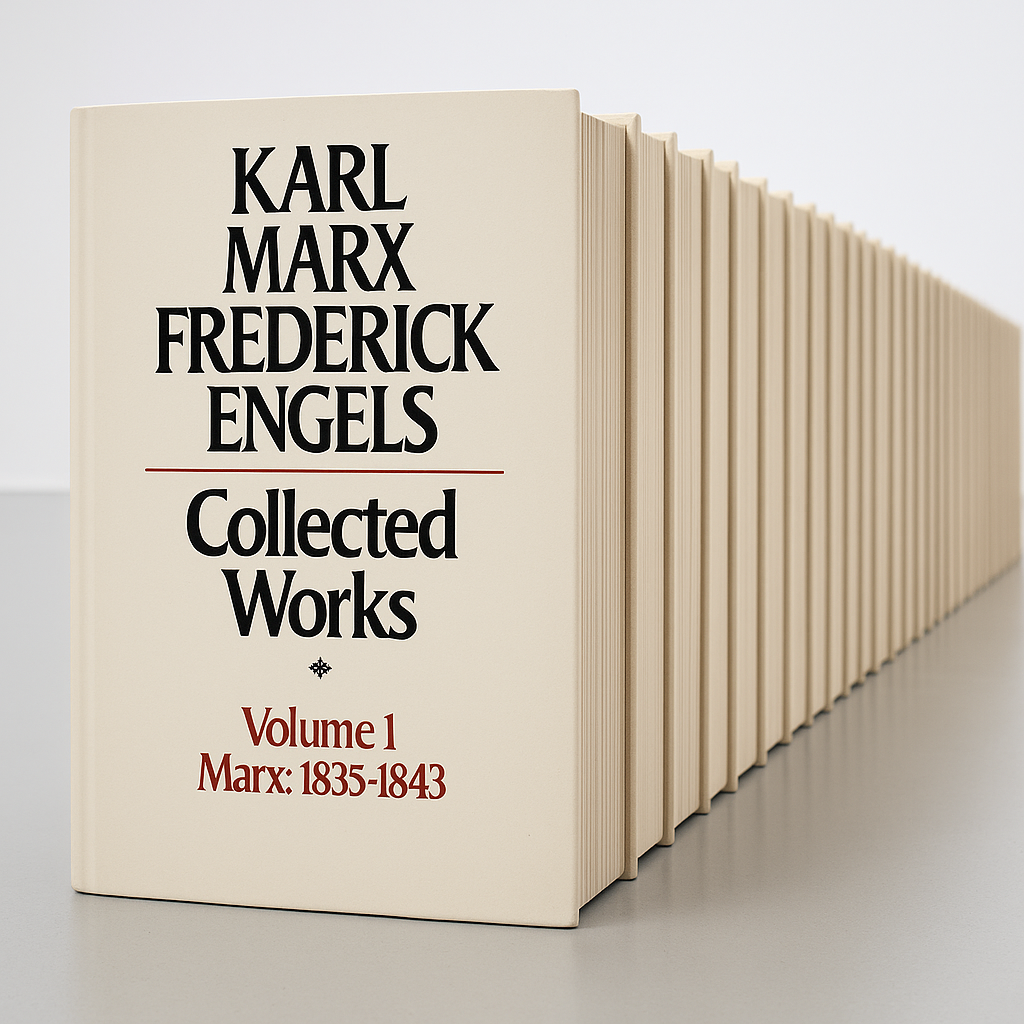
The Marx/Engels Collected Works (MECW) is an unparalleled compendium of the intellectual legacy and revolutionary spirit of Karl Marx and Frederick Engels, extending from the early years of their careers in 1835 through to Engels’ death in 1895. This monumental collection, spanning fifty volumes, represents the most extensive and comprehensive translation into English of their works, encompassing their published writings, unpublished manuscripts, and extensive personal correspondence. Published from 1975 to 2004 through a coordinated transnational effort, the edition ensured that many of their seminal texts as well as lesser-known documents reached an English-speaking audience in a form that is both philologically disciplined and historically intelligible. It is at once an archive and an instrument: a systematized corpus that allows readers to track, across six decades of composition, the formation, testing, and iterative re-articulation of concepts under political and organizational pressure.
The MECW constitutes the most systematic English-language presentation of the writings of Marx and Engels, conceived as an editorially structured record of two overlapped intellectual careers and a political partnership whose range spans philosophy, political economy, journalism, organization, and correspondence. It covers the period from Marx’s earliest juvenilia in the 1830s through Engels’s final writings in the 1890s and, in doing so, provides a continuous documentary horizon against which the evolution of problems, categories, and strategic judgments can be tracked with unusual precision. The edition’s internal architecture and scholarly apparatus are designed to make that developmental line visible and usable: texts are arranged primarily by date of composition; variant versions and authorial revisions are identified; the sources and circumstances of publication are documented; cross-references orient the reader within a shifting constellation of periodicals, associations, and correspondents; and the editorial team indicates, via notes and indices, the relevant names, organizations, and literatures implicated in each work. In this sense, the edition is both a repository and a research method, staging what might be called a controlled encounter between finished publications, preparatory materials, and letters so that the historical movement of thinking becomes legible in its own time signatures.
Planned and executed as a fifty-volume series, the MECW is divided into three large groups corresponding to the practical periodization of the joint oeuvre. Volumes 1–28 assemble philosophical, historical, political, journalistic, and other writings; volumes 29–37 present Capital and the directly connected economic manuscripts (including the 1857–58 materials commonly referred to as the Grundrisse); volumes 38–50 gather the letters, beginning in August 1844, that supply a living chronology of projects, crises, alliances, and revisions. The first three volumes are structurally distinctive because they precede the formal consolidation of the partnership: the initial volume contains Marx’s works and letters up to March 1843; the second gathers Engels’s output over roughly the same early period; the third presents, in adjacent sections, the texts of Marx and Engels from spring 1843 to August 1844, making felt an incipient convergence of method and purpose before the long decades of co-development. Thereafter the edition treats their work in parallel and in tandem, reflecting the continuous exchange characteristic of the period from 1844 onward while preserving the grain of individual authorship where attribution is secure.
This arrangement is not merely convenient; it is a methodological wager. The editorial practice that privileges date of composition establishes a documentary rhythm in which a newspaper column can be read against notes from the same week, a public speech can be situated by letters sent three days before and two days after, and an unfinished manuscript can be placed within a chain of topical interventions whose sequence records the pressure of events on theory. The MECW’s decision to separate finished publications, unfinished manuscripts, outlines, fragments, and major serial runs while maintaining a distinct zone—From the Preparatory Materials—for drafts and discarded passages gives the reader a workshop view of the labor by which categories are specified, definitions narrowed, and explanatory claims disciplined in contact with recalcitrant cases. In effect, the edition renders visible the becoming of problems and the way positions harden into doctrine only provisionally, in response to new evidence or altered institutional conditions. It is this transparency that enables the reconstruction of conceptual trajectories across genres, languages, and organizations without effacing the contingencies of composition.
Volumes 1–28 gather a continuous field of philosophical, historical, political, and journalistic writings in which a set of recurring problems is approached at shifting distances: the legal and institutional form of the modern state, the social presuppositions of property relations, the dynamics of class composition, the temporality of crises, the grammar of parliamentary regimes, the strategies of parties and associations, the colonial expansion of capital and the unevenness of development, and the materiality of ideology as an ensemble of habits, routines, media forms, and administrative instruments. Within this field, well-known landmarks—The Condition of the Working Class in England, the analyses of 1848–1852 culminating in The Eighteenth Brumaire of Louis Bonaparte, the programmatic interventions around the International Working Men’s Association, the long expository and polemical canvases from the 1860s through the 1880s—are surrounded by dense serial runs of reportage, commentary, and strategic assessment. The editorial choice to print such series intact, date by date and outlet by outlet, yields a systematic effect: it allows readers to see concepts working at the speed of events, subject to revision across weeks, tested against contradictory signals from elections, strikes, cabinet reshuffles, financial disturbances, colonial wars, and peasant uprisings. In such a layout, journalism becomes a mode of theory conducted under the discipline of recurrent topics and serial publication, and theoretical motifs acquire the index of contingency that belongs to decisions taken in real time.
Volumes 29–37 concentrate the long labor on political economy: preliminary drafts, outlines, synopses, and manuscripts that culminate in Das Kapital and that display the successive architectures by which the critique of political economy is organized. The Grundrisse (1857–58) provides an especially vivid instance of the MECW’s methodological promise: notebooks where the vocabulary of value, money, circulation, surplus, and reproduction is tested, reconfigured, and tightened; transitional passages where philosophical residues are seized and refitted to the morphology of capitalist relations; analytic sketches that are later contracted into the expository economy of Capital. The proximity of these preparatory materials to the published text, and the exactness with which variants and revisions are identified, equips readers to follow the formation of the categories that structure the mature critique without projecting later systematics into earlier experiments. The edition’s apparatus makes clear what is composed when, how a sequence of notes opens into a plan, where a plan is adjusted in view of a discovery, and how doctrinal solidity is the hard-won product of writing under complex constraints that include the need for money, the obligations of correspondence, the interruptions of illness, and the demands of organization.
Volumes 38–50 gather an immense correspondence that functions as the living backlight to the entire corpus. Here projects are proposed, deadlines negotiated, research tasks divided, interlocutors characterized, allies gathered, opponents situated, and failures diagnosed. Letters fix the composition sequence, record the editorial politics of publication, register the economy of time and resources within which composition was possible, and transmit the tacit diagrams of the work as it proceeds. When placed alongside the serial runs of the 1840s and 1850s, the programmatic writings of the 1860s, and the synthetic expositions of the 1870s and 1880s, the correspondence anchors interpretation in a calendar and a world: plans take shape, are revised or abandoned, and are either given public form or temporarily shelved, all under the force of events that none of the authors could command. The effect is to re-situate even the most familiar texts within a process that was neither linear nor serene, and to invite readings that reconstruct rather than merely cite.
Because the edition aspires to be reliable across philological, historical, and conceptual uses, it specifies its textual principles with unusual clarity. The inclusion criteria extend beyond familiar published works to embrace authorized publications, verified reports of speeches, manuscripts not published in the authors’ lifetimes (unfinished works, outlines, drafts, fragments), selected synopses and excerpts when they carry substantive authorial commentary, and appendices with biographical documents, official papers, minutes, reports, interviews, and organizational documents composed by the authors or written on their instructions. Rough versions and drafts for works whose final texts appear in the main section of a given volume are grouped in a separate dossier so that the construction of arguments is observable without erasing the horizon of the finished text. The prefaces and general introductions articulate the hierarchy of textual authority, the rationale for chronological ordering and its exceptions, the principles governing annotation, and the responsibilities of translation—readability coupled to strictness of technical nomenclature, with brief first-mention glosses where German terms must be retained. The apparatus is deliberately modest in tone: it identifies, dates, situates, and clarifies without dictating conclusions, trusting that the continuous presentation of materials, accurately framed, is sufficient to elicit the discipline of inference that advanced reading demands.
The institutional framework of the MECW is integral to its scholarly character. The edition emerges from an agreement among British, American, and Soviet editors, translators, and scholars and is published jointly by Lawrence & Wishart (London), International Publishers (New York), and Progress Publishers together with the Institute of Marxism-Leninism of the Central Committee of the Communist Party of the Soviet Union (Moscow). Work proceeded under editorial commissions appointed by these publishers, with a coordinated division of obligations, cross-checking of decisions, and printing at the First Model Printers in Moscow. The general principles were agreed at a conference in Moscow in December 1969 and subsequently refined by the three editorial commissions whose composition—bringing together figures like Maurice Dobb, E. J. Hobsbawm, Philip S. Foner, and colleagues from Progress Publishers and the Institute—signals a dual investment in philological precision and historical adequacy. This cooperative provenance is visible in the edition’s consistency of reference systems across volumes, its cautious attributions, its steady tone of annotation, and its refusal to allow the apparatus to become an interpretive machine. The scaffolding is present and reliable; it remains in the background so that the texts can show their own logic.
The need for a complete English edition arose from both historical and bibliographical considerations. While many major works were translated into English during the authors’ lifetimes (and some were written directly in English for the British and American press), significant portions of the corpus—especially economic manuscripts, early Engels materials, much of the Neue Rheinische Zeitung content of 1848–49, and the bulk of the correspondence—remained unavailable or scattered. Existing translations varied in quality and annotation. The MECW addresses these gaps by consolidating, checking, and annotating a practically complete collection for English readers, drawing on the second Russian edition and the German historical-critical edition and making use of results from international scholarship on Marx and Engels and the history of Marxism. The result is a coherent platform for studying the formation of arguments in their dynamic historical sequence rather than as isolated canonical texts—a design that fosters reading across genres and moments and that encourages conceptual reconstruction through chronological comparison.
Because the series is pledged to periodization without dogma, it never forces a clean break. The philosophical preoccupations of the early writings carry forward into strategic diagnoses; the language of critique is gradually disciplined by the demands of institutional analysis; the vocabulary of political economy is elaborated under the stress of parliamentary crises, street mobilizations, and organizational struggles; and the attention to legal and administrative forms persists even as the grammar of value and accumulation becomes more exact. The continuity and the tension are equally legible because the edition resists the temptation to anthologize only a canonical subset and instead prints the routine work of analysis that surrounds the better-known texts. In the aggregate, the volumes demonstrate how coherence emerges from repetition with variation: problems are revisited at higher levels of determination, definitions are tightened in light of counterexamples, strategic lines are adjusted as facts accumulate, and concepts are made to earn their explanatory power by doing work across different scales—from the workshop and the parish to the ministry and the world market.
Within this horizon, certain patterns of reasoning recur and deepen. There is a repeated practice of entering an opponent’s position to reconstruct its internal necessity, treating polemical targets as serious moments in the object’s self-presentation. There is a discipline of extracting the social presuppositions of legal, political, and philosophical claims so that conceptual argument is never separated from the practical routines that sustain it. There is a sensitivity to the ways in which conceptual systems are stabilized by institutions and media forms: newspapers, clubs, unions, ministries, parliaments, police ordinances, and budgetary procedures appear not as neutral containers but as structures of reproduction and contestation. The MECW’s architecture makes these habits visible by preserving runs of writing tied to specific conjunctures and venues, so that the temporality of judgment—the revisability that belongs to week-by-week analysis—becomes part of what the reader studies.
In the mid- and late-1840s, when revolution and reaction organize the calendar, the edition’s promise becomes especially palpable. The long sequences of articles linked to the upheavals of 1848–1849 display the transfer of philosophical motifs into the morphology of political situations. Analyses of French electoral coalitions, addresses to Chartists, reports on cabinet realignments, commentary on colonial fronts: each piece is situated by date, outlet, and addressee; each is surrounded by letters that prepare and assess; each participates in the tightening of a vocabulary that must perform across pamphlet, speech, and editorial. Categories such as class, state, party, property, and law operate here as variables whose determination depends on the articulation of practices in institutions. When the sequence is read attentively, one sees that the theory lives in the adjustments—the tempering of an initial claim a week later, the recalibration of a tactical hope after a failed action, the tuning of a general schema to a stubborn decree or ordinance. The MECW’s refusal to isolate only the famous text and its insistence on printing routine pieces allow this dynamics to be studied rather than inferred.
The 1850s and 1860s advance this pedagogical rhythm into the domain of political economy and international organization. The serial nature of the economic manuscripts and the disciplined economy of the published Capital show a movement from exploratory notes through transitional architectures to mature exposition. Here the MECW’s editorial economy—a strict chronology, careful attribution, thorough identification of variants—permits readers to follow the narrowing of definitions, the stabilization of distinctions, and the integration of conceptual innovations into the expository plane. At the same time, programmatic writings tied to the International Working Men’s Association and to debates in parties and unions show how analytical categories are put to use in composing demands, evaluating strategies, and diagnosing defeats. The simultaneity of these modes—research notebooks and programmatic texts—destroys any picture in which theory floats above practice; rather, theory is seen composing the very instruments that give it effect.
The final decades, culminating in Engels’s last writings, exhibit the same disciplined alternation of scale. Organizational memoranda, letters of counsel, prefaces to new editions, surveys of historical developments across continents, and sharp topical interventions form a heterogeneous body that remains unified by a method trained to treat institutions as material. A law is an enforceable shape of conduct; a party program organizes expectations and actions; a statistical table is a structure of decisions about what counts and what is counted; a newspaper’s alignment, circulation, and audience are constraints within which argument acquires determinate sense. The MECW’s paratext—brief notes on venues, meeting places, rules of order, and biographies of interlocutors—supplies just enough of this texture to deter allegorical readings in which concepts float free of the world that elicited them. The effect is to return abstractions to their sites and to make the adequacy of a concept a question to be measured against the stubbornness of institutional forms.
All of this depends on translation that balances lucidity with exactitude. The MECW’s policy aims for readable English that preserves technical precision and cadence, with German terms retained only when necessary and briefly glossed at first mention. The result is to show that complex claims can be carried in English without draining them of force and to prevent the drift into terminological folklore that often attends partial or inconsistent translation traditions. Because the same concepts move across journalism, manuscripts, programmatic texts, and letters, and because the same authors write in different registers for different addressees, translation must carry a double responsibility: it must transmit both the conceptual burden and the genre-appropriate tone. The edition meets that responsibility at scale.
From the vantage of method, the MECW’s most consequential contribution is to render visible the movement from critique to constructive theory without dissociating either from practice. In the earliest writings, critique often takes as its object a body of thought—jurisprudence, theology, speculative philosophy—and adopts a key of immanent demonstration. In the middle decades, critique bends toward institutional analysis in which the relevant necessity is located in the reproduction requirements of a social order. The series makes this transition studyable because it keeps together preparatory materials and finished texts, the letters where plans are laid out and the published pieces where plans are implemented, the speeches where argument is compressed into consequences and the minutes where organizational effects are recorded. A reader who accepts the discipline of chronology and comparison can watch as species-being and alienation are gradually subordinated to a grammar of labor, exchange, accumulation, and reproduction; as moral vocabularies are translated into analytic ones without being abandoned; and as a theory of the state grows out of recorded encounters with cabinets, assemblies, decrees, budgets, and apparatuses.
The MECW also refuses to stabilize a single authorial voice. Side-by-side presentation of contemporaneous texts by Marx and Engels, with careful attributions and scruples where certainty is unavailable, allows readers to perform controlled comparisons of style and argument, to identify pivot points where a formulation is taken up and transformed by the other, and to register the different rhetorical currencies in which the same conceptual stock is expended. Co-signed pieces and ghostwritten materials are identified; differences of emphasis and tone are preserved. This is not an antiquarian virtue; it is a condition for any rigorous history of concepts grounded in authorship and collaboration.
The edition’s internal economy presupposes and rewards a particular discipline in its users. It invites reading that accepts the long arc of development and resists premature synthesis. That discipline is rewarded with patterns that only emerge at scale: the progressive consolidation of a vocabulary of class; the testing of hypotheses about the state across different constitutional arrangements; the recurring problem of the peasantry in revolutionary strategy; the constructive role of organizational forms in the reproduction of class power; the transformations of the public sphere under the pressure of modern media and police; the international unevenness of development and its specific political rhythms; and the intertwining of economic conjuncture with political form across countries and continents. The notes and indices are sufficient to navigate these patterns without imposing them.
When considered as a whole, the MECW is an archive of Marx and Engels’ writings that shows their enduring influence on the course of world history while preserving the work by which influence is earned. Their collaboration—from early radical diagnosis through mature architectures of critique—is documented with remarkable fidelity. Through these volumes, readers trace the evolution of their thoughts, the sharpening of their critiques, and their relentless commitment to revolutionary praxis. Theoretical work is shown to be inseparable from practical engagement in the working-class movement; writing is seen as a form of organization; and organization appears as a field in which concepts are proved. The translations render dense German originals into English that is both accessible and exact, and the apparatus supports rather than substitutes for reading.
Within this terrain, certain works serve as exemplary nodes not because they exhaust the method but because they concentrate it. The Communist Manifesto appears as a compact, militant synthesis whose long afterlife is intelligible only when placed amid the serial analyses and organizational documents that prepared and followed it. The Eighteenth Brumaire of Louis Bonaparte reads as a masterclass in political morphology, anchored in the stubborn particularities of a parliamentary regime and its class articulation. Anti-Dühring shows Engels’ capacity to crystallize hard-won results into a didactic form capable of arming a movement. The letters that surround and follow these landmarks record the conditions of their production and reception, the arguments and hesitations that they generated, and the ways in which success and failure were measured inside organizations and across borders. The MECW lets these texts be studied as moments within sequences rather than as isolated pronouncements.
The collaborative, multinational provenance of the edition matters for interpretive practice. The convergence of British, American, and Soviet editorial traditions is visible not only in institutional credits but in the careful balance of philological sobriety and historical framing, in the steadiness of tone across thousands of pages of apparatus, and in the restraint that keeps identification and context from sliding into commentary. Agreements reached in 1969 among the publishers and commissions indicate a procedural pragmatism—coordinated labor, cross-checking of attributions, centralized printing—that contributes to consistency of presentation. Documentary illustrations and maps, the occasional reproduction of drawings in letters, and the exactness of indices and cross-references exemplify a conviction that textual scholarship can be materially enriched without being overloaded.
Overall, the MECW realizes three commitments that are easy to state and difficult to implement: to preserve authorial intention where discernible, to document historical and textual variation transparently, and to equip readers to judge the evolution of arguments across decades of political crisis and intellectual innovation. The edition shows why this is not a mere aggregation but a means of research, a way to follow the composition of problems that would eventually structure later, more famous works, and a means to test whether explanatory categories retain their power when redeployed in new conjunctures. For scholars, students, and readers approaching Marx and Engels through English, this is both the best available access point and an editorial argument about how to make a complex intellectual legacy legible without taming it.
It’s important to note that MECW is not a relic of a finished doctrine; it represents a set of pathways through ongoing work. Its earliest materials show how far the early Marx and the early Engels are from the later architecture of critique and yet how certain lines are already drawing themselves: the insistence on the public character of reason, the dislocation of philosophy from a purely contemplative mode, the irritation with inadequate political forms, the gravitational pull of economic relations on legal and political argument, the requirement that institutional analysis be equipped with concepts that can survive contact with administrative detail. By gathering works, letters, drafts, notebooks, and documents into a single, disciplined frame—by making the movement among them readable—the edition offers something that isolated volumes cannot: a means to study the trajectory by which intellectual positions become political stances and by which political stances seek adequate theoretical expression. That design choice is the MECW’s lasting strength and the reason it still serves as an indispensable point of reference for students of nineteenth-century social thought and its legacies.
In the end, the MECW demonstrates a principle about intellectual labor that the authors themselves stressed in other registers: theory is a social practice embedded in institutions, constrained by time, answerable to history, and obligated to revise itself in light of stubborn facts. The volumes make that principle legible in their very construction. They give the reader the means to study how an argument is composed, how it navigates the compromises of public speech, how it organizes evidence and marshals concepts, how it is translated across languages and media, how it is taken up, contested, and revised in collaboration. The unity of the work appears as the emergent property of this disciplined process—an achievement of method under pressure rather than the reflection of a pre-given system.
E. J. Hobsbawm’s judgment that the MECW is indispensable for serious study of Marx, Marxism, and the nineteenth century captures a consensus that becomes intelligible when the edition is used as designed: chronologically, comparatively, across genres, and with attention to the apparatus that holds the materials in a common field. The Sunday Times’ praise for the translations’ readability and fidelity is borne out by the experience of moving between journalism and treatise, between letter and speech, without loss of conceptual traction. For scholars, activists, and readers seeking to understand the roots and development of revolutionary thought, the MECW offers an unrivaled wealth of knowledge precisely because it equips them to work with the materials rather than to venerate them. It remains an enormous scholarly achievement—and a living one—because it transforms a collected works into an instrument for following how ideas merge in practice and are displaced by the very realities they were summoned to explain.
 Simon Gros
Leave a comment