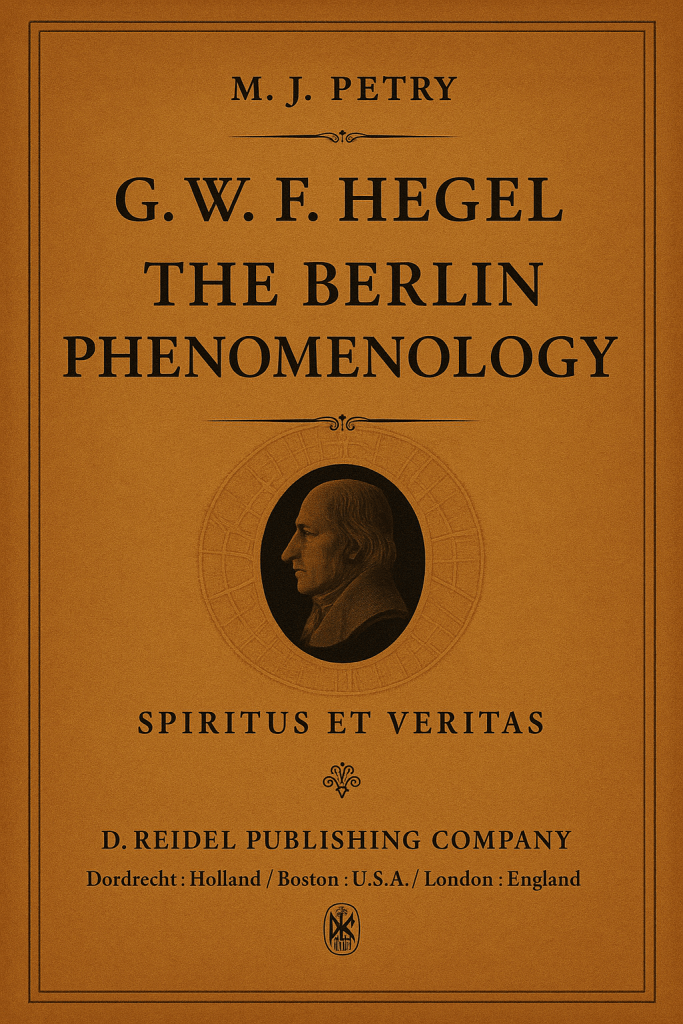
The Berlin Phenomenology presents, in a compact and rigorously articulated register, a doctrine of consciousness that is at once internal to the Encyclopaedia’s systematic architecture and responsive to the empirical texture of the human sciences. Its distinctive scholarly stake lies in exhibiting how consciousness, treated not as a free-standing tribunal but as a domain continuous with empirical knowing and practical life, becomes intelligible only when its moments are reconstructed as asymmetrically ordered levels whose interrelations are presuppositional rather than merely juxtaposed. The book’s contribution is twofold: a methodological clarification—distinguishing everyday, empirical, and comprehending modes of consciousness—and a critical recalibration of the legacy of Kant, Fichte, and Schelling, achieved by relocating their claims inside a graded account of ego, recognition, and reason whose intelligibility culminates in the Idea’s notional unity of subject and object.
The outer frame of the volume, as Petry makes explicit in the Preface, is pedagogical without being reductive. Extracted from the Philosophy of Subjective Spirit and reissued as an independent teaching text, it gains didactic economy precisely by holding fast to the Encyclopaedia-context in which its arguments breathe; there, the phenomenological materials are never severed from their logical and psychological neighbors. The result is a work “concise and to the point,” yet one whose concision intensifies rather than dilutes the radicality of its analyses of Kant’s epistemology, Fichte’s ethics, and Schelling’s system-building. Petry’s stated aim is to provide a reliable base text and a translation controlled against manuscripts, and to supply an introduction and notes calibrated to both teachers and advanced students; these editorial interventions clarify provenance without usurping the text’s inner argumentative movement.
The Introduction opens with a maxim that orients the whole: sciences, taken “merely as such,” are organized ignorance; only within systematic exposition do their contents acquire philosophical significance. The gesture is double: it refuses to despise empirical sciences—Hegel’s materials are drawn from standard textbooks, journals, and first-hand reports—and it resists granting “professedly philosophical interpretations” any automatic primacy over that material. What confers philosophical weight on empirical content is not an external badge of a priori dignity but the labor that integrates it into a network of necessary relations. This early positioning is decisive for the phenomenology to come: the subject-matter to be grasped is ordinary knowledge, and the method that confers significance is the reconstruction of its presuppositional order.
From here the Introduction carefully stages the problem-history that gave this Berlin text its shape. At Jena, Hegel struggled to locate consciousness: Was it a narrow province contiguous with empirical psychology, or did it bear a central philosophical charge? The Jena manuscripts explore even sub-conscious states such as animal magnetism and derangement, together with the psychological factors of language and sociability; the treatment remained unsettled and lacked systematic precision. The Berlin decision, by contrast, is to make consciousness a major philosophical theme while integrating it within the Encyclopaedia’s architecture; the Anthropology will harbor sub-conscious and physiological presuppositions, the Psychology will follow as immediate sequent, and the phenomenological inquiry will remain squarely about the experience of consciousness only as that experience is methodically articulated. In this sense the “Berlin Phenomenology” is not a reprise of the Jena experiment but a re-siting of its legitimate insights within a clarified system.
That relocation reconfigures the relation to Kant and Fichte. Kant’s “unity of apperception” is acknowledged as a remarkable focus, yet Hegel’s critique is systematic: Kant retains the dualism of the subjective unity and the thing-in-itself, and thereby confines himself to a dialectic of antinomies whose complementarity he cannot comprehend as necessary moments of a single order. In the Berlin construction, such antinomies are neither scandal nor failure; they are indices of a level-structure that only comprehending consciousness—i.e., reason as the Encyclopaedia’s mode of exposition—can display as mutually implicative. Ordinary consciousness (the Kantian standpoint) juxtaposes modalities of being-conscious—sensing, perceiving, understanding, desiring, struggling for recognition—without making explicit their presuppositional ties; comprehending consciousness shows how those ties articulate a progression. The result is not an erasure of empirical plurality but its elevation into a network of asymmetrical inclusion, where each “lower” determination lives on, sublated, in the “higher.”
This methodological advance depends on a strict distinction among three registers. First, everyday consciousness: the living involvement of a subject with its object—sensing a manifold, noticing a law, confronting another living being, desiring and using an object, commanding or being compelled. Second, empirical consciousness: the reflective, classificatory exploration of those involvements as objects of inquiry—dividing sensuousness into space, time, manifoldness; distinguishing “thing,” “property,” and “alteration”; differentiating perception from understanding, drive from recognition. Third, comprehending consciousness: the Encyclopaedia’s speculative reason, which does not replace empirical analysis but gathers its findings into a sequence of necessities, exhibiting a hierarchy where each level presupposes and transforms those below it. The Berlin text is alive to all three, but it is written in the third.
Because the book is deliberately included in the Encyclopaedia, its table of contents functions not as a mere index but as a conceptual map of the level-structure. The German–English parallel layout underscores that we are reading a bilingual, tightly cross-checked presentation: from Das Bewusstsein through Das Selbstbewusstsein to Die Vernunft, with fine-grained partitions—sinnliches Bewusstsein (space, time, manifold), das Ding (externality, content, concrete alteration), Wahrnehmen, Verstand (necessity, law, subjectivity), then the arc through Begierde, Anerkennung, Herrschaft und Knechtschaft, Gemeinschaft des Bedürfnisses, to allgemeines Selbstbewusstsein, and finally Vernunft as subjective, objective, and notional, concluding in Geist und Wahrheit. The compositional signal is unmistakable: we do not leap from sensation to spirit; we traverse a ladder whose rungs are named.
The work begins, characteristically, not from a transcendental fiat but from the ego as a natural center of awareness—das Ich with its diremption, its Seele, and the movement of Aufhebung. The opening emphasis places the ego within nature (and thus within Anthropology’s presuppositions) while refusing to make it the absolute principle. The Ich is that which “has a world within itself and knows of it”: in saying so, Hegel signals that the ego stands on foundations it does not itself posit and that must be reconstructed by the science that follows. Precisely this renders Kant’s transcendental I think too narrow for the phenomenological task here assigned: the natural ego is not the apodictic ground of all science; it is the place where consciousness begins for us and the site where levels of object-relatedness are disclosed.
Within this horizon the early triad—knowledge, certainty, truth—appears not as three independent pits to be filled but as three aspects of a relation binding subject and object. Knowledge gives the content of the relation, certainty the form of its self-assurance, truth the unity that can be shown only when the levels that feed into any given cognition are made explicit. In this sense, even before the critique of subjective idealism is mounted, the Berlin text has quieted the impatience that drives so many programs to a hasty primacy of either object or subject. The structure to be unfolded will not tolerate a premature absorption of one pole into the other; instead it discloses the sequence by which such absorption becomes intelligible as sublation rather than erasure.
The critical node labeled “Subjective Idealism” (Kant, Fichte) is then engaged at the right depth. Kant is treated as an advance over empiricism to the extent that he related the thing-in-itself and empirical classifications to the unity of apperception; yet, by maintaining the unbridgeable split between that unity and the thing, he bequeaths only antinomies where the Encyclopedia’s method would teach complementarity. Fichte, by making consciousness foundational, relieves one dualism only to expose another: an infinite reiteration of presuppositions that cannot ground its own logical forms without circularity. The Berlin Phenomenology does not cancel their achievements; it re-sites them within a phenomenology that keeps faith with empirical content while submitting it to comprehending reason.
This operational distinction—ordinary versus comprehending consciousness—pervades the entire book and sets its tone. Ordinary consciousness, left to itself, will state with equal plausibility that the understanding of nature is a matter of perceiving regularities or of recognizing necessity; it will launch into an “infinite progression” of presuppositions, demanding further grounds for every ground. Comprehending consciousness, by contrast, does not deny the phenomena that generate such antinomies; it inserts them into a chain of levels in which “perceiving” is shown to be sublated within understanding, and “law” is exhibited as the form that determinate necessity takes at a certain remove from immediacy. This is the meaning of Aufhebung here: progressive inclusion. Negation is not annihilation; it is the logical name for a higher inclusion that both conserves and transforms.
What follows is the first stretch of that ascent: Consciousness as such. The analytic sequence—division of consciousness, division of the object, relation of consciousness and spirit—immediately opens into sensuous consciousness. Here the determinations of space and time are not ancillary decorations but the very grammar of immediacy; the manifold is not yet a system but a delivering of content whose very thickness shows why a “thing” must be said, in the next movement, to have externality, content, and the capacity for concrete alteration. The grammar of perception arises as soon as these “givens” are no longer merely suffered but connected; object and property become correlative; Erfahrungen acquire the shape of a Verknüpfung; the subject, still at the level of consciousness, is already oriented toward law. Verstand then articulates necessity and law, and finally raises the specter of subjectivity: motion, animation, the consciousness of life. Each step presupposes the previous one and transforms it, and each answers to a real cognitive posture that empirical investigation had long since differentiated in practice.
The center of gravity then shifts to Self-consciousness. Hegel’s manner of entry is anatomically precise: characterization, freedom (first abstract, then as free self-certainty, and then as objectification), and division of self-consciousness. The arc through desire is not psychology in the reductive sense; it is the account of how an ego’s drive and activity aim to identify itself through and in an object that is, at first, consumed or destroyed, only to learn that this route cannot stabilize self-certainty. The recognitive turn is therefore necessary. Struggle, imperiousness, life and death, coercion and subjection—all figure philosophically because they name structural possibilities of the relation between two egos whose certainty of themselves is at stake. Mastery and servitude is not a parable; it is the schema whereby dependence on the other’s recognition is revealed as a condition of achieved selfhood. From there, the Gemeinschaft des Bedürfnisses discloses a thicker texture—slavery, service, communal provision—that finally makes possible the allgemeines Selbstbewusstsein, where recognition and acceptance acquire the profile of rationality.
Two aspects of the recognitive section are decisive for the whole. First, sublation and negation are now shown at the interpersonal scale: the other is not annihilated but interiorized as the condition of selfhood; the movement from coercion to mutuality is exactly a passage from the abstract freedom of self-certainty to a mediated freedom in which the other’s independence is constitutive. Second, the “community of need” signals that social objectivity—institutions of provision, service, labor—does not merely follow from self-consciousness; it is already implied by the struggle’s outcome. This is why the Berlin text, even while it remains within the phenomenology, prepares the ground for the later Philosophy of Right: it shows how legal and ethical forms presuppose the very recognitive structures that phenomenology exhibits without yet developing them juridically.
When universal self-consciousness is introduced, the argumentative music changes key. The singularity that sought self-certainty through consumption or domination now appears as the immediate presupposition of universality; reason, at this juncture, means the achieved unity of self-consciousness with its object, a unity too often sentimentalized in treatments that rush past the structural work performed by the earlier levels. Hegel’s insistence—echoed in Petry’s commentary—that this level sublates the preceding spheres of consciousness and self-consciousness without liquidating them is the systematic heart of the book. Universality is the form in which earlier forms live on, not a vapor into which they dissolve.
The section entitled Reason consummates the internal logic of the progression by explicitly subdividing reason as subjective, objective, and notional. To call reason “subjective” at first is to recall that self-certainty must be preserved; to call it “objective” is to mark the forms in which necessity appears in the world and in our practices; to denominate it “notional” is to assert that these two, subject and object, are bound together in a unity that is not the naiveté of immediacy but the achieved identity of the Begriff with its objectivity. Hence the culminating triads—certainty (subjective, objective, knowing), substantial knowledge (self-certainty, spiritual activity, cognition), and finally spirit and truth (unity, spiritual certainty, truth)—are not ornamental catalogues; they gather the dispersed achievements of the previous movements into a self-conscious unity, the very form in which the Idea’s logical characterization becomes legible within phenomenology.
Here the relation to the Logic becomes legible without confusion of genres. Petry emphasizes that the Idea is “the absolute unity of the Notion and objectivity,” not a mere correctness of opinions about things. The Berlin volume shows how comprehending consciousness exhibits the subjectivity of sensuousness, perception, understanding, and the objectivity of desire, struggle, recognition, as systematically structured within reason. This is the sense in which phenomenology, at its limit, touches logic: not by leaping out of experience but by displaying within experience the form that only the Begriff can name. The phenomenological ascent is complete when the levels of being-conscious and self-consciousness are seen as moments of reasonable order.
The relation to the Jena Phenomenology is clarified ruthlessly but without rancor. Petry collects testimonies—reviews, correspondence—to show both the fascination and the bewilderment the 1807 book provoked; but the Berlin text’s point is not historical gossip. It is to mark a methodological decision: Hegel abandons the teleological, impressionistic “experience of consciousness” as an introduction to the system and instead integrates a clarified doctrine of consciousness into the Encyclopaedia. The Jena book’s vast middle—its ethical, cultural, historical, religious “shapes of spirit”—is thereby relocated to the Philosophy of Spirit proper, where the achievements of the understanding can be made to bear the weight they must. The Berlin volume thus retunes phenomenology to its proper scope and equips it to perform the function the system requires of it.
The language of the Berlin text—Petry dwells on this—confirms the Griesheim text’s consistency with Hegel’s published vocabulary in the Logic and later Encyclopaedia editions. But Petry’s philology is not antiquarian; it is philosophically diagnostic. He shows that the meanings of the key terms—setzen, Widerspruch, Bestimmung—are conferred not by dictionary stipulation but by the work of comprehending consciousness as it relates and compares levels, always in the presence of empirical analyses. This is why the Introduction insists that we not confuse empirical and comprehending consciousness: the former brings to light the materials (concepts like consciousness, certainty, relation; subject-object dichotomies across which independence, objectivity, reality are distributed), while the latter confers determinate meaning by situating those materials within necessary relations.
A central gain of the Berlin construction is its treatment of the ego that neither dissolves it into a bundle of impressions (Hume) nor inflates it into a transcendental monarch. The natural ego is analyzed empirically and located systematically: it presupposes subconscious states and the natural body (Anthropology), it stands over against a world that is both object and presupposition of consciousness, and it is the subject through which the sequence of levels is articulated. If in Kant the unity of apperception and the transcendental ego can appear as two intimately related aspects of knowledge, Hegel’s system refracts that unity into two tracks: the logic of the Idea (where the unity appears as a category’s telos) and the phenomenology of the ego (where the unity appears as the living center of consciousness traversing its levels). This clears away the confusion that would identify the natural ego as the foundation of all philosophizing; its dignity is great, but its role is determinate.
Sublation’s ontological reach bears emphasis. Because the subject-matter is everyday consciousness—concrete comportments like perceiving, recognizing, laboring—the analytic and synthetic procedures here are not merely methodological. Levels really sublate one another. The struggle for recognition really negates in the sense of interiorizing domination and dependence into a mediated reciprocity; law really appears as the objective form of necessity at a certain level of practice; communal provision really reworks need into institutions. Thus the identity of method and subject-matter is not a flat identity; it is a constantly checked coincidence realized by realism about the phenomena and empiricism about the sciences that analyze them. That is why Hegel can agree with Jacobi that sciences are organized ignorance and still insist that by being organized they become cognition; the organization that matters is the one that inserts empirical findings into the network of necessity.
Against this background, the Berlin text’s treatment of Kant’s antinomies acquires a determinate sense. The dualisms that ordinary consciousness cannot master—freedom/causality, finite/infinite, discrete/continuous—are not dissolved by fiat; they are relocated. When comprehension shows how a given dualism arises from the limits of a level (e.g., the way perception’s dependence on immediacy prevents it from grasping necessity as anything other than repeated connection), it also shows where the resolution lies: not as a third thing between contraries but as the higher form where the earlier determinations find their place. The Berlin book does not ask us to leap from dualism to intuition; it shows us how to climb.
Once this is seen, the notorious “mastery and servitude” passage can be finally read without myth. Its internal logic is the logic of mediated selfhood: coercion reveals dependence; work internalizes and stabilizes self-relation; recognition structures the field in which universality can appear as more than a pious wish. The level of slavery and service is neither an allegory nor an empirical generalization; it is the conceptual notation of a necessary possibility of self-consciousness, and it justifies the turn to universal self-consciousness not by edict but by exhausting the lower path. This is as far from a romantic reconciliation as one can get; it is a sober exhibition of structure, complete with the institutional shadows it casts.
The closing pages—Spirit and Truth—do not exceed the remit of phenomenology; they delineate the point at which the notional unity of subject and object is no longer an aspiration but a structure of consciousness capable of bearing universality without dissolving into abstraction. “Unity,” “spiritual certainty,” “truth”: the triad is not simply formal; it names the achieved condition under which the sciences’ organized ignorance becomes, in fact, knowledge—because it is systematized according to the inner order that the Idea prescribes. The philosopher’s task here is not to deliver decrees from beyond science but to show how science already stands within a whole, if only it knew what its own presuppositions commit it to.
Petry’s Introduction also contributes a lucid historical demarcation. He shows how early phenomenologies (Lambert, Fichte)—concerned with illusions of appearance or with introspective foundations—could influence the young Hegel’s boundary-probing between consciousness, sub-conscious states, and physiology. But he insists that the Berlin turn—not merely to treat consciousness as central, but to weave it into the encyclopaedic system with Anthropology as presupposition and Psychology as sequel—marks the decisive correction to Jena. Even Schelling’s formidable System des transzendentalen Idealismus, whose influence on the Jena period is acknowledged, receives its final place here: the sublation of the subject-object split, Schelling’s aesthetic consummation, is presented not as a separate epiphany but as implicit in the subject-matter that the ensuing Philosophy of Spirit develops.
Finally, the composition sequence and editorial scaffolding deserve note. The Berlin text arises as a selection from the Subjective Spirit volumes; it is anchored in lecture cycles (1817, 1820, 1822, with material still in use in 1825), and the notes Hegel had before him (as edited by Nicolin and Schneider) help explain certain revisions made to the Encyclopaedia and to the distribution of materials across Anthropology, Phenomenology, and Psychology. Petry coordinates these materials with Boumann’s later editorial labor, marking how the Berlin Phenomenology’s internal economy—the stress on reason as culmination, the care not to confuse everyday with comprehending consciousness—became a touchstone for posthumous systematizers and a stumbling block for those tempted by psychologism. The book thereby occupies a pivotal place: it is both a gate into the system and a sieve that strains out confusions that had long troubled the field.
The distinctive claim of The Berlin Phenomenology is that consciousness is systematically reconstructible as a series of levels whose interrelations are of the essence. The evidence for that claim is drawn from the very materials ordinary and empirical consciousness already furnish—the manifold of sense, the patterns of perception, the laws of understanding, the interpersonal tensions of recognition, the social objectivities of need—and the method is to show how each, in turn, presupposes and transforms the last. What remains textual is the layout of the sequence, the terminological precision that pins each move to a named determination, and the insistence that no level is skipped. What remains inferential is the contention—argued but not deducible from any single example—that the hierarchy is necessary and exhaustive for the domain at issue. In this balance between textual nomination and rational reconstruction the book earns its compactness: it does not annotate a life-world; it composes a staircase.
The Berlin Phenomenology makes clear what the Jena precursor intimated but could not secure: that a phenomenology adequate to the system cannot substitute a grand narrative of spirit’s shapes for the painstaking display of presuppositions that make those shapes intelligible. Its philosophical claim is not that a speculative vision can vault from sense to spirit, nor that a transcendental fiat can secure the ego’s dominion; it is that the only durable passage is the one that shows, level by level, how consciousness is threaded together by the very relations that must be thought if experience is to count as knowledge. In so doing, it renders plausible the thesis with which it began: organized ignorance becomes knowledge not by disowning its empirical birthright but by consenting to the discipline of form that alone merits the name of reason.
 Simon Gros
Leave a comment