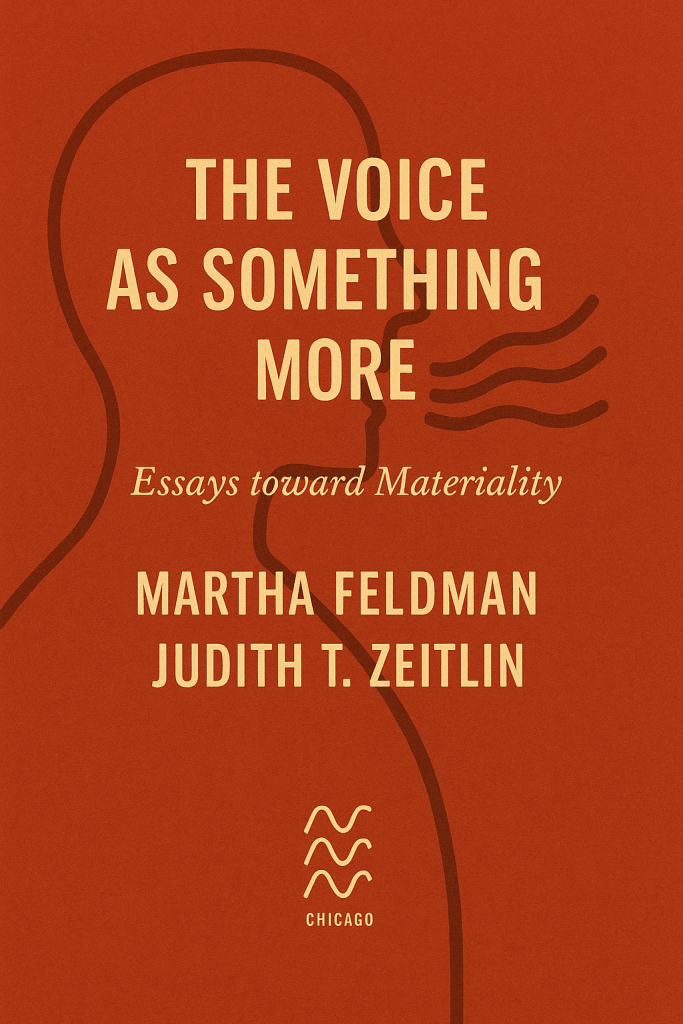
The Voice as Something More: Essays toward Materiality stakes a precise claim in the crowded field of voice studies: it recenters inquiry on voices as sensuous, technical, and historically situated phenomena while keeping in view psychoanalytic accounts of vocal excess and desire. The book’s distinctive contribution is a method of double illumination: raising the light on tangible vocal bodies, media, and devices—timbres, membranes, vocoders, microphones—while dimming metaphysical assumptions that voices transparently deliver meaning or identity. In place of system, the editors stage a carefully plural dramaturgy in which musical modernism, radio, cinema, myth, race, gender, and technology rub against one another and shift the contours of what counts as “voice.” The collection’s wager is that renewed attention to materialities produces conceptual remainder and remainder produces theory.
The outer frame is programmatic and historical at once. The book grows from a multi-year Voice Project at the University of Chicago (2013–2016), a 2014 symposium, and an international conference in November 2015 whose title the volume adopts and transforms; the editors openly position their sequence of essays as an after-vibration of those gatherings, with Michel Chion reprising a keynote and Mladen Dolar responding, and with institutional scaffolding acknowledged with unusual specificity, as if to signal from the start that voices are produced by scenes, infrastructures, and publics rather than by subjects alone. What remains, the editors suggest, is a volume that makes its heterogeneous genesis legible as method: an event’s clamor condensed and redistributed as written argument, then re-sonified in a closing afterword.
The preface’s single image sets the conceptual tension that the essays variously thicken and twist. Jin Shisheng’s Self-Portrait in Darmstadt (1939–1940) frames a camera aimed at a man whose mouth is opened to the limit, a noiseless O that obliges us to supply a voice we cannot hear. When the photographer’s son recalls that the friend was parodying Hitler’s oratorical bark, the picture’s acoustic politics snap into focus: an absent radio fills the room as a “ghost in the machine,” and the problem of vocal attribution—to whom does a voice belong?—becomes historically fraught. The preface asks us to draw a methodological lesson from this impasse: technology allows us to frame voice as object, but objectification constantly slides away; voice hovers between embodiment and spectral circulation and therefore demands analytic modes that include the psychoanalytic, literary, and mythic alongside history and media archaeology. The book’s title promises precisely that “something more,” the surplus that remains after microphones, membranes, and archives have had their say.
The introduction opens by stating the central double movement: make concrete voices more available while acknowledging that few things are more elusive than the human voice. It inventory-lists the terrains in which “voice” now circulates—sounding and aphonic, material and immaterial, literal and metaphorical—and then tightens focus on a guiding pivot: psychoanalysis gives a language for voice as the object that occasions desire, while a turn to materiality prevents that object from dissolving into mere figure. The editors spell this out with tactile concision—the “grain” of timbre, the cartilage and mucus that phonate, the veils that mask a sound, the vocoders and synthesizers that enhance and distort, the pleasures and anxieties that adhere to sonic fantasy—and insist that this list functions as a lithic counterweight to a purely interior account of voice.
The book’s argumentative engine is calibrated against Dolar’s A Voice and Nothing More, which asserts that among worldly sounds, only voice implies a subjectivity that inhabits its means of expression while, paradoxically, disappearing as a “vanishing mediator” in the very act of signification. The introduction treats Lacan’s objet petit a as a shorthand for how the object-voice exceeds bodies, languages, and sounds without becoming any of them. From this vantage, the volume’s task is not to deny that excess—an excess that psychoanalytic theory seizes as the elusive cause of desire—but to force it to pass through the membranes of practice, mediation, and history. On this point the editors are explicit: they do not assemble a systematic confrontation with Dolar’s object-voice; they curate an aleatory set of encounters unified by a propensity toward materiality that repeatedly brings the psychoanalytic picture to heel at the point of contact with singers, listeners, apparatuses, genres, racialized and gendered bodies, and limit-cases of performance.
What follows reads as a composition in polyphony rather than a thesis proven linearly. The table of contents marks a deliberate refusal of disciplinary silos. The first part gathers “sound-producing” voices in speech and song and in premodern Chinese theorizing of vocal sound; a second part poses limit cases in the modernist voice and radio; a third experiments with ownership, borrowing, and mimicry; a fourth explores myth, wound, and gap; an interlude addresses sexual difference on cinema’s plane; a last part tracks prostheses, uncanny technicity, and absent voices across Greece, Jamaica, Japan, and horror’s “voice that is not mine.” The afterword returns the psychoanalytic frame, but only after it has been deflected by the book’s prior insistences on bodies, devices, and scenes.
Two conceptual levers organize the argument-like narrative that the editors and contributors cumulatively advance. One is grain, summoned through Barthes to name the juncture where vocal materiality presses into signification from within: the tongue, glottis, teeth, and mucosa that make diction a site where meaning is felt as friction. The other is gap, a term that mediates Lacan and ethnography at once: gap is the structural non-coincidence that allows desire to circulate; gap is also the audible break, failure, or crack that renders virtuosity impressive and panic-inducing and gives radio or recording their peculiar acousmatic power. In this volume grain brings language down into the body, while gap opens the scene of hearing to what exceeds anchorage in text, score, or face. These terms prevent the chapters from hardening into case studies; they supply common pressures.
The essays cut across three problem-knots that the introduction foregrounds. A first knot concerns the relation of voice to language. The editors cite traditions that cast voice as the bearer of semantic meaning and traditions that enthrone voice as a source of aesthetic admiration, only to caution that vocal sound routinely veers away from sense and that music can operate as a substitute that disavows the disturbance the object-voice represents. The book’s wager is that attending to diction as geno-song neither reduces singing to coded style nor abandons it to ineffability; it rather situates the sonorous body as where language begins to work on itself. This is the point at which mimicry, ventriloquy, and “borrowed voices” in the book’s middle part begin to mean philosophically: they expose uniqueness as an ethical aspiration more than an empirical predicate and force listening to acknowledge both intersubjective relay and technical mediation. These claims are textually secured in the editors’ conceptual map; where the review speaks of ethical aspiration it marks an inference drawn from the juxtaposition of Polito’s and Stras’s chapters with the introduction’s account of vocal “ownership.”
A second knot concerns the politics of acousmatics. The editors note that for Dolar true “disacousmatization” is structurally impossible because the source of voice remains constitutively obscure to the desiring subject. By staging radio’s “screamlines,” cinematic close-ups of sound, and a voice that is not mine in technologically saturated terror, the volume asks how media build, perforate, and dramatize that obscurity. The preface’s silent parody of Hitler already suggested an answer: the acousmatic need not be metaphysical; it is manufactured by apparatuses and regimes that flood space with voices while withholding bodies, or conflate bodies with megaphones and loudspeakers. Essays on cinema and on Jamaican popular music make this tangible by binding vocal technē to colonial circuits, dub plates, pitch correction, and sound system ecologies; they allow “acousmatic” to be heard as a political-technical arrangement rather than an ontological fate. The shift of emphasis is secured where the preface calls Hitler’s radio voice a ghost saturating Darmstadt’s ether; it is inferential where the review frames acousmatics as a political-technical arrangement across the later parts.
A third knot concerns race, gender, and the claim that materializing the voice can serve as restitution. The editors name a recurrent desire in recent scholarship to return bodies to voices that modernist and metaphysical frames had abstracted away, and they accent how gendered and racialized listening practices and performance techniques create heterogeneous vocal agencies—what one cited strand calls the break—that move in between codes and identities. This motif anchors the collection’s insistence on concrete, contextualized voices and on organizational choices that make a sinologist brush against a pop theorist, a radio archaeologist against a high-modernist analyst, so that categories unsettle one another by adjacency rather than dialectical sublation. The review’s understanding of these curatorial pairings as an experiment in method is textually secured in the introduction’s explanation of the book’s arrangement; where it advances the language of restitution, it infers from the editors’ explicit emphasis on bodily return and their concluding claim that such a return is urgent.
If the opening and middle parts work to densify relations among voice, language, music, and media, the penultimate turn toward myth, wound, and gap changes the tempo of the argument. A rereading of Ovid’s metamorphic vocalities, an essay on virtuosic failure and crack, and an analysis of Zemlinsky’s Der Zwerg and the wounded voice together identify a phenomenology of injury that the book threads back into its materialist program. The body that sings is an instrument of potential fracture; the technologies that relay it are likewise given to rupture. By the time Seth Brodsky asserts that there is no such thing as the composer’s voice, the volume has prepared the claim as a hard corollary of its general stance: “voice” names a distributed set of mediations, borrowings, and fantasies that composition neither contains nor legislates. These argumentative displacements are legible in the table of contents’ sequence and in the introduction’s emphasis on the “gap” as both concept and structure of feeling; the review’s use of injury as a unifying image is inferential, merging multiple essays’ local insights.
The interlude on the gendered voice presses the cinematic plane for an account of sexual difference as it surfaces in vowels and consonants, allowing cinema to be heard as a laboratory where vocal categories are whispered into audiences by montage and mix. The final part’s excursions—to prosthetic voices in ancient Greece, to Jamaican sound system culture, to the actor’s absent voice in prewar Japanese cinema, and to the mythology of the technological voice that induces terror—do not so much add range as return to the book’s originary paradox under new pressures: embodiment and disembodiment recur, now specified by horn, dub plate, silent intertitle, and machine. The collection’s global breadth thus serves a tight conceptual loop rather than an encyclopedic aim; range is a technique for audibilizing the materiality/excess tension across architectures and epochs. This reading of range as technique is inferential; the factual itinerary and the part-titles are secured in the book’s contents.
Running through the volume is a declared relation to composition, in both senses. First, the composition sequence of the book—research seminar to symposium to conference to edited essays—anchors a claim about method: ideas were tried in the room, revised under pressure, and finally composed into chapters that keep traces of their dialogic origin. In acknowledging the Neubauer Collegium and an extensive cast of colleagues, the editors underscore that voice, as an object of study, solicits collaborative audition and curation as the appropriate scholarly form. Second, the book’s internal composition is planned to preserve difference and even omission. The editors insist that gaps and breaks are not defects to be airbrushed away; they are structural features of voice as a phenomenon and of voice studies as a field. The review’s linking of these two senses of composition—event-sequence and editorial design—is textually secured in the preface’s narrative of genesis and in the introduction’s rationale for the disruptive arrangement.
The afterword, titled “Voices That Matter,” returns to the dilemma with which the preface began, now cast in a classical adage that Lacan inverts: verba volant, scripta manent becomes an occasion to argue that printed words whirl in history while spoken words remain where they were emitted, dying where they were born. That contrast explains, for Dolar, the paradox of capturing voice in writing without lapsing into elegy for a lost presence or into endless trace; it frames his appreciation of the volume’s capacity to do “something more” with his earlier argument, exceeding and traversing it by making heterogeneity itself the truest fidelity to the object-voice. The afterword thereby completes the book’s outer frame: the conference’s spoken clamor remained in place; the book enters the whirlwind; the conceptual problem of voice persists as a remainder. The review’s emphasis on completion is inferential; the afterword’s core formulations and its gesture back to the 2015 event are textually secured.
Across this long arc, the contribution the volume makes is methodological before it is doctrinal. The editors refuse both a purely psychoanalytic metaphysics of voice and a purely historicist empiricism. Their solution is a practice of controlled promiscuity: move freely among psychoanalysis, music analysis, media history, ethnography, philology, and film theory, but keep returning to the same set of friction points—grain, gap, acousmatics, mimicry, prosthesis, wound—so that each essay’s local argument deposits pressure in a common conceptual aquifer. In this sense the collection is an “entry point” for thinking toward materiality precisely because it does not generalize prematurely; it builds a zone of shared problems that can be entered by readers from different disciplines. The book’s self-description as an essential entry point for scholars thinking toward materiality is secured in the front-matter frame; the review’s expression “controlled promiscuity” paraphrases the curatorial principle articulated in the introduction.
The volume also sharpens a series of claims about evidence. It privileges source-proximate warrants—scores, recordings, films, photographs, technologies and their affordances, myths reread with philological care—over generalities. Yet it repeatedly marks the limit where material description alone cannot explain a voice’s power to disturb or compel. At that limit, the editors authorize recourse to concepts of desire, fantasy, and the object-voice to account for how voices travel beyond their bodies without dematerializing altogether. Where this review calls that authorization a license, it is extrapolating from the introduction’s programmatic turn to psychoanalysis alongside its equally programmatic inventory of membranes, mikes, and masks.
From the perspective of disciplinary stakes, two further clarifications emerge. First, the collection complicates the habitual yoking of “voice” to personal identity. Through essays on mimicry, archival absence, and composerly ventriloquy, the book shows how vocal ownership is a practice rather than a predicate. Ownership is negotiated through listening communities, institutions, and media; it is as likely to be staged, borrowed, or contested as it is to be claimed. This is textually grounded in the part titled “Vocal Owners and Borrowed Voices” and in the editors’ description of voices as “borrowed, owned, mythologized, ‘raced,’ and imitated.” Second, the collection advances a conception of technology as neither mere extension nor neutral channel, but as an ensemble that generates differences of voice—prosthetic, duppy-haunted, absent, terrifying—that would not otherwise exist. That claim is secured in the part organization and in the preface’s insistence that technology frames voice as an “object” while continually exposing objectification’s limits.
All of this converges on a single argumentative motion that the volume executes again and again: begin from a situated voice—an aria at the edge of failure, a radio screamline, a dub plate, a silent performance with archival bleed-through, a myth of metamorphosed speech—trace how devices, bodies, and conventions shape its audibility, and then register what remains uncaptured, the something more that persists as pressure on theory. Each passage through this motion changes what comes next. Essays that start with song end in media history; essays that begin in film end in the psychanalytic topology of object and desire; essays that open on antiquity end in present technologies of uncanniness. The book’s parts thus congeal into one another by a logic of displacement more than accumulation; they bear onto, and are altered by, the recurrent remainder that voice refuses to surrender.
If one asks where the book stands with respect to the psychoanalytic frame that catalyzed it, the best answer may be the afterword’s own: the chapters do not form a mosaic that adds up to a picture; their heterogeneity is fidelity to an elusive object. The introduction already prepares that verdict when it says that the volume is far from a philosophical confrontation with the object-voice and is better described as encounters that produce crucial remainders. Dolar’s closing pages mirror this position while also repositioning psychoanalysis as a way to think the written capture of voice without nostalgia or dissolution. The review’s concluding synthesis follows from these explicit statements.
To clarify what has been anchored in text and what has been ventured as reconstruction: textually secured are the volume’s genesis in the Voice Project and 2015 conference; the organizing commitment to materiality—grain, membranes, devices, veils, vocoders; the dialogue and divergence with Dolar’s object-voice; the curated sequence of parts and their titles; the emphasis on gap as conceptual and musical structure; the cross-cultural and media-spanning scope; and Dolar’s afterword’s framing of spoken presence, written whirlwind, and “something more.” Inferential are the review’s redescriptions of the collection’s method as controlled promiscuity and of its plural range as technique; the rendering of injury as a unifying figure for myth, wound, and crack; the description of acousmatics as a political-technical arrangement across apparatuses; and the claim that the book’s through-line is a repeated three-step of situation, mediation, and remainder. Each inference is warranted by patterns the editors stage and by the friction points they explicitly name, even when the wording is the reviewer’s own.
In closing, the book persuades by practicing what it proposes. It puts the body back in voice without abandoning the insistence that something in voices resists capture. It multiplies the scenes and devices through which voices become audible while insisting that audibility is always historically and technically produced. It engages psychoanalytic thought without letting the object-voice float free of the phonograph, the archive, the vocal fold, the screen, or the room where a mouth opens and no sound reaches us. Its conceptual center is therefore neither purely materialist nor purely Lacanian. It is a method for letting the remainder sound as pressure inside description, and for letting description return pressure to theory. In that sense, The Voice as Something More does what its title promises: it teaches us to hear the more in the voice, and to think with the more without treating it as an escape from bodies, media, or history.
 Simon Gros
Leave a comment