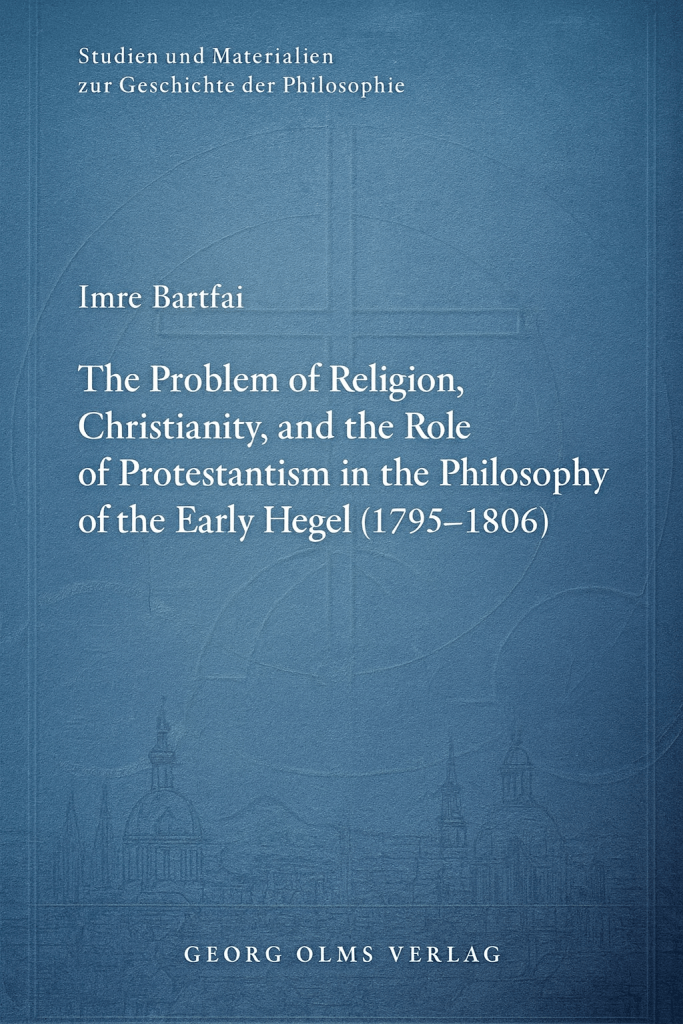
Hinging its argument on the early Hegel’s struggle to convert religious inheritance into a generative logic of system, Dr. Imre Bártfai’s study isolates religion—Christianity in general and Protestantism in particular—as a constructive problem-space through which moral aspiration, civic motivation, and speculative method are successively refashioned from Tübingen through Bern and Frankfurt into Jena. The work’s distinctive claim is that an initially Kant-inflected project of Volksreligion and moral reform is reworked by concepts of unification and life into a speculative philosophy of religion; within that trajectory, Protestantism appears as a philosophical construction rather than a confessional thesis. The result is an architectonic account in which religion is not ornament or residue but the motor of system-formation, argued wherever possible philologically and marked as inferential where reconstruction exceeds direct textual avowal.
Bártfai begins from the simple but exacting methodological demand that the religious elements in a philosophy be identified by their conceptual function and historical position, rather than by recourse to background pieties or inherited rhetoric; only then can one test the sense in which Hegel calls himself Christian and, still more provocatively, Protestant. Against caricatures of a mystical “professor’s God,” an anti-theological reduction to politics, or a merely instrumental use of religious language, the investigation disaggregates what can be secured from the early corpus from what must be reconstructed. This framing is not external to the argument; it governs the movement of the book itself and the discriminations it draws between explicit formulae (e.g., Hegel’s own descriptions of religion’s conceptual place) and pressures that are historically legible but textually oblique. In this meta-register the author makes two preliminary determinations: first, that Hegel’s later talk of a Protestant principle is the outcome of a philosophical construction continuous with earlier problems; second, that the young Hegel is best read as contesting Christianity and Protestantism before re-composing them through concepts forged in the transit from moral religion to speculative unity. Both points anchor the study’s compositional narrative and guide its distinction between textual and inferential warrants.
The point of departure is the Enlightenment problem of religion as it enters German discourse through Kant’s ethicotheology. The ethical purification of religion preserves the rigor of duty while evacuating the thick, binding content that might animate a people; it postulates God as a moral necessity while structurally suspending the realization of the good into a beyond. Bártfai reconstructs Hegel’s dissatisfaction with this bifurcation—pragmatically admirable, motivationally precarious—as the earliest form of a problem that will reappear at higher levels: religion becomes a formal supplement to morality, precisely when civic animation requires a medium that binds sensibility, symbol, and communal life. In this matrix, a merely philosophical religion—proved by reason, purified of image, anchored in postulates—begins to lack the festive and institutional means to set communal life in motion, an early need that Hegel explicitly avows. The study’s reconstruction of this dissatisfaction is grounded in the early materials and in the author’s careful delineation of what Hegel takes “moral religion” to achieve and what it must sacrifice; the inference is that the sacrifice acquires political significance when a Volksreligion is sought as the organ of ethical-historical unity.
The Bern writings give the diagnosis concrete form. There the project is to shape a public-facing religion capable of animating ethical life and patriotism. Bártfai shows how the differentiation between rational religion and folk religion is the hinge: the former names the Kantian moralization of faith; the latter indicates a symbolically rich, festival-centered communal practice modeled on Greek religion. The textually secured finding is straightforward: Hegel sees Christianity, historically configured, as private religion—apolitical inwardness that consoles and moralizes but does not provide the shared sensuous forms of communal commitment. In this frame the Leben Jesu is decisive evidence: Jesus recast as teacher of a purely moral religion, miracles set aside, Kantian terms saturating the exposition, and God identified with pure reason; the more coherent the moralized content, the thinner the medium of popular embodiment. The experiment’s outcome is not asserted polemically; it is read from the procedure itself and the tone of the treatise: moral rigor, diminished festival energy, refined maxims without public rites. At this stage, Hegel’s view of Christianity’s positivity coalesces: a private, historically grounded complex of doctrines and rites whose juridical “positivity” signals its dependence on historical deduction rather than on living communal actuality. Each of these determinations is documented in Bártfai’s close reading of the Bern corpus.
The juridical genealogy of “positivity” is one of the book’s most revealing philological contributions. Drawing on jurisprudential usage, where positive right denotes a historically deduced, sovereignly conferred title, Bártfai clarifies how “positive religion” in Hegel designates a religion sedimented in historical facts and commands, rather than a religion of present, living unity. This precision explains why a moralized Christianity, however elevated, cannot suffice as the organ of civic freedom: its positivity binds subjects to historically given representations whose authority must be proven genealogically, not enacted communally. The inference that this juridical structure undermines the very public motivation Hegel seeks is warranted by Hegel’s own descriptions of private religion and by the Leben Jesu’s formal economy.
At the same Bern juncture, the figure of Luther appears ambivalently—as a hero sanctified by translation and reform, an educator of the people, and yet not the nucleus of a truly public Christian religion. This hesitation is itself evidence: the materials for a Christian Volksreligion do not easily cohere; the Greek political festival has no straightforward Christian analogue. What can be secured is that the attempt to convert Christianity into a civic religion by moral purification does not deliver the sought “living” unity. What is inferential is the scope of the political disappointment attached to this failure.
Frankfurt supplies the decisive conceptual turn. Here the young Hegel no longer treats alienation as a merely moral or historical defect but as a structural separation overcome by Vereinigung—unification conceived as a living act in which subject and object are one without loss of difference. Bártfai names this the Vereinigungsphilosophie and shows it operating simultaneously as method and as solution: not an edict of love opposed to law, but an ontology of life whose movement integrates what it had opposed. In this optic, “positive religion” is re-inscribed: it is no longer simply statutory heteronomy but a historical shape of separation; reconciliation must therefore be conceived as a metaphysical unification adequate to life. The textual anchor for this elevation in register—Hegel’s own demand for a “metaphysical treatment” of the finite–infinite relation—is deployed here to justify the transition from moral critique to speculative work. The political consequence is not incidental. In The Constitution of Germany, religion appears as an index of separation: where a people lives divided between private inwardness and hollow forms, political articulation cannot be free; where life is conceptually grasped as unifying, institutions can be rationally re-formed. The link between the Frankfurt religious fragments and the constitutional analysis is argued through shared categories of separation, fate, and life.
Bártfai’s reconstruction of unification is particularly specific on two fronts. First, he traces Hegel’s first dialectical gestures to the analysis of faith as a relation to an alien power and to the counter-model of a living unity in which the other does not remain merely opposed. The consequence is double: a critique of any religion that makes the other an object commanding obedience from the outside; and a corresponding insight that unification must be an active identity in difference rather than the erasure of alterity. Second, he shows how Hegel’s historical portraiture—Judaism’s fate under law, the emergence of Jesus as prophet of love—functions not as theological dogma but as phenomenology of alienation’s genesis and overcoming. Where Bártfai attributes an early appearance of dialectics or a first loosening from Kantianism, he marks the inference and shows the textual threads that support it.
From Frankfurt’s unification as life to Jena’s speculative architecture, the study demonstrates how the same need—overcoming separation—yields a transposition of media. Life becomes concept; unification becomes the self-movement of absolute subjectivity; religion becomes a necessary but limited shape of absolute spirit. In Jena’s system drafts, religion appears as the form in which spirit knows itself in representative images, higher than art because its object is spirit itself, yet still short of philosophical self-comprehension. Here Bártfai secures a key Hegelian characterization of religion as assurance without insight: an elevated confidence of the community’s spirit in itself that nonetheless falls short of the concept’s self-transparent movement. What is crucial for the book’s thesis is not the hierarchy but the continuity: religion is preserved as the community’s truth-form while philosophy is assigned the task of rendering audible, as concept, what religion intuits and images. The argument is grounded in precise Jena formulations and carefully framed against the atheism dispute and the Romantic reaction to Kantian moralization.
This hierarchy is not merely epistemic; it is temporal. In the speculative determination that has become classical for Hegel’s readers, the absolute must be here—reconciliation cannot be deferred to an eschatological beyond. Bártfai quotes and explicates the proposition that the I knows the absolute “here,” insisting that the absolute content is thought and that time is external to absolute spirit. The consequence is political as well as theoretical: church and state relate as ideating and real spirit, and the precedence of the state signals that bad religion endangers freedom as such, because conviction underlies all action and institutions. Where Bártfai moves from Jena formulations to political implications, he signals the step and recalls earlier analyses of separation to show continuity rather than an extrapolation.
It is within the Phenomenology of Spirit that Bártfai binds the whole. The conflict of “pure insight” and “faith” is rendered as an internal opposition within spirit’s path, not as a culture-war of rationalists and believers. “Insight” lacks content; “faith” holds content without conceptuality; reconciliation requires their elevation into a knowing in which spirit recognizes itself. The author’s reading emphasizes that this moment is the recollection, at a higher level, of the Bern and Frankfurt impasses: the expressive energy and communal depth of faith do not become system unless the concept appropriates them; the formal rigor of insight does not attain truth unless it becomes content-laden self-recognition. Crucially, faith is neither absurdity nor mere delusion in Hegel’s account: its object is the spirit of the community, and in faith spirit bears witness to itself; historical proofs corrupt it because they outsource conviction to external facticity. Bártfai secures this from Hegel’s own formulations and deploys it to argue that religion has an essential place in the realized whole while remaining intrinsically transitional relative to philosophy.
On this backdrop, the book’s most delicate thesis becomes intelligible: Protestantism appears in the early Hegel not as a theological allegiance but as a philosophical index of inward freedom’s reconciliation with objective ethical life. Early on, Hegel’s assessments of Protestantism remain political and historical: he treats Protestantism as one agent among others in German constitutional development, at times critical of its fragmenting effects, at times appreciative of its role in displacing Catholic intolerance. He refuses inherited identifications of Prussia as Protestant champion and even entertains the political advantages of a newly tolerant Austria; Gustav Adolf is analyzed as a complex historical agent rather than sanctified icon. This is a Protestantism viewed under the sign of history and positivity, not yet elevated to a principle of system. The textual warrant for this circumscribed reading is strong in the Frankfurt political writings; the inference that a later philosophical reconstruction will transform this horizon is explicitly marked as such.
The compositional sequence is thus not a series of negations but a chain of preservations and displacements. The Bern project of moral Volksreligion does not simply fail; it reveals a need that moral purification cannot meet and supplies the memory of a legitimate demand for subjective animation and public form. Frankfurt’s Vereinigung does not abolish morality; it transforms the moral opposition (law versus love, object versus subject) into an ontological movement of life that renders separation a moment. Jena’s speculative “Good Friday”—Bártfai’s apt name for the moment at which absolute subjectivity comprehends itself in and as difference—does not dismiss religion; it locates religion as truth’s communal embodiment whose completion requires conceptual self-identity in otherness. The Phenomenology recollects each of these prior stages as figures on the way to absolute knowing, and in that recollection the theological vocabulary is transposed: what appeared as Protestant inwardness becomes a philosophical determination of subjectivity; what appeared as reform becomes a demand for institutions adequate to freedom; what appeared as church versus state becomes a theory of spheres within spirit. Each step in this sequence is argued with citations where explicit language is available and with cautious inference where connections are conceptual rather than verbal.
Two clarifications about method give Bártfai’s contribution its distinctive profile. First, the insistence that religion for Hegel is conceptual content and community—a living reality of the holy—precludes any reduction to feeling or to moral utility. This governs both the reading of Bern (where moralization depletes communal form) and of Jena (where representation is preserved as a necessary but limited way of truth). Second, the genealogical handling of “positivity” prevents an anachronistic opposition between reason and superstition; it is precisely because positivity is historicity that the problem of a modern ethical order cannot be solved by abstract demystification. Throughout, the author flags when he leaves the closed circle of explicit statements—for example, when correlating Hegel’s anti-Romantic polemics with contemporary political-theological debates—and justifies the extrapolation by showing how the same categories do concrete work elsewhere in the corpus.
A final pass through the material under the title “Protestant principle” brings the disparate threads into relief. What is secured is that Hegel ultimately identifies a shape of freedom in which inwardness is neither privatized nor pitted against institutions, but articulated as Sittlichkeit—the mediation of the particular and the universal in living institutions. This is the philosophical content of the later Protestant principle as Bártfai reconstructs its conditions of emergence. What remains inferential is the precise path by which the early, often ambivalent judgments on Protestantism become the mature claim that Protestantism reconciles state and God in a modern ethical order; the author proposes that this path runs through the appropriation of life as the engine of dialectic and the elevation of religious representation into speculative concept. Evidence for the first is abundant in the Frankfurt and Jena texts; evidence for the second is explicit in the Jena drafts’ determinations of art, religion, and philosophy and in the Phenomenology’s account of faith’s inner truth and outer limits.
To a reader concerned with the stakes of system-building, the most consequential upshot of Bártfai’s study is the way it identifies religion as the architectonic motor of early system formation. Hegel’s earliest labors on religion were not a detour from philosophy but philosophy’s point of entry into problems of motivation, institution, and truth’s medium. The maturation of those labors entails both affirmation and renunciation: affirmation of religion’s dignity as the community’s form of truth; renunciation of any hope that moral purification or historical demonstration could substitute for speculative reconciliation. In the lexicon that the study patiently reconstructs, this means that private religion is inadequate to public freedom, positive religion marks historicity rather than credulity, unification names a living act rather than a pious feeling, and assurance without insight both honors and limits religion’s reach. The “Protestant principle,” in that light, is less a confession than a concept: the worldliness of reconciliation in and through institutions, where the absolute is here for the I that knows, and where philosophy is the medium in which that knowing recognizes itself.
To summarise for clarity: The Problem of Religion, Christianity, and the Role of Protestantism in the Philosophy of the Early Hegel (1795–1806) proposes that the early Hegel’s path—from the Bern program of moral Volksreligion, through the Frankfurt ontology of unification and life, into the Jena determination of religion as a shape of absolute spirit, and finally into the Phenomenology’s narrated reconciliation—can be read as a single, architectonic migration in which religion is both the laboratory and the motor of system. Where the texts speak, the study stays close; where motives and meta-categories must be supplied, it signals the step. In that measured procedure lies the book’s distinctive contribution: it secures an image of Hegel for whom “Protestantism” signifies the philosophical shape of modern freedom—inner assurance mediated as ethical actuality—rather than the badge of a party or the echo of an upbringing.
 Simon Gros
Leave a comment