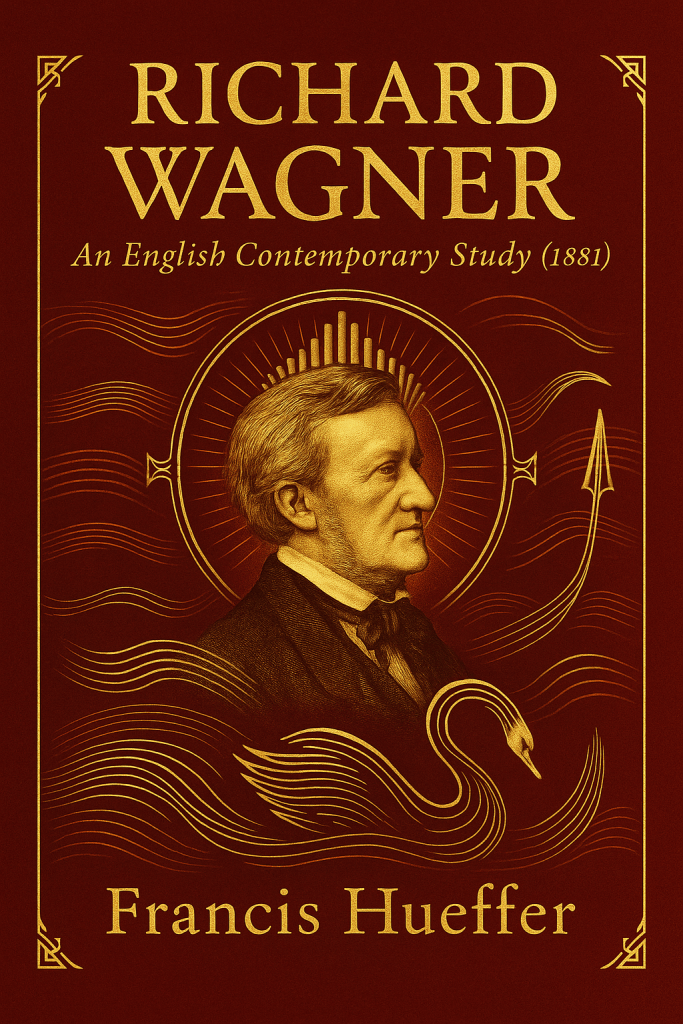
Hueffer’s Richard Wagner occupies the precise historical interval in which the composer’s career was still a moving target and yet sufficiently formed to admit a synoptic judgment. The book’s distinctive contribution is twofold: it articulates a continuous line from the biographical restlessness of a “man of action” to the evolving grammar of the modern music-drama, and it does so within an English critical idiom capable of rendering the technical and the poetic without sensationalism. Its wager is that Wagner’s compositional metamorphoses are legible only when tracked across failures and displacements—Parisian privation, theoretical self-clarification, practical theater problems—and that the works merge from these pressures into a method: a drama whose musical language grows from the scene itself.
Hueffer opens by contesting the convenient partition of genius and deed, and he does so by refusing to subtract the historical turbulences from the artistic profile. Wagner is presented as the rare dramatist who heard battle both figuratively and literally: the roar of cannon offstage and onstage, the press of crowds, the administrative noise of a royal theater, the brittle applause and the harsher silence of Paris. This is not merely decor; it is Hueffer’s way of establishing a field in which action and composition interpenetrate. The framing is lucid: a handful of secure dates, little indulgence for anecdotal embroidery, and a steady insistence that the operative materials of the life are those that directly mediate the works’ emergence. The implied claim—textually secured—is that the useful “facts” are the facts of artistic decision under constraint; the rest is incidental.
Already in the early pages Hueffer fixes a biographical constant that will become a conceptual operator later on: a restless appetite for the new, which he shrewdly separates from youthful caprice. He notes the boy’s scattered energies—poetry on the grandest scale, dramatic ambition, undisciplined piano study—then condenses these trifurcations into a single upshot: a decisive turn to technical study that could sustain large form. The point is methodological. What looks like childish excess becomes intelligible as the earliest register of a later principle: the dramatic requirement pulls the musical invention after it and not the reverse. The piece of evidence that anchors this interpretation is Wagner’s self-reported attempt to write music for a Shakespeare-sized tragedy for which he lacked the rudiments; the “error” is explanatory because it shows that, at origin, dramatic necessity was the motor and harmony and counterpoint the derivative acquisition. This line from need to technique—from scene to score—is Hueffer’s first essential throughline.
From Riga and the provincial operatic routines Hueffer extracts a lesson that recurs across the book: repetition under inferior conditions yields a conductor’s intimacy with orchestral mechanism and singerly habit, and that knowledge later informs the precision of Wagner’s rehearsal demands and formal designs. The Riga–Paris decision—an audacious attempt to route a German grand opera into the Paris Opéra via scribe’s good offices—fails in precisely the right way to reveal an axis of development. Hueffer is emphatic: had Rienzi been taken up quickly at the Opéra, the composer might have been conscripted into a lucrative Meyerbeerian destiny. The counterfactual is not romantic wishfulness but a critical instrument to mark the contingency of the actual path: failure functions as a compositional condition. Textually secured here is the catalogue of humiliations and drudgery that Paris imposed; inferential—but disciplined—is the suggestion that the deprivation forced Wagner to seek a different economy of motives, one that made the scene itself, rather than vocal display, the generative center.
It is out of this pressure chamber that Hueffer situates The Flying Dutchman. The storm-tossed passage to London furnishes the germ, but Hueffer refuses mythopoeic haze and fixes the dates: Rienzi completed November 1840; Dutchman conceived during the voyage and composed at Meudon in spring 1841. He then marks the decisive internal shift: with Rienzi the aim was worldly éclat within the Grand-Opéra apparatus; with Dutchman the aim became expressive necessity—music as the outlet for a specific suffering. Consequently Dutchman inaugurates the loosening of absolute-music forms under the pressure of dramatic utterance. Hueffer is careful here to distinguish what is textually secure (compositional chronology, stated aims) from his interpretive surmise (that personal desolation demanded a new dramaturgical form). The result is a guarded but clear thesis: in Dutchman the previously emulative operatic ambition is displaced by the need to find a musical syntax adequate to a symbol saturated by the composer’s own situation.
On Rienzi Hueffer is honest and diagnostic rather than apologetic. He calls it a youthful “sin” in the composer’s retrospective judgment and then corrects Wagner’s severity without special pleading: the score has passages of genuinely grand choral architecture and a melodic amplitude that anticipates later beauties, even as its duet-writing could have come from a fatigued Donizetti. The object here is not to praise with faint blame but to use the opera as a hinge: “representative forms”—introductions, multi-part finales, processions, arias—are deployed with a consciously decorative ambition, and yet, in the second act’s massive finale, Wagner achieves a dramatic fusion that outgrows decoration and pushes toward an organic scene-complex. Hueffer’s tight reading of the second act—he isolates the “Miserere,” the intercessions of Irene and Adriano, Rienzi’s vacillation, and the people’s shifting response—serves as evidence for a nascent technique: contrasting musical ideas are no longer numbers to be strung but pressures to be worked until they discover a larger unity.
The speculative but disciplined claim that follows is central to Hueffer’s method: Rienzi taught Wagner how to exploit the crowd as a musical protagonist, but it did so within imported conventions; Dutchman taught him to cancel the very operatic habits that had made that exploitation effective, and to discover a through-composed current whose thematic economy could do the dramatic lifting without recourse to “set piece” interruption. This is an inferential stitch across chapters, yet Hueffer lays under it a strong warp of textual material: the pairing of the Parisian failure with the Meudon composition and the insistence that the new work was conceived without the horizon of public favor.
From this point Hueffer proceeds by alternating work-specific exegesis with structural claims about Wagner’s technique. The Dutchman discussion becomes a staging area for the leitmotivic principle before the word is allowed its later systematic place. He attends to details that are probative: the Steersman’s song as a locally colored lyric that anchors the sea’s world; Senta’s ballad as a thematic seed whose recurrence organizes both memory and fate; the spinning chorus as social texture and kinetic counter-rhythm; the Senta–Dutchman duet as the point where psychological and symbolic lines cross. He adds an observation that is small and brilliant: the work sounds the “weird atmosphere of the northern sea” in every bar, a consistency of tone astonishing in a composer reared far from the coast. The observation is both aesthetic and evidential; it is used to argue that timbral imagination, when governed by a dramatic symbol, can substitute for mere pictorialism.
With Tannhäuser Hueffer traces a clarifying bifurcation. The action is schematized around two realms—Wartburg piety and Venusberg voluptuousness—but Hueffer refuses a moralizing opposition in favor of a musical-dramatic dialectic. His synopsis is unusually attentive to functional detail: Wolfram’s hymn to chaste adoration, Tannhäuser’s championship of mutually urgent love, the audience’s fluctuating sympathies, the fatal outburst that confesses Venus’s spell, and Elizabeth’s intercession which transforms a retributive crowd into a penitential procession. Hueffer isolates the acts’ climactic architectures rather than enumerating numbers. The second-act finale, in particular, is treated not as an anthology of big moments but as a continuous design in which prayer, accusation, apology, and decree are continually re-voiced until the scene resolves itself. That is, the finale is an engine for conceptual pressure rather than a vessel for display.
Hueffer’s tonal claims are anchored by concrete listening-cues—he never theorizes in mid-air. He calls the overture a masterly pre-articulation of the drama’s law: the pilgrims’ chorus and the Venusberg rhythms are not mere themes but principles whose alternation and contamination will tell us how the action must proceed. He does the same for the narrative locus classicus of the last act: the Roman journey, the papal interdiction rendered figuratively by the withered staff, the counter-sign given by the transfigured Graal sonority when reconciliation becomes imaginable only as posthumous grace. The upshot is critical: Tannhäuser demonstrates that it is possible to work with the inherited apparatus of opera while subordinating it to an emergent, scene-born logic; but the cost is stylistic tension, and Hueffer measures it rather than smoothing it.
Lohengrin is treated as a decisive advance from a dramaturgical as well as a musical angle. Here Hueffer moves with characteristic circumspection between dramatis personae and the orchestral argument. The Prelude becomes an immediate illustration of his Leitmotiv doctrine before the treatise: the Grail-motive, spun in highest violins at a near-inaudible dynamic, arrives as a visionary descent and recedes, teaching us to hear a metaphysical background against which human calculation will break. This lets Hueffer interpret the first act’s miracle with unembarrassed specificity: the swan-drawn boat, the vow demanded (the “Motive of Warning”), the structural function of Elsa’s trust as a temporary equilibrium. Because he has already established the relation between motive and scene, his analysis of the bridal chamber can be psychologically scrupulous without losing musical traction: he traces the growth of doubt from a stray interrogative particle into destructive insistence, while keeping the warning motive audible as the rhythm that the drama cannot escape.
At the point where many narrations would return to reception history, Hueffer pauses to install the friendship with Liszt as the linchpin of Wagner’s mid-century survival and dissemination. He does not romanticize the bond; instead, he quotes Wagner’s own prose to indicate the exact contours of the mutuality: Liszt’s early, almost stubborn insistence on understanding; the Weimar refuge; the decisive act of mounting Lohengrin in 1850 when the composer could not. This is not a digression. Hueffer uses it to demonstrate a concrete social mechanism by which a technique could appear before a public under conditions that in every other respect had been unfavorable. The philosophical point is quiet and strong: what theory later calls the “work of art of the future” required a present institutional love to be heard at all.
Hueffer’s most delicate maneuver is his handling of the theoretical writings in relation to the compositional corpus. He states the chronological asymmetry with didactic clarity: The Flying Dutchman (1841) and Tannhäuser (1845) and Lohengrin (1848) are practical reforms that precede, by roughly a decade, the Zurich theoretical synthesis in Opera and Drama; therefore the operas are not written to a pre-existing program, and the treatises are better read as after-the-fact illumination and projection. This rebuts, with evidence, the polemical claim that Wagner engineered works to justify a theory. The logic is simple and sharp: the works existed before the doctrine; the doctrine consolidates what practice discovered. From this vantage Hueffer explicates key elements—mythic concentration, scenic necessity, organic continuity—and ties them to Wagner’s deliberate repudiation of number opera as a consequence rather than as a program. The strongest passage states the principle in Wagner’s own terms: the mythical simplicity allowed concentration on decisive points; from these, the musical form had to be generated; therefore grafting older operatic forms would only have broken the organism. Hueffer offers this not as apothegm but as a reconstruction of working method.
A brief excursion through Schopenhauer follows, and Hueffer is judicious in scale and aim. He does not turn the biography into a metaphysics seminar; rather, he isolates gestures that clarify the late stylistic gravity: music’s peculiar vicinity to the noumenal, the priority of harmony as near-timeless substance, rhythm’s injection of becoming, and melody as the child of their union. He then notes, with precision of dating, that Wagner’s most important theoretical tracts predate his Schopenhauer encounter and that the Schopenhauerian coloration—a deepening of the tragic and a calm of renunciatory insight—enters explicitly with the Beethoven pamphlet (1870). The effect is to prevent a retrospective erasure of the earlier, more Promethean projects and to show how the later philosophical persuasion completes rather than originates the aesthetic. Textually secure here are the contours of Schopenhauer’s account and Hueffer’s citation of their appearance in Wagner’s writings; inferential is the degree to which this lens reframed the composition of Tristan and the later Festspiel project, a point Hueffer keeps suggestive rather than doctrinal.
The question of verse structure and its musical consequences receives one of Hueffer’s most illuminating treatments. Seeing that modern rhyme and blank verse block the fluidity needed by an unbroken melos, he traces Wagner’s turn to Germanic alliterative measure, not as antiquarian flourish but as a rhythmic scaffold that can bear extended declamation without the amputations enforced by iambics. The claim is both technical and phenomenological: accentual staff-rhyme gives the line a backbone of stress while keeping the syllabic undercarriage loose enough to follow speechlike inflection; thus the verse meets the melody halfway. He drives the point home by instructive comparison (the Tannhäuser song “Dir hohe Liebe” versus the Walküre love-song “Winterstürme wichen”), and generalizes a lesson: when the poetry’s meter serves the scene’s breath rather than a stanzaic geometry, the music can finally achieve the unforced continuity the dramaturgy demands.
Hueffer’s account of Lohengrin’s last scene is exemplary of his compositional hermeneutics. The return to the Scheldt meadow is not merely cyclical stagecraft; it is the recurrence of a political and theological space in which secrecy and authority are adjudicated. The exposure of the name—Lohengrin, son of Parsifal—becomes a sonorous disclosure: the Grail-motive appears “in its fullest development,” a musical verification of the dramatic act of naming. Ortrud’s revelation that the swan is Elsa’s bewitched brother redirects our hearing backward; the dove-drawn departure leaves the motive in minor, a tonal inscription of irrevocable loss. The analysis is careful to preserve the textual status of each claim: secure are the plot’s hinges and the motive’s placements; inferential is the suggestion that the minor turn functions as a theologically inflected dissolution rather than a mere tragic close.
Once these pillars are set, Hueffer allows himself a parsimonious glance outward—Bologna’s Lohengrin, the English productions, the Albert Hall apotheosis—and only to the extent that they explain how the style travelled and which institutions could receive it. His most consequential reception claim is micro-sociological: without Liszt’s settled Weimar and his victory over provincial inertia, a public audition for the “music of the future” would have been deferred beyond a generation. Hueffer uses Wagner’s own warm, astonished testimony—recognizing his “second self” in Liszt’s rehearsal—to sharpen the point: the composer’s practical isolation and theoretical lucidity were insufficient; they had to be translated into a sounding event by a friend who could make an orchestra do what the prose envisioned.
Beyond the works-through-Lohengrin plateau, Hueffer sketches the arc in larger spans—Tristan, Meistersinger, and the Ring—with a view to showing the maturation of premises already in play. He reserves his most acute generalizations for the logic of scene-generation and the abrogation of number: the destruction of aria and duet is not the emblematics of a destroyer but the morphology of subjects that demanded concentration and continuity. He points, moreover, to the Ring’s alliterative dramaturgy as the moment where formal, musical, and philological threads are tied off: the mythic substrate, the verse’s stress-spine, and the leitmotivic web converge to produce a music-drama whose apparent boundlessness is—paradoxically—an effect of severe constraints. This is not a praise-song for vastness; it is an argument that only under constraints could the drama sustain multi-evening continuity without disintegration. The claim is inferential, but it tracks directly from Hueffer’s earlier demonstrations.
When Hueffer finally turns from compositional to polemical Wagner, he resists the temptation either to excuse or to condemn. The critique of Kapellmeistermusik is registered for what it was: a satiric coinage that helped clarify a problem—the stage as milk-cow—and also a symptom of a combative temperament not always discriminating. It matters because it positions the theoretical writings as acts of self-education: Wagner discovers the consequences of his practice by writing, and these consequences rebound into future practice. Hueffer’s balancing act here is delicate: he acknowledges the indiscretions while insisting that they are entangled with the very force that made reform possible. The useful conclusion is methodological: a theory that arises from doing will inevitably simplify other people’s doings; it remains valuable insofar as it sharpens the profile of its originating deeds.
One of the book’s most elegant features is its management of composition sequence and framing. Hueffer never lets the chronology harden into a mere list; he keeps each date alive as a hinge. Rienzi’s Dresden triumph is not only a calendar entry but the portal through which the Paris drudge becomes a Kapellmeister with a platform big enough to test his second work; the Dutchman’s Meudon gestation is not only a place-name but a sign of how failure can produce the privacy needed to hear a symbol clearly; Lohengrin’s Weimar premiere is not only a credit to Liszt but an experiment in whether a provincial stage can carry a metaphysical fabric. The larger frame—a life that oscillates between institutional proximity and exile—is allowed to function as a compositional parameter: the Zurich tracts, written when performance was foreclosed, are not outside the story but belong to it as the medium by which practice was preserved and projected. The list of works at the end, succinctly enumerated, is thereby re-inscribed as a sequence of trials in which institutions and ideas antagonize and assist one another.
A final pair of tensions deserves emphasis because Hueffer lets them work through his whole account without didactic refrain. First, the tension between spectacle and symbol: the grand-opera apparatus in Rienzi can create overpowering scene-masses, and Hueffer, far from denying their force, asks how such masses can be made to carry ethical and psychological weight rather than merely astonish. His answer is by pressure and recurrence: when the same material—petition, decree, crowd—returns under changed circumstances, it gains a second voice; music becomes the record of that change. Second, the tension between secrecy and declaration: Lohengrin makes this thematic, but Hueffer shows that the logic binds other works: vows and names, interdictions and revelations, are not plot-gimmicks but forms by which music is allowed to withhold or disclose its full sonority. In both cases the strictly musical and the strictly dramatic are revealed as each other’s conditions. These are inferential theses, argued across Hueffer’s demonstrations rather than quoted.
The book closes—in effect if not in typography—by situating the still-unperformed Parsifal (from Hueffer’s vantage) in the same Grail circle as Lohengrin, and by fixing Wagner’s 1877 English reception as a late corrective to the old Parisian alienation. The catalog of works and writings, sparely laid out, gives the reader the means to cross-check the developmental narrative: dates, first performances, and the discrete genres (operas, choral works, orchestral pieces, songs, piano music, and a crowded shelf of prose). It is not a superfluous appendix; it is the skeleton that the previous chapters have clothed with nerve and skin. The method remains consistent to the end: the fact is not inert; it is an index of a decision, and the decision is audible.
Hueffer’s Richard Wagner is a contemporaneous assessment that declines both panegyric and elegy; it treats biography as the vector of compositional invention, treats theory as the belated clarification of acts already performed, and treats institutional history as the set of possible rooms in which a new kind of drama might sound. Where the book is textual, I have kept close: the Paris desolation and Meudon turn, the structural readings of Rienzi’s second act, Dutchman’s leitmotivic germination, Tannhäuser’s overture logic and penitential arc, Lohengrin’s warning-motive and final revelation, the Liszt correspondence and Weimar premiere, the Schopenhauerian deepening, the alliterative verse as rhythmic scaffold, the enumerated works and dates. Where the book invites inference, I have marked the guidance: failure as a compositional parameter; constraint as the generator of continuity; secrecy and declaration as the hinges by which music and drama teach one another how to proceed. The result is that Wagner emerges, in Hueffer’s glass, as a maker whose works do not merely express a life but discover the form of that life’s decisions.
If one wanted a single sentence to preserve Hueffer’s stake, it might be this: the music-drama is not a theory Wagner imposed upon his operas; it is the name of a form gradually precipitated when scenes, motives, institutions, and friends forced the composer to hear what his own practice was already saying. That formulation, while inferential, is faithful to the book’s temper, and it is warranted by the chain of textual anchors Hueffer lays out and this review has retraced.
 Simon Gros
Leave a comment