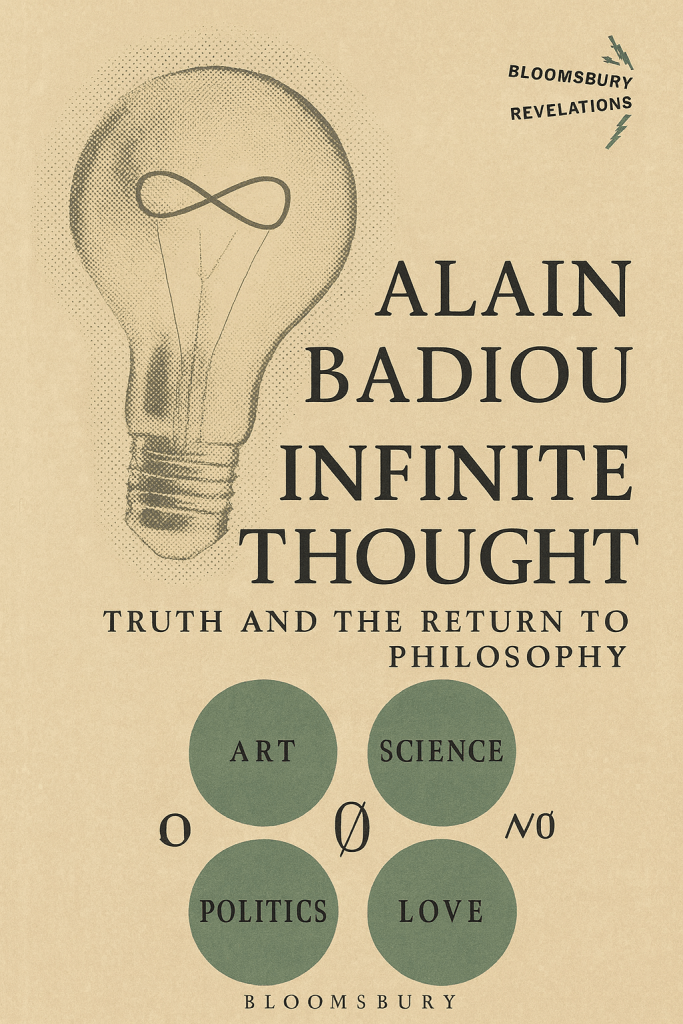
Infinite Thought: Truth and the Return to Philosophy stakes a precise claim in the contemporary field: it reopens the question of philosophy’s vocation by binding the existence of truths to four extra-philosophical procedures—art, science, politics, love—while defending an austere ontological minimalism drawn from set theory as the proper grammar of being. The distinctive contribution of this collection lies in its dual movement. First, it condenses Badiou’s systematic theses (event, truth, subject, void, the generic) into a portable repertoire. Second, through targeted interventions—on desire, politics, psychoanalysis, art and cinema, the “death of communism,” the “war against terrorism,” and a concluding definition with an interview—it shows how philosophy measures, composes, and disciplines itself by listening to its conditions, refusing sovereignty while constructing a universal address oriented by truths rather than opinions.
From the outset the book is neither miscellany nor syllabus; its editorial frame is programmatic. The introduction situates the volume against two grand families—post-Heideggerian and analytic—and identifies Badiou’s singular problem as the compatibility of a modern doctrine of the subject with an ontology. That compatibility is rendered as a methodological tension, not a reconciliation by fiat. The editors announce the itinerary: an initial polemic on the present of philosophy; a general exposition of truth and ethics; applications to each condition (politics, love, art and cinema, science by way of Being and Event); ideological diagnoses (“death of communism,” “war against terrorism”); a formal “definition of philosophy”; and an interview clarifying the operational core. This composition sequence—diagnosis → model → applications → critiques → definition → auto-commentary—functions as the book’s inner skeleton. The stated aim is an “accessible introduction” that nevertheless keeps the set-theoretical scaffolding in view because it “grounds his entire doctrine.” The frame is not neutral: it polemically distinguishes Badiou from “poststructuralism” by restoring a tension between subject and ontology, and it sets fidelity to events (rather than identity or reflection) as the index of agency. These are textually secured claims.
The volume’s decisive argumentative wager concerns ontology. Badiou’s ontological discourse is subtractive: it speaks of being as inconsistent multiplicity, formalized in set theory; it renounces any catalogue of beings, qualities, or totalities. Identity is thought of as extensional (in a coincidence of elements), not qualitative; multiplicity has no global “One” and no encompassing “universe of all sets.” Such theses are expounded in the introduction’s meta-ontological translation of axioms (extensionality, separation, power-set, union, empty set). The existential commitment begins with the null set, and the articulation of presentation/representation is indexed to belonging/inclusion (situation/state). The void names the subtractive suture by which presentation occurs while barring access to primordial unity. This architectonic is presented as the only discourse able to articulate being as multiple without re-importing unity, whether as substance, cosmic order, or linguistic horizon. These are secured reconstructions of the introduction’s long exegesis.
A number of conceptual tensions are deliberately opened rather than soothed. First, unity without One: situations have unity by the count-for-one (from a structure), yet being as such lacks primordial unity. The count is an operation internal to the situation; there is no external agent (no God, History, Grand Discourse). This places philosophy in a delicate posture: it must speak of unity as an effect while guarding itself against any substantialization of unity as principle. The introduction’s illustration of normal, singular, and excrescent multiples (and the “state” as the power-set) hardens this tension: representation exceeds presentation by combinatorial right, which implies that every situation harbors elements represented without being presented. The effect is to reframe the perennial problem of the state/people relation as a structural disproportion between inclusion and belonging. These determinations are textually secured.
Second, subject without substance: the subject is defined as neither a reflective self nor a correlate of objects. It is a local configuration sustained by fidelity to an event—a sequence of decisions and enquiries that forces consequences within a situation. Agency is displaced from an inner faculty to a procedure of consequences; the problem of identity is deferred; the problem of agency is transposed from will to the logic of novelty. The editors insist that this is the point at which Badiou breaks with both poststructuralist dissolutions of the subject and classical voluntarism: the subject emerges within a changing situation as a function of fidelity. This is secured in the introduction’s contrast with Derrida and Foucault and in the rendering of “evental-site,” “intervention,” “generic procedure,” and “forcing.”
Third, novelty without historicism: the new arrives through undecidable events that have no ontological warrant in determined being; their nomination is a hazardous decision. Paul Cohen’s method enters to model this: generic subsets are indiscernible within a ground model yet can be added to yield a new situation where what was only included becomes presented. Fidelity is the finite labor of forcing statements about the new with the resources of the old. The result is a structural notion of transformation without teleology, determinism, or mythic rupture. The editors’ reconstruction of Cohen’s “generic” and “forcing” anchors this. The work does not mention Hegel’s Phenomenology as the source reference of the notion.
If ontology is subtractive and novelty is generic, philosophy’s desire becomes legible as fourfold: revolt, logic, universality, risk. The opening essay “Philosophy and desire” states the problem in poetic keys—Rimbaud’s “logical revolts,” Mallarmé’s wager—then considers a contemporary world that trivializes revolt by guaranteeing freedom while coding its use through the circulation of commodities. The philosopher’s task is then set to maintain reasoned revolt, to propose universality against the pressure of segmented communications, and to preserve risk where consensus manufactures immunity. This proposal is not nostalgia for metaphysics but a restoration of philosophy’s audacity under a rigorous discipline: to think universality without the One, revolt without ressentiment, logic without scholasticism, risk without arbitrariness. The textual basis is explicit.
From desire to truth: the second movement articulates “truth” as a name for the result of a procedure conditioned by an event. In the book’s economy the editors indicate this is where ethics and truth converge: ethics becomes an ethics of truths—of the subject’s perseverance in a fidelity that refuses to measure itself by pre-given norms or by the pathologies of suffering and consensus. Although the detailed articulation of this ethics belongs to Badiou’s Ethics, the present volume’s insistence is internal: philosophy is the place where the there are of truths is declared and where their compossibility can be thought. Later, in “The definition of philosophy,” this is made maximally explicit: philosophy is the space where the fact that there are truths and that their togetherness can be articulated is seized as an act. The “act” seizes truths by superposing a fiction of knowledge (matheme) and a fiction of art (poem), in an address to all (political universality) animated like a love without object. Each of the four conditions leaves its trace in philosophy’s discourse, while philosophy remains conditioned rather than productive of truths. These are textually secured claims.
The book’s central tension—between conditioning and sovereignty—is worked at two scales. At the macro-scale, philosophy is de-sovereignized: it does not legislate in the name of a meta-knowledge; it listens, learning from transformations in its conditions and elaborating a space of compossibility among simultaneously active procedures. The introduction emphasizes this desubjectivation of philosophy’s mastery while maintaining its organizing role. At the micro-scale, each essay stages a modality of conditioning: politics concentrates the question of the subject and sequence; psychoanalysis refracts love as a truth-procedure; art and cinema stage intensities of form and visibility; the critiques of the “death of communism” and “war against terrorism” analyze naming, sequence, and the production of consensus as problems in the political condition. All of this is textually secured.
Within politics, Badiou’s emphasis falls on sequences initiated by interventions at evental-sites. A political procedure is emancipatory when it subtracts itself from State logic (representation) and composes a generic body beyond identity predicates. The book returns to this under two conjunctural headings. In “Philosophy and the ‘death of communism’,” the argumentative idea is that the collapse of bureaucratic socialism neither abolishes the category of emancipation nor validates liberal triumphalism; rather, it clears a space where egalitarian axioms can be rethought without statist hypostasis. This is part of the collection’s project of re-opening universality under subtractive protocols. The editors’ summary is inferential in its accent but consistent with description of the chapter’s role.
“Philosophy and the ‘war against terrorism’” exemplifies Badiou’s nominal analysis. Beginning from the affect of disaster, the text refuses to stop at affect. It interrogates the name terrorism as a formal designation that has slid from adjective (“terrorist” action) to substantive (“terrorism”) and thereby generated three effects: subject (“We,” “the West,” “the Democracies”), predicate (“Islamic”), and sequence (“war against terrorism”). The philosophical duty is to resist the immediacy of affect and the propaganda of naming, testing both origin and application. The essay unpacks how “terrorism,” as empty name, is filled by its supposed opposite (“the West,” “our societies,” “the democracies”), and how the pairing “Islamic terrorism” supplies spurious content while rendering the crime unthought. The term “war,” symmetrically formal, is analyzed as the subjective figure through which American imperial power attests its existence; the call to “war” shifts what should be policing and legal pursuit into an epochal narrative. These claims are textually secured.
The critique here is exemplary of the method: philosophy names and undoes names insofar as they occlude truths; it restores the difference between vengeance and justice; it refuses simple transitivity between affect to concept. The ethical injunction is clear: there is no automatic deduction from horror to retaliatory state violence; the “democracies” are not in themselves equivalent to truth; and the category “West” carries a history of imperial projection that cannot ground a universality. These determinations are directly textual.
The engagement with psychoanalysis pivots the volume toward love. In Badiou’s system love is one of the four truth-procedures: it is the construction of a world from the Two, the ongoing labor that follows an amorous event. The interview makes the knotting explicit: there are connections among procedures (e.g., politics and love), but there is no fusion; one needs a theory of connections indexed by shared categories (event, undecidable, indiscernible, unnameable, stopping point, numericity). The book does not offer a totalizing syncretism; it proposes a regulated site of linkages and crossings without hierarchy. This is secured by the interview’s insistence on thinking the “knots” while preserving heterogeneity.
Art and cinema deepen the aesthetic register. Poetry is conceived as the artistic paradigm because it internalizes decision, measure, and thought in language; cinema is modernity’s emblem of sequencing, montage, and the visible. In the volume, the essays do not offer history of art or film theory as such; they enact the inesthetics that Badiou elsewhere theorizes: philosophy thinks with artworks to see how truths appear there without extracting a philosophical “content.” The editors signal these essays as applications of the central conception of philosophy as conditioned thought; on that basis, the reader can see how the artistic condition modifies and sharpens the conceptual lexicon (appearance, sequence, subject-point). This framing is textually secured, while the precise aesthetic claims demand close reading of the chapters themselves.
The essay “Philosophy and truth” stabilizes the system’s backbone. Truths are infinite procedures, generic with respect to knowledge, without guarantee, universal in address, and precarious in trajectory. The subject is the local bearer of a fidelity that decides on the undecidable, enquires, and constructs. Philosophy’s role is neither to produce truths nor to relativize them, but to declare their existence and to compose their compossibility. The later “Definition of philosophy” formalizes this as an act that seizes truths by superposing two “fictions”—of knowing and of art—addressed to all and animated by an intensity that is “like a love without object” and “like a political strategy without the stakes of power.” It also names philosophy’s structural adversary: the sophist, discursively indiscernible from the philosopher because he also superposes fictions, but subjectively opposed insofar as he disavows any positive assertion concerning truths. Philosophy is thus the act of separating itself from its double, breaking the mirror of language where it might otherwise contemplate itself. These are explicit textual determinations.
Against this background, the ethics of philosophy is formulated with severity: ward off the triple lure of the sacred, ecstasy, and terror that would corrupt the philosophical operation by converting the subtractive void into a hypothesis. The history of philosophy is read as the history of this ethics—repeated desubstantializations of Truth that free philosophy’s act. Within the collection, that ethic governs the political essays (resisting sacralization of “the democracies,” refusing ecstatic “unity” in war, exposing terror as a formal name), the aesthetic reflections (guarding against ecstatic transfers from art to philosophy), and the interview’s restraint about system-closure. These are secured textual statements.
The interview consolidates and displaces. It clarifies “structure” as the combination of presentation (belonging) and representation (inclusion)—the two determinations of consistency—and insists that the operation of the count-for-one is the situation itself, not an external agent. It also signals a shift in the work-in-progress (toward localization of being, the forthcoming Logics of Worlds), indicating how the edifice will evolve beyond the terms of Being and Event. The interview thereby serves as the book’s hinge between completed system and open research: the doctrine is sturdy enough to discipline debate, porous enough to welcome future categorial refinements. These are explicit textual points.
Two meta-consequences crystallize across the book’s parts. First, philosophical universality without cultural proprietorship: the address “to all” does not ratify “the West” as bearer of truth; the name “West” is revealed as compromised by imperial appropriation, while universality is re-anchored in procedures that anyone may enter through acts of fidelity. This is textually secured in the critique of “our societies,” “the West,” and “the democracies” as rallying names, and in the definition’s universal address.
Second, infinity against finitude: the book rejects the omnipresent motif of finitude as a quietist capitulation to contemporary nihilism. Philosophy must rationally reconstitute a “reserve of affirmative infinity” needed by liberating projects; it is an “attic” in difficult times, stockpiling tools for other practices. Here the work’s title—Infinite Thought—is not merely rhetorical. Infinity is the internal measure of truth-procedures and the external task of philosophy: to keep open the thought of the infinite against the reductions of market, communication, and security. This is textually explicit.
To track how parts merge into—and are displaced by—others, one can read the volume as a dialetheia of discipline and risk. The introduction disciplines ontology; “Philosophy and desire” re-risks the vocation; “Philosophy and truth” disciplines ethics as an ethics of truths; the political essays re-risk nomination in the face of propaganda; the aesthetic essays discipline the philosophical gaze toward artworks (inesthetics); “Definition of philosophy” formalizes the act; the interview re-risks the system by announcing shifts (localization, connection-theory of procedures). Each segment binds to a previous one, then partially unseats it. The inner motion is neither linear nor cyclical; it is a sequence of subject-points within the book’s own situation.
What, then, is textually secured, and what is marked as inferential? Secured: the set-theoretical ontology as subtractive; the four conditions as types of truth-procedure; the concepts of event, fidelity, intervention, generic, forcing; the critique of “war against terrorism” as a nominal analysis of subject/predicate/sequence; the definition of philosophy as the act that declares “there are truths” and composes their compossibility; the ethic of resisting the sacred/ecstasy/terror; the desovereignization of philosophy into a conditioned discourse; the interview’s clarifications on structure and coming shifts. Inferential: the precise ways in which the art/cinema essays modulate categories such as appearance and sequence beyond the explicit formulations; the detailed reconstruction of the “death of communism” essay’s demonstration (its argumentative function in the book is specified, its full internal detail exceeds the present synthesis); and the exact technical contours of the proposed general theory of “knots” among procedures (which the interview announces as work in progress). These inferences remain within the compass the text provides.
The book’s final clarification is as simple as it is demanding. Philosophy, when faithful to its desire—revolt, logic, universality, risk—does not produce truths; it declares that there are truths, and composes a thinking adequate to their simultaneous existence. Its ethics is the tireless separation from its sophistic double—language without truths—and from the fascinations that would enthrone substance in the place evacuated by the subtractive void. Its politics is the refusal to derive war or vengeance from affect; its aesthetics is an exacting love of artworks that does not appropriate them; its science is a respect for the matheme as ontology; its love is the recognition that the Two can be a site of truth. In this sense the book is a compact workshop rather than a statement. It offers concepts aimed against the seductions of our time and a grammar by which people can become, again and again, the bearers of a subject in the wake of events. The wager is that infinite thought—disciplined by mathematics, sharpened by art, made courageous by politics, transfigured by love—can still be practiced, and that philosophy’s proper act is to keep that idea alive.
 Simon Gros
Leave a comment