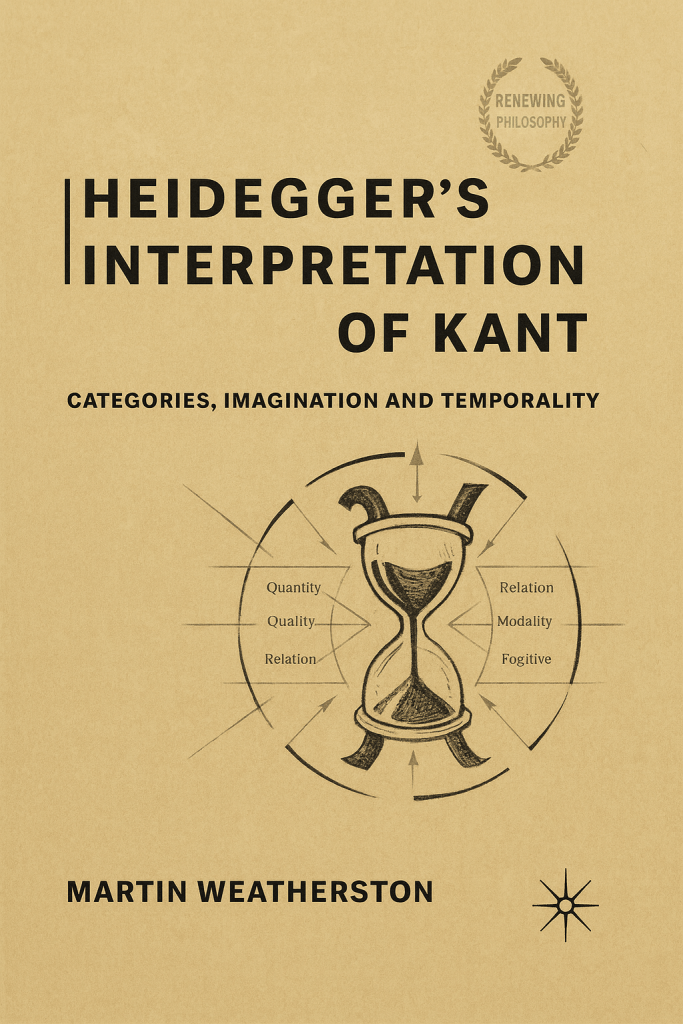
Martin Weatherston’s Heidegger’s Interpretation of Kant: Categories, Imagination and Temporality undertakes a precise test: whether the architectonic that lets Kant and the Problem of Metaphysics press the Critique toward time, imagination, and apperception can be reconstructed, sharpened, and weighed on its own evidence—as an interpretation measured against Kant’s texts and against Heidegger’s phenomenological aims. The scholarly stake is twofold: to exhibit how Weatherston locates the nerve of Heidegger’s reading in the articulation of categories with intuition through synthesis and schematism, and to judge if the attendant “interpretative violence” is methodologically warranted by a disciplined retrieval of problems—truth, transcendence, and freedom—rather than by thesis-driven grafts. Its distinctive contribution is a sustained, source-bound reconstruction of Heidegger’s Kant that clarifies the sequence from logic and judgment to temporality and imagination while keeping in view an external horizon of assessment: Is this good Kant? Is this good Heidegger?
The book frames its inquiry inside a series program oriented toward “renewing philosophy,” which already signals the double horizon Weatherston keeps in play: a minute, textual reconstruction and the larger question of what is philosophically released when Kant is read as a partner in a struggle over foundations. Gary Banham’s preface stresses precisely this doubleness: the argument never loses the horizon of philosophical stakes even as it tracks technical points; the “Auseinandersetzung” between the thinkers becomes a means to renew our sense of what such an encounter can do. This outer framing is not ornamental; it functions as a methodological caution against both antiquarian philology and speculative free-handing, and it opens the path Weatherston travels: a rigorous, slow reading that keeps the encounter’s scope visible.
Weatherston begins from the problem of truth and the crisis of logic that guides Heidegger’s path into Kant. If scientific knowing “lets beings be seen” through objectification and thematization, then the conditions under which beings become available to assertion must themselves be explicated; hence the turn to the constitution of judgment, category, and the projective fore-understanding that makes any science possible. This means that logic in its living, older sense as logos is entangled with ontology; the question of the copula’s meaning in propositions about being becomes the question of how the a priori configures access to what is. Weatherston’s reconstruction thus positions Kant’s Critique as an inquiry into the grounds of logic understood ontologically, which is why the Critique is said to sit at the crux where ontology has been guided by logos since antiquity—and why Heidegger thinks Kant centers ontology in logic “in a new way.”
Within that setting, Weatherston emphasizes a decisive stake: can categories—traditionally treated as forms of thought—be shown to bear an essential relation to time such that their “content” is inseparable from temporality? Heidegger’s claim, reconstructed and pressed by Weatherston, is that categories neither arise merely from a table of judgments nor remain indifferent to sensibility; rather they have a “double origin” in thought and time, and their unity must be sought in the original synthesis that binds them to intuition. This is the point where interpretation becomes argumentative: Heidegger rejects the derivation of the categories solely from the table of judgments because that procedure misses their transcendental relation to intuition, and Weatherston shows how Heidegger’s critique targets just this lacuna.
The first decisive maneuver is the recalibration of “synthesis.” Weatherston makes the terminological work do conceptual work. Against readings that treat intuitions as passive “mere manifolds,” he follows Heidegger in distinguishing a non-conceptual, original syndosis—an “original togetherness” that gives space and time as unified pure intuitions—from a reflective or concept-governed synthesis. The unity of the manifold in pure intuition, on this view, proceeds “out of an original unity as whole,” so that the very givenness of space and time as intuitable presupposes this syndotic belonging-together. Weatherston’s exposition is careful here: he shows why “synopsis” would mislead (suggesting a merely aggregative viewing) and why “syndosis” better names a unity that belongs to space and time themselves, prior to any conceptual grasp.
That terminological innovation is more than a verbal tweak; it underwrites Weatherston’s presentation of Heidegger’s strategic aim: to defend the integrity and spontaneity of sensibility without collapsing it into understanding (as in some neo-Kantian trajectories), and thereby to prepare the ground on which imagination can be argued as a “common root” of the two stems. Sensibility, on this reading, is not inert matter awaiting form; it bears an originary power of donation whose unity is neither conceptually imposed nor derivable from judgmental functions. In Weatherston’s hands, the point is precise: the categories’ synthetic unity presupposes the prior, non-categorical syndotic unity of intuition.
The consequences for transcendental logic are immediate. General logic abstracts from all relation to objects and thus cannot disclose truth—which is relation to an object—in any transcendental sense. Transcendental logic, by contrast, investigates the a priori relation to the object as object, and in so doing it inherits the burden of showing how pure thought is already bound, non-accidentally, to the pure forms of intuition. Weatherston extracts the methodological upshot Heidegger wants from Kant: there is no “general criterion” of truth in abstraction from the object; any talk of truth must be anchored in the conditions under which the object can be there for us as something determinable. Hence the shift from formal to transcendental logic marks a shift from correctness-rules to object-constitution.
But it is exactly here that Weatherston opens the central tension that animates his whole analysis: Kant insists that categories as pure concepts “extend further than sensibility,” thinking an object in general independent of our specific mode of intuition; therefore a schematism is required to mediate application to our time-bound intuition. Heidegger, as Weatherston reconstructs him, counters that the categories’ very intelligibility already betrays their temporal content; the schema is not an external bridge but the explicit recognition that the categories’ unity is unity-in-time. Weatherston does not merely report the disagreement; he tracks the argumentative load-bearing points: the insufficiency of the table of judgments as origin; the role of pure synthesis prior to its reflection “into” concepts; and the claim that what transcendental logic “brings to concepts” are not ready-made representations but the pure syntheses themselves in their ontological sense.
This is why the chapter architecture matters. Weatherston inventories Heidegger’s path as moving from the foundations of metaphysics “as science” (an inquiry into how objectification/thematization presuppose an understanding of being), through the Transcendental Aesthetic (where time’s priority is argued via the self-relation of inner sense), into the problem of judgment and ontological predication (where reflection and assertion interlock), and on to the Relation of the Categories to Ontological Synthesis (where §10 of the Critique becomes decisive). The indexing of major motifs—time, transcendence, truth, thematization—marks a deliberate composition that mirrors the interpretive priorities: from science’s crisis to ontology’s grounds; from intuition’s unity to category’s origin; from deduction’s quaestio juris to apperception’s temporality.
A lynchpin in Weatherston’s retelling is the threefold map of synthesis. At the ontological level there is syndosis (the original unity of pure intuition), reflective/predicative synthesis (the understanding’s unifying function), and the “gnoseological” or pure veritative synthesis (the a priori union that lets being be determinable as object). At the ontic level there is veritative synthesis (truth-revealing), predicative synthesis (attributing unity to a subject), and apophantic synthesis (letting something be seen in discourse). Weatherston shows how Heidegger nests the latter within the former: the logical figures of assertion presuppose the more originary combinations that first grant objects as possible objects for judgment. The upshot is that the veritative function cannot be reduced to formal correctness; it relies on a prior synthesis of time-bound intuition and unifying thought.
Crucially, Weatherston neither hides nor softens the place where Heidegger’s reading strains Kant’s wording. The notorious footnote to §26 (Aesthetic vs. formal intuition) is handled with exemplary sobriety. Heidegger’s move—treating the “unity” at issue as the form of intuition rather than formal intuition and reading “synthesis” there as a non-conceptual syndosis—is shown to be textually forced. Weatherston argues that on the straightforward grammatical reading Kant speaks of the unity of formal intuition and explicitly connects that unity to a synthesis “by means of which the understanding determines sensibility.” Hence, even while defending the independence of sensibility, Heidegger distorts the distribution of labor: the unity that precedes concepts is still the result of a synthesis tied to the understanding. The interpretive price of avoiding this is too high.
This criticism is not externalistic. Weatherston keeps Heidegger’s motive visible: resist the neo-Kantian reduction of intuition to thought, secure sensibility’s spontaneity, and thereby clear a path on which imagination can serve as common root. But as Weatherston shows, one can acknowledge the non-derivative status of intuition while maintaining that the unity at stake is “produced a priori” through an understanding-bound synthesis, without positing a third faculty as the originary source. In this light, the insistence on a pre-facultative root threatens to miss Kant’s solution, namely that the two stems are equally original and conjoin in objective cognition via the schematism and deduction.
Weatherston’s discussion of transcendental logic as the locus where ontological and logical problems have long been confused is among the book’s strongest contributions. He presses Heidegger’s claim that Kant still subordinates ontology to a theory of judgment, thereby defaulting to the primacy of assertion in the grasp of being; yet Weatherston also marks the generosity of Heidegger’s reading: Kant “transforms logic,” makes it once again a living philosophical field, and reopens the question of its grounds in a way not seen since Plato and Aristotle. The judgment here is calibrated: the Critique is neither a failure nor a full general ontology; it is an ontology of extant beings—nature—precisely because its transcendental project investigates what can be known a priori of nature as object of possible experience.
From here Weatherston threads the Deduction into the question of temporality. The unity of apperception, the form of inner sense, and the schema’s “time-determinations” converge in a thesis Heidegger wants: the categories “get their unity” from their relation to time, and the concepts themselves represent the pure, necessary unity of synthesis. Weatherston unfolds the argumentative rhythm by dwelling on Kant’s crucial sentence: analysis brings representations under concepts, but transcendental logic “brings pure synthesis to concepts.” That is, what is conceptually brought to explicitness is the unity already operative in time-bound synthesis—the very unity whose representation is the category. In this way, the category is no mere form of thought but the thought of synthesis as such. Weatherston shows how this reading relieves a pressure point in the text (the awkward impression of synthesis occurring “prior to” its unity) by shifting from a sequential picture to a structural one.
Yet again, the interpretive cost is weighed. Kant can be read as saying that the concepts “give unity” to the synthesis—suggesting concepts are prior as rules. Heidegger reverses the direction: the unity of synthesis, in its temporality, grounds the concepts. Weatherston’s verdict is discriminating: the reversal illuminates a genuine phenomenological insight (categories as the thought of synthesis), but it cannot be straightforwardly secured from Kant’s own text without compressing the difference between functions of unity and the representation of that unity; here Weatherston’s attention to the possible gleichursprünglich (equiprimordial) status of the two aspects—unity and consciousness of that unity—offers a charitable bridge that remains closer to Kant’s letter while granting Heidegger’s experiential stake.
The theme of freedom—often submerged in expositions of the first Critique—is, in Weatherston’s account, the undercurrent that surfaces at precisely the right moments. Heidegger’s dissatisfaction with a merely negative concept of moral freedom and with any severance of spontaneity from receptivity motivates his insistence on a more originary freedom evident in transcendence itself: the free projection that lets beings be as such. Weatherston maps how this background aim inflects the whole interpretation without dominating it. The link to truth is direct: freeing access to beings (transcendence) and letting them be what they are (truth) belong together. But Weatherston also marks the limit of Heidegger’s own 1920s account: freedom is gestured at, not yet adequately articulated, and later recalibrations acknowledge entanglements that obscured the essence of truth.
Methodologically, the work’s center of gravity is the measured adjudication of violence in interpretation. Weatherston reproduces Heidegger’s own explicit claim: every genuine interpretation must “use violence” if it is to force a work to say what it “wants to say,” though such violence must be guided by the idea that shines forth from the work. Weatherston’s procedure is to identify precisely where the force exceeds its warrant (as in the §26 note) and where it reveals hidden structure (as in the reconstrual of categories as representations of pure synthesis). The result is not a verdict for or against Heidegger, but an argument-like narrative of when and how the text bears the pressure.
This narrative is anchored by a finely graded account of composition and sequence. Weatherston’s table of contents is itself a map of the interpretive project: an Introduction staging “Categories and the Question of Being,” with explicit sub-sections on “Truth and the categories” and “Transcendence and freedom”; Chapter 1 on laying foundations in ontology and the nature of a priori knowledge; Chapter 2 on the Aesthetic and the unity of the faculties (syndosis); Chapter 3 on transcendental logic, judgment, and ontological predication; Chapter 4 on categories in relation to ontological synthesis; Chapter 5 on the quaestio juris and the threefold synthesis in the Deduction; Chapter 6 on apperception, objectivity, temporality, imagination as common root, and the schematism; and a Conclusion that returns to the book’s initial two questions by way of the reconstructed pathway. This composition does not simply summarize Heidegger; it displaces and restructures, building an inner progression where each step both depends on and reinterprets the last.
In that spirit, Weatherston clarifies how the earlier chapters on science, logic, and objectification are not merely preliminary. They supply the outer frame of the conceptual space in which time can come to ground categories. The movement is dialectical without dramatics: objectification presupposes thematization; thematization presupposes a pre-ontological understanding of being; the articulation of that understanding requires distinguishing general from transcendental logic; the latter forces the question of how pure thought bears on objects as such; hence the necessity of a non-derivative unity of intuition (syndosis) and a reconstruction of synthesis as temporally structured. At each juncture, Weatherston crosschecks the step against the Critique’s architecture and alerts the reader to the pressure points where Heidegger must either read Kant generously or press beyond Kant’s text.
No single passage is made to do more work than it can bear. For instance, when Weatherston elaborates the priority of time over space in Heidegger’s analysis, he registers both the phenomenological rationale (inner sense as the condition of self-intuition) and the methodological caution (do not slide from the empirical self to ontic arguments), noting that the Deduction is where the full justification must be carried. This is typical of the book’s pattern: to defer decision until all the structural elements are in view, refusing quick wins by local exegesis.
The concluding assessment is as restrained as it is definite. On the Kant question, Weatherston shows that Heidegger’s strongest advances—categories as the thought of synthesis, schematism as the explicit temporality of the concept’s application, apperception as intrinsically time-bound—can be aligned with Kant’s intention to ground objectivity in an a priori synthesis, provided one does not obscure the letter of Kant’s claims about the understanding’s role in producing the unity of formal intuition and the non-derivative status of the two stems. Where Heidegger reads past the grammar to secure sensibility’s spontaneity, the text resists; where he reads the architectonic movement of the Critique as a path toward time, the text assists. On the Heidegger question, Weatherston argues that the interpretation remains philosophically fecund exactly where it obliges us to see that logic’s life reaches into ontology and that truth cannot be prised from transcendence; yet it is least persuasive where it must invent a syndosis to preserve an originary root and thereby risks reassigning Kant’s delicate distribution of synthesis, unity, and concept.
The book’s distinctive strength lies in its capacity to let a problem show itself in the push and pull of text and thesis. Truth’s site in transcendental logic, transcendence as freedom’s field, categories as temporalized unities, imagination as the alleged common root, apperception as time’s form—all are presented as knots where the demand to “let Kant speak” meets the need to think through what the Critique wanted to say. Weatherston succeeds in keeping both questions open to the end. Is this good Kant?—yes, insofar as the reconstruction restores the centrality of synthesis and time without denying the understanding’s productive role, no, where textual constraints are forced. Is this good Heidegger?—yes, insofar as the interpretation releases phenomenological insight into logic’s ontological ground and truth’s dependence on transcendence, no, where a desire for a more “positive” unity overleaps the measured limits of the Critique’s architectonic. The clarity gained is itself philosophical: one learns to see categories as living at the hinge of thought and time, to treat schematism as the heartbeat of objectivity, and to hear in the copula the muted question of being. That, as Weatherston shows, is justification enough for subjecting the Critique to a carefully guided force that reveals what it shelters and what it resists.
Finally, the book does not claim to settle the controversy over “violence” in interpretation; rather it models a discipline by which interpretative force is constrained by textual sequence, conceptual necessity, and problem-pressure, so that any excess can be named and any gain can be kept. In doing so, it leaves the reader with a more exact sense of where time enters Kant, where imagination can be thought with and against the text, and how judgment becomes the passage to ontology. It thereby answers, in its own way, the two governing questions it inherits: it vindicates elements of Heidegger’s Kant where they deepen the Critique’s living problematic, and it withholds vindication where the grammar holds a line. The result is a painstakingly argued path from categories to temporality that earns its right to be read as both an internal reconstruction and an external measure of philosophical worth.
 Simon Gros
Leave a comment