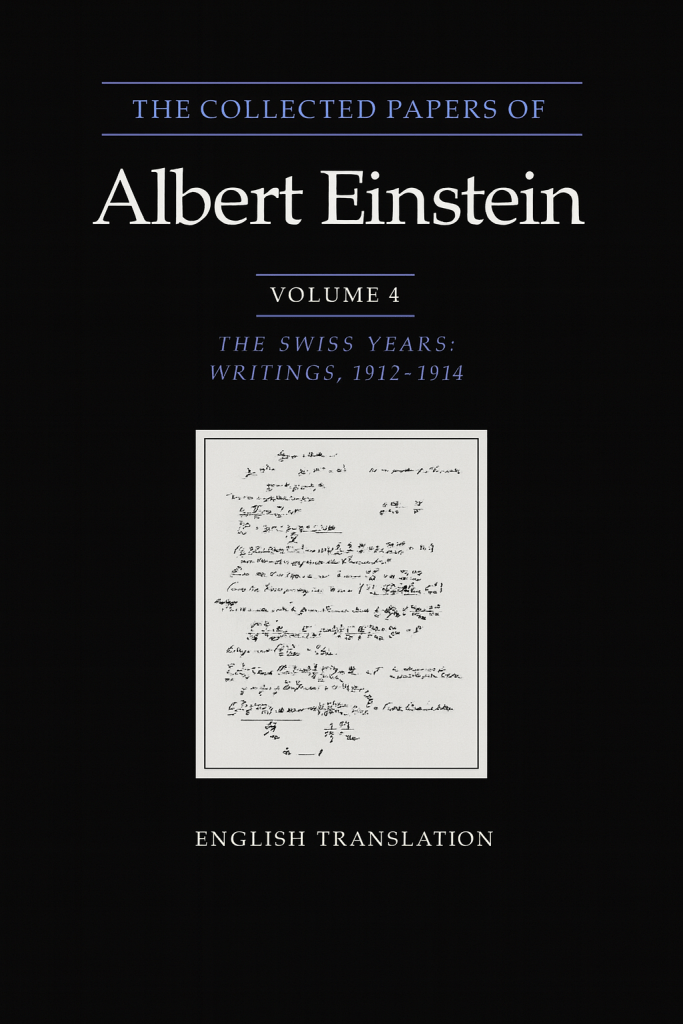
The distinctive scholarly stake of The Collected Papers of Albert Einstein, Volume 4: The Swiss Years: Writings, 1912–1914 lies in its careful assembly of texts that document the conceptual and technical struggle by which Einstein sought to unify the relativity principle, the equality of inertial and gravitational mass, and the conservation of energy–momentum into a single, internally coherent field theory of gravitation. What sets this volume apart is the way newly printed manuscripts—among them a synthetic review of special relativity, research notes on gravitation, and calculations on Mercury’s perihelion—are braided with programmatic essays and collaborative papers so that one can watch the dialectic of method and result tighten. The contribution is therefore double: it secures primary evidence of the search, and it reorganizes our sense of the path by which that search became the general theory.
The editorial corpus presents a field of problems rather than a finished doctrine: covariance as a regulative ideal constantly abrades against conservation requirements; the equivalence of inertial and gravitational mass, once pressed to encompass the inertia of energy, forces a revision of what a “privileged” frame could mean; the hope for a generally covariant set of gravitational field equations is repeatedly disciplined by the need to keep track of energy and momentum in matter-and-field together. In the Zurich papers with Grossmann and in the adjacent reflections, this tension is explicit and technically argued. When Einstein writes that imposing the conservation laws on matter and field “taken together” selects a class of reference systems and that the resulting field equations are covariant only under linear transformations, he is not merely trimming a principle; he is showing how a physical desideratum—global energy–momentum bookkeeping—acts as a constraint on permissible symmetries. The text is unambiguous on this point, and the restriction to linear transformations is asserted and defended in the exposition of the “foundations” of the generalized theory.
The argumentative thread that binds these disparate documents can be stated thus. Begin from the empirical identity of inertial and gravitational mass; amplify that identity by the relativity-theoretic assimilation of mass to energy so that all energy carries inertia. Require next that any viable gravitational theory assign gravitational effect to the same quantities that fix inertial resistance—namely, the stress–energy content of the system—and that it allow for energy exchange between matter and the gravitational field in forms that admit a global conservation statement. The moment that exchange is granted, the bookkeeping cannot be expressed as a divergence-free condition on matter alone; one must write conservation for matter plus gravitational field, and doing so in the 1913–14 framework led Einstein to a specialized covariance compatible with linear substitutions. That this specialization was deliberate rather than a failure of imagination is textually secured by the step-by-step derivation in which the would-be generally covariant form is acknowledged in principle yet set aside as “of no special interest” for physical or logical reasons, given the way conservation had been built into the theory at that stage.
Yet the volume also contains Einstein’s counterpressure against any merely formal trimming of covariance. When, in a compact “Comments” piece, he sketches a proof that generally covariant equations determining the metric uniquely from given sources cannot exist—because a coordinate substitution that is identity outside a matter-free region but differs within would generate non-uniqueness for the metric while leaving the source identically zero—he uses the very logic of substitutions to show why one is “forced to restrict the choice of the reference system.” Here the text is plain that the restriction comes from the uniqueness demand together with conservation in the combined matter–field system; and the resulting privilege of linear transformations is explicitly thematized as the physical meaning of “straight lines” and “planes.” The emphasis falls on the physical interpretation of coordinate conditions: a conservation form defines the physically meaningful class of frames without reintroducing absolute structures by fiat. This line of reasoning, including its short, formal core and its aftermath in mixed-tensor notation that clarifies the field equations, is a fixed point of the volume’s narrative.
Against this restriction there is a second, equally insistent movement: a persistent search for a more comprehensive invariant-theoretic language—what the texts call the “absolute differential calculus”—capable of exhibiting both Nordström’s scalar theory and the Einstein–Grossmann tensorial Ansatz as different specializations of a single general schema. The paper with Fokker is exemplary: it shows that if one takes the general, coordinate-free machinery seriously and then imposes the possibility of frames in which light’s speed is constant, the ten functions that characterize the metric degenerate to a single scalar, thereby reproducing Nordström’s theory. In this setting, conservation obtains as a generally covariant law expressed in terms of a mixed tensor associated with the stress–energy, and the field equation is identified as the scalar curvature built from the Riemann–Christoffel tensor equated to a scalar made from the matter variables. The upshot is methodological: one can reach Nordström by purely formal considerations once a privileging assumption about light is allowed, and one learns how close the formal resources of the absolute calculus bring the alternative gravitation theories. The conclusion—stated as a preference for Nordström among the theories that retain the constancy of light—simultaneously names the price of that preference: precisely by keeping light’s speed fixed, one forecloses the route that the equivalence principle seemed to demand. The text’s closing suggestion that the Riemann–Christoffel tensor might also generate a derivation of the Einstein–Grossmann equations independent of extra physical hypotheses registers a program rather than a result; it is a methodological promissory note that links the two theories through shared geometry while discreetly preserving their physical divergence.
The Zurich period lectures and short essays frame these technical developments with an epistemological posture that is neither rhetorical ornament nor afterthought. In the lecture to the Zurich Natural Science Society, the juxtaposition of Nordström and Einstein–Grossmann is sharp. Assuming the identity of inertial and gravitational mass and the assimilation of inertia to energy, one faces a bifurcation: either preserve the constancy of light by choosing adapted frames (the scalar theory), or abandon that constancy and generalize relativity so that the velocity of light depends on potential. The lecture does not decide the matter by proclamation; instead, it points to an experiment—the deflection of starlight by the sun during an eclipse—as the decisive discriminant, while conceding that only the tensorial theory (the Einstein–Grossmann “Entwurf”) makes the bending of light inevitable. The gesture is both empirical and strategic: while the scalar theory obtains formal clarity and an attractive harmony with special relativity, the tensorial theory offers an epistemological restitution by dissolving privileged frames and relocating inertia in relative acceleration among bodies. This is not a rhetorical flourish but a signed commitment to a criterion—light-bending—that could break the formal tie, and the text is explicit that preparations were underway for the August 1914 eclipse.
A companion essay serves to articulate, for a broader audience, how the narrow and broad senses of relativity are related and where gravitation forces the issue. The “narrow” theory articulates a principle—Lorentz covariance—that functions as a constraint on admissible equation systems; it is not a factory of content but a sieve that retains only those laws consonant with a refined concept of simultaneity and spatial distance. What the essay adds—and what makes it central to this volume’s outer frame—is the insistence that the equivalence of inertial and gravitational mass, sharpened by the inertia of energy, presses beyond the narrow framework. The argument is presented in stages: first, the empirical near-identity of inertial and gravitational mass (as shown by torsion-balance experiments); second, the relativity-theoretic absorption of mass into energy; third, the conclusion that a closed system’s gravitational mass must be determined by its energy, including the energy of its gravitational field. That last sentence is the hinge: any theory that allows heating to increase inertial mass while leaving gravitational mass unchanged is ruled out on principle. Nordström’s scalar theory is praised for satisfying the relativity principle and the gravitation of energy “as a statistical law,” while quietly noting that it predicts longitudinal gravitational radiation and assigns a time-averaged gravitational mass to closed systems at rest. The judgement is not empirical censure but a philosophical pressure: even if the scalar theory integrates gravitation into the narrow schema without contradiction, it leaves in place the epistemological discomfort of privileged frames. The essay thus advertises the goal of a “broader” relativity that displaces privileged spaces and replaces “absolute acceleration” by acceleration with respect to other bodies, re-siting inertia as relational resistance rather than resistance to motion in a metaphysically singled-out arena. This move—explicitly linked to the absolute differential calculus—documents the philosophical motive force behind the shift to a covariant field theory whose variables and equations make no sense that is independent of the coordinate choice.
If one tracks the composition sequence through the documents the volume places side by side, a pattern of advance and retreat becomes legible. First comes the methodological expansion: the absolute calculus equips the theory with a coordinate-free grammar. Then comes the first restriction: to hold conservation and uniqueness together, covariance is trimmed to linear transformations in the “Entwurf” presentation of the foundations, with a clean explanation of the price and the gain. Immediately after, in the “Comments,” the non-uniqueness under arbitrary substitutions is used to justify that trimming, and the physical meaning of straightness and planarity in privileged systems is underlined. The lecture then opens a gate outward again, inviting empirical decision between the scalar and tensorial pathways by way of light bending. Finally, in the broader essay, the epistemological demand for non-privileged frames is pressed with urgency, and the program of generally covariant formulation—anchored in the invariance of the line element and the mixed-tensor form of conservation—is set as the direction of travel. The composition rhythm is thus: formal generalization → conservation-driven specialization → reflection on the status of specialization → empirical proposal to discriminate → methodological recommitment to a broader covariance. Each step is textually secured; the synthesis here is inferential but constrained by those explicit moves.
The gravitational manuscripts highlighted by the editors—especially the newly presented calculations on Mercury’s perihelion—take their place within this collection as laboratories of adequacy conditions. The editorial summary clarifies that these notes attempt to test the developing theory against the classical anomaly in the precession of Mercury’s orbit, one of the phenomena that would later be canonized as a test of general relativity. Textually secured details in the printed gravitational memoirs show how Einstein, within the constraints of the 1913–14 framework, looked for a differential expression in the metric that would reproduce, on the right-hand side, the stress–energy of matter plus a gravitational contribution so that the combined conservation equation could be written in divergence form. When he indicates that “there do not exist generally covariant systems of equations of the type of equations (5)” and that only linear transformations preserve the conservation-form specialization, the implied consequence for orbital calculations is decisive: any anomalous perihelion advance derived at this stage is a test of the restricted-covariance field equations, not of a fully generally covariant theory. It is therefore an inferential (but warranted) reading to see the Mercury problem in these notes as a probe that exposed the limitations of the “Entwurf” structure and helped motivate the later abandonment of the linear-covariance restriction in 1915. What is textual here is the restriction and its reasons; what is inferential is the retrospective interpretation of the Mercury calculations as revealing stress points that the 1915 field equations would relax.
The volume’s inclusion of two short statistical manuscripts—on the determination of statistical values for irregular processes and on quasiperiodic fluctuations—might seem tangential, but in the edited sequence they mirror the gravitational argument in miniature. In each, Einstein fashions an invariant (or at least device-independent) characterization of a process by moving away from raw, time-local observations to functionals—characteristics and intensities—that can be mechanically realized and compared across systems. The conceptual maneuver is analogous to the replacement of coordinate components by tensorial objects in the gravitational papers: in both cases, one seeks quantities whose transformation behavior is controlled and whose physical meaning does not evaporate when observational perspective changes. In the statistical notes, the “characteristic”  and the spectral “intensity”
  are connected by integral transforms; the methodological refrain is that mechanical procedures (integrators) can implement the averaging needed to pass from raw time series to invariant portraits, and even to test causal hypotheses by inspecting the extremum structure of cross-characteristics. This is neither a diversion nor an accident of the archive; it shows a unified habit of thought in which invariance under change of viewpoint is constructed by identifying the right derived quantities and by building the appropriate calculus to carry them. The strategy, declared in the gravitational essays as the absolute differential calculus, is echoed in these compact methodological forays.
Reading the key Zurich texts alongside the collaborative Nordström paper crystallizes a deeper conceptual tension, one that the editors let emerge through their ordering rather than through commentary: does one begin from a privileged empirical axiom and then deduce the form of the field (constancy of light → scalar theory), or does one begin from an epistemological demand about frames and then tolerate empirical departures (variable light speed in potential) to satisfy that demand? The Fokker paper is exemplary of the first approach: assume the possibility of frames that make light’s speed constant and derive the field equations as the only second-order generally covariant scalar relation formed from the curvature tensor equated to a scalar from the stress–energy; show further that, in those adapted frames, covariance extends to Lorentz and similarity transformations, and that the influence of gravitation on matter is mediated by a single scalar. The lecture and the broader essay exemplify the second approach: insist that the equality of inertial and gravitational mass, joined to the inertia of energy and to the equivalence principle, compels one to remove privileged frames at the root, even at the price of letting light’s speed vary with potential. What is textually explicit is the formal derivation on the scalar side and the epistemological insistence on the tensor side; what is inferential is the reading of the composition as staging this choice so that empirical tests (light bending, perihelion) can adjudicate.
The most pregnant sentences of the broader essay belong to the sections where Einstein leverages the inertia of energy against any theory that would keep gravitation and inertia apart. Once energy is the bearer of inertia, the gravitational mass of a closed system must track its energy content; and because the system’s gravitational field also stores energy, that field’s energy must gravitate as well. From here the critique of rival theories is immediate: an Abraham-style theory that violates the relativity principle is set aside; a Mie-style theory that decouples gravitational from inertial mass under heating is judged incompatible with the equality of masses; Nordström’s theory is granted consistency within the narrow schema but judged epistemologically insufficient; and the broader theory is advertised as the only route that rescues both relational inertia and global covariance. The crucial phrase is that physical properties peculiar to privileged spaces “no longer exist” in the broadened theory; the law of motion for a mass point in a gravitational field is written in a form independent of the coordinates, with the invariant line element serving as the carrier of physical meaning. These points, including the invitation to use the absolute calculus of Ricci and Levi-Civita (as systematized through Christoffel’s work), are textually explicit; the interpretive claim that such insistence already contains the seed of the 1915 equations is, again, inferential—plausible given the geometry invoked, but not stated as such in these 1912–14 writings.
What then do the three newly printed manuscripts contribute to our understanding of the creation of general relativity? First, the review of special relativity in this period functions as a calibration device for the subsequent generalization: it recasts the heuristic content of the narrow theory as a criterion of covariance and as a redefinition of time and distance, shorn of any lingering absolutist residue. In so doing, it positions the conservation laws and the stress–energy tensor as the natural conveyors of energetic and inertial content, preparing the way for their gravitational deployment. Second, the research notes on gravitation exhibit Einstein’s particular economy: instead of a headlong leap to general covariance, he asks which differential expressions in the metric could serve as gravitational “left-hand sides” once the “right-hand side” has been fixed by stress–energy and once conservation-in-the-whole is demanded. The outcome in 1913–14 is the specialized covariance and the linear class of transformations, with explicit remarks that generally covariant analogues exist but lack physical interest under the then-chosen constraints. Third, the Mercury perihelion calculations provide a reality check: orbital data become a crucible in which candidate equations must prove their adequacy. The textual record confirms the structure of the field equations used in these calculations and the conservation logic behind their form; it does not, in these documents, close the story that will end in 1915, but it does show why such an end would need a different left-hand side—one that preserves conservation as an identity and thereby restores general covariance. The first and second contributions are textually secured by the formal derivations and programmatic statements; the third is inferential in its teleology but anchored in the very use of Mercury as a test case within the 1913–14 scheme.
The editorial frame gains further coherence from the way the volume interlaces public-facing expositions with technical memoranda. In the Scientia essay, the two-tier structure—narrow relativity as a principle of form; broad relativity as a program to remove privileged structures—allows Einstein to motivate the absolute calculus without drowning the reader in indices. The insistence that theory is a “criterion” rather than a factory of laws is as much a methodological confession as a philosophical stance: it explains why the gravitational search is dominated by adequacy conditions—covariance, conservation, equivalence—rather than by a proliferating list of postulates. In the Zurich lecture, that confession hardens into experimental counsel: measure light bending; use the sun as a natural gravitational lens; accept that only such an experiment can pick between formally well-behaved rivals. The impact of placing these pieces adjacent to the Nordström–Fokker paper is to render intelligible the decision-tree of 1913–14: if one keeps light’s speed constant, one gets a scalar theory expressible with elegant general covariance in adapted frames; if one refuses that privilege, one must live with variable light speed and build a tensorial structure that can absorb it. The composition sequence thus documents a search under constraints, with each constraint both enabling and limiting.
A further conceptual thread running through the volume concerns the physical meaning of general covariance. In the foundations text, Einstein’s language is cautious: generally covariant equations “corresponding” to his specialized ones undoubtedly exist, but their derivation is neither physically nor logically special at that juncture. In the “Comments,” the non-existence claim is sharpened but redirected: the impossibility concerns unique determination of the metric from matter sources if arbitrary substitutions are admitted, not the formal possibility of covariant writing. In the Scientia essay, the absolute calculus allows any law to be written in a coordinate-free form, and the line element is thereby elevated to an invariant of direct physical meaning. The conceptual tension, visible across these pages, is between writing covariantly and living with the consequences of covariance. If conservation is taken not as a derived identity but as a postulate binding matter and field, then covariance must be trimmed; if conservation can be repositioned as a contracted Bianchi identity of a geometric left-hand side, then covariance can be restored. The documents in this volume situate Einstein at the cusp of that shift. The textual testimony is ample on the first posture; the second posture is present as a program and as a hope.
Methodologically, the repeated turn to mixed tensors in the comments on the “Outline” is significant. The move from symmetric contravariant stress–energy 𝑇𝜇𝜈 to mixed  is not a notational quibble: it clarifies conservation as a true tensorial equation
 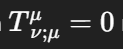 relative to the affine structure given by the metric, and it expresses more cleanly the way gravitational terms enter as “pseudotensorial” contributions in non-general-covariant frameworks. The text emphasizes how, under the linear class of transformations, these conservation equations are meaningful and select the physically privileged frames. In this respect, the “Entwurf” era is not a failure of geometry but a stage in which geometry is asked to serve conservation rather than to produce it. The philosophical rhetoric of the Scientia essay then insists that one reverse the order: construct a left-hand side whose contracted covariant divergence vanishes identically, so that conservation appears as a theorem rather than an axiom. The documents do not yet display the tensor that will accomplish this; they do display the conceptual need for it.
The short Zurich lecture is equally frank about the stakes for optics. If light is to bend in a gravitational field, the scalar theory will fail at the sun; if light does not bend, the tensorial theory will be in trouble. The lecture’s geometrical economy is impressive: it places the equality of inertial and gravitational mass, and the inertia of energy, next to the one decisive effect—the deflection of a null geodesic—and then measures the competing theories by their commitments. That way of thinking presumes, without yet naming, the identification of free fall with geodesic motion in a metric spacetime. It is reasonable (though inferential) to say that the lecture’s optics presupposes a metric interpretation of gravitation that only a tensorial theory can fully accommodate; the text itself says only that a violation of light-speed constancy follows from the equivalence principle and that this violation forces a generalization of relativity to regions of varying potential.
There is, finally, a subtle unity between the gravitational manuscripts and the statistical notes that bears on Einstein’s long-standing concern for operational meaning. In both domains, invariants are constructed by an average or by a contraction. In the statistical notes, the “characteristic” is a mean product over an interval, and the “intensity” is an averaged square of Fourier coefficients across a band—both designed to suppress accidental irregularities and to expose structural content. In the gravitational documents, the invariant line element and the mixed-tensor divergence serve the same function: they remove the dependence on arbitrary labeling and expose physical structure. This is not to collapse statistics into geometry; it is to remark that, for Einstein at this time, objectivity is an achievement of calculation. One does not discover an invariant; one builds it by choosing the right calculus and the right class of operations.
The editors’ outer frame makes one other contribution: it locates the practical and polemical context without importing secondary literature. The Scientia essay is explicitly responsive to criticisms; yet the reply is characteristic: rather than arguing point by point, Einstein recasts the content of the narrow theory as a principle of covariance and then displays how gravitation uses the same logic to call for a broader formulation. In that sense, the polemic vanishes into method. Wherever the archival record grows polemical, it does so to defuse polemic: the correct answer to objections against the narrow theory is to clarify simultaneity and distance; the correct answer to doubts about general covariance is to show how conservation is written and what that writing entails. This tonal discipline is part of what the volume documents, and its presence inherits significance from the way later developments would make the polemics irrelevant.
To close, it is useful to articulate, in the style of the volume itself, what is textually secured and what is inferential in the account just offered. Textually secured are the following: the conservation-driven restriction to linear covariance in the “foundations” exposition, including the explicit defence of this restriction and the acknowledgement of corresponding generally covariant forms; the “Comments” argument against unique determination under arbitrary substitutions and the attendant physical reading of straightness and planarity in privileged frames; the formal derivation in the Nordström–Fokker paper of a scalar theory from the absolute calculus under the assumption of light-speed constancy in adapted frames, including the identification of the relevant scalar curvature and the mixed-tensor conservation law; the Zurich lecture’s empirical proposal to use solar light-bending as the discriminant between scalar and tensorial gravitation; the Scientia essay’s two-tier articulation of relativity, its insistence on the inertia of energy, its critique of rival theories on mass–energy grounds, and its programmatic appeal to the absolute calculus and to a coordinate-free expression of the law of motion; and the statistical notes’ construction of characteristics and intensities, with explicit gestures toward mechanical realization and causal testing. These are securely in the text.
Inferential—though grounded in the sequence and in the logic of the manuscripts—are the following: the claim that the Mercury perihelion calculations served, within Einstein’s own practice, to reveal structural limitations of the “Entwurf” field equations and to motivate the 1915 shift; the reading of the composition sequence as a deliberately staged alternation between formal generalization and conservation-driven specialization in view of an eventual restoration of general covariance via a geometrically constructed left-hand side with an identically vanishing divergence; the suggestion that the statistical manuscripts are methodological isomorphs of the gravitational program, presenting a miniature of the same invariant-seeking strategy in another register; and the claim that the Zurich lecture presupposes a metric-geodesic reading of free fall that the texts do not yet name explicitly. These inferences are disciplined by the documents, but they exceed their letter. If one accepts them, the volume appears not only as a record of a search but as a map of the pressures that would, by the fall of 1915, force the search past its early constraints.
The book’s distinctive contribution, then, is not to reveal a straight path from special relativity to general relativity, but to fix for the record the knots in which physical principle, mathematical form, and empirical proposal were tangled between 1912 and 1914. It shows in detail how the demand for conservation and uniqueness bound Einstein, how the absolute calculus offered a language rich enough to host competing gravitation theories, how optical phenomena (light bending) and celestial mechanics (Mercury’s perihelion) were cultivated as judges rather than as inspirations, and how a philosophical allergy to privileged structures found its mathematical correlate in the aspiration to general covariance. By assembling the foundational expositions, the formal derivations, the empirical counsels, and the statistical interludes, the volume allows us to see how the parts congeal—around conservation, covariance, and equivalence—and how, in that very congealing, new tensions arise that displace earlier commitments. The effect is to render the creation of general relativity less an act of discovery than a sequence of disciplined renunciations and restorations: renunciations of privilege to save principle; restorations of identity (conservation) by deepening form (geometry). That this sequence ends elsewhere, with equations not yet written here, does not diminish the volume’s achievement; it clarifies it. The documents make plain why the 1915 theory had to be different, and they preserve the moment in which the reasons for difference came into view.
 Simon Gros
Leave a comment