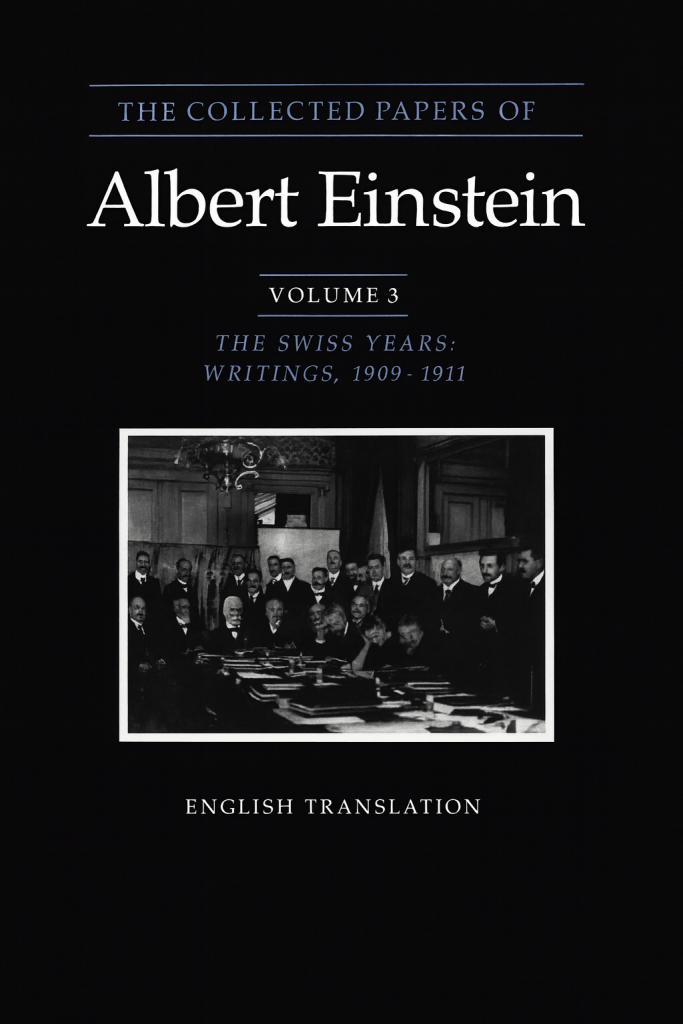
The third volume of the English translation of The Collected Papers of Albert Einstein, The Swiss Years: Writings, 1909–1911 isolates a short but decisive interval in which Einstein’s research program bifurcates and then recombines: from the classroom to the journal page, from statistical mechanics to radiation theory, from kinematics to gravitation, and finally from a large constellation of unresolved quantum puzzles to a single, testable relativistic prediction about the bending of light. Its distinctive scholarly stake lies in showing how the pressures of newly assumed academic life—lecture preparation, course design, public exposition—become method for discovery, how frustration with recalcitrant quantum phenomena sharpens conceptual economy, and how a nascent equivalence principle is pushed into a preliminary gravitational optics. The contribution of the translation supplement is to preserve, with philological tact, the working texture of Einstein’s notes, their abbreviations, lacunae, and draftlike economy, while retaining the signposts that anchor each document to the fully annotated documentary edition.
The framing of the translation volume, announced in the preface, binds fidelity of diction to reproducibility of technical context: equations and notations remain close to their originals; editorial footnote numbers are left intact and bracketed to point the reader back to the documentary apparatus. This decision is methodological, not merely archival, because it allows the lecture notes—often fragmentary and telegraphic—to function as evidence for how Einstein structured argument under pedagogical constraint. The translator’s choice to render period-specific terms consistently (including the dual rendering of Spannung as “voltage” or “potential difference” depending on context) provides a historical metric against which shifts in Einstein’s usage, and therefore in his conceptual alignment, become legible. The three sets of lecture notes—mechanics, kinetic theory, and electricity and magnetism—are singled out as unusually challenging for translation and are consequently the privileged index of Einstein’s evolving voice as a teacher-researcher.
The mechanics lectures at Zurich open with an emphatic statement: mechanics seeks to reduce the manifold of motions to the smallest number of elementary laws of simplest form, reconstructing the complex from the primitive. This is not merely a pedagogy of first principles; it is a foregrounding of reduction as a constructive operation, and one that already presumes a statistical sensibility: the reconstruction of complex phenomena proceeds by carefully chosen idealizations—the material point, the relative character of motion, the coordinate system, the clock—and by discriminating which invariances to enforce and which dependencies to track. The early pages install the main kinematic variables, then press immediately to the decomposition of acceleration into tangential and normal components and onward to integrals of motion. The conceptual rhythm is telling: a definition (inertial motion), an equivalence (force as mass times acceleration), an organizing theorem (areas, moments), and a conservation law (kinetic energy), all arranged to locate, with minimal assumptions, the force functions that can be integrated without full knowledge of the trajectory. This labor of structuring is textual and conceptual at once; the lecture notes are not a mere propaedeutic to later results but a template for how Einstein wants physical law to look when it works—expressive enough to absorb special cases, economical enough to expose defect when an expression grows unwieldy. The sequence through free fall, Keplerian motion, the center-of-mass reduction, constrained motion on surfaces, the pendulum (elementary and damped, small and finite amplitude), and then motion in rotating frames, culminates in a compact treatment of terrestrial rotation effects (Coriolis/Foucault), that openly insists on the operational meaning of coordinates tied to the Earth. The notes are messy in places, but the didactic architecture is crystalline: build a grammar of reduction, then test it against geometrically distinct constraints.
This same grammar—in which the solvability of motion hinges on the dependence of forces on coordinates and time, and in which first integrals are prized as structural witnesses to lawfulness—reappears in the summer 1910 course on the kinetic theory of heat and then again in the winter 1910/11 electricity-and-magnetism lectures. The importance of these courses is not exhausted by their content; they reveal what Einstein chooses to standardize in his students’ conceptual repertoire: statistical additivity, equipartition as a limiting law, and the careful separation of hypotheses about microdynamics from claims about macroscopic constitutive behavior. The Zurich E&M notes, situated in the volume between comments on thermodynamics’ mechanical foundations and notes on fluctuations, constitute part of a compositional corridor that leads directly into his contemporaneous published attempts to align radiation theory, probability calculus, and fluctuation phenomena. The lecture notes thereby form an outer frame for the documents in which the quantum difficulties become explicit.
Among those documents, the pair of 1910 papers with Ludwig Hopf pick out the core dilemma: when standard statistical assumptions are “correctly applied,” one is driven inexorably to the Rayleigh–Jeans spectrum. Einstein and Hopf then demonstrate that even if one restricts equipartition to translational degrees of freedom of molecules and oscillators, the classical route remains closed—one still arrives at the classical spectrum and thus at a contradiction with experiment. The inference, sharpened by the calculation of resistive forces and momentum fluctuations imparted by the radiation field to a mobile resonator, is methodological: if impeccably classical methods, prudently applied, again deliver the wrong law, then the correction cannot be merely local or technical; it must touch the fundamental conceptions governing rapid periodic processes. The argument is not a mere negative result—its internal structure exhibits a commitment to isolating which assumptions about statistical independence and force coupling do the essential work. The conclusion is that the radiation field, treated as a continuum carrying energy density, cannot be reconciled with the observed spectral distribution unless the underlying mechanics or the conception of the field is altered at the root.
The terse statement “Comment on a Fundamental Difficulty in Theoretical Physics” from January 1911 compresses this verdict into a lapidary program note. Classical mechanics and Maxwellian electrodynamics excel for slow processes; they accommodate thermodynamics’ range and deliver the law of radiation in the long-wavelength, high-temperature regime. But the same foundations “leave us in the lurch” for phenomena characterized by rapid periodicity and large-energy elementary processes (short-wave radiation, low-temperature specific heats, optical degrees of freedom without corresponding thermal contributions). Planck’s quantization enters in this text as a phenomenological modification that works, not yet as an underlying theory: one can derive the correct radiation formula if energy comes in discrete packets of magnitude (h\nu), but the conceptual legitimacy of that move remains to be earned. The document’s conceptual claim is precise: point mechanics is not valid for rapid periodic processes, and the customary picture of radiant energy’s spatial distribution cannot be maintained. The text thus articulates, in the first person, the meta-theoretical state of play at the threshold of Einstein’s Prague period: a field theory that fails in the ultraviolet, a statistical mechanics that cannot authorize itself across the frequency domain, and a quantum postulate that fixes too much while explaining too little.
In parallel with this negative diagnosis, Einstein continues to pursue constructive bridges between radiation and matter by reframing specific-heat anomalies. The 1911 paper Elementary Observations on Thermal Molecular Motion in Solids reshapes the earlier single-frequency (monochromatic) oscillator model into a more physically articulate picture: real solids behave like mixtures of resonators with distributed proper frequencies and appreciable damping, behaving more like strongly damped oscillators in a radiation field. That move both narrows the mismatch with experiment and re-situates the specific-heat problem as a coupled radiative–mechanical phenomenon in which frequency dispersion and damping dominate. This paper’s argument belongs to the same compositional corridor that leads to the Solvay lecture of autumn 1911, where Einstein frames the “present state” of the problem: kinetic theory achieves its most elegant successes in monatomic gases, but the inadequacy of molecular mechanics appears precisely in solids, where equipartition over bound degrees of freedom overpredicts heat capacities, and where low-temperature data enforce a qualitatively different law. The rhetorical stance is diagnostic and architectural at once: the radiation law dictates the temperature dependence of specific heats, but the extant derivations misapply the molecular picture and ignore the damping-laden, polychromatic reality of thermal oscillations.
This cluster on solids is punctuated by a pair of short notes that perform conceptual housekeeping of an unusually revealing kind. One corrects a numerical value obtained in a previous determination of molecular dimensions, revising the Avogadro number by integrating viscosity and diffusion data on sugar solutions; the other acknowledges Madelung’s precedence in drawing a connection between elasticity and optical frequency for diatomic compounds and stresses the empirical implication that in certain solids molecular bonds are essentially dissolved—an early recognition that local bonding pictures strain under the phenomenology of ionic solids. These notes are not incidental; they demonstrate a habitual calibration: the theory is allowed to stand only so long as its numerical consequences survive confrontation with alternative derivations, and priority is accorded when it redirects a conceptual line (elastic constants to optical frequencies) with fresh force.
The long pedagogical armature of the volume supports a second arc—Einstein’s public exposition of relativity and the emergence of a gravitational optics through the equivalence principle. The Zurich lecture “The Theory of Relativity” situates kinematical relativity in an accessible register while already hinting at the pressure exerted by accelerated frames and gravitation on the invariance of light speed. The exchange with Viktor Varičak on the Ehrenfest paradox and the “subjectivity” of Lorentz contraction is characteristic: Einstein insists that simultaneity, defined operationally, renders contraction a matter of physical measurement, not conventional stipulation; he then supplies a thought experiment with oppositely moving congruent rods to show that contraction can be exhibited by purely comparative means, independent of clock-setting conventions. What is cultivated here is not a polemic but a methodological rectitude: definition first, then the experimental entitlement of the definition; only afterward a geometric reconstruction of the phenomena. The text secures the standing of contraction by tying it to measurable coincidence relations between bodies; thus the charge of subjectivity dissolves once one sees that coincidence patterns can be laid against proper-length rods at rest relative to the measurement device.
The paper On the Influence of Gravitation on the Propagation of Light (June 1911) provides the central constructive episode of the Prague period. Here Einstein posits the physical equivalence of a homogeneous gravitational field and a uniformly accelerated frame and uses that equivalence to deduce that the velocity of light varies with gravitational potential. From that, via Huygens’ principle, he derives a deflection of light rays traversing a gravitational field, obtaining for a ray passing near the Sun an apparent angular shift on the order of an arcsecond. Crucially, he frames the result as a first approximation and emphasizes both the experimental testability—stellar positions near the solar limb—and the provisional nature of the derivation, which rests on a still-classical background kinematics to which the equivalence idea is grafted. The paper’s architecture is lucid: isolate the consequence (variable light speed), show how it induces a refractive picture of gravitational bending, and compute the leading-order deflection by integrating along the ray’s path against the potential gradient. The claim is both conservative and radical: conservative in that it does not yet rewrite the geometry of spacetime, radical in that it withdraws the usual universality of constant c in favor of a potential-dependent propagation law in gravitational fields, thereby announcing the breakdown of the ordinary formulation of the relativity principle when gravitation is present.
This gravitational optics does not come from nowhere; it is the reconstitution of the reduction grammar in a new context. Where earlier the integrability of motion depended on whether forces derived from a potential, here the tractability of deflection depends on whether one can represent gravitation as an effective index variation for light. The performative effect is similar: a complicated phenomenon (light in gravitation) is recast as a solvable problem (ray bending in a graded medium) at the price of introducing an equivalence that later will demand full geometric expression. The method is transitional but internally coherent, precisely because it keeps the experimentally referable content in view. The echo of the classroom is still audible: once the dependence (c(\Phi)) is established, the angle-per-unit-length follows analytically, and the integral delivers the deflection with its mass and impact-parameter dependence. That the conclusion awaits later revision in the full general theory does not diminish the conceptual achievement here; it specifies the constraint that the later theory must meet and exceed.
Balanced against this gravitational strand is a deepening engagement with the thermodynamic and statistical underpinnings of quantum phenomena. The discussion notes and the Solvay report make explicit Einstein’s twofold strategy: to test the reach of statistical mechanics in domains where equipartition has strong warrant (translational degrees of freedom) and to identify, without evasion, where classical mechanics—and with it Maxwell’s picture—must be renounced or depopulated of authority. His remarks at Brussels (e.g., on the illegitimacy of deducing mechanical admissibility from thermodynamic behavior via an undefined state probability (W), or on the necessity of local departures from Maxwell’s equations if oscillators are to radiate discretely) are the public edge of the private program diagnosed in January. These interventions are unsparing but precise; they do not discard statistics as such (he explicitly defends their application to radiation in principle) but insist that their physical anchors—definitions of probability and of microscopic admissibility—be made explicit before inferences are drawn. The Solvay text on specific heats then presents the constructive half: if one accepts that energy exchange occurs in quanta (h\nu), the temperature dependence of heat capacities follows qualitatively and, with damping and frequency distribution, quantitatively much better than before. The lecture’s first section links specific heats and radiation formulae, thus tying what might appear to be a materials problem to the universal spectral law.
A different yet related strand in the volume concerns the mechanical foundations of thermodynamics and their limits. Einstein’s comments on P. Hertz’s work revisit the project of grounding thermodynamic behavior in point mechanics, while simultaneously registering the growing unease that the very degrees of freedom invoked to account for optical properties contribute nothing to specific heat. The breadth of this concern is quietly indicated by the arrangement of documents: the comments on Hertz stand adjacent to the E&M lectures and just upstream from the note on fluctuations and the formal Statement on the Light Quantum Hypothesis. The editorial sequence enacts the intellectual one: to speak responsibly about the mechanical foundations is to admit where mechanics ceases to hold sway and to specify by which criteria—frequency, damping, coupling—those limits set in. The remarks on thermal conduction in insulators at Solvay push further: neither conventional mechanics nor mere quanta suffice to account for significant conductivities at low temperatures; the picture of energy transfer as local, independent hops between neighbors yields values too small by orders of magnitude. Disorder is therefore incomplete; some coherence in thermal motion persists, and with it a path for energy transport that escapes the simple stochastic scheme.
Einstein’s short interventions on Eötvös’s law and on elasticity-specific-heat relations in monatomic solids link the statistical and the mechanical arcs to precision measurement and materials phenomenology. The Eötvös remark, read alongside the gravitational paper, looks like a small but telling triangulation: equivalence in the inertial–gravitational sense must show in capillarity-derived density relations if the law is to survive under careful scrutiny. The elasticity note identifies a quantitative relationship between elastic behavior and optical frequency and acknowledges that the coherence of the argument requires one to contemplate dissociation in the solid state—an inferential step with strong empirical taste. These are not digressions; they are test cases for a broader methodological principle: whenever a law claims universality, scout the material borderlands where it must cash out in numeric invariants or in unexpected couplings (surface tension to density; optical frequency to elastic constant).
The editorial silhouette of the volume—lecture notes, research articles, comments, discussions—thus does more than collect; it dramatizes a process. The lecture notes display a commitment to minimal postulates, integrability conditions, and energy accounting. The research articles on radiation and probability expose the failure modes of that minimalism when faced with high-frequency phenomena. The comments and discussions metabolize those failures into a research stance: accept quantization where it delivers law and prediction, deny the authority of unanchored statistical constructs, and find the experimental leverage points where a first approximation—like a light-bending estimate—can be dragged into observation. The composition sequence, from Bern’s patent office exit to Zurich and then Prague, is visible as an outer frame: the rhythms of course design and public lectures interleave with condensed, targeted papers and with dialogic, occasionally polemical exchanges that stabilize terminology and sharpen scope. The translation’s retention of editorial footnote numerals within square brackets, and of the “p.”-references to notebook pages, ensures that this process remains navigable as a scholarly object—the reader can shuttle from the translation to the documentary edition for context, and the distinct registers (lecture vs. paper vs. remark) are maintained in their intended distances.
One can now bring the concept tensions into a single field. The most visible is the tension between statistical mechanics as an instrument that underwrites thermodynamics and as a theory that misfires on radiation: Einstein does not throw away the former success when encountering the latter failure; he isolates the domain where the inference breaks and declares what kinds of processes (rapid periodic) resist point-mechanical description. A second tension arises between relativity’s operational definitions (simultaneity, length) and the suspicion of their conventionality; here he reasserts the empirical content by inventing a measurement procedure that cannot be dissolved into convention. A third tension arises between the positional reading of gravitation (potential as scalar field) and the kinematical reading (acceleration frame equivalence); Einstein’s 1911 optics of gravitation is the temporary marriage of these, one that will be dissolved and replaced by a fully geometric account. The volume, taken as a whole, shows each of these tensions doing necessary work: they forestall premature synthesis, force the retention of first approximations, and mark the waypoints—bending of light, low-temperature specific heats—at which the theory must answer to the world.
What in this book is secured by the text itself, and what is inferential? Textually secured are the explicit derivations, premises, and claims of scope: the mechanics lectures’ structure and exemplars; the Einstein–Hopf demonstration that classical methods, even restricted to translational equipartition, feed back the Rayleigh–Jeans law; the January 1911 verdict that classical foundations fail for rapid periodic processes; the 1911 gravitational paper’s calculational pathway to a first deflection value and the statement that the constancy of light speed, in the usual sense, cannot be maintained in a gravitational field; the Solvay lecture’s link between radiation formulae and specific heats and Einstein’s insistence, in discussion, on explicit statistical definitions and on the consequences for oscillators’ radiation if Maxwell’s equations are to be kept intact in their vicinity. Inferential—though strongly indicated—are the claims about how the lecture-note pedagogy becomes a method for discovery, how the arrangement of the volume encodes a research corridor from reduction grammar to gravitational optics, and how the short notes on materials and corrections instantiate a recurring calibration routine that polices Einstein’s own results. These inferences are warranted by the composition sequence and by the mutual reinforcement of documents, but they are nevertheless interpretations of the ensemble rather than discrete statements within any one item.
If we ask how the parts merge and then displace one another across the two years, the following narrative suggests itself. The winter 1909/10 mechanics notes establish a controlled idiom of law-extraction and energy accounting. The 1910 radiation studies, including the theorem of probability calculus and the resonator-in-radiation analysis, stress-test that idiom in a domain where it predictably fails; their conclusion refocuses the research on what new primitive—quanta of action—must be admitted. Through 1911, Einstein exploits this admission on the condensed-matter side (specific heats, damping, dispersive mixtures of resonators) and simultaneously discovers that the equivalence idea can be forced into a concrete optic for gravitation with a clean observational signature. The public lectures and the exchanges (Varičak, Solvay) tighten definitions and confront alternative routes (e.g., Sommerfeld’s action principle) by asking what must give if the observed phenomena are to be recovered. By the end of 1911, the ensemble has crystallized into two charges to the future: provide a theory of gravitation that preserves the empirical core of equivalence while restoring the universality of light speed at a deeper structural level, and provide a microphysical account of radiation–matter exchange that does not merely borrow quantization but explains its necessity. The later general theory of relativity and the 1916–1917 quantum emission–absorption analysis can be read as fulfillment of these charges; here we encounter the preconditions, painstakingly established.
A final clarification. The translation supplement explicitly declares that it does not replace the documentary edition and that the marginal apparatus—footnote numerals, notebook page references, angle-bracketed deletions—is deliberately preserved to facilitate scholarly cross-reference. That preservation is not a mere courtesy to editors; it is the condition under which the working notes and public papers can be read as a continuous research dossier. The volume’s scholarly contribution, therefore, is double: it supplies English access to Einstein’s texts in their period idiom and technical dress, and it stages, through sequence and juxtaposition, the transformation of a set of problems (radiation law, specific heats, gravitation) into a pair of decisive programmatic demands. The intellectual portrait that results is neither linear nor celebratory. It is a record of a physicist confronting the edges of his own methods, using teaching to refine the canons of derivation, and allowing a negative result—the stubborn return of Rayleigh–Jeans under every classical respectability—to dictate what has to be rebuilt. And it is the record of a provisional construction—gravitational optics in 1911—whose virtue is to be wrong in the right direction, dense enough to attract observation, rigorous enough to constrain its eventual replacement. That, precisely, is why these two years matter and why this translation’s scrupulous literalness is warranted: it lets us see Einstein thinking in the open, at the very moment when the lines of force of his later theories were crossing into view.
 Simon Gros
Leave a comment