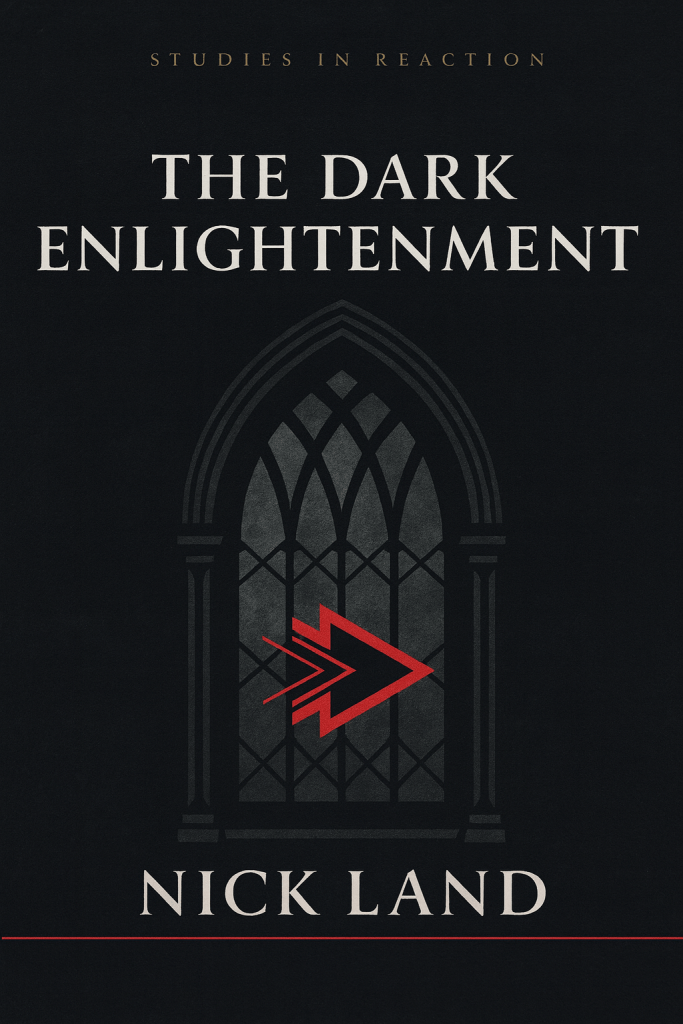
Nick Land’s The Dark Enlightenment enters the scene as a document of cold lucidity and nocturnal exactness, neither sermon nor simple polemic, but a protracted autopsy of the Enlightenment’s living corpus carried out under artificial light. What appears at first as a blog-born accumulation of interventions arranges itself—once read with patience and method—into a single, continuous organon. Its guiding thread is spare and ruthless: modernity’s legitimating self-narratives of emancipation, progress, and democratic self-rule exhibit not merely error but an intrinsic degeneration, a systematic drift toward institutional entropy, moral sentimentality, and managerial religion. The text does not simply contradict this orthodoxy; it treats it as a symptom-complex whose depths demand clinical exposition. The result is a work that conjugates political theory with cybernetic realism, social ontology with economic thermodynamics, and speculative futurism with an almost monastic sense of diagnostic discipline, all voiced in tonality that is deliberately funereal—neogothic not in ornament but in atmosphere, rigorous in its science and sepulchral in its lighting.
At the level of argument, the project unfolds as a negative phenomenology of the liberal-democratic state form and its meta-institutional ecology. The inherited faith that identifies enlightenment with a priori improvement is read as a kind of Whig dreamwork: spontaneous idealization of victorious outcomes retold as necessity. Land’s analysis treats such narratives as animated by an invisible liturgy, a recurring confession that reason and dignity are historical constants destined to conquer their opposites. Instead of marching with that daylight, he extinguishes the illumination source and examines the apparatus in infra-black: the price signals, incentive gradients, principal–agent misalignments, informational choke points, and reputational markets through which sovereignty is effectuated regardless of how the polity names itself. Under this exposure, democracy ceases to be a sacred predicate and becomes a mechanism whose outputs can be measured against systemic criteria: capital formation, security production, time preference management, institutional learning rates, and the avoidance of what the text repeatedly figures as social zombification—political life animated by decaying purposes.
The central figure guiding this analysis is the Cathedral—a term Land adopts, sharpens, and repurposes to designate the distributed meta-institution composed of elite universities, prestige media, credentialing guilds, managerial bureaucracies, NGO complexes, and their philanthropic patrons. This is not a conspiracy because it has no sovereign center; it is a spontaneous order of doctrinal coordination. Its theology is benevolent, its sacraments moralized, and its dogmatics universal; but its cybernetics is a monoculture of risk aversion. Against this background, democratic ritual appears not as rule by the many but as priestly circulation of consent; elections are the liturgical calendar; policy debate the sermonized homily; the judiciary a synod of high interpreters; the civil service a monastic order in business attire. The effect is not secret rule, which would at least be efficient, but a slow-walking labyrinth of proceduralized virtue through which accountability dissolves into sentiment and power masks itself as pedagogy. Once the Cathedral is seen, the text intimates, a claim like “popular sovereignty” can no longer be uttered without the metallic aftertaste of euphemism.
Departing from the Cathedral’s courtly ritual, the analysis moves to the mechanics of exit. Where conventional constitutionalism seeks to calibrate voice—procedure for complaint—Land turns to the option of defection. The decisive political right is not the franchise but the capacity to withdraw, to secede from institutional catastrophe, to disaggregate from a failing policy equilibrium, to compose new jurisdictions instead of eloquently protesting old ones. The intuition is at once economic and thermodynamic: systems that deny exit accelerate internal rot, while those that multiply sovereign competitors lower time preference, reduce rent-seeking, and heighten vigilance against failure. The figure for this reorientation is patchwork—a fractal plane of orders whose stability doesn’t derive from the consent of an undifferentiated people but from their persistent capacity to relocate their allegiances without civilizational rupture. What democracy undertakes by sanctifying debate, patchwork performs by intensifying selection.
In this scheme, neocameralism becomes less a provocation than a design brief. If governance is a production function—security, adjudication, and coordination delivered with predictable quality—then its incentive structure must be formalized like a firm’s. The sovereign is reconceived as a legally insulated corporate entity with concentrated ownership claims and explicitly priced responsibilities; subjects, reconceived as clients, possess contractual clarity; administrators, reconceived as managers, are bound to performance by fiduciary duty intact enough to be justiciable. The king is not romanticized; he is audited. Public goods cease to float on oratory and are secured by competitively constrained providers whose survival depends on the durability of peace, the credibility of law, and the horizon of capital accumulation. The democratic preference for diffuse, morally resonant mandates is replaced by explicit contracts enforceable through market discipline: if the state fails at safety or solvency, it fails at everything, and loses. Institutional virtue is thus abstracted into a measurable function; moral appeals are not denied their theater, but the theater is not permitted to run the treasury.
Such formalism demands a theological sacrifice that much political philosophy refuses to make. The composite entity named “the people” is not invested with metaphysical attributes; it is treated as a stochastic aggregate of agents with heterogeneous preferences, bounded rationality, and manipulable heuristics. From this vantage, the egalitarian promise of equal rule is reinterpreted as a costly fiction—costly because it replaces clarity of command responsibility with a mystical diffusion of causal agency. Where the Cathedral treats the people’s will as an everinterpretable revelation, Land insists the only wills that matter for institutional analysis are those bound by enforceable accountability. A doctrine of moral equality may still carry ethical weight, but as a design principle for executive control its effect is to replace governance with sentiment and replace sentinel duty with narrative management. Formalism does not excommunicate morality; it disenchants it into contract.
Underlying this reorientation is a hard Darwinism that refuses to be embarrassed by selection. Societies compete. Time punishes high time preference and rewards low; firms that defer gratification survive; polities that restrain parasitism outbuild those that indulge it. The alluring democratic gesture—to lift burdens from the present through redistributive consolation and transgenerational debt—functions under this analysis as institutionalized myopia. And myopia, because it shortens civilizational attention span, selects regimes that flatter the immediate at the expense of the durable. Democracy’s basic flaw is thus not only that it entrusts complex decisions to electorates lacking expert knowledge; it is that it structurally enshrines impatience as a constitutional principle. The visible talismans of participation substitute for the less visible mathematics of survival, and the system drifts. The claim is severe and unemotional: where governance refuses selective pressure, entropy resumes its ancient work.
The consequence is a style of critique that refuses consolation and pushes relentlessly past the humanist horizon. A distinctly accelerationist motif courses through these pages: technological development is not a neutral instrument whose tempo can be choir-led by moral persuasion; it is a self-reinforcing gradient, a runaway positive feedback loop in capital, computation, and control that melts legacy constraints like an acid fog. The modern state imagines itself as master of this vertigo; Land treats it as the state’s master. Formal politics underestimates the alien intelligence of markets and machines, and proceeds as if civics could still pace the storm. The response proposed here is not Luddite refusal—romance is the Cathedral’s aesthetic—but compositional submission to the gradient: align institutions with expansion, fuse governance with skin-in-the-game, build for plasticity, and cease narrating stagnation as stability. Where democracy sees speed as threat, accelerationist formalism sees sluggishness as lying.
If the argument were purely technical, its controversy would be measurable; it is notorious because it sharpens its knives around domains the liberal conscience prefers to drape in hush. The work includes excursions into social identity and stratification, not as völkisch romance but as an unprogrammed willingness to ask whether taboos have replaced study. Land’s method is austere: refrain from grand claims, insist on invariants, test intuitions against data and incentive structures, bracket pieties. In doing so, he neither pleads for ugliness nor flatters cruelty; he holds that design without truth is murder by delay. Many readers will refuse this framing on ethical grounds; many will insist that scientific inquiry here becomes a trap door to inhuman policy. The text never hides from that charge. It argues instead that political theology has smuggled a liturgy of compulsory ignorance into governance, and that to prevent harms we must first restore the right to know. The risk is acknowledged; the alternative, it submits, is dignified decay.
Literary texture and rhetorical architecture are in service of this program. Land writes with a compression that feels metallic, each sentence a mechanism whose parts cannot be removed without the device failing to fire. He does not declaim; he calibrates. Recurring images—zombie processions, labyrinthine cathedrals, factory sirens, bionic horizons—are not gothic indulgences but mnemonic devices for complex cybernetic relations. The neogothic color of the prose does not romanticize ruin; it renders visible the structural chiaroscuro of modern governance as a built environment of corridors, tunnels, and maintenance shafts, where moral illumination pools in ceremonial naves and leaks away in bureaucratic basements. The mood is dispassionate even when the imagery darkens; the metaphors are displayed like anatomical specimens, labeled and cross-referenced, never allowed to become spells.
A crucial distinction pervades the questioning: diagnosis versus prescription. The text is routinely accused of championing a politics of hierarchy, plutocracy, or worse. It answers this predictable indictment by reframing itself as a method rather than a doctrine: identify the feedback loops; remove the euphemisms; impose accountability; prefer systems that intensify selection over those that ritualize assent. Whether one then prefers city-states with shareholders or federations with charters is, from this vantage, a secondary question so long as the institutional scaffolding admits exit and the sovereign is not immunized from bankruptcy. Even where the argument aligns with reactionary motifs—skepticism toward mass suffrage, disgust with managerial speech, impatience with sentimental egalitarianism—it presents itself as analysis constrained by invariants rather than nostalgia. If there is prophecy here, it is not of restoration but of consequences.
To understand the distinctive sharpness of the method, one must place it against Land’s longer philosophical itinerary. There is an unbroken vector from the earlier investigations into machinic desire and anti-humanist time to this sustained analysis of state form. The consistent constants are a disdain for anthropomorphic flattery, a suspicion that consciousness is late and derivative, and a conviction that systems seek their gradients independent of the stories we write about them. The Enlightenment treated reason as sovereign; Land treats intelligence as inhuman. The shift is not rhetorical but structural: once intelligence is defined by problem-solving rather than by dignity, the institutional map rearranges itself. Governance either retunes to that map or writes poetry about a map that no longer matches the territory.
This is why artificial intelligence, automation, and the planetary nervous system of telecomputation recur as more than examples. They are the real antagonists of twentieth-century civics. Democracies administer through debate, but debate is slow; capital allocates through price, and price is fast. When code automates price discovery and supply-chain choreography at scales that exceed committee comprehension, institutional time must rebase itself or sink into decorative function. Land’s accelerationism is not a cheer for novelty but a formal recognition of tempo: when selection cycles compress, constitutional designs optimized for glacial change become show windows dressing a backroom whose inventory moves at machine speed. Systems that cannot be audited by their own decision latencies fall under the control of their delays. In such a theater, a doctrine of measured hierarchy is less paranoia than hygiene.
None of this, however, exempts the project from rigorous criticism, and the text itself anticipates much of it, sometimes curtly, sometimes at length. Treating governance as a firm risks neglecting the goods that cannot be priced without distortion. A sovereign corporation may protect safety and contract, but where does it place the aesthetic, the compassionate, the gratuitously humane? The answer—that competitive pressure can internalize such goods insofar as they fortify solvency—will not convince those for whom the point of politics is to shelter certain values from exposure to market weather. Equally substantial is the worry about the principal–agent problem at the apex: who audits the auditor if ownership itself becomes a sacral object, stabilized by legal enclosure? The analysis insists that bankruptcy and exit suffice; critics will insist that concentrated property breeds mutation-proof tyranny. The text grants no palliative there; it insists that immunity from failure, whether for kings or committees, is the true tyrant.
A parallel objection concerns the empirical anthropology implicit in the argument: do electorates always behave as time-inconsistent mobs? Is dignity truly spent whenever it is not collateralized? What of the documented benefits of universal suffrage in constraining predation and imposing basic accountability on cruel elites? The response offered is not denial but reframing: the question is not whether mass participation occasionally disciplines rulers, but whether it reliably optimizes institutional time preference across cycles. In contexts where it does, accelerate it; where it does not, redesign. The point is adaptive architecture, not totalizing ideology. Yet the very refusal to endorse a consoling piety will strike many as complicity with cruelty. The book remains at peace with this disapproval. It prefers the cruelty of reality-testing to the cruelty of pious lies.
The figure of the Cathedral invites its own countercharge: what appears as doctrinal consolidation may be less theological conspiracy than the emergent order of meritocratic elites solving complex problems under intense scrutiny. The analysis replies that even if so, the problem remains unchanged: emergent orders can be efficient in the short run and brittle in the long. Homogeneous consensus produces spectacular moral pageantry and surprisingly mediocre risk control. When reputational networks punish dissent faster than they reward accuracy, error-correction ceases to function and the system drifts into palliative governance—compassionate in speech, negligent in structure. Land’s preference for polycentric sovereignty is justified by this fear of consensus brittleness: redundant systems resist failure modes that monoliths conceal until their collapse is entropic.
The text’s moral temperature—ice-cold, clinical, precise—has been read as nihilism. The charge misses the subtlety because it treats warmth as the sole index of care. What The Dark Enlightenment undertakes is a laboratory ethics: the refusal to misdescribe a thing in order to feel better about it. In that sense it is not beyond good and evil; it places good and evil under audit. A politics of charity that refuses to track long-term incentives constructs humane ruins. Charitable ruins are still ruins. Land’s writing does not delight in that ruin; it treats it as a technical fault to be corrected by architecture, not lamented by declamation. The tonal austerity of the prose—its lack of lyric softness—serves that refusal. Sentiment is not abolished; it is disallowed from performing institutional work for which it is structurally unsuited.
One recognizes across the argument a continuous rhetorical inversion of the Enlightenment’s ecclesiology. Where the old faith proclaimed light and denounced darkness, this text insists that the apparent brightness has blinded the custodians and that much of what is called illumination is staged radiance—amplified candlelight in vaulted halls from which real work has been outsourced to departments nobody votes for. The neogothic imagery is not a costume but a calibrated instrument: under the haunted arches of venerable institutions, one can still hear the echo of sermons whose credibility is a function of the stone beneath them rather than the true calculus of effects they produce beyond the walls. The message is not to love the dark; it is to remove the theatrical lighting long enough to see the wiring.
In its movement across themes—the anatomy of democratic time inconsistency, the economics of exit, the jurisprudence of ownership, the cybernetics of selection, the alien tempo of computation—the text composes a single continuous claim: modernity’s administrative theology has mistaken legitimation ritual for institutional design. Emancipatory speech is not itself a system; constitutional poetry is not governance. Sovereignty exists as the ability to produce order, and order is measurable by the constraints it imposes on preference and the durability it affords to law, property, and the peaceful conduct of life. Whoever can do that is sovereign, whatever the hymnals say. Whoever cannot, but continues to speak in the language of emancipation, is a priest of decline, however glittering his sanctuary.
The reader should not seek comfort here and will not find it. What the work offers instead is a peculiar liberation: release from the obligation to describe the age in adjectives pleasing to its masters. For those who mistrust concentrated power, the insistence on skin-in-the-game will be tonic. For those who distrust markets, the treatment of price as intelligence will be offensive. For those with a romantic conscience, the description of charity as a misdesigned control module will look like cruelty masquerading as realism. Yet even the offended will learn two permanent techniques from these pages: first, to inquire after the channel by which any institution can be made to fail and replaced without civil war; second, to refuse any piety that insulates administrators from the honest costs of their errors. Those two techniques are not reactionary; they are simply adult.
If one asks what is new here, the answer is both minimal and decisive. The argument does not invent hierarchy, corporate governance, or polycentric sovereignty; it re-situates them within an accelerationist ontology in which intelligence is machinic and selection relentless. The novel move is to bind political design to the tempo of the world rather than to the flattering stories the world tells about itself. Once tempo is recognized as constitutive, the rest follows: formalism replaces moral suasion as the locus of control; exit replaces clamor as the citizen’s leverage; competition replaces sanctimony as the virtue of institutions; and the sovereign ceases to be a person or a parliament and becomes a machine that can be made to fail safely and rebuilt fast. That is a terrifying sentence to readers who locate dignity in deliberative ritual; it is pragmatic relief to those who locate dignity in the reduction of crime, the protection of property, and the capacity to forecast ten years out.
The charges that gather at the margins of this text—hyper-neoliberalism, neo-fascism, contentless nihilism—testify more to the poverty of the conceptual arsenal deployed against it than to the nature of the thing itself. The method on display is neither worshipful of markets nor intoxicated by domination; it is allergic to sentimental confusions between words and systems. If there is an ethics here, it is ascetic: do not call a procedure legitimate unless it can be shown to survive contact with incentive, time, and error; do not call an administrator virtuous if his failures carry no cost; do not call an order just if one cannot leave it. Those axioms are sparse and harsh; they are also—if the book’s steel-voiced insistence is correct—the only ones that can still produce civilization when the lights of inherited theology continue to flicker.
To read The Dark Enlightenment carefully is to encounter an experimental politics in which cathedral architecture becomes engineering schematic: arches annotated into trusses, stained glass reduced to spectrum filters, organ music reinterpreted as signal noise, nave acoustics measured as channel capacity, and liturgy timed against latency budgets. It is austere, yes, but not empty. Within this austerity there is still room for a guarded hope: that institutions can be designed to absorb error without theatrical self-absolution, that sovereignty can be rendered transparent to bankruptcy, that civilian life can be protected by entities that feed on their own failures rather than on grand narratives, and that progress—if one still wants the word—can be measured not by slogans but by the cold facts of safer streets, lower time preferences, deeper capital bases, lighter taxes, and the sustained invisibility of government in everyday life.
No reader will exit unchanged. Some will leave convinced that the age requires, not more ritual ornament, but a dismantling of the moral chandelier that distracts from rot in the beams. Some will leave enraged that a text so indifferent to warmth can dare to speak of human flourishing. All will leave with new questions: where, exactly, is the exit in their own city; what is the explicit contract by which they are governed; how soon does failure become visible; who pays when the managers err; how to multiply sovereign options without triggering war; how to build law that stabilizes investment without freezing error; how to design schools whose output is intelligence rather than catechism; how to keep the lights on without pretending the light is virtue itself. None of those questions is reactionary. Each is technical. Each is the right question for an age that has mistaken ceremony for system.
In this sense, Land’s contribution is less satanic than surgical. The darkness of the title is not an aesthetic of cruelty but a refusal of stage lights. The enlightenment it names is not a doctrine of emancipation but a discipline of seeing what systems do when we stop listening to their speeches. It is a book for engineers of the political, auditors of the sacred, designers of failure, and skeptics of charm. It is also, quietly, for anyone who has felt that our illuminated vaults are held up by beams that have not been inspected in a century. The respect it pays the Enlightenment is the only respect that still matters: it treats it as a hypothesis and tests it against the world. And the verdict, though written in the same measured hand that traced the diagnosis, is one the reader must articulate for themselves after the laboratory lights go out and the long corridor of institutional life resumes its whispering movement into the night.
 Simon Gros
Leave a comment