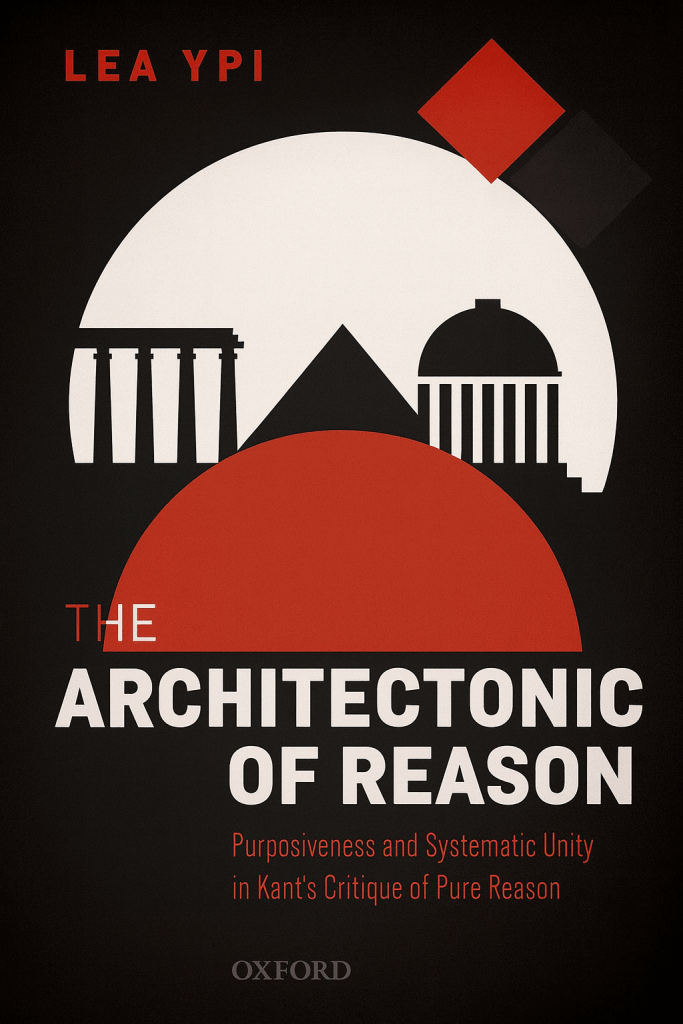
Lea Ypi’s The Architectonic of Reason isolates and restores a neglected nerve of the Critique of Pure Reason: the Doctrine of Method’s culminating section on architectonic unity. Its precise scholarly stake is to show how Kant’s system requires a transcendental principle of purposiveness to integrate theoretical and practical uses of reason, and to explain why the integration, as it appears in the first Critique, proves unstable. The book’s distinctive contribution is twofold. First, it reconstructs how the Architectonic links ideas, ends, and a plan of system such that science becomes possible as a whole. Second, it demonstrates that this linkage, in the first Critique, tacitly presupposes purposiveness as design—with physico-theological residues—rather than purposiveness as normativity, a shift Kant only achieves later, thereby clarifying both the ambition and the failure of the initial architectonic project and the trajectory that follows.
Ypi begins from what the first Critique itself declares: architectonic is the “art of the system,” the condition under which ordinary cognitions become scientia. To write the Doctrine of Method is not to pile materials but to articulate the plan that distributes and binds the materials in conformity with reason’s ends; and to write the Architectonic is to determine the formal conditions under which pure reason forms a complete whole. Kant’s own staging of the project is programmatic: he first disciplines the employment of reason, next determines its canon from the side of practical interest, and finally gives the plan of system that integrates both, thereby promising a unitary completion of critique and a route to metaphysics as science. Ypi’s reading keeps this architectonic sequence in view as the outer frame of the book and as the inner logic of Kant’s enterprise.
With exemplary directness, the book formulates its central thesis: the unity of reason in the first Critique stands or falls with a transcendental principle of purposiveness. This principle coordinates ideas (as principles of unity for the understanding’s rules) with ends (as the orientation of reason toward completion), and thus supplies the schema by which the whole can be represented as a whole. But the principle that is actually operant in the first Critique remains compromised: in the absence of a worked-out doctrine of transcendental freedom within that book, purposiveness tends to be read by Kant as a design—an orientation of nature for us—that repeatedly solicits the idea of an intelligent author. Ypi insists that only later, with the reconstruction of purposiveness as normativity and its assignment to reflective judgment, does Kant find an internal, critical ground for unity. The upshot is a precise diagnosis: the first Critique’s achievement is real but provisionally underwritten; its failure is equally real and philosophically fecund.
Methodologically, Ypi maintains a disciplined proximity to the text’s architectonic scaffolding. She reconstructs how the Doctrine of Method is introduced by the building metaphor—retaining just enough of that imagery to name the task—then follows the analytic sequence by which Kant passes from scholastic to cosmic conceptions of philosophy, explicates the idea of system, and models reason as an organism whose germinal principle orders the growth of parts toward a whole. The insistence on system and organism is not merely rhetorical. Kant equates systematic unity with the very difference between an aggregate and a science, and he compares the unity-idea to a germ (Keim) that silently governs development. Ypi pauses over this analogy, drawing out its implications for the status of purposiveness in the first Critique and for the historical debates on generation and form that inform Kant’s vocabulary of germs and predispositions. In doing so, she shows how the conceptual machinery of the Architectonic borrows a logic from natural history yet still seeks transcendental standing.
The book’s narrative of composition places the Architectonic at the center of Kant’s initial plan. In the 1776 letter to Herz, Kant announces the need for a critique, a discipline, a canon, and an architectonic of pure reason, specifying that only such a complete survey of the “field” of reason could provide reliable boundaries and roads. Ypi reads this letter as evidence that the unity-project was not an afterthought but a constitutive intention: the Architectonic was tasked to do more than summarize; it was to unify. This is further supported by Kant’s early expectation that one work could contain both the theoretical and practical settlements; only later were separate critiques for practical reason and for judgment conceived. Ypi tracks these shifts carefully, adducing the architectonic program’s continuity and the subsequent reallocation of functions across the second and third Critiques as Kant encountered pressures internal to his first execution.
A first decisive step in Ypi’s reconstruction concerns the scholastic and the cosmic (or cosmopolitan) definitions of philosophy in the Architectonic. The scholastic definition aims at logical perfection—the complete system of philosophical cognitions as such. The cosmic definition orders philosophy by ends: it asks what use reason makes of its cognitions in relation to our destination as rational beings. Ypi insists that Kant’s system requires both and that their articulation demands a purposive principle that is at once methodological and teleological. The Architectonic’s promise is precisely to secure the passage from the unity of knowledge to the unity of ends without trespassing the boundaries of sensibility; its difficulty is to find a principle that both licenses and limits that passage. On Ypi’s account, the first Critique tries to satisfy this demand by giving the ideas of reason a double role—logical guidance for unifying the understanding’s rules and practical orientation toward the highest end—while allowing that this double role must be mediated by a schema that represents the whole.
The middle of Ypi’s book is an extended examination of that double role, and the locus classicus is the Appendix to the Transcendental Dialectic. There Kant attributes to ideas a positive, “immanent” employment: they are neither empty nor merely inhibitory; rather, they systematize rules, provide a guiding thread for research, and demand homogeneity, specification, and continuity. But the Appendix is structurally ambiguous. Does the unity that ideas project rest solely on logical principles (a weak heuristic reading), or must a transcendental principle be presupposed (a strong reading)? Ypi argues for the strong reading: the very possibility of empirical lawlikeness presupposes the necessity that nature be unified; without such a presupposition, the understanding’s rules would lack the condition for their reliable coherence, and the mark of empirical truth would be undermined. Kant therefore must treat the unity of nature as objectively valid and necessary—an orientation that exceeds mere logic. This is the precise point where purposiveness enters as a transcendental ground.
Her reconstruction here is strikingly careful. First, she differentiates the spontaneity proper to understanding (unity of intuition under rules) from the spontaneity proper to reason (unity of rules under principles). Second, she reads the positive function ascribed to ideas—linking objects by ordering relations rather than creating objects—as a functional notion of purposiveness: ideas confer order for the sake of ends, thereby drawing distinct cognitive domains into oriented connections. Third, she shows that Kant’s own language in the Appendix repeatedly tempts him to declare the unity of nature objectively valid and necessary, a declaration that, once made, calls for a deduction of the principle that would warrant it. The Appendix provides intimations of such a deduction without completing one; the Architectonic will thus have to recover the missing step by aligning ideas with ends and by appealing to a schema of the whole oriented by reason’s final end.
At this juncture Ypi confronts the pivotal difficulty: the only principle available in the first Critique that could bear the weight of such necessity is saturated with the vocabulary of design. The very comparison of system to organism, and the conception of the unity-idea as a germ that coordinates growth, draws upon eighteenth-century theories of development in which preformed seeds are guided by an ordering cause. Kant’s own remarks on germs and predispositions in the essays on race, and his periodic concessions to preformationist explanations, suggest that the analogical framework within which he imagines unity leans heavily on purposiveness as design: the organism’s parts exist for the whole; the whole is “as if” engineered; and the unfolding of traits answers to an antecedent purposive plan. Ypi neither inflates this analogy into doctrine nor dismisses it as ornament. Instead, she treats it as symptomatic of the first Critique’s constraint: in the absence of a clear transcendental grounding for freedom within that book, the only available image of purposiveness is still tethered to an intelligent orderer.
A sustained historical excursus illuminates how this tethering works. Kant’s discussion of germs and predispositions, which he opposes to purely mechanical accounts of organic development, interprets living forms as equipped in advance for environmental variation. Such equipment looks like a distribution of innate purposive structures awaiting the right occasion to unfold—thus explaining both the unity and diversity of the species. When this biological pattern migrates into the architectonic domain, the result is a conception of reason whose unity is germinal and whose organization is teleological in a way analogous to natural purposiveness. The analogy is potent; it enables Kant to think unity as internal growth rather than external aggregation. But it also presses toward a cosmic author whose wisdom the system mirrors, which is precisely what a strict critique of metaphysics must resist. Here, Ypi is explicit that she is tracking a pressure intrinsic to Kant’s text rather than imputing a doctrine from outside.
The pressure becomes explicit where Ypi turns to the Deduction of the Ideas. If the Appendix hints at a need for deduction, the discussion of deduction makes the need acute: the unity demanded by reason is necessary, yet the ground of this necessity cannot be merely logical. The only place where Kant sketches an argument robust enough to shoulder this necessity is his treatment of physico-theology. Kant repeatedly praises this argument’s accessibility and its capacity to enliven the study of nature; the world’s order, purposiveness, and beauty seem to demand a supersensible ground. Nevertheless, as a theoretical proof it overreaches: at most it licenses a highest architect, never a creator; and even this much, if taken as an objective inference, would violate the very strictures of critique. Ypi’s analysis of Kant’s vacillation here is exact: the purposive guidance of research does not itself authorize an ontological conclusion; yet within the first Critique, Kant lacks any other principled way to underwrite the necessity of systematic unity that he has claimed to be indispensable.
Ypi’s resolution is programmatic rather than apologetic. She does not try to save the first Critique from its own dynamics; she clarifies where they lead. If reason must assume the systematic unity of nature as objectively valid and necessary, and if the only available way to figure such an assumption is in terms of design, then the architectonic unity achieved in the first Critique imports a transcendental theology “through the back door.” This is what it means to say that the project “fails” by the very measure of its critical aspiration: the separation of critique from metaphysics is threatened by the need to guarantee unity. The practical upshot is decisive for the system’s subsequent development. In the second Critique, transcendental freedom becomes the thematic center; in the third Critique, purposiveness is relocated and reconceived as a reflective, normative principle of judgment, thereby allowing Kant to retract physico-theology in favor of ethical theology and to distinguish the guidance of reason from any objective design in nature. Ypi thus binds the diagnosis of failure to a narrative of transformation; failure is a hinge, not an endpoint.
This reading recasts the Canon of Pure Reason in an essential role. The Canon explains how ideas function practically—how the highest good orients action and how belief in God and immortality, while theoretically unprovable, is practically grounded. Ypi shows that the Architectonic requires this practical orientation to close the circuit between ideas and ends. Yet the Canon, within the confines of the first Critique, does not yet distinguish practical from transcendental freedom with the sharpness later achieved; nor does it assign purposiveness to a special faculty. Consequently, when the Architectonic seeks a single principle able to unify the system of nature and the system of freedom, it relies on a purposive conception whose practical necessity is still read in the key of design, and whose systematic impact is secured via the highest end understood within a physico-theological horizon. The unity this yields is coherent relative to the first Critique’s resources, but it remains critically precarious.
One of the book’s strongest moments is the careful tracing of what is textually secured and what is inferential. It is textually secured that Kant defines architectonic as the doctrine of what is scientific in our cognition in general; that the Architectonic aligns ideas and ends by a schema of the whole; that the Appendix ascribes an immanent, positive role to ideas; that Kant speaks of the necessity to presuppose the systematic unity of nature; and that he grants physico-theology a distinctive warmth while denying it demonstrative force. It is, by contrast, inferential—but argued for with attention to Kant’s vocabulary and sequenced claims—that the first Critique’s operative conception of purposiveness is design-laden; that the organism metaphor-plus-germ language imports a preformationist cast to unity; and that the demand for a deduction of the purposive principle cannot be satisfied without either transgressing critical limits or relocating the principle to reflective judgment. The inferential moves are not leaps; they are constrained by the task the Architectonic itself sets.
Ypi’s engagement with the organism analogy merits emphasis, since it exposes the structural ambivalence of Kant’s first architectonic. On the one hand, the analogy provides an anti-aggregative image of unity—growth from within, parts for and by the whole, self-organization—that is indispensable if systematicity is to be anything more than a table of contents. On the other hand, the eighteenth-century sources that supply the analogy (germs, predispositions, ordering causes) reintroduce precisely the kind of teleology whose objective status critique is designed to delimit. The analogy thus both equips Kant to state the problem and constrains the form his solution can take. Ypi makes that dialectic visible and thereby clarifies why the third Critique’s distinct faculty of judgment and its reflective notion of purposiveness are philosophically necessary and architectonically motivated.
The book’s closing movement returns to the outer frame. If the Doctrine of Method promised a unitary whole by combining discipline, canon, and architectonic, then any account of the unity of reason must meet three simultaneous conditions: it must preserve the negative fruits of critique (the demolition of dogmatism); it must ground the practical orientation of reason (the highest good’s claim upon our agency); and it must integrate both in a way that renders science a coherent totality rather than an accidental aggregate. Ypi argues that Kant’s first execution achieves an integration in form but at a price in principle: the very success of the integration leans on a transcendental theology that critique cannot, in the end, authorize. The necessity of unity is correctly seen; the place of its principle is not yet correctly assigned. The later reconfiguration—recasting purposiveness as normativity and assigning it to judgment—honors the demand for unity while keeping metaphysics critical. This is why Ypi can say both that the first architectonic fails and that its failure is productive: the system’s promise is kept by the system’s self-correction.
The historical consequence of this self-correction, Ypi suggests, reaches beyond Kant’s own texts. Once purposiveness is reflexively secured and detached from design, the long nineteenth-century philosophies of history can inherit critical commitments without borrowing a metaphysical blueprint of nature’s order. That is, the architectonic becomes historical and cumulative rather than ontologically pre-patterned: the unity of reason is achieved in practices, institutions, and public uses governed by normative principles, not guaranteed by a cosmic engineer. The architectonic, so reconceived, unifies nature and freedom without violating the limits of sensibility because it asks what rational beings can make with nature under the guidance of judgment, rather than what nature must have been made for by a supersensible author. This is a Kantian legacy, but one that Kant had to discover by moving beyond his first solution.
Throughout, the book is problem-laden in a salutary sense: it presses on tensions instead of smoothing them. It shows how Kant’s own desire to keep critique clean of dogmatic metaphysics contends with his equally deep conviction that reason, as such, is a system and must think its cognitions from a point of view of the whole. It tracks how the Appendix’s confident talk of necessity outruns its logical tools; how the Canon’s practical orientation, indispensable for unity, lacks a properly transcendental freedom to anchor it within the first Critique; how the organism analogy both aids and derails; and how physico-theology animates inquiry while threatening to bind system to an alien ground. The argumentative effect is cumulative: each part lends weight to the claim that the first architectonic both succeeds in drawing the shape of unity and fails to keep that unity within the bounds it has set for itself.
The book’s contribution, finally, clarifies the place of the Architectonic within the first Critique’s outer frame, the composition sequence that gave it its charge, and the precise sense in which the section is indispensable rather than decorative. It clarifies the internal pathway from ideas to ends to schema to system, and why that pathway leads to physico-theological temptations within the first Critique and to a reflective relocation thereafter. And it clarifies what a contemporary reader can learn from this itinerary: that a demand for unity calls for a reflexive principle that orients inquiry without hypostatizing order, one capable of being vindicated as practical necessity and articulated as normative purposiveness. Ypi’s account, grounded in the text’s own architectonic, gives that lesson without importing it, allowing Kant’s pages to show both the need and the turn they required in order to remain faithful to critique.
Clarification: This study secures, with textual warrant, that the first Critique’s unity-project is driven by a transcendental principle of purposiveness; that, in its first execution, this principle is figured under the aspect of design and so compromises critique’s boundary; and that the system’s subsequent development rectifies this by re-anchoring purposiveness in judgment and freedom. Its distinctive achievement is to treat the Architectonic of Pure Reason as the site where the problem is both most pressing and most illuminating, and to show how Kant’s own architectonic compels the reconfiguration that follows. In doing so, Ypi gives the Architectonic back its decisive role in the Critique of Pure Reason and renders visible the precise hinge by which the unity of reason becomes thinkable without becoming dogmatic.
 Simon Gros
Leave a comment