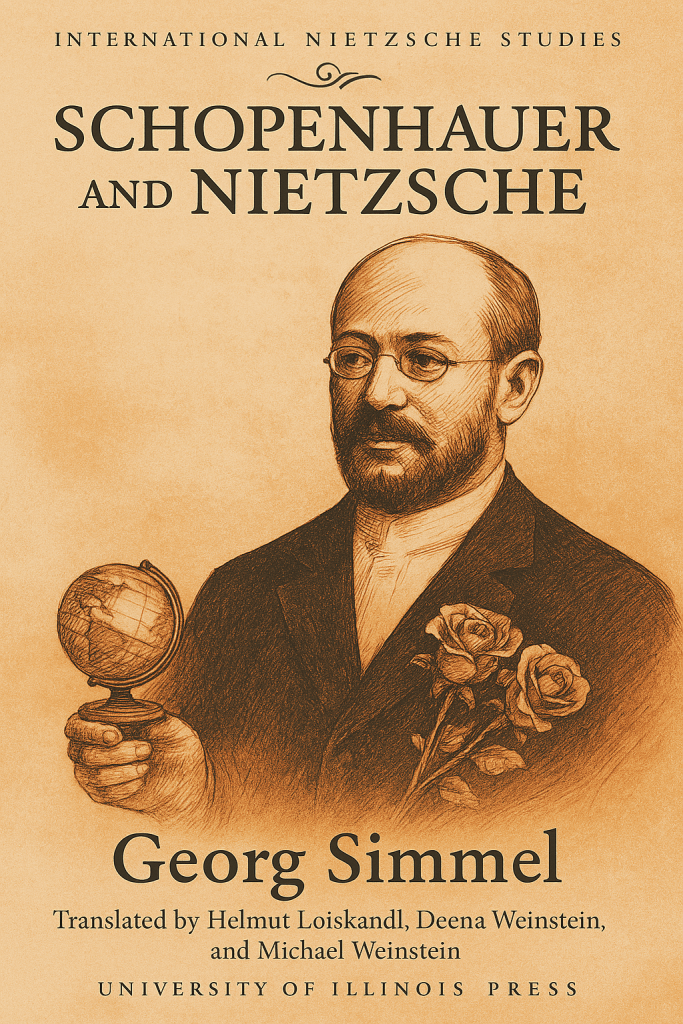
Simmel’s Schopenhauer and Nietzsche advances a precise and programmatic claim: by staging a double inquiry into pessimism and exuberant moralism as temperaments that crystallize into systems, Simmel demonstrates how philosophy of life becomes a diagnostic instrument for the modern crisis of meaning, while also exposing the intrinsic antinomies that any such instrument generates. The distinctive contribution lies in the method—an analytic critique moving from sympathetic internal reconstruction, through immanent antinomy, to selective salvage—which lets Simmel extract “psychological facts” from metaphysical constructions without surrendering to mere psychologism. The book’s wager is that the objectivizations of culture can be both historically dissolved and normatively recuperated only by tracking how metaphysical pictures arise from, and fall back into, lived form; the argumentative theatre is furnished by Schopenhauer’s monism and Nietzsche’s individualism, each pressed until it discloses its other.
The outer frame of the work matters for grasping its stakes. Composed as a lecture cycle in 1907 and republished posthumously in 1920 and 1923, Schopenhauer und Nietzsche appears here in its first English rendering, prepared from the 1923 edition. The translators explain why they opted for a lucid, non-literal idiom: Simmel’s idiosyncratic syntax compresses multiple lines of thought into vast sentences whose resolutions are often deferred, demanding editorial untangling to preserve argumentative sequence while keeping the texture of exploratory thinking. Their aim was accessibility without conceptual loss—an operation justified by the book’s status within Simmel’s oeuvre as a bridge between the sociological critique of culture and the late metaphysical vitalism. The series context (International Nietzsche Studies) situates Simmel’s essay as both a contribution to Nietzsche scholarship and a reflection on philosophy’s “agenda and prospects,” underscoring the text’s structural ambition to reassess the conditions and forms of philosophizing itself.
From the outset the introduction anchors Simmel in a generation tasked with assimilating and overcoming the nineteenth century’s ambivalent legacies—industrial optimism and corrosive rationalism—and in a project characterized by the dismantling of conceptual realism and the attempt to preserve the phenomenological independence of cultural forms as objectivizations of life. The price of this dismantling is a legitimation crisis: once the genesis of forms is referred to the life-process, their constraining dignity threatens to evaporate into projection; yet Simmel resists both a relapse into transcendentalism and a reduction to historical relativism by seeking a non-mythic a priori within the structure of life itself, a quest that will culminate in a tragic ontology.
The composition sequence, carefully charted by the editors, clarifies how the book functions as a hinge. Around 1900–1910 Simmel spreads the philosophical enterprise across epistemology (Kant), value theory (Philosophie des Geldes), and, in this volume, the meaning of life as such. He deliberately deepens the Kantian scission of pure and practical reason: epistemology is critical, metaphysics confers significance, and neither returns to pre-critical dogmatism. By confronting Schopenhauer and Nietzsche, Simmel first delineates the form of metaphysics—in which world-pictures are projections of temperament—before sketching, late, a substantive metaphysics of life. The lecture-cycle thus functions as a germinal philosophy: here the lines of later doctrine are already inscribed as unresolved, mutually limiting tendencies.
The table of contents already signals the argumentative gait: cultural-historical positioning; anthropology of the will; the metaphysics of the will; pessimism; aesthetics; morality and self-redemption; human values and decadence; and the morality of nobility. The sequence oscillates between object and subject—objectified doctrine then its temperamental ground—before pivoting to Nietzsche as counterpoise and concluding with a laconic statement of a vital, skeptical individualism.
Simmel’s method governs every turn of the analysis. He begins at the “own center” of a thinker’s problematic, reconstructing doctrine without external intrusion; he then generates an alternative that follows from the same premises to break the aura of necessity; finally, he preserves what is tenable—the germ of lived insight that motivated the construction—while releasing it from metaphysical pretensions. The tool of this deconstruction is often a Kantian antinomy recast in vital terms; the criterion of salvage is the irreducible integrity of psychological facts. This triadic movement is not merely exegetical; it is Simmel’s proof-of-concept for a way of doing philosophy under conditions of disenchantment.
To unfold the central antinomy, Simmel first re-opens the Kantian wedge that Schopenhauer had refunctioned. Kant’s thing-in-itself had incited the post-critical desire for being beyond imagination; Schopenhauer grants this an essence—will—and enforces a split between a cognizable world of representation and an inapprehensible world of will. Simmel shows that this is one possible reinterpretation of Kant; Hegelian and Schellingian routes conceive absoluteness as the structure of appearance, preserving multiplicity without sacrificing unity. Thus already in the first move Simmel displays the temperamental divide: Hegel’s type saturates each point with pantheistic fullness; Schopenhauer’s type carves a harsh line to make room for the absolute as such.
The decisive counter-construction is metaphysical individualism. Even if phenomenal plurality is declared mere appearance, the inference to a unitary reality is not forced. One may conceive an ultimate element in absolute individuality, mirrored experientially by the feeling of a single soul’s freedom-for-itself. Simmel refrains from system-building; he insists instead that both holism and individualism express basic vital directions: toward the whole in which one finds oneself, and toward distance, separation, and form. His deconstructive path in the book traverses a loop: from metaphysical doctrine to psychological fact to temperament, and back to speculative possibility now understood as projection of temperament.
From this point the narrative deliberately reverses the order one might expect. Simmel begins with objectified metaphysics and then turns to the subjective ground in a chapter on pessimism. The problem is not abstract epistemology but meaning. He diagnoses an historical intensification of means-chains in advanced culture: consciousness binds itself to instrumental series while final ends recede beyond the horizon; technology becomes the essential site of struggle; the anxious question of life’s sense re-emerges whenever means become transparent as means. The same structural pressure marked the early Christian world; its modern revival lacks a unifying transpersonal synthesis.
Schopenhauer represents one pole of response: the will is the essential metaphysical essence; its decisive expression is our own willing; and because will is without proper object, satisfaction is by structure unstable. Hence the transvaluation of happiness into pacified will, hence the primacy of suffering in valuation. Simmel’s two-fold strategy is exemplary: first, he relieves psychological fact from a dogmatic reading (pleasure and pain cannot be rendered purely negative without falsifying experience); second, he nonetheless concedes the moral depth in the claim that no quantum of happiness can redeem a single instance of suffering. In doing so he exposes pessimism’s temperamental root while refusing to dismiss its ethical gravity.
This temperamental analysis is not a reductive psychology. It is an index of the inner form that selects and composes the world. For Simmel, philosophical unity lives first in subjectivity: the psyche knows itself as unity; diverse impressions and strains are internalized around a subjective demand for coherence. From this derives Simmel’s audacious thesis about philosophy: it is “a temperament seen through an image of the world,” and its assertions answer less to correspondence with an object than to adequacy as expression of a lived stance. The price of this honesty is the brush with absurdity: philosophy threatens to become an inverted poetry in which the will to unity remains unrequited by the world; Simmel will later seek to mitigate this by appeal to human types, but the edge remains.
At the center of Schopenhauer’s system Simmel discerns a structural desire: redemption from individuality and from the spatial-temporal-causal determinations that bind living elements into restless succession. The metaphysics of the will supports a privileged route to this redemption—aesthetic contemplation. Here Simmel’s analytic critique is at its most intricate. Psychologically, aesthetic experience suspends practical striving; subject and object seem to fuse in an intuition of essence; temporality loosens its grip as the moment acquires non-successive force. Yet, precisely when Schopenhauer elevates this into a metaphysical soteriology, Simmel intervenes. The price of redemption via essence is the loss of the artwork’s specificity: the materiality and formedness that make a painting this painting are demoted to a mere vehicle for a Platonic idea. Art is thus conscripted into a program foreign to its autonomy.
Against this conscription Simmel asks a deceptively simple question: is the value of a work located in presenting this content, or in this presentation of the content? The former binds art to the idea; the latter vindicates art’s independence by rooting significance in transformation, style, and formedness—what a later aesthetics would call significant form. In Simmel’s counter-proposal, the liberation of the real from materiality is achieved by material means, and the so-called “subjugated” elements—color harmony, light and shadow, grouping, diction—are intrinsic bearers of objective value within the artistic totality. Art ceases to be a ladder to an idea and becomes a self-justifying configuration whose world-content arises from its inner norms.
Simmel refines the point by distinguishing the space within a work from circumambient space: the canvas and marble are in space, but the pictured space and sculpted configuration belong to the work’s ideal world; the drama’s time is heterogeneous to lived time. Thus, from the standpoint of reality, the artwork stands outside space and time even as it includes spatio-temporal determinations internally. The modern correction of Schopenhauer requires giving time and space a meaning in the ideal world other than their empirical form, preserving the sense in which each work forms its own world without dissolving its formal specificity into a timeless idea.
The same analytic energy is brought to morality. Simmel maintains that the moral domain is least amenable to Schopenhauer’s metaphysical holism because moral experience is practical: it presupposes a division between self and other that cannot be fused into aesthetic unity. There is no evil, guilt, or inner contradiction until will takes singular form in imagination; the moral life measures itself against an ideal it is obliged to realize, independent of hedonic calculus. Schopenhauer must elide this structure to turn morality into liberation from will; yet compassion, as identification, fails to become fusion, and once all pleasures and pains converge in a supra-personal center, the reason for preferring thou to I or I to thou disappears. In this way the metaphysical foundation threatens to nullify the moral viewpoint it sought to ground.
Simmel’s critique here is edged with a psychological aside—handled with caution, as he says, given the risk of abuse—that Schopenhauer’s deep ethical non-relatedness explains the overvaluation of ascetic self-annihilation and the under-recognition of selflessness as lived practice. The opposition he draws is diagnostic: the ethical disposition aligns with the artistic (active, formative), whereas Schopenhauer’s disposition is aesthetic and non-ethical (contemplative, distancing). The remark does not moralize against Schopenhauer; it marks the limit of a temperament for which moral value cannot be articulated except by submerging individuality back into the One.
Yet Simmel can also render Schopenhauer’s ethical grandeur in its own idiom. On one reading, altruism, love, compassion, and helpfulness externalize an already given unity; beings become what, in their metaphysical core, they are. Ethical action then expresses a proper essence that is definitive only when revealed as identical with the essence of all others. Simmel calls this a dogma—and immediately pairs it with its antagonist: the dogma that the final element is an unmistakable individuality, the qualitative center that will not be dissolved by totals. The practical antinomy—fusion versus separation—thus returns as a metaphysical alternative.
Simmel’s treatment of pessimism and redemption completes his re-entry into Nietzsche. Nietzsche appears as moralist, not metaphysician, who wagers that through an evolutionary sequence of individuations life can become the goal of life. He is set against Schopenhauer’s announcement of the end of metaphysical optimism. The subtext of the entire book thereby becomes explicit: a test of the metaphysical will by its moral alternative, an internal contest within Simmel’s own thinking about the sense of life. The introduction’s dramaturgy maps the arc: social-cultural genesis of the problem; analysis of the will; descent into temperament; outwards again to art and morality; then forward to Nietzsche’s evaluations and the ethic of nobility. The coda gestures to a vital, skeptical individualism that leaves the holism/individualism antinomy formally unresolved while practically siding—methodologically and existentially—with the claims of singular form.
Within this Nietzschean turn Simmel’s most telling comparative move is to place Nietzsche’s valuations alongside a properly transcendentalized Christianity. He argues that Nietzsche often reads Christian value through the lens of altruistic outcomes, missing its internal orientation toward the quality of individual being—toward a centripetal perfection of the soul for which activity is valuable as the manifestation of inner state rather than as an instrument to external results. In this restricted but crucial sense Nietzsche and Christianity share a structural emphasis on the inner measure of life, though Nietzsche remains wholly within history and immanence. The upshot is double: Nietzsche’s critique of compassion misses a domain in which ethical value accrues by the mode of willing itself, and Simmel again emphasizes inner quality as the criterion that refuses both utilitarian summation and metaphysical absorption.
The aesthetic section returns with renewed light when read through Nietzsche’s side. If Schopenhauer bends art toward redemption from individuality, Simmel’s own view—close to a theory of significant form—makes art exemplary of how objectivizations can sustain autonomy without severing their root in life. The “paradoxical character” of aesthetic experience (relief from will that yet does not conquer it) guarantees, for Simmel, that art cannot serve as sufficient redemption; to wrestle with will is the task of morality and form of life, whereas art turns away momentarily and shows a how of transformation that cannot settle the question of meaning.
Across these traversals Simmel keeps returning to his master problematic: once the transcendental cover is removed, can form retain objectivity? The translator-editors’ introduction articulates the tension with philosophical candor. The more one refers form to the flux, the more its constraining dignity looks like projection, and the more one confronts both personal and cultural crisis: the absurd as the experience of a life that lacks transpersonal purpose; the disorganization of meanings in a plural society; the loss of a unifying discourse. Simmel’s project is to vindicate form as objectivization without re-sacralizing it; the drift into relativism pushes him to search for a real a priori anchored in life’s structure—a search he declares successful only tragically in late work. Schopenhauer and Nietzsche documents the crucial middle moment in which the objectivist hope and the relativist diagnosis are both kept in sight, neither sacrificed to the other.
This middle position becomes palpable in Simmel’s portrait of metaphysical construction as a peculiar border-practice. Metaphysics resembles art in its distance from analysis and measurement, yet it is neither science nor art; it expresses, in generalized concepts, an individual but not merely subjective feeling for the whole. The attraction of systematic philosophies lies in the tension they sustain between sublimated abstractions and the affective relation of the soul to being. Precisely because metaphysics aims at the whole, its constructions are always afterimages of a temperament’s stance; their value is then judged less by correspondence to an object than by their capacity to articulate what the soul experiences as ultimate. This repositioning is Simmel’s most systematic methodological claim about philosophy under modern conditions.
On the Schopenhauer side, this repositioning is exacted with rigor. By making the thing-in-itself inaccessible to intellect, Schopenhauer lacks grounds for naming it will—since human knowledge grasps only acts of will bound to objects and imagination. Yet Simmel salvages the impulse behind the naming: the felt “more-than-that” accompanying every determinate that—a dynamism enfolding the ego’s experience. He repeatedly insists that the intent of his deconstruction is to dismantle metaphysics as objective knowledge while vindicating the lived experiences that summon metaphysical speech. Hence the peculiar equilibrium: criticism of the claim to truth, retention of the motive force.
On the Nietzsche side, Simmel reconstructs the arc whereby an optimistic temperament converts the collapse of metaphysical horizons into an ethics of rank and a nobility of form. Where Schopenhauer’s “altruism” threatens to erase the site from which duty is experienced as mine and yet binding from without, Nietzsche re-inscribes value into the interiority of the agent, measuring acts by the states of being they realize rather than the external goods they deliver. The asymmetry is instructive: both systems generate evaluative worlds that answer to life after disenchantment; each bears, under Simmel’s pressure, a limit that invites the other as corrective.
The book coheres, finally, through its carefully staged alternation of vantage. Chapter 1 supplies a sociological genesis of the question of meaning—man as the indirect being, as chains of means multiplying until ends become invisible—thereby setting the existential task. Chapters 2–3 present the metaphysics of will; chapter 4 turns back to pessimism as lived sentiment; chapters 5–6 move outward again to aesthetics and morality as objectivizations biased by temperament; chapters 7–8 examine Nietzsche’s counter-temperament and the morality of nobility. The conclusion’s brevity is programmatic: the argumentative labor has been to show that any full-dress resolution would be mere imposition; what remains are a set of balanced tensions with which an honest philosophy of life must work.
In this sense, the cumulative claim of the book can be stated in a deliberately problem-laden way. First, there exists a duplex necessity: the necessity to deconstruct metaphysical claims into their temperamental sources and psychological facts, and the necessity to reconstruct from those facts a practicable image of meaning that can guide life without false transcendence. Second, there persists a structural antinomy that cannot be healed conceptually: holism versus individualism; identification versus individuation; redemption by dissolution versus redemption by form. Third, there is a graded map of objectivizations—art, morality, culture, value—that display different resistances to metaphysical subsumption: aesthetic contemplation can suspend striving but cannot wrestle with will; moral obligation binds the self both as mine and as other-addressed; cultural forms can regain dignity as formedness securing worlds within life. Each of these theses is argued, not as doctrine, but as the outcome of Simmel’s analytic critique deployed across two paradigmatic temperaments.
What, then, is textually secured, and what is marked as inferential? Secured are Simmel’s own methodological triad; his diagnoses of modernity’s means-chains and the crisis of meaning; his reconstructions of Schopenhauer’s metaphysics of will, aesthetics, and compassion; his psychological corrections regarding pleasure, pain, and the positivity of happiness; his formal question about the locus of artistic value; his practical thesis about duty’s strange objectivity; his comparative placement of Nietzsche’s valuations vis-à-vis a transcendentalized Christian internality. Marked as inferential—though consonant with Simmel’s declared aims—are the following: that the book functions as an explicit hinge in his career (the editors argue this, and the internal evidence supports it); that the concluding “vital, skeptical individualism” tacitly privileges individual form over monistic fusion (implied by method and salvage choices); that the aesthetic theory anticipates later formalism (the terms are Simmel’s, the genealogy is ours).
Simmel’s closing balance—stalemate, in one editorial word—does not read as paralysis. It reads as an ethic of philosophical conscience appropriate to post-transcendental culture. The dignity of form can be protected without mythology if one insists that objectivizations be read from inside their own norms; the claims of life can be respected without romanticism if one admits the irreducible role of temperament while refusing to equate temperament with truth. Amid disenchantment, meaning appears neither as a recovered dogma nor as a resigned silence, but as an achieved formedness under tension: aesthetic where transformation exhibits its own measure; moral where obligation binds the singular without dissolving it; cultural where worlds remain buildable even after unity’s loss. That Simmel arrives at this stance by pitting Schopenhauer’s and Nietzsche’s temperaments against and through one another is the work’s decisive theoretical ingenuity; that he does so while mapping the procedures by which philosophy can continue after the loss of absolutes is its lasting scholarly stake.
 Simon Gros
Leave a comment