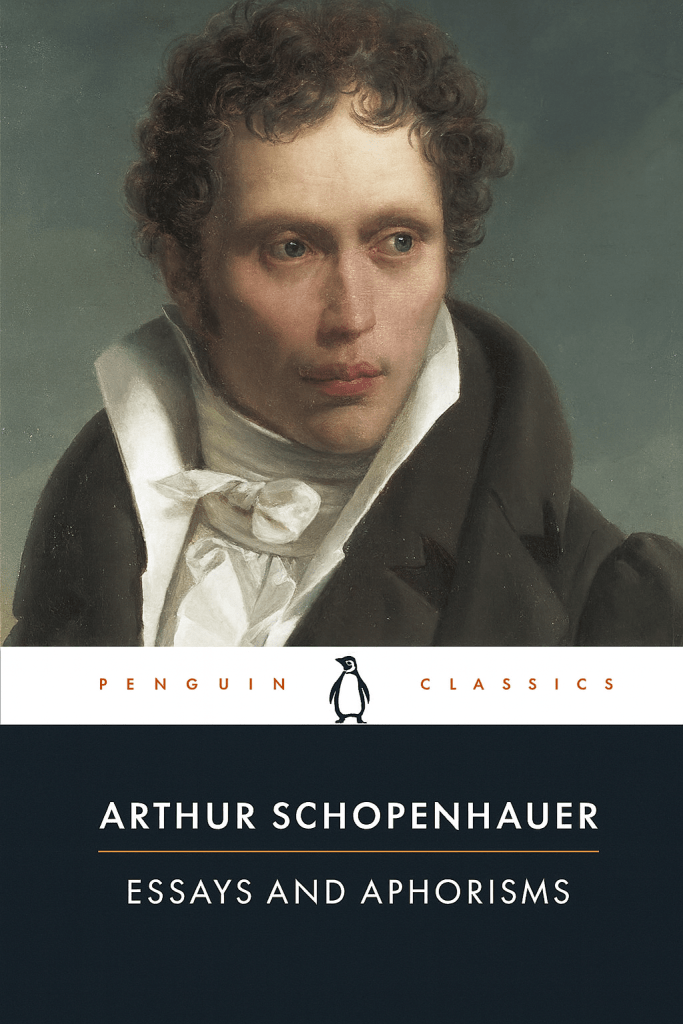
Schopenhauer’s Essays & Aphorisms, gathered here through the historically layered work of Mrs. Rudolf Dircks, R. J. Hollingdale, T. Bailey Saunders, R. B. Haldane and J. Kemp, presents a deliberately fragmentary architecture through which its author prosecutes a continuous metaphysical claim: that the world given in experience is a representation conditioned by intellect, while the real engine of agency—will in the minimal sense of aimless striving—presses through every façade of reason, habit, convention, and piety. The distinctive contribution of this collection, as arranged and voiced in these translations, lies in the way disparate occasional writings—programmatic aperçus, practical maxims, polemical thrusts, and reflective miniatures—mutually amplify one another, congealing into a single argumentative current in which ethics, aesthetics, psychology, and social counsel become instruments for testing and exhibiting a metaphysics of suffering and release, before yielding, finally, to the question of how a thinking life acquires form inside this diagnosis.
The compositional exterior of the volume is unashamedly composite. What the reader encounters is neither a single treatise nor a mechanically excerpted digest, but a curated set drawn principally from the Parerga und Paralipomena and the Aphorismen zur Lebensweisheit. The outer frame is therefore double. On the one hand, there is the declared genre of parerga and aphorisms: appendices and life-wisdoms that presuppose an earlier system but also insinuate themselves as its most accessible frontage. On the other, there is the translatorial polyphony. Hollingdale’s modern clarity, Saunders’s Victorian compactness, Dircks’s idiomatic gravitas, and Haldane & Kemp’s classicizing cadence generate a controlled tremor in the English voice—variation in register that mirrors the author’s own oscillation between austere metaphysical compression and worldly counsel. This doubling does not blur the doctrine. It dramatizes the work’s real procedural stake: a method that allows the same claim—the hegemony of will and the derivative, instrumental place of intellect—to be verified across heterogeneous domains of life.
The essential proposition of the book does not remain a proposition. It is transposed into the experience of reading: a sequence of tests. The text examines whether the canonical predicates by which human life names its dignity—reason, virtue, justice, genius, love, honor, religion, the state—hold independently of the impulses that animate them. The essays repeatedly show that whenever the intellect claims sovereignty, the claim either conceals the sway of motives whose source lies in blind appetition or else marks a rare interval in which the intellect frees itself so decisively from the service of will that it achieves a temporary suspension of striving. Every local thesis is arranged to fall under that larger hypothesis. The rhetoric is plain where the proof is direct (for instance, when the text exposes the why behind social postures, or when it analyzes the dynamics of reading and writing as acts of borrowed thinking versus thinking for oneself), and oblique where the proof is experiential (as in the analyses of aesthetic intuition, compassion, and the ascetic gesture). What emerges is an argumentative itinerary: the author shows that worldly projects culminate in disappointment and vexation, that even happiness resolves into negation of pain rather than positive possession, and that the mind’s highest dignity appears where it most thickly forgets the individual will—first in aesthetic intuition, finally in ethical renunciation.
The movement begins on the plane of culture, authorship, and education. Counsel on style, authorship, and reading is not ancillary ornament. It serves as a laboratory in which ideas about intellect and will can be made experimentally visible. Style that strives for effect exposes the will-to-seem; style that says exactly what it means exhibits an intellect that has turned toward the object. The famous contrast between reading and thinking for oneself aims at more than literary hygiene. Reading transfers the pathway of another’s thought into one’s own mental channels, in which case the will gains the comfort of vicarious fruition without the discipline of discovery; thinking for oneself re-writes the topology of attention, forcing the intellect to bind itself to the object until it yields insight. The book thus treats the most mundane operations—choice of prose rhythm, depth of study, the habit of marginalia—as micro-ethics. Their evidence is immediate: the reader can test, in the very act of reading, whether an argument clarifies the object or seduces the appetite.
A second plane introduces the social world’s currencies—honor, reputation, rank, statecraft—and demonstrates how they reorganize the same economy of motives at a larger scale. The analysis of honor shows that what appears as a pure regard for virtue dissolves into a mechanism of intimidation and conformity, a social contrivance that disciplines self-assertion by threatening exclusion. Government enters as another instrument that manages reciprocal harms rather than a promoter of collective flourishing. The tone here is diagnostic rather than cynical. Laws, reputations, and customs are understood as necessary guardrails within a world whose fundamental movement is collision of wills. They generate a modus vivendi by substituting symbolic satisfactions, delays, and concessions for open warfare, and to that extent they deserve respect. Yet they remain contingent arrangements. Their measure is prudential. Their dignity is functional. They cannot redeem existence, which is to say, they cannot transfigure a structure grounded in lack.
The next plane radicalizes the inquiry by turning to suffering. The essays devoted to the misery of life, the vanity of existence, and the futility of hoping for stable satisfaction do not trade in theatrical gloom. They are demonstrations. The logical structure is unembellished. Desire sets an object before the subject as promise; this promise, once attained, collapses into satiety and boredom; boredom, in turn, renews desire by positing a new promise; where desire is thwarted, suffering intensifies, and where it is fulfilled, new forms of suffering arise through emptiness, comparison, or fear of loss. The equilibrium that human agency imagines as happiness proves evanescent because the field in which happiness is sought is generated by an impulse that cannot find closure in any determinate object. The text anchors this in pictures of daily life—envy in the neighborhood, the quick fatigue of games and fêtes, the restlessness of those who have too much leisure—and in observations about work as a prophylactic against misery rather than a path to beatitude. The argument takes a further step when the author remarks that what the mind calls “the value of life” is usually a retrospective license the will gives itself to continue, rather than a measured sum of intrinsic goods. Pain, deprivation, and fear enjoy ontological precedence over fleeting cheer; relief from evil is intelligible in a way the possession of positive happiness is not.
These considerations prepare the metaphysical center. The intellect is adaptive equipment grown in the service of the will’s survival. Representation is a useful mirror in which the will can learn the configuration of obstacles and means. The intellect’s instruments—causal inference, discursive generalization, memory—are all calibrated to advance and protect the organism’s projects. When these instruments pretend to legislate ends, the pretense collapses under analysis; what they legislate are better tactics. Against this, the book proposes a twofold dignity for the intellect. The first is aesthetic. In the experience of beauty, the mind quits the practical posture and allows the represented object to absorb it so completely that the subject becomes a transparent medium through which the form of the thing shines. The claims are carefully bounded. Aesthetic intuition does not abolish the will. It suspends its grip. It installs a sabbath in which the urgency to own or change the object gives way to the calm of seeing what it is. The author’s descriptions of art, landscape, music, and the genius who is “entranced by the object” are evidential episodes rather than theses. They point to a phenomenology of disinterestedness, one the reader can verify by recollecting moments when the world was experienced without need to touch or compare.
The second dignity is ethical. If aesthetic intuition arrests striving without terminating it, compassion breaks the hermetic circle of the individual will and acknowledges the foreign suffering as inwardly felt. Compassion is not an inference. It is a shock of recognition: the same aimless drive that gnaws at me gnaws at the other. From this recognition grows an ethic that regards injury as self-injury at a deeper level and therefore restrains the hand. Here the book’s method shifts. Where earlier it tests claims through quotidian observation, here it offers an inner criterion. The reader is asked to consider acts in which the ego’s profit plainly diminishes and to notice that the content of those acts—the reduction of harm, the refusal of cruelty—evinces a logic foreign to calculation. At the limit, compassion shades into ascetic negation, an attitude in which the individual will chooses to weaken its hold on the world’s lures. The argumentative line is cumulative: practical prudence organizes life to avoid needless suffering; aesthetic attention detaches the intellect from instrumentality; compassion installs a solidarity that quickens in the sight of pain; asceticism radicalizes compassion into a refusal to reproduce the structure that generates pain.
Between these climactic dignities and the grim account of common life moves a series of essays whose showpieces—the treatises on love, on women, on genius and madness, on noise and on reading—return obsessively to the same problem of motive and appearance. The celebrated analysis of sexual love discloses how a set of intensely rationalized fictions—destiny, complementarity, spiritual union—mask an essentially species-directed impulse. The essay does not dismiss tenderness or companionship; it insists that their heat and insistence draw their energy from a project that outruns the lovers: reproduction of the type as a natural aim whose means are psychology’s idealizations. The claim is textually secured where the author tracks the disproportion between the immense pathos lovers attribute to their desires and the often pedestrian realities of life together after the spell has dissolved. The further claim—that intelligence serves the genus by plotting the best match for the next specimen—belongs to the same line; yet the suggestion that idealization arises as a ruse of the species, while internally coherent, remains inferential in the absence of empirical corroboration beyond the plausibility of the pattern.
The essays on women are entangled with their time and bear the stamp of contemporary prejudice. Their argumentative function in the book, however, is symptomatic rather than legislative. The text uses a generalization—about care for the immediate, about instinct over abstraction—to dramatize a polemic about intellect’s tasks and limits. Where it posits an “eternal feminine” of prudential intelligence and present-centered evaluation, the demonstration is thin; the best one can say is that in passages where the author isolates concrete motifs—how economic security structures marital strategy, how social dependence produces practiced forms of dissimulation—the observations function as a sociology of constraint. Readers alert to the asymmetries of education, property, and law will register that many universal claims here in fact measure institutions. It is therefore prudent to distinguish the secured descriptive detail—about courtship economies and the uses of beauty as social capital—from the broad anthropology the essay would derive from it; the latter is inferential, produced under the shadow of contingent norms.
By contrast, the analyses of intellectual life—on authorship, the noise of cities, the discipline of solitude—display evidence continuously available to the reader’s own experience. The polemic against noise is not a refined complaint. It exhibits how attention is a fragile instrument that requires negative conditions to reach the object. The picture is that of an intellect that must wean itself from reactive habit if it is to reach insight. Sudden interruptions, mechanical rhythms, and the built environment of distraction remind the author that thought is an accomplishment, always threatened by the body’s demands and the world’s proximate stimuli. These pages interact tightly with the counsel on reading and writing. A mind trained on robust objects—problems chosen for their intrinsic power rather than their promise of social reward—gains resistance to distraction; a mind formed by easy digest and prestige-books remains available to any passing signal. The method of these essays is self-validating: the reader can test the thesis by creating the conditions the text prescribes and noticing the difference in thought’s traction on its object.
The domain of art and genius receives an anatomy governed by the same rule. Genius is not a permanent quality but an occasional overpowering of the practical will in favor of the object, a capacity for the object to impress itself with such force that the usual self-concern falls away. Genius and madness are neighbors because both break the continuity of practical orientation, but in opposite ways. In genius, the intellect stays lucid while practical aims grow silent; in madness, the intellect’s connection to the object deteriorates while practical aims erupt in ungoverned projects or incoherent affect. The book’s evidence here is exemplary description rather than proof: depictions of the artist captured by the landscape, the philosopher whose abstraction keeps faith with the nearest, smallest fact, the scientist compelled by the form of a law rather than by honors. The measure remains the same: how far has the willing individual withdrawn to allow the object to appear?
The analyses of honor and reputation, of pride and vanity, continue the sifting of motives with particular subtlety. Honor is revealed as an externalized conscience, a projection of the community’s threats and promises that the individual internalizes as a second nature. Reputation, while psychologically potent, purchases compliance at the price of truth, since it rewards performance rather than substance. Pride clings to an imaginary self-valuation that cannot become knowledge because it refuses evidence; vanity, which oscillates between self-inflation and self-contempt, remains dependent on others’ glances. The counsel that follows is severe and humane. One should arrange one’s life such that the ratio between effort and satisfaction is governed by the things that cannot easily be taken away—clarity of thought, durable habits, cultivated interests, a small circle of sincere attachments—and one should learn to decline reputational temptations that subject peace of mind to the theater of status.
Here the Aphorisms on the Wisdom of Life interpose their constructive program. They do not promise happiness. They teach economy. Their distinctions—between what one is (character, intellectual and moral equipment), what one has (property and income), and how one is regarded (reputation, honor)—sort the field of possible goods according to their resistance to fortune and their contribution to equanimity. The book treats the first as most decisive. The grounds are palpable. What one is determines the meaning of what one has and of how one is seen. Wealth without character decays into restlessness. Reputation without inner ballast coerces. The aphorisms argue that moderation of desires, orderly daily routines, engagement with objects that do not exhaust themselves in consumption, friendship disciplined by frankness, and deliberate solitude form a strategy by which life becomes bearable, and sometimes quietly content. The tone is practical without utilitarian bravado. The point is relief from pains rather than conquest of pleasures. The test is the quality of one’s weekdays. To the extent that these pages follow a doctrine, it is that genuine advantage emerges where comparison ceases, and that comparison ceases where one’s pursuits become autotelic.
At several junctures the book allows its polemical edge to sharpen against institutions—religions, universities, governments—that pretend to cure misery by distributing grand explanations or conferring public dignity. The critique of religion does not trouble itself with doctrinal rebuttals. It asks what desires sustain belief and what effects belief produces. Fear, hope, resentment, and the need for guardianship crowd the stage. Where religion consoles, it does so by promising a landscape in which will finally comes to rest; where it governs, it tends to stabilize hierarchies that serve existing power. Yet even here the analysis grants a functional concession. To the degree that religion restrains cruelty and induces mutual assistance through imagination of surveillance and judgment, it acts as a moral pedagogue for imperfect creatures. The university receives a related verdict. It manufactures learnedness, credentialing, and party formation rather than thought. It rewards commentary on commentary, system preservation, and polite heresies that confirm the dignity of the guild. Against these economies, the book proposes the older ideal of the solitary thinker bound to problems, indebted to predecessors for tools rather than conclusions, and ready to discard career when the object requires an unfashionable method.
The strong negative account of public pieties finds its existential counterbalance in the text’s defense of quiet pleasures: landscape walking; music as the most direct art of the will’s rhythm; the companionship of animals; the integrity of a well-furnished study; the relief of silence; the dignity of chosen poverty over anxious plenty; the happiness of work done for its own form. These are not private comforts inserted to soften a system. They are the proofs that the intellect, when freed from status-competition and appetite’s fever, discovers a world that can be borne and sometimes loved. The recommendation of travel—alone, slowly, with the eyes open to form and custom—exhibits the same pattern: the mind meets variety without demand to own it. Even the small counsel about health, diet, and sleep reinforces the metaphysical argument. The intellect shines when the body is gently husbanded rather than whipped into displays. A mind that cannot sleep cannot think; a life given to excessive stimulation dissolves attention into irritation. The text’s minimal hedonism is a grammar of care in a world where grand satisfactions collapse.
A particularly intricate thread winds through the discussions of character, responsibility, and freedom. The book holds character to be given and constant. Education and habit reveal it; they do not manufacture it. The claim seems to threaten responsibility. The text answers by relocating responsibility from the fictive freedom to choose one’s essence to the concrete freedom to choose one’s acts in knowledge of one’s essence. The will’s inner form—the proneness to envy or generosity, the swiftness to anger or slowness to offense, the appetite for order or taste for risk—does not excuse what it does. It determines the field of likely temptations. The intellect, as the capacity to foresee consequences and to grasp the universality in a case, provides leverage over impulse. This leverage never perfects us; it can orient and restrain. On this view, punishment protects and deters; it does not redeem. Praise acknowledges and encourages; it does not create. The philosophical advantage of this austere stance lies in its immunity to moral melodrama. It neither demonizes nor romanticizes agents. It bids us work with the instruments really available: foresight, structure, honest appraisal of one’s type, and—when the occasion arises—the asymmetrical force of an insight that shifts a life’s vector.
The book’s most acerbic pages on society and its entertainments appear less as a curmudgeon’s outburst than as a methodological necessity. If the world’s ordinary consolations—wealth displays, fashionable company, the pursued noise of novelty—do little more than quiet the will by occupying it, then the philosophically serious person, whatever her temperament, must learn the skill of subtraction. A field of fewer inputs is not an ascetic fetish in these pages. It is the precondition for testing whether the mind can find a rhythm independent of the market’s signal. The invectives against clatter and bustle sketch the negative image of attention: what it needs to exist, how easily it is dissolved, and how quickly it becomes impatient with itself when deprived of external amusements. The result is not withdrawal for its own sake. It is the capacity to return to the world’s ordinary intercourse without becoming its captive.
This collection’s inner architecture places the Aphorisms on the Wisdom of Life so that they speak both backward and forward. Read backward, they translate the metaphysics of the will into daily economy: choose pursuits whose satisfactions do not depend on volatile comparison; steward your health; economize your social bonds; read slowly; write only when you must; guard long unbroken hours; prefer the companionship of a few rare souls to the applause of the many. Read forward, they become stepping-stones to the more paradoxical claims at the end of the argumentative arc: that the highest ethical posture approaches renunciation, that the most intense seeing quiets the will, and that the noblest art sings of the world’s form without stirring desire. The editorial weave of the volume heightens this arc by letting counsel and critique alternate: practical maxims distill and domesticate the system, then polemics tear away any remaining illusions that clever arrangement could abolish mortal hurt.
From within the text one discerns a quiet theory of method. The essays do not seek a dialectical deduction of ethical life from first principles. They prefer an inductive procedure whose hypotheses are metaphysical but whose verifications are phenomenological. Observe repeated disappointments and ask what structure of desire generates them. Observe the peace that descends in the presence of a mountain and ask what change of mental posture allows the object to rule consciousness. Observe the mixture of cruelty and mutual aid in ordinary life and ask what motive, if any, breaks the circle of self-assertion. The procedure yields a two-storey picture. Below, a physiology of striving; above, fragile storeys of attention, compassion, art, and restraint. The work repeatedly tests whether the upper storey can carry the lower’s weight. Its answer is non-utopian. The lower storey remains load-bearing. The upper bears only itself. That modesty is the collection’s moral seriousness.
The translators’ presence matters for method as well. Hollingdale’s straightforwardness underwrites the polemical clarity of the cultural essays; Saunders’s turn of phrase lends sap to the maxims; Haldane and Kemp give the metaphysical villages a classical map; Dircks’s idiom allows a certain 19th-century compression to survive. The different Englishes do not fracture the argument. They distribute its emphases. Where the English grows bracingly plain, the reader feels the bite of counsel. Where it grows more formal, one hears the architecture of the underlying system. Since the book’s claim is that philosophical truth must be felt in the temper of life, this distribution of voices is an advantage. It keeps the reading mind moving between clarity and weight, between a modern appetite for economy and an older patience for abstraction.
One can reconstruct from the sequence of topics a composition-history that supports the work’s interior logic. The earliest stratum consists of counsels and literary essays: On Authorship and Style, On Reading and Books, and their kin. These pieces define the habits that make thinking possible. The next stratum, which includes the essays on honor, government, noise, and the vanity of existence, widens the lens to common life and its structures. A third stratum, reaching into the Aphorisms on the Wisdom of Life, distills the art of living under conditions the metaphysics has demystified. A final stratum, threaded through discussions of compassion, denial of the will, and aesthetic experience, gathers the philosophical horizon toward which the earlier strata tend. This is less a chronology than a logic of increasing depth: from the apprenticeship of attention, through the sociology of striving, to the metaphysics of relief. The outer framing of this translated collection respects that logic by allowing the reader to pass through recognizable practical topics into more demanding meditations without abruptness.
Two tensions animate the whole. First, the tension between diagnosis and prescription. The book names a structure of experience in which suffering is native and in which happiness appears chiefly as relief from suffering; yet it also prescribes a regimen—habits of mind and body, friendships, arts, hours of solitude—by which life acquires form and even grace. The reconciliation lies in the measure: prescriptions never claim to transform the structure; they promise lucidity and a more intelligent distribution of attention within it. Second, the tension between the intellect’s servility to will and the intellect’s capacity for release. The text insists on both intelligence’s origin in appetite and its vocation for de-instrumentalized seeing. It resolves the tension by refusing a theory of intellect that would make it a second independent power. The intellect is will’s offspring that can revolt, temporarily, against the parent—never by force, always by a change in object-relationship. Aesthetic absorption and compassion are precisely such changes.
It would be easy to caricature the book as pessimism disciplined into aphorism. The book makes a more difficult demand. It asks the reader to evaluate, by personal experiment, whether the goods ordinarily praised—love’s transports, social distinction, wealth, fame—truly yield stable satisfaction, and whether humble goods—clarity of thought, musical absorption, a walk alone, a clean page, an honest friend—truly stabilize the inner weather. It asks the reader to entertain without resentment the possibility that life’s best states are negative goods (peace, relief, the cessation of a great noise) and then to test whether “negative” here names an absence or a distinct kind of fullness. It asks the reader to examine whether one’s best deeds were motivated by calculus or by something that felt like a recognition of the other as inwardly the same. It invites the reader to notice what concentration requires and to guard those requirements with a cheerful severity.
From within the text, several claims are textually secured. The description of the desire–satiety–boredom cycle and its consequences is grounded in a thick phenomenology of common life; the priority accorded to what one is over what one has and how one is regarded is argued across many aphorisms with cascading examples whose force is cumulative; the characterizations of reading versus thinking for oneself, and of style that serves the object versus style that serves vanity, are supported by sustained interior analysis; the phenomenological essays on aesthetic absorption offer experiential warrants that invite immediate verification. Other claims, while coherent within the system, are inferential: the species-teleology proposed in the account of sexual love extends a metaphysical picture into an empirical domain in which available evidence is suggestive rather than decisive; the anthropology implicit in the essays on women generalizes from cultural arrangements that the text itself shows to be contingent; the theory of character’s immutability, though powerfully argued, relies on an essentialism that the book defends chiefly by appeal to constancy of temperament and the limited success of moral education.
The closing movement of this collection leaves the reader with a clarified topography rather than a final command. At the center lies a metaphysical portrait of existence as striving; around it stand practices that tame and sometimes suspend the inward pressure: simplicity of life, concentration of attention, aesthetic absorption, generosity that forgets itself, quiet forms of piety that do not ask the world to become something it cannot be. The recommendation is measured renunciation, a life whose care for health, study, work, and affection is itself a kind of art. The style in which this emerges—short, exact statements punctuated by longer excursions—enacts the doctrine it propounds: concentrate, withdraw, return, and articulate what you have seen in sentences that leave the object standing.
If one asks finally what this collection contributes that a summary of the system would not, the answer lies in its evidentiary density. The system is here lived in prose. The same theses recur in different guises because they are tested in different theaters: a library, a salon, a city street, a mountain path, an orchestra, a sickbed, a lover’s quarrel, a desk at dawn. The translators’ uneven yet convergent voices let the single doctrine sound against multiple timbres; the arrangement lets counsel educate critique and critique purify counsel. What remains with the careful reader is neither resignation nor glee but a new scale for measuring matters of life and thought, and a more exacting sense of what a mind can responsibly seek: clarity where clarity is possible, kindness where it breaks the circle of harm, attention where a reality deserves to be seen, and a quiet courage in the face of a world that does not owe us joy.
DOWNLOAD: (.epub)
 Simon Gros
Leave a comment