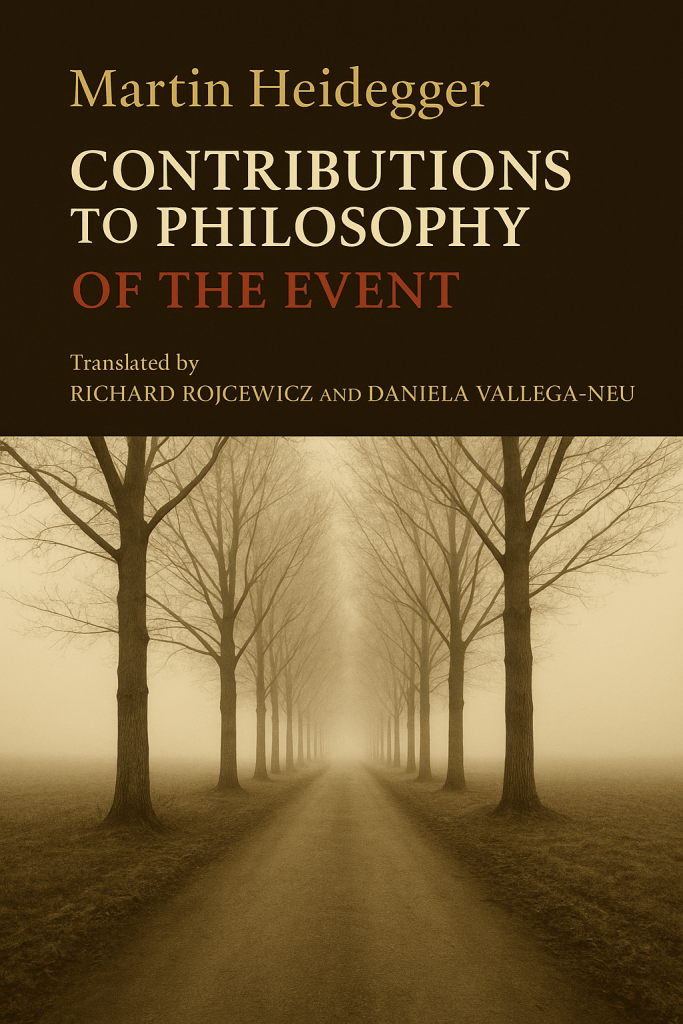
This work stands at the turbulent crossroads of Martin Heidegger’s philosophical “turning,” composed in a hidden stretch of years when he sought anew the question of what it means for being to happen as event rather than to endure as a fixed entity. In the intensity of these private meditations, which were once never intended for any audience beyond himself, Heidegger wrestles with the paradoxes of how truth both reveals and conceals, how the gods may simultaneously preside over absences and presences, and how history can be experienced as the unfolding and withholding of something more primordial than simply the totality of beings at hand. He conjoins a persistent reflection on the dizzying heights of Western metaphysics—where being has long been interpreted in relation to constant presence, objectivity, and intelligibility—with a radical gesture that seeks to leap beyond that tradition, so that being might come into focus as an elusive, self-withdrawing gift that both needs the human being and uproots it.
Heidegger’s text is anything but linear exposition. It carries readers through a series of jolting questions, austere aphorisms, and cryptic incantations, challenging in its resistance to conventional argument, yet astonishing in the vistas it opens for those patient enough to linger in its resonating words. The private nature of its composition leaves in place the raw immediacy of Heidegger’s thinking, where he returns time and again to the motif of an event (Ereignis) that must not be understood merely as an incident in time but as the originary co-belonging of being, truth, and the human being’s capacity to ground that truth. In this event, Heidegger sees the human being refigured out of its habitual stance as “rational animal,” out of mere subjectivity, and into the one who can become the site of being’s clearing—a ground that is no ground in any conventional sense but an abyss of self-concealment and refusal, from which beings emerge and withdraw.
The text thus draws close to the edge of speech. It continually dislodges the reader’s reliance on familiar concepts, so that the question of what it is to be—indeed, of what “to be” might even mean—undergoes a fateful shift. Over and again, Heidegger insists that metaphysics, understood as the traditional inquiry into the beingness of beings, cannot sufficiently challenge itself to think how being eventuates in concealment, or how truth necessarily entails self-withholding. Written between 1936 and 1938—called “the dark years” by some interpreters—this composition both bears the heavy atmosphere of its historical context and transforms it into a philosophical impetus by way of confronting the abandonment by being. In these pages, the “darkness” is not mere gloom; it is the half-lit region in which one can sense the trembling of reality itself, where history harbors a hidden strife between earth and world, between emergence and refusal, and between the fleeting illusions of complete mastery and the more disquieting path opened by the gods’ absence and advent.
To read these Contributions (Of the Event) is to witness how Heidegger, already known for his boldness in Being and Time, now undergoes an even more radical rethinking. The text calls into question the entire sequence of Western philosophy from the ancient Greek inception of metaphysics to the pronouncements of modern technology and the frantic restlessness of what Heidegger calls the “gigantic.” It exposes the deep threads that tie our civilization to calculative thinking, ceaseless machination, and the longing for total explanatory dominance, all of which risk obliterating the fundamental sense of awe at the sheer strangeness of being. It equally urges a new “history of being” that refuses to remain trapped in what came before and yet does not simply destroy or ignore the paths blazed in the tradition. Rather, it seeks to encounter that tradition from an uncanny angle, pushing beyond the guiding question—“What are beings?”—and into the question of the truth of being, namely how being can be experienced as event, as a demanding call that requires human receptivity in order to appear at all.
This translation by Richard Rojcewicz and Daniela Vallega-Neu is itself a remarkable achievement that has helped countless readers penetrate Heidegger’s often overwhelming expressions. Where earlier renderings risked overburdening the text with opaque jargon or confounding complexities, this version clarifies without diluting. Careful decisions about how to convey words like Ereignis (event), Da-sein (the site for the truth of being), and Seyn (Heidegger’s distinction from ordinary “being”) enable a surer grasp of this challenging itinerary. The translators’ labor invites a more meditative reading, so that one can return to passages, turning them over slowly in thought, and perhaps approach them even “out of order,” or in the middle, as some readers suggest, letting one’s attention be guided by the pull of certain phrases or lines of thought.
Several who have grappled with this volume have testified to its exceptional difficulty, noting that it took Heidegger’s own brand of meditative reflection to wrest free from the default values of a civilization that may be “star-crossed.” Yet these same readers speak of an existential urgency within these pages, an unsettling confrontation with what it means for us to be, for a society to cling to or to forgo the gods, and for each of us individually to live out the question of what meaning or aim can be found in mortal existence. The text functions at times like an “extended koan,” occupying the same paradoxical, near-poetic realm one might associate with Eastern meditative disciplines that teach, not by explanation, but by intensifying the crisis of understanding so that a new glimpse of clarity might break through. In that sense, it draws Western thought toward an Occidental “dharma,” summoning stillness, silence, and humility so that the event of being may be glimpsed, however faintly, in the spaces where the usual structures of knowledge fall away.
Other readers point out the inexhaustible creativity and near-hysteria in Heidegger’s attempts to name that which by its nature eludes all naming. They note the shocking repetitiveness of his words and the strange manner in which he moves from reflection to reflection, putting forward a “history of being” that ultimately demands a rethinking of Kant, a reinterpretation of Plato, and a confrontation with Nietzsche’s attempt to invert Platonism. One finds in the text the outlines of themes that color Heidegger’s later writings—his talk of the fourfold, the strife of earth and world, the necessity of the flight of the gods—all emerging here in a climate of experimental thinking. The text thereby unites some of Heidegger’s darkest pages, where he forcefully highlights the plight of a humanity that cannot grasp the essential, with the most luminous pages, where he ventures an outlook on being as an intimate yet fathomless event, pregnant with transformative potential for those who can endure its shock.
Because Contributions is so unorthodox in structure—nonlinear, sprinkled with fragmented observations, elliptical leaps, and radical new terminology—it redefines what philosophy might look like. The standard demand for a neat chain of arguments is deliberately subverted. Instead, the pages bristle with an internal logic of “leaps” that reflect Heidegger’s conviction that the truth of being cannot be reduced to formal demonstration. He believed that only a slow, “step-back” thinking can approach being in its historicality, its swirling interplay between epochs of oblivion and rare bursts of insight. The later Heidegger’s convictions, so famously prefigured in Being and Time, are here carried to a limit beyond which they become nearly unrecognizable to ordinary discursive habits.
This new edition foregrounds that limit while easing access to it. The translators balance uncompromising fidelity to the original German’s often awkward grammar and archaic overtones with straightforward clarity, bringing out how Heidegger’s language, though cryptic, remains a striving toward the clearing of a new beginning. Readers who once felt it was “impossible” to track the movement of the text now discover a vantage point from which to sense its inner rhythm. Even so, one must read these passages in a mode distinct from hurried scanning. As some have remarked, opening the book in the middle or at random, lingering over whichever thoughts speak at that moment, might yield unexpected glimpses of the entire question of being and event.
Although the text is profoundly shaped by the complex moral and historical structure of the author’s era, its philosophical impetus towers above the merely personal. It carries a universal urgency that compels us to ask whether our own age, given to the machinery of technological manipulation, can bring itself back to wonder at the fact that there is something rather than nothing—back to that simple astonishment at the enigma of being. Yet Heidegger is not simply turning from technology to romantic nostalgia; he suggests, instead, that technology is itself a manifestation of the same forgottenness of being that might carry a hidden potential for a second beginning, if only it were engaged at a sufficiently primal level.
Thus, Contributions to Philosophy (Of the Event) is a book whose subtlety both demands and resists quick understanding. Its sentences often feel charged with a stillness that belongs not to straightforward explanation, but to a waiting for what cannot be forced. It exhorts those few who can muster courage to enter solitude and genuinely question, making no pretense to universal accessibility. Indeed, many have observed that only the few will truly read it as it was meant to be read: as a path—or better, a set of paths—through the illusions of metaphysics, toward an experience of beyng that arises in a deeper region of our being than conventional rationality allows. At the same time, it neither commands nor preaches, for it breaks with the entire tradition of philosophies that position themselves as doctrines. Instead, it composes an invitation to step into the clearing where something ineffable might shimmer forth: that stillness in which the last god may pass by, an advent that displaces our worn-out categories of belief and unbelief.
In all these respects, this text remains among the most formidable monuments of twentieth-century thought. Some call it the transitional bridge from Heidegger’s earliest landmarks to his later meditations; others find here the unrepeatable core from which his later writings merely echo. However one assesses it, the book is indeed indispensable for confronting the question of being as Heidegger reimagines it. It is a text that should be approached with discipline, care, and an expectation of being dislodged from one’s comfortable frames of reference. The tension between clarity and enigma reverberates in every line, but it stands among the most profound testaments to the seriousness and wonder that can belong to philosophical reflection. To consult these pages is to roam in the realm of an irreducible question, one in which the question itself may shatter our everyday complacencies and unleash, at least for an elusive moment, a transformative insight into the event of being—the unthinkable heart of Heidegger’s unique and challenging Contributions to Philosophy (Of the Event).
 Simon Gros
Leave a comment