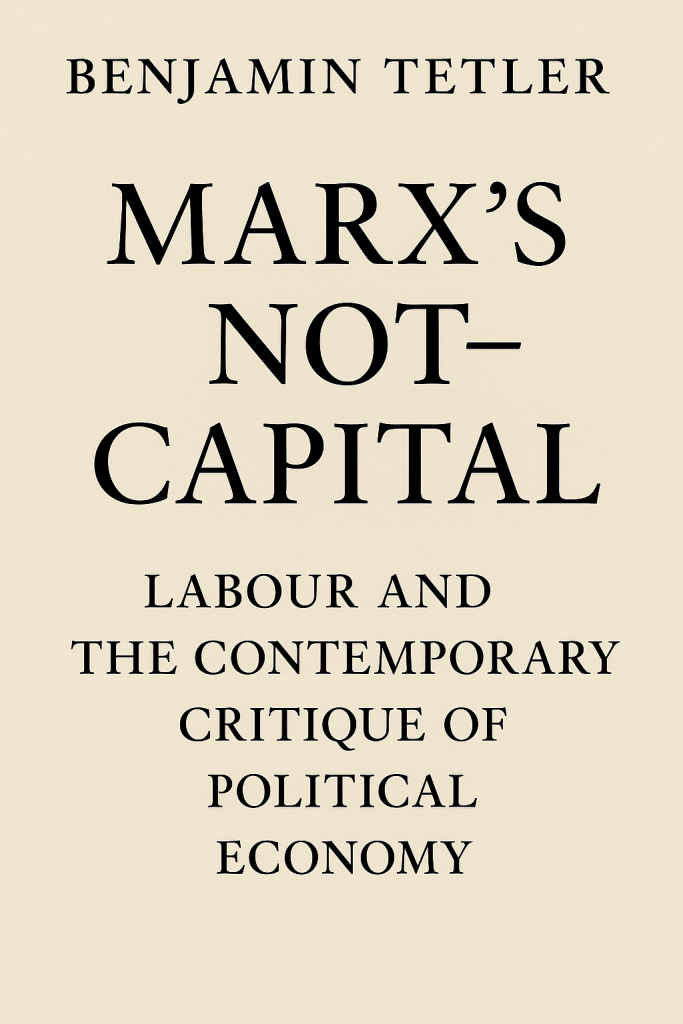
Benjamin Tetler’s Marx’s Not-Capital: Labour and the Contemporary Critique of Political Economy stakes a precise claim within Marx scholarship: the recovery, systematization, and methodological testing of Marx’s scattered determinations of labour as not-capital and value as not-value, drawn from the preparatory manuscripts to Capital, in order to reorient critique away from the affirmation of labour and toward the abolition of the labour-form itself. Its distinctive contribution lies in showing, with close textual argument and a stringent conceptual economy, that labour functions in Marx as a historically specific negativity immanent to capital’s social form rather than as an external substance awaiting emancipation. By tracking how this negativity is constituted, operationalized, and displaced across Marx’s manuscripts, Tetler transforms debates over value, fetishism, and class into a single question of mediation: what it would mean for labour to be nothing more and nothing less than capital’s own non-identity.
Tetler’s point of departure is the sobering constancy of modern labour’s compulsion and its naked precariousness. The social world still labours, and the universality of labour as a practical necessity persists, yet it persists as a necessity whose form is determined by capital’s needs rather than by any free collective end. That observation is not offered as a moral lament or political exhortation, but as an index of objectivity: a way of registering the enduring dominance of abstract, impersonal compulsion—the rule of value—over the patterns of social reproduction. The book’s outer frame is therefore avowedly critical rather than ameliorative; it is a work about the logic of domination before it is about any strategy of its overcoming. The methodological insistence is clear: to describe domination one must not hypostatize the terms it imposes. Labour cannot be praised as the surviving kernel of human essence if its very modern form is the effect of a historically determinate social mediation. In this sense, the opening pages state the problem without consolation: the more ubiquitous labour appears, the more scrupulous one must be about the form of its ubiquity.
What Tetler calls the outer framing of the project is simple to state and difficult to execute: reconstruct Marx’s argument from the manuscripts that lead into Capital—the Grundrisse, the Urtext (sometimes called the “Original Text” for the first book of Capital), and the 1861–63 Manuscripts—so as to determine what, in Marx’s own presentation, licenses speaking of labour as not-capital and value as not-value. The promise is that such reconstruction will dissolve two false alternatives: first, the naturalization of labour as a transhistorical principle of wealth; second, the symmetrical celebration of labour as an always already antagonistic counter-power. Tetler proposes that Marx’s own writing offers the means to avoid both. The crucial determinations are explicitly textual where Marx states them; the larger systematic picture that renders them mutually implicative is developed by Tetler inferentially, by testing how these determinations function when placed within the dialectic of value-form, money, and capital.
The book opens its interior argument with a minimal maxim: a critique of political economy that wishes to be immanent must not import a standpoint external to the categories it examines. This methodological maxim is not merely a meta-theoretical preface; it acts as the rule of exposition. To examine labour under capital is to examine labour as a category that exists for capital, as the use-value of capital and the bearer of a specific negativity. Tetler insists that a sober reading of Marx refuses the invitation to jump from the empirical ubiquity of toil to an ontological apotheosis of labour. Where labour appears as the privileged site of truth, it is already misrecognized; where it appears as a pure outside, it is already abstracted from the very relation that gives it social force. The reader is repeatedly returned to the same fulcrum: labour is neither natural principle nor metaphysical residue, but a social form-determination whose universality, under capitalism, expresses the universality of commodity mediation. This is the book’s first claim, and it is textually secured by the moments in Marx where labour is explicitly grasped as the use-value of capital and as the latter’s Gegenstandslosigkeit—its non-identity that capital itself produces and presupposes.
From this maxim Tetler builds a slow demonstration, conducted almost entirely within the manuscripts. The Grundrisse supplies the decisive cue. Marx, probing the conditions under which capital can treat labour as its living complement, allows himself a language of negativity: labour appears as not-capital—as that moment which, though indispensable to capital’s self-expansion, has not yet been subsumed into capital’s completed form. Tetler does not inflate these remarks into a doctrine; he treats them as functional determinations inside a moving argument. The textual evidence is secure wherever Marx explicitly marks labour as capital’s otherness, the moment in which capital confronts its own necessary dependence on an activity it does not fully contain. But Tetler is careful: Marx’s not-capital determinations in the Grundrisse are not romantic privileges; they mark a structurally necessary difference that capital incessantly labours to abolish in order to reproduce it anew. Thus the not in not-capital is not an ethical sign; it is a logical sign of mediation. That is why Tetler treats the notion as methodologically priceless: it both insists on difference and refuses the leap to an ontological counter-pole.
Once this negative determination is in view, Tetler calibrates it against Marx’s most forbidding object—the value-form itself. Here the argument becomes more intricate. Value, as Marx will show in the published Capital, is a social determination of labour, and abstract labour names the social reduction that makes unlike labours commensurable through exchange. In the manuscripts this argument is rehearsed and re-worked; Tetler traces these rehearsals not as philological curiosities but as the very stages in which the possibility of not-value becomes thinkable. If value is the impersonal form in which labour’s sociality is constituted by exchange, then not-value cannot mean a different measure or an alternative standard; it can only indicate the practical suspension of the form that makes value what it is. The textual warrant for not-value is less programmatic than the not-capital determinations, but Tetler shows that Marx’s persistent distinction between the material side of production and its specifically capitalist form authorizes, with care, such a negative use. The inference is transparent: whenever Marx speaks of wealth that is not mediated as value, he is furnishing a conceptual index for not-value. It is an index, not a blueprint.
From there the book advances a second major claim: the fetish-analysis in Marx does not merely unmask misrecognition, it diagnoses a practical inversion whereby social relations take on the character of things because, at their core, they are mediated by an abstract, impersonal equivalence. For Tetler, this analysis is not a detachable appendix to the theory of value; it is the very condition for the later determinations to cohere. If labour is capital’s use-value, and if value is the impersonal form in which labour’s sociality is established under capital, then fetishism names the inevitable self-presentation of this sociality to those who enact it. There is no vantage point from which labour could be seen, under present conditions, as simple immediacy. The strict neutrality of Tetler’s exposition contributes to the book’s force: he does not require one to agree with any political attitude toward labour; he requires only that one follow the conceptual trail from the form of value to the appearance of social power. The conclusion is plain. Any direct affirmation of labour, qua labour, will be a displaced affirmation of the very social mediation that requires critique. This is not a polemical flourish; it is the mechanical consequence of the categories.
At this juncture the study revisits a familiar divide in Marxist discourse only to unwind it meticulously. On one side stands the tradition that secures labour as the ontological source of wealth and therefore as the site of emancipation; on the other stands the tradition that treats labour as the restless foe of capital, the motor of antagonism. Tetler’s tactical choice is to grant both traditions their strongest versions and then to ask what becomes of their claims once the not in not-capital is taken literally. If labour is the not-capital that capital presupposes and constantly produces, then the autonomy of labour is structurally mediated by capital’s own process; and if labour is the substance of value only under specifically capitalist conditions, then its exaltation as an eternal measure is methodologically illicit. The textually secured pieces—Marx’s formulations of labour as capital’s use-value, as capital’s living opposite, as the moment of non-identity—do not imply a metaphysical labour-subject. They imply a dependence relation shot through with negativity. Tetler’s own inference is disciplined: antagonism does not entail ontological independence; it entails the potential generalization of a practical negation if and when the social forms that sustain the antagonism become practically superfluous.
The 1861–63 Manuscripts sharpen this picture. Their convoluted engagement with the classical political economists brings a recurring emphasis into focus: the categories of labour, value, and capital must be comprehended as social forms and not as transhistorical determinations. Tetler uses these pages to illuminate a deeper methodological claim: the very operation of critique is internal differentiation, not external opposition. Where the classical economists treat labour as a natural measure, Marx treats it as a historically determinate abstraction; where they treat capital as accumulated tools, Marx treats it as a social relation that commands labour through the mediation of value. The not-capital determination thus acquires a determinate content: labour is the not-capital inasmuch as it is the living activity that capital must subsume and ceaselessly re-produce as its own otherness. In other words, the not-capital is the negative pole of a relation that capital itself organizes. Tetler is emphatic that Marx provides textual support for this view: the passages where Marx says that capital and labour only exist as elements of a social totality in which each presupposes the other are numerous and unequivocal. What the book adds is the insistence that the not-capital designation functions as a reminder that this presupposition is antagonistic and historically specific, not ontological or eternal.
It is in the book’s extended middle—its most intricate sequence—that Tetler tests the robustness of this reconstruction against systematic dialectic and value-form theory. Without laboring a literature review, he treats reconstructions of Marx’s logic as proposals about the order in which determinations must appear if the concept is to present itself adequately. He affirms the crucial lesson that negativity is not a rhetorical surplus but the very motor of the exposition: every category must disclose the non-identity that both grounds it and compels its transformation. Within that setting, the risk of smuggling affirmative labour back in becomes a recurrent temptation. Tetler identifies those moments where reconstructions, precisely in order to show negativity’s priority, end up granting labour a quasi-transcendental role. The corrective he proposes is to let Marx’s explicit not-capital markers do their work: they prevent labour from functioning as a last ground. Method’s integrity is protected by preserving labour’s status as internal limit, not as condition of possibility in any stronger sense.
The inferential strength of the book is most apparent where it re-situates value-substance talk. Abstract labour, in Marx, names the social reduction required by exchange; it is not a physiological constant but a historical form of mediation. Tetler emphasizes that this proposition is textually secured in the preparatory manuscripts and in the first edition arguments that will surface in Capital. He then draws the consequence that many critics draw and many enthusiasts resist: if abstract labour is the substance of value only in this specific society, then the very form of labour that appears as social universal is already the cipher of domination. To speak of not-value is to speak of social wealth that would no longer be mediated by this reduction. That thought is necessarily negative, an index rather than a program. In maintaining the indexical character of not-value, Tetler safeguards Marx’s method from the charge of utopian projection without allowing the negativity to wither into mere critique. The book thus inhabits a narrow corridor between two walls: the wall of empirical resonance and the wall of systematic necessity. Its movement along that corridor is steady and exact.
Behind these conceptual maneuvers lies a concrete compositional insight that Tetler keeps in view: Marx’s manuscripts are not failed drafts of a final book; they are the record of a problem learning its own form. The order of exposition in each manuscript is both a strategic choice and an index of maturation. By presenting the determinations of not-capital and not-value across these shifting expository orders, Tetler can show how the same conceptual negativity is made to carry different argumentative burdens. In the Grundrisse, where circulation and production are entwined from the outset, labour as not-capital crouches near the point at which money must secure access to living activity; in the Urtext, where the discipline of presentation hardens and the value-form receives special care, not-value indicates the horizon beyond which “wealth” could cease to be a bearer of equivalence; in the 1861–63 Manuscripts, where polemic against classical economy is strenuous, the not-capital designation marks the historical specificity of exploitation rather than an anthropological truth. None of these placements is accidental; each clarifies how negativity circulates through Marx’s argumentative architecture. The composition sequence is not an ornament to Tetler’s reading; it is the hinge on which his reconstruction turns.
One consequence of this attention to composition is a re-specification of the old question of class. If labour is not-capital in the sense reconstructed, then the “working class” cannot be posited as the bearer of a positive essence. It appears, rather, as the practical concentration of the contradiction by which capital lives. Tetler does not deny class antagonism; he crystallizes it. The antagonism is real only insofar as it is the antagonism of a social form with its own reproduction, which it must sustain by preserving the difference it attempts to digest. The inference here is explicit and argued, not casually asserted: any theoretical appeal to labour’s positive content either duplicates the classical economists’ naturalization of labour or inflates antagonism into ontology. In both cases the specificity of Marx’s critique is lost. To anchor antagonism in negativity is to anchor it in the movement that proceeds from the value-form to capital and back again. That movement is both the content and the discipline of Tetler’s exposition.
This is also why the book’s aversion to external standpoints matters. When the critical tradition takes refuge in an ethical image of labour—dignity, creativity, immediate sociality—it abandons the immanent track supplied by Marx’s own method. Tetler does not forbid ethical language; he renders it irrelevant to the determination of the object. The object is the capital-labour relation as a social form, and the task is to follow its logic from equivalence to accumulation. In that following, labour’s not is the signal that the relation is internally riven. But the signal is not a banner; it is a constraint. It obliges one to resist the urge to leap out of the object into an anthropological norm. The prime merit of Tetler’s conduct here is its serenity: by never pressing the language beyond what the manuscripts license, he arrives at conclusions whose sharpness lies precisely in their restraint.
A further consequence concerns the interpretation of fetishism. Because value is a social relation, and because its impersonal rule is enacted by the agents who submit to it, fetishism names a real inversion in which subjective actions appear as the effects of things. Tetler’s use of the negativity of not-value clarifies that the antidote to fetishism is not “de-fetishization” by sheer cognition; it is the practical transformation of the form of mediation. This is a point that the manuscripts secure more than they perform; Tetler uses it to delimit the practical horizon of critique. The horizon is not an image of communal labour purified of exchange; it is the disappearance of labour as the universal social mediator. In this sense, the abolition of labour is not an abolition of activity, but an abolition of the social form of activity that secures domination via value. The formulation may sound severe; Tetler’s device for softening it is to keep returning to the difference between work as a concrete manifold of activities and labour as a specifically capitalist determination of those activities. The textual basis for that difference is robust: Marx himself insists on the distinction between the physiological expenditure of human effort and the abstract labour that counts as value’s substance. Tetler’s inference is direct: a critique of labour is not a hostility to activity; it is a critique of the form of mediation that renders activity socially valid only as a bearer of value.
At several points the argument pauses to take up readings that are both powerful and, in Tetler’s judgment, susceptible to the re-entry of affirmative labour. Autonomous and operaismo traditions, in which labour is treated as the primary motor of history whose autonomy capital reacts to, supply an example. Tetler credits their acute feeling for antagonism and their intuition of negativity while showing that their formulations often ascribe to labour an independence that the manuscripts do not warrant. The not-capital label in Marx is internal to capital’s own reproduction; it does not designate an exterior subject. Labour’s power is real, but it is the power of the contradiction, not the power of a metaphysical other. The corrective requires no polemic; it requires only a disciplined refusal to grant labour what the method denies it. On the other side, reconstructions that place “living labour” at the center of systematic dialectic are treated with the same evenness. Whenever living labour functions as a tacit ground, the negativity is blunted. The right to speak of not-capital is preserved only so long as the not remains the mark of an immanent non-identity, not the name of a positive substrate.
As this work advances, one recognizes that its literary force derives from two repetitive gestures: (1) a careful citation of Marx’s preparatory texts at exactly those junctures where labour is determined in negative relation to capital or where value is separated from wealth; and (2) a re-insertion of those local determinations into a global movement that runs from simple exchange to capital’s self-expansion. The first gesture secures the vocabulary; the second gives it necessity. The composition sequence of Marx’s manuscripts is the silent ally of both. Because Marx experiments with orders of presentation, the same negativity must be seen at different angles: as the not-of circulation’s access to production; as the not-of value’s relation to wealth; as the not-of capital’s dependence on living activity. In each case Tetler uses the draft’s architecture to infer how the negativity functions. The inference is argued, not asserted, and it ends in the same refrain: the negativity is capital’s own, and labour’s critical determination is to appear as capital’s not-self.
From here, the book allows itself a wider claim about contemporary critique. Many movements that claim Marx’s name render his critique harmless by degrading it into a theory of distribution. If labour is affirmed, the struggle is recoded as a fight over the share of value that flows to those who produce it, while the form that makes value possible remains untouched. Tetler positions his reconstruction as a means to keep critique immanent. A critique of political economy that aims at emancipation must not tacitly affirm the very predicate it wishes to overcome. Therefore, the criterion for the adequacy of a critical program is whether it presupposes labour as the universal intermediary or whether it imagines forms of cooperation that would no longer require equivalence. Tetler does not draw blueprints; he draws a conceptual border. Inside that border efforts at justice can only redistribute domination; outside it they would transform the form itself. The outside remains logically indicated, not programmatically filled.
Throughout, the tone stays exactingly neutral; even where historical grievances demand indignation, Tetler’s prose declines the register of outrage in favor of conceptual stringency. This neutrality is method. The reader is not asked to share any metaphysical abhorrence of markets or to pledge allegiance to any positive image of human flourishing. The reader is asked to accept a single discipline: that categories be taken at their word. Once that discipline is accepted, the consequent path is narrow but inexorable. Labour becomes visible as capital’s not-self; value as the impersonal form that realizes that relation; fetishism as the practical necessity of misrecognition under those conditions; class as the concentration of that contradiction; emancipation as the disappearance of labour’s universality. Each step follows the one before, and each is steeled by a return to Marx’s drafts.
In its closing movement the book performs a displacement that it has been preparing from the beginning. Having shown that labour’s apparent positivity is in fact an index of capital’s form, Tetler allows the category of labour to be replaced by a different universal: social mediation. The concept of labour recedes, and the question becomes which forms of mediation are compatible with freedom. In that displacement, the vocabulary of abolition acquires precision. To abolish labour is to abolish a historically specific universal mediation and to replace it with forms of coordination that do not require equivalence as their condition. This is not an immediate possibility but a regulative figure of critique: it orients thought and practice away from the improvement of labour’s lot within capital and toward the termination of the universal rule of labour as such. The textual justification for such a closing is modest—Marx’s insistences that wealth could be socially organized without taking the value-form—yet it suffices to legitimate the inference. The originality of Tetler’s book is to have shown that this inference is not a leap beyond Marx, but an immanent consequence of Marx’s own negative determinations.
The book thereby accomplishes what it promises in its outer frame. It reads the manuscripts not as precursors to a doctrine but as engines of a method; it refuses to elevate labour into ontology while granting its centrality as the contradiction through which capital lives; it clarifies the relation between value and wealth by producing a disciplined use of the index not-value; it keeps fetishism at the core of the theory of domination; it exposes the two temptations—naturalization and romanticization—that repeatedly blunt Marx’s critical edge; and it re-centers the question of emancipation around the transformation of social mediation. None of this is achieved by polemic; it is achieved by a severe fidelity to Marx’s expository logic as it finds its way through successive drafts.
A final clarification gathers what is textually secured and what is inferential. Textually secured are the characterizations of labour as capital’s use-value and as capital’s otherness within the Grundrisse; the repeated insistence, in all three sets of manuscripts, that labour’s “universality” is a category of a historically specific society; the designation of abstract labour as the substance of value only under capitalist conditions; the description of fetishism as a real inversion rooted in the form of mediation; and the opposition between value and material wealth as a difference in social form, not in physical content. Inferential, though argued from those texts, are the systematic unification of the not-capital and not-value determinations into a single logic of negativity; the insistence that any affirmation of labour must, under these conditions, be a displaced affirmation of capital’s form; the redeployment of class antagonism as the practical intensification of a contradiction rather than as the expression of an ontological dualism; and the final displacement of labour by the category of social mediation as critique’s universal horizon. The book invites the reader to test these inferences by re-walking its route through the manuscripts. Its wager is that the route itself compels them.
To say that Tetler’s work is a “reconsideration” of Marx would be to understate its ambition. It is a re-composition of Marx’s negative determinations into a method for contemporary critique. By refusing both the sanctification of labour and the melodramas of antagonistic ontology, it retrieves a Marx whose most unsettling thesis is also his most liberating: that the social universality we take for granted—labour as the common measure of life—belongs to a world that can end. The price of understanding that thesis is to treat labour as not-capital without turning the not into a name for a new idol. The reward is a critique that points, with lucid severity, beyond the world whose necessities it describes.
 Simon Gros
Leave a comment