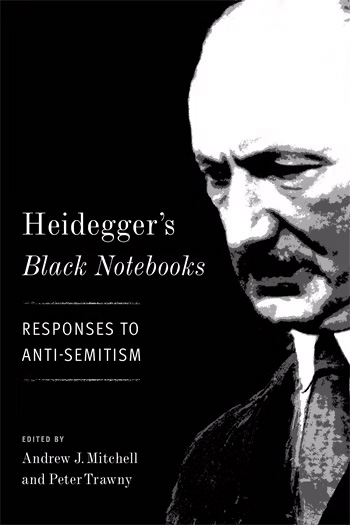
This volume advances a precise and austere scholarly stake: it offers the first sustained, plural, and text-grounded assessment of how the anti-Jewish remarks in the Black Notebooks intersect with, and in key passages are articulated from within, Heidegger’s being-historical project. Under the editorship of Andrew J. Mitchell and Peter Trawny, it refuses the disjunction between biography and philosophy by reading the notebooks where Heidegger himself placed them—at the end of the Gesamtausgabe and alongside his “pathwork” writings—and it tests, at close range, the claim that the anti-Semitic formulations belong to a metaphysical antagonism internal to his later thinking rather than to an episodic private animus. Its distinctive contribution is to stage a rigorous confrontation between conceptual architecture and incriminating passages, and to let that confrontation reconfigure the very criteria by which one judges philosophical integrity, methodological responsibility, and the fate of an oeuvre after scandal.
The outer frame that gives the book its argumentative coherence is laid down in the editors’ introduction. The chronology and editorial architecture matter. The first volumes of the Black Notebooks appeared in March 2014, comprising Considerations (Überlegungen) I–VIII; a fourth volume, Remarks (Anmerkungen), followed. The editors recall that Heidegger himself arranged these notebooks to close the Gesamtausgabe. That late placement is not an accident of archival housekeeping; it designates the notebooks as a terminal aperture through which the decades-long path of thought is to be retrospectively seen. The same introduction restates two decisive facts that guide the collection’s method. First, the entries in question do not merely note this or that colleague or local grievance; they formulate, in the idiom of the “history of beyng” (the later orthography designed to signal a departure from the horizon of metaphysics), oppositions in which “world Judaism” is figured as a historical power bound to machination and uprooting. Second, those entries are threaded through a corpus—Contributions to Philosophy (Of the Event) and the related treatises—in which the ontological stakes of history, technology, and the possibility of a “first beginning” and an “other beginning” are deliberately bound together. That double orientation compels the editors’ central question: to what extent do the notebooks’ anti-Jewish judgments belong to that binding, and what happens to the structure of the project if one isolates, resists, or removes them?
A book with this stake cannot proceed by repeating familiar polarities. The introduction delineates two unsatisfactory postures that had dominated early reactions: the exonerating restriction of anti-Semitism to the private man, on the one hand, and the totalizing condemnation that reads every Heideggerian concept as a cipher for political hatred, on the other. The editors resist this binary through a methodological wager. They adopt a practical definition of anti-Semitism as a structured hostility directed at Jews as Jews, traceable across discriminations, exclusions, expulsions, and annihilations, and they propose to investigate the notebooks’ formulations as being-historical inscriptions of such hostility. That wager generates a disciplined reading protocol: build claims on the documentary status of the notebooks within the Gesamtausgabe; track the cross-references between the notebooks and the treatises from the mid-1930s; identify the metaphysical oppositions (uprooting vs. groundedness, machination vs. preservation, calculative power vs. thoughtful care) in which the anti-Jewish tropes are set to work; distinguish what is textually secured from what is inferred by conceptual continuity; and acknowledge the compositional form of the notebooks—private, aphoristic, often reactive—without letting that form dissolve their philosophical address. The editors’ own formulation is instructive: if the anti-Jewish antagonism is tied to metaphysics in Heidegger’s converted idiom of the history of beyng, then its overcoming would require an overcoming of metaphysics that is itself no oppositional negation but a Verwindung (convalescent transposition), and precisely therefore leaves a remainder that critical vigilance must continue to register. The introduction thus prepares the argumentative space in which the essays move: vigilance instead of absolution; reconstruction instead of excoriation; a long view of method instead of the short energy of scandal.
Peter Trawny’s contribution provides the keystone for the conceptual interpretation of the anti-Semitic passages. He reconstructs how the notebooks map a “universal topography,” an abstract yet intensely polemical image of modernity as a boundless virtual landscape in which beings are leveled to availability and counted under a planetary order without rooted places. In this projection, “world Judaism” appears as a privileged operator of the universal: a name for the calculative, a symbol for the uprooted. Trawny does not treat this as psychological animus intruding into metaphysics. He shows that it is the inverse: a being-historical antagonism that seeks historical agents commensurate with its metaphysical contours. The notebooks identify powers—America, Russia, what they designate as “world Judaism”—as exemplary or symptomatic bearers of machination; their assignations operate as nodes for an ontological topology. The decisive claim is methodological: the anti-Jewish formulations are integral to the topology’s antagonistic construction. When the logic of history hinges on an opposition between a machinational unworld and a new inception that guards the truth of beyng, and when this opposition requires concrete bearers, then the selection of “the Jewish” as a name for uprooting does conceptual labor. The essay’s strength lies in showing how the rhetoric functions inside the system. The cost of the system’s antagonism is thus counted: it supplies an interpretive grid that can at any moment absorb Jews into a metaphysical role, and it shelters that assignment under the dignity of an ontological decision. On Trawny’s account, the most honest route beyond this structure is not a choice against Heidegger but the transformation of the oppositional logic itself—an arduous conceptual convalescence that preserves difference without installing a counter-principle disguised as a destiny-bearing people.
Sander L. Gilman places this antagonistic topology against the longue durée of German debates on cosmopolitanism and mobility. He traces the twinned figures of the Jew as cosmopolitan and as nomad, two modern inversions that allow the same stereotype to serve contrary myths: beneficent global citizen or corrosive uprooter. Gilman’s historical cartography does not dilute the notebooks’ specificity; it makes their imagery legible. The being-historical lexicon’s talk of worldlessness, calculative thinking, and desituated agency intersects with a repertoire long in circulation. This intersection secures two findings. First, the notebooks’ anti-Jewish images are culturally furnished; they draw on available classifications that conflate movement, intellect, and deracination. Second, the metaphysical register lends those classifications a speculative intensity. The ordinary trope of the wandering Jew becomes a cipher for a planetary reconfiguration of being. Gilman’s evidence thereby sets a crucial limit for inferential temptation: while the notebooks embed themselves in a cultural matrix of stereotypes, they also refashion that matrix according to a grand ontological scheme. The result is not reducible to the stereotype; it is an alliance between conceptual oppositions and inherited images.
Eduardo Mendieta takes up the most provocative of the notebooks’ ontological discriminations, the axis that runs from world-poverty to world-destruction, and asks what happens when “worldlessness” and “world-forming” are tacitly mapped onto peoples. The claim that human beings are “world-forming,” animals “poor in world,” and the stone “worldless” had been articulated in earlier Heidegger, yet here the assignations shade into an ethnometaphysical gradient. Mendieta shows how the later idiom permits an analogical slide: from the ontological difference between modes of access to world to a civilizational difference between those who bring worlds into radiant presence and those who, by calculative machination, disable the very possibility of world. When entries cast Jews as accomplices to planetary uprooting, the metaphorical circuit threatens to harden: “worldlessness” is redistributed as a mark of a people. Mendieta reads this as a structural violence within the thought, a violence that obscures concrete histories while universalizing a polemical image. His analysis confronts a methodological dilemma the volume keeps in view. One wants to keep German technical terms to a minimum, yet here one must name the heart of the matter: Machenschaft (machination) becomes a schema for moralized ontology; Heimat (homeland) becomes a metaphysical predicate rather than a historical condition. Mendieta’s reconstruction thus registers a dangerous conversion of phenomenological distinctions into a metaphysical anthropology of peoples, accomplished through the grammar of the notebooks.
Bettina Bergo threads a different path by returning to the concept of Dasein and its latent analogies to animality in the later texts. Her question is finely tuned: how do certain passages in the notebooks, where Heidegger’s discriminations between kinds and kinds of kind take on a polemical edge, reconfigure the line between human existence and the “animal”? The strength of her essay lies in its resistance to overstatement. She does not claim a direct bestialization of Jews as a doctrinal thesis; she shows how the taxonomic imagination at work—reclassifying lives under the sign of disposability or historical insignificance—borrows the authority of ontological difference while enacting ethical depreciation. The inferential content here is kept under control by a precise textual practice. Bergo identifies the form of the move rather than imputing an explicit claim: the notebooks’ casual re-sorting of beings invites metaphoric transfers that carry grave ethical freight.
Richard Polt documents a compositional tension at the heart of the notebooks that bears directly on their interpretability. The notebooks, he reminds us, cultivate a stance of silence toward “publicness” even as they were destined to be published. Heidegger envisages writing as an attempt to guard what eludes common intelligibility, yet he lectures, publishes, and arranges a posthumous plan for disclosure. Polt explores this dialectic without theatrics and draws the conclusion that matters here: if the notebooks belong to the path, and if the path is itself an economy of reticence and disclosure, then the anti-Jewish formulations cannot be screened as private slips in a margin. They are written into the carefully curated corridor by which the later thought approaches its own legacy. Polt’s essay also advances a pointed observation that the introduction had already intimated. The Contributions and related treatises explicitly cite the Considerations in their self-accounting; when Heidegger lists what “preserves what is attempted” across decades, he includes entries from the notebooks. The volume thus secures the notebooks’ status as more than documentary residue.
Michael Marder turns the collection’s central question around: if there is a “Jewish question” in the notebooks, what other question is simultaneously being silenced? He argues that Heidegger’s later practice of questioning, which would claim to honor the question as such and to let the matter of thinking come to speech from itself, ends up presupposing a delimitation of who counts as historically addressable. The rhetorical figure “world Judaism” becomes an index to a limitation of questioning as such. Marder’s conceptual strategy is precise: he does not oppose questioning to a moral code; he shows that a genuine commitment to questioning without reserve would have had to subject the notebooks’ assignations to the same scrutiny they direct at modernity. The failure is methodological before it is moral: a suspension of questioning at the point where a stereotype supports a comprehensive narrative of decline.
Martin Gessmann’s intervention, written with declarative urgency, refuses to dilute the political specificity of the 1930s and early 1940s discourse in the notebooks. He argues that one cannot keep repeating that Heidegger’s “philosophy” was free of Nazism when the notebooks themselves write National Socialism into the matrix of a world-historical opportunity. The essay is careful with evidence and severe in judgment. It highlights places where the notebooks cast National Socialism as a barbarous principle with a perverse promise, and it insists that postwar silence or later refinements do not erase the rhetorical force of that casting. On Gessmann’s account, “he meant what he said,” which is to say that the conceptual idiom—Volk, destiny, inception, downfall—did not constrain a private man; it enabled a philosophical style to gesture toward a politics capable of embodying its metaphysical hopes. The volume gives this claim a necessary place because it checks an academic reflex that always seeks a saving distinction; here the distinction collapses under pressure of the document.
Hans Ulrich Gumbrecht presses the question of popular sovereignty and the people’s will as it appears in the notebooks’ occasional remarks on the “supreme will of the people.” The interest of his essay is to draw out the paradox by which a philosophy that distrusts publicness and mass society nonetheless invokes a destiny-bearing people as the decisive historical agent. The notebooks’ rhetoric oscillates between disdain for enframed publicity and evocation of a communal will commensurate with ontological history. Gumbrecht neither harmonizes nor nullifies the oscillation; he treats it as the signature of a broken political metaphysic that requires a people in order to appear, yet fears the degradation of thought at the hands of its own public.
Peter E. Gordon proposes a disciplined reactivation of Heidegger’s own methodological slogan—Destruktion—toward the metaphysical tradition. The question is whether a “future destruction of metaphysics” can be conducted with the Black Notebooks in view. Gordon’s answer is to tighten the circle: if destruction is to lay bare the sedimented presuppositions that guide our thinking, then it must also expose the presuppositions that permitted the notebooks’ anti-Jewish assignations to appear as philosophical necessities. The practice he sketches is exacting: treat the anti-Semitic passages as philosophical data, identify their function inside the system, and then ask whether that function is dispensable, replaceable, or indispensable. Gordon’s assessment, meticulous rather than accusatory, finds that much of the anti-Jewish content reprises what was already legible in seminars from 1933–34, which confirms that the notebooks are neither an accidental aberration nor a late-life relapse; they are internal witnesses to a construction underway. The proposed Prolegomena thus unites two imperatives that define the volume’s central ethical posture: safeguard what is enduring in phenomenological questioning and hermeneutics, and refuse any arrangement by which that safeguarding demands blindness to the structure that made the anti-Jewish inscriptions appear compelling.
Tom Rockmore examines how a reading “after Trawny” must decide whether what one encounters in the later Heidegger is philosophy—capable of argument, refutation, re-appropriation—or a worldview insulated from correction by its total image of history. The argument tracks a sequence. If the notebooks cross-wire ontological difference with an historical Manichaeism that identifies peoples with destinies, then the result resembles a worldview more than a system of reasons. If it is a worldview, the available modes of critique shift: one can unmask, contextualize, or reject, but one cannot dispute premises as though they were offered to an interlocutor. Rockmore’s essay thereby adds a meta-criterion to the volume’s shared inquiry: to discern where the text offers reasons and where it demands allegiance to images of destiny. The cost of blurring this distinction is high; it allows a metaphysical antagonism to masquerade as ontological necessity.
Robert Bernasconi’s piece poses a sharp historical-philosophical question: is there genuine originality in Heidegger’s anti-Semitism, or are the notebooks rehearsing an archive whose content is already codified in polemical genealogies that predate him? By staging the comparison with figures such as Eisenmenger, the essay argues that many of the notebooks’ tropes—the calibrated marriage of intellect and conspiratorial power, the identification of Jewish mobility with the corrosion of communal rootedness—have a long pedigree. This is not an exercise in guilt by association; it is a delineation of sources and a diagnosis of how the notebooks’ idiom renovates old devices with speculative pathos. The payoff is double. It clarifies what in the text is formally new—its embedding of hostility in an ontological topology—and what is inherited. And it furnishes a standard of textual security: when a motif can be traced to prior polemics, attribution to Heidegger’s conceptual invention is unwarranted, though its placement within his system remains his responsibility.
Slavoj Žižek closes the volume with a provocation meant to insist on the persistence of ontological difference as a resource even after the exposure of the notebooks. He cautions against a moralizing criminalization that would replace criticism with interdiction. The argumentative thread is consistent with the book’s overall ethos: read against the later Heidegger with resources provided by the later Heidegger. Žižek’s insistence that one can deploy the structural insights of ontological difference without carrying along the being-historical antagonism that nourished the anti-Jewish passages is contentious, but its inclusion matters. It sharpens the volume’s central conceptual fork: either the anti-Jewish antagonism is structurally constitutive and ruins the edifice, or it is locally decisive yet detachable through a conversion of the very oppositional logic that sponsored it.
Across these essays, certain problems recur with productive intransigence. There is the problem of placement: whether the notebooks belong to the private hinterland of thought or to its lit corridor. The editorial decisions of the Gesamtausgabe, the explicit self-citation of Contributions to Considerations, and the ordering that reserved the notebooks for the end all speak in one direction. The notebooks are part of the path; they are a summative basin into which the stream empties before its last cataract. That placement is textually secured. It warrants the inference—though the inference must be marked as such—that the anti-Jewish formulations cannot be domesticated as incidental. The inferential character of this step is important for the book’s honesty: it is the editors’ and contributors’ responsibility to say when the text compels and when it suggests. There is the problem of composition: notebook form invites aphorism, polemic, and reaction to events. The essays do not deny that form; they methodically abstract from it the recurrent oppositions the entries mobilize and inspect those oppositions for their ontological content. There is the problem of vocabulary: the later lexicon recalibrates ordinary terms. Here the collection maintains a delicate balance. It keeps German terms to those needed to identify the mechanisms at issue—Geschichte as ontologically weighted “history,” Machenschaft as the totalizing objectification that levels beings, Heimat as the site of belonging transposed into a metaphysical key—and it translates their effects into ordinary English where possible. This restraint keeps the exposition exact without letting terminology perform the work of argument.
A deeper tension concerns method. The contributors do not read the notebooks as a cache of opinions to be sorted into the moral columns of the day. They take seriously the notebooks’ claim to participate in a conversion of thinking, and they test that claim by returning to philosophical ground: What structure of opposition organizes the later project? What or who must be identified to complete that structure? Which images are recruited and how are they imported? At each step, the essays record a constriction in the room for difference: a consistent pressure to array the world under a destiny-bearing polarity. The names that fill that polarity are not interchangeable. “World Judaism” is drafted to stand for the calculative universal; its imagined ubiquity and mobility make it convenient. The book registers this convenience as a philosophical vice. If the topology requires an adversary of uprooting, the adversary can always be found. In that sense, the anti-Jewish motif is at once historically furnished and systemically solicited. This is the conceptual heart of the book’s argument-like narrative.
The collection also clarifies how parts of the work congeal into others and are displaced in the process. In the middle 1930s, the movement from the analytic of Dasein to the history of being reorients the field. The Contributions and adjacent treatises organize thinking around inception and downfall, preservation and machination, an “other beginning” after the exhaustion of metaphysics. The notebooks accompany this pivot and feed it images. In one phase, the figures of America and Russia condense an axis of technological gigantism; in another, “world Judaism” is named where the topology seeks an operator of the universal. The essays trace these condensations and their displacements as the war years advance and the rhetoric darkens. After the war, explicit remarks of the same kind recede from view even as the structural oppositions persist. The book does not claim that the hostility evaporates from the later texts; it shows that the explicit naming of Jews recedes while the conceptual arrangement capable of hosting that naming remains available. This sequential account is textually anchored by the volumes’ dates and cross-references and by the editors’ insistence on reading the notebooks within the corpus’ self-understanding as a path. The displacement is neither complete nor neutral; it is the sort of displacement that increases the burden on the reader’s vigilance precisely when overt polemic quiets.
When the volume pivots toward ethics and pedagogy, it does so without sermon. The question is how one is to teach and write after these notebooks, and the replies exemplify the method that has governed the whole. Do not treat the anti-Jewish passages as detachable blemishes; explain their conceptual role. Do not declare the oeuvre unusable; specify what must be transformed for its use to be honest. Do not attribute to the notebooks more than they say; allow their function within the system to set the standard of critique. This triad keeps the essays sober even when the evidence is severe. At times they allow themselves the briefest citation in order to maintain proximity to the text. The restraint is significant. It models a scholarly discipline capable of absorbing scandal into method rather than substituting scandal for argument.
A recurring theme is vigilance toward the “remainder” that the editors mark as ineradicable if one understands overcoming as Verwindung rather than annihilation. Several essays make this remainder visible in different lights. For Mendieta, it is the residual availability of a gradient that maps ontological rank onto peoples. For Gilman, it is the persistence of a cultural taxonomy that can be refitted to contemporary anxieties. For Gordon, it is the sediment in the concept of destruction itself, which must now be applied to the very apparatus that had authorized its own exemptions. For Trawny, it is the return of an antagonistic grammar that a truly converted thinking would have to disable from within. The convergence is striking. It reveals the book’s constructive ambition: the contributors do not only expose a failure; they sketch the contours of a practice that would meet the failure at its level.
The book’s strength also lies in its discrimination between what is secured and what is inferential. Secured: the notebooks’ compositional place in the Gesamtausgabe; their cross-reference by the 1936–38 treatises; their deployment of anti-Jewish images in being-historical contexts; their casting of National Socialism at moments as an epochal possibility; their invocation of a destiny-bearing people; their incorporation of cultural stereotypes into a metaphysical polarity. Inferential, yet carefully argued: the degree to which the later rhetoric about technology and enframing silently sustains the earlier antagonism; the extent to which the postwar shift to “releasement” and “serenity” neutralizes or preserves the structures that enabled the earlier naming; the possibility of extracting from ontological difference a resource that resists world-historical Manichaeism without dissolving specificity. The volume is at its best when it marks this line, because marking it allows disagreement among the contributors to become philosophically productive rather than merely evaluative.
One of the most demanding tasks the book undertakes is to think the relation of concept to image. The notebooks do not simply express prejudice; they use images to articulate a metaphysical dichotomy. This use raises a foundational difficulty for phenomenological method. If phenomena are to be described with fidelity, what happens when the description enlists inherited figures whose very generality blunts the singularity of the phenomenon? Several essays respond by re-centering the duty to description against the allure of mythic compression. Marder articulates the demand as a demand of questioning; Polt shows the failure of reticence when it becomes a shield; Gordon proposes the re-education of destruction by forcing it to destruct its own image-repertoire. In each case, the method of phenomenology is not abandoned; it is asked to carry the weight of its own correction.
A final thread concerns the political concept of people and its double role as ontological addressee and empirical collective. Gumbrecht, Gessmann, and Rockmore collectively force the issue: the notebooks alternately sacralize and distrust the people, elevating them as the subject of destiny and fearing them as the medium of publicity that corrodes genuine thought. This double gesture is less inconsistency than symptom. It discloses the unresolved need for a bearer commensurate with an ontological drama that, by its own lights, cannot be borne by an individual subject. The people substitutes for the absent subject of metaphysics in a theater where history is to become manifest. The cost of this substitution is paid in the currency of exclusion; to figure a people as bearer is to imagine those who cannot bear, and the figure of “world Judaism” is made to serve as that limit. By returning to this political metaphysic without anxiety, the book adds clarity at the point where many discussions prefer indignation.
The compositional sequence of the Black Notebooks threads the entire volume as a quiet argument. Earlier Considerations begin to draft the universal topography and to summon the names that will populate it. The escalating war-years deepen the antagonism and sharpen the assignations. The subsequent Remarks shift tone but do not disassemble the apparatus that allowed the earlier identifications to function. The self-accountings in the treatises—from the mid-1930s survey of materials to the later reflections on what has been attempted—install the notebooks as witnesses to the path rather than as casual jottings. The outer framing of the Gesamtausgabe, which withholds the notebooks until the end, then operates as a final displacement: one approaches them after the published volumes have shaped expectations, and one leaves them with the sense that they had always already been bearing the weight the end confers. The book’s contributors read this frame as part of the phenomenon. They do not break it; they let it weight their interpretations.
What, then, is the collection’s clarifying outcome? It demonstrates with documentary rigor that the anti-Jewish passages in the Black Notebooks are entangled with the being-historical project at structurally important junctions. It shows that those passages draw on cultural stereotypes while intensifying them through an ontological opposition that demands historical agents configured as metaphysical foils. It distinguishes between placements and functions, thereby avoiding the shortcuts by which some condemn and others absolve. It models a procedure by which one can continue to read Heidegger’s conceptual innovations—on disclosure, on the poverty and wealth of world, on the difference between beings and being—without allowing their historical application to escape judgment. And it argues, across several idioms, that any honest inheritance of Heidegger must include a transformation of the antagonistic grammar that became hospitable to images of Jews as uprooters of world.
The collection is neither tribunal nor sanctuary. It is a workshop in which conceptual parts are disassembled, their bearings traced, their capacities to injure assessed, their salvageability measured without panic and without rescue fantasies. The essays converge on the view that the being-historical antagonism, unconverted, solicits exclusion; that conversion, if it is more than a motto, must change the very structure that called for an adversary; and that this change can be attempted with resources drawn from within the corpus—questioning, destruction, reticence—once those resources are turned back on the apparatus that had once protected them from self-application. In this sense, the book undertakes the responsibility it assigns to its readers. It asks for vigilant convalescence: a long labor by which one reads what remains indispensable in phenomenology and hermeneutics while refusing the myths that once gave those disciplines a false historical pathos. It offers no final verdict because the work of convalescence is by definition unfinished. What it does supply, with uncommon steadiness, is a standard of seriousness equal to the scandal it addresses, and a way to continue thinking where the temptation to stop thinking is strongest.
 Simon Gros
Leave a comment