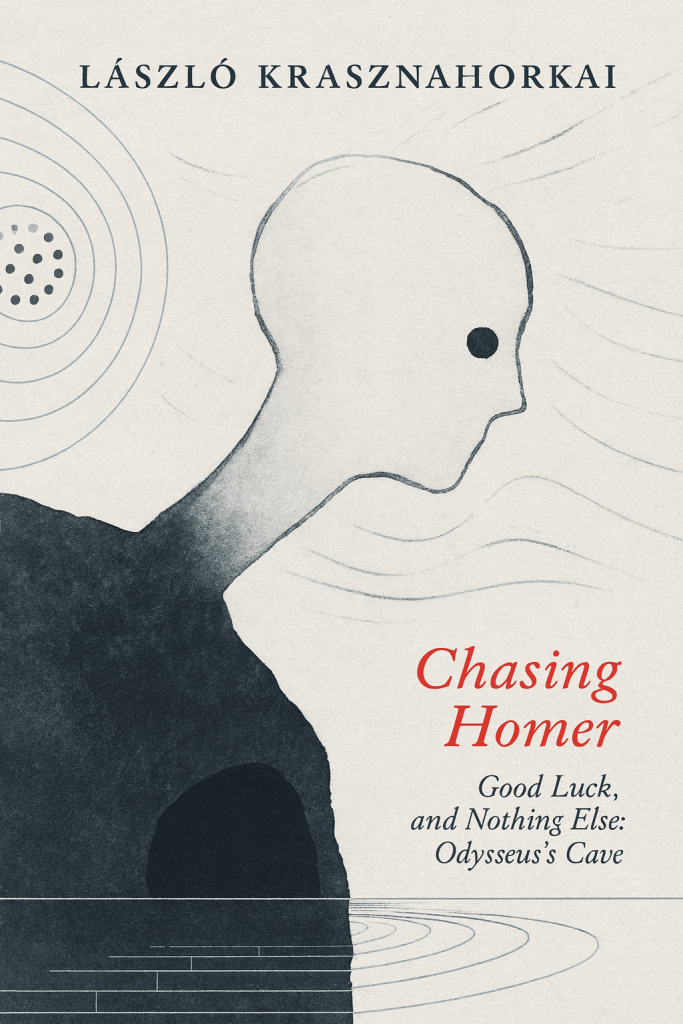
This book stages a controlled experiment in narrative pressure and philological memory. László Krasznahorkai compresses a pursuit story into a sequence of conceptual modules—Velocity, Faces, Relating to sheltered places, and so on—whose cumulative claim is that survival, once reduced to method, becomes a cognitive discipline that interrogates its own premises. The distinctive contribution lies in the book’s bifurcated construction: a first-person manual of evasion that continuously tests the adequacy of its own procedures, and an external Homeric frame—in explicit allusions and embedded recitation—through which the flight discovers its archaic prefigure. The volume’s composition and outer apparatus—an Abstract, numbered sections with diagnostic rubrics, musical cues, and an iconographic accompaniment—establish a research protocol: how far can danger, stripped to bare technique, carry an account of human measure before it folds back into mythic orientation.
The constitutive wager is stated from the outset with an unusually naked proposition: killers not swans. The phrase is less an exclamation than a methodological marker. It identifies the entire enterprise as a proscription against aestheticization and a prophylaxis against metaphor that has not been earned by danger. The Abstract sets the register: the speaker’s task is to remain alive and intelligible to himself under conditions that erode both prospects. The insistence that they are killers, as opposed to a poetic flock mistakenly rising from a peripheral perception, eliminates the available romantic buffer that might make terror narratable in any immediate sense; in its place, the book introduces a protocol of sobriety. At this scale, what counts as evidence becomes strictly bounded: any procedure that increases the chance of survival counts as rational; any intellectual ornament that distracts from procedure counts as liability. The narrative is thereby placed under the same constraint as its protagonist. It must move as quickly, as obliquely, and as distrustfully as he does; otherwise it would betray its own ground.
The speaker’s initial claim is simultaneously epistemic and practical: the ordinary expectations of causality become unreliable at the pace of pursuit. He rejects rational progressions that move toward the optimal choice on the assumption that enemies will course-correct into his path if he behaves predictably. What follows is an algorithm of wrongness: he selects the wrong alley, the wrong staircase, the wrong ferry, not because these are intrinsically better, but because they are illegible to an intelligence tracking statistically probable behavior. The force of the move is more philosophical than tactical. He is replacing maximization with perturbation and thereby reconfiguring rationality as the construal of second-order expectations. The book tests whether such second-order reason—reason that knows it must appear unreasonable—can be sustained without collapsing into superstition.
From the first numbered section, Velocity, the text defines the problem as a relation between movement and decision. The slower he moves, the clearer the options appear, and the more he risks being located by the very clarity that tempts him. The faster he moves, the worse his options appear, and the more his safety depends on committing to them before evaluation. This produces the first stable tension: survival requires a rate of action that outstrips comprehension. The sections thus become attempts to retrofit reasons behind moves already made. The method is to articulate why a choice that could not be justified at the time should now be seen as rational given the adversary’s modeled intelligence. This retroactive justification is the narrative’s way to import intelligibility without recourse to a falsely consoling teleology.
Faces tightens the screw. The speaker catalogs the human field not to identify individual enemies but to observe how perception itself is altered by the universal possibility of betrayal. The diagnostic quality of these pages is secured by their restraint. The face ceases to be a window into character and becomes a surface against which hypotheses about threat are provisionally tested. The book thereby dislodges a venerable humanist intuition: the interpretability of expression. On the run, the face marks a vector in space; its moral content is a surplus dangerous to attend to. The reasoning is not cynicism but triage. The moralization of perception would cost him time he cannot afford; the refusal to moralize is a concession to tempo rather than an assertion about persons. The claim is internally consistent with the initial proscription against swans: maintain only those conceptual loads that do not slow the body.
Relating to sheltered places and Relating to insanity advance the same economy by showing how thought itself can become an enemy once it takes a shape more elaborate than the minimal schema of avoidance. Sheltered places, which look like reprieve, are dangerous because they invite duration; duration invites circumspection; circumspection invites system; and system, at this pitch, invites capture. Insanity presents the mirror image: the danger that the necessary counter-rationality—the technique of choosing the wrong—hardens into a self-generating compulsion. The text secures these observations by binding them to material circumstances: benches, arcades, underpasses, and the minor infrastructures of travel that in ordinary life regulate circulation become adversarial devices once the possibility of being followed is introduced. The world is denatured into an index of routes that distribute visibility and concealment. The argument is not that the world has changed; rather, the rule under which the world is read has been replaced.
Moving about in crowds and Advisory test the limits of cover. Crowds equal anonymity and are therefore a template strategy for evasion; the book nevertheless shows that anonymity requires an improbable discipline: one must mimic average movement without ever succumbing to its cadence. Any long continuity with a particular cluster of bodies creates a pattern legible to a pursuer. The evidence here is procedural rather than descriptive. The speaker rehearses ways to be in a moving mass while refusing any stable rhythm that might produce a signature. This is the book’s recurring methodological gesture: elaborate one tactic, then, with the same lucidity, dismantle its sufficiency. Even the most successful procedures deteriorate under repetition; once articulated, they begin to fail. The narrative therefore pressures its own insights by forcing them to generate counter-insights, an internal dialectic with an explicit survival cost.
In Adapting to the terrain the line breaks widen and the sentences extend as if to register a new scale. Terrain is more than setting; it is an apparatus of constraint that hosts, tests, and invalidates habits. The text situates the run within a coastal and insular grammar—quays, docks, ferries, bays, cliffs—and in doing so establishes the first connective with the title’s Homeric provocation. A life measured by crossings will tend to be legible through stories of sea-passage, even if such legibility is precisely what the speaker must fight. The book’s discipline here is exacting: it neither indulges in the allegorization of seascape nor suppresses the resonance. It maintains a scruple: the sea is a medium with schedules, wind conditions, hard timetables, and checkpoints; it is only after these features have done their practical work on the narrative’s decisions that the Homeric layer becomes audible as a relay rather than as an interpretive frame imposed from above.
On the meaning of pursuit & murder formulates the book’s stringent anthropology. Murder is declared as a structural possibility that organizes thought without granting it ontological privilege. The pursuers are less characters than constant functions whose only meaningful predicates are distance, angle, and probable learning rate. The text is extremely careful in withholding what it cannot secure: names, motives, affiliations remain in suspension. This is not a mystery; it is a methodological refusal. The narrative will not license inference where warrant is absent. It restricts itself to signatures of proximity—sounds, shadows, convergences at transfer points—and construes them as signals in a game played against unknown parameters. The protagonist’s intelligence, in consequence, evolves away from reconstructing an enemy identity toward constructing robustness against any identity at all. He assumes that whatever they are, they can adapt, and therefore his plan must shape itself as a moving target that outruns their adaptation. The section thus defines the measure of thought under pressure: devise only those conceptions that do not require a stable adversary.
The second portion of the book, beginning around Life and Choosing an escape route, shifts the problem from reactive survival to the possibility of proactive orientation without surrendering the anti-teleological stance of the first half. The chapters here are braced by a compact phenomenology of fatigue, hunger, and weather; the Bora arrives as a pressure event that not only reorganizes the ecology of movement but also discloses the limits of body and plan. These pages generate the book’s strongest philosophical claims: any concept adequate to danger must remain porous to meteorology and infrastructure. The argument is secured by factual registers—timetables, ferry lines, ticket windows, quayside procedures, the awkward choreography of embarking and disembarking. The world insists in the form of schedules that cannot be deduced from first principles and in gusts that do not honor intention. The protagonist’s reasoning must therefore be constantly revised by the minor facticity of transport and climate. The burden of thinking becomes one of interleaving: a method stitched out of anticipations that assume their own partial wrongness.
Stations culminates this inquiry into the rationality of transit. It treats transit points not as neutral connectors but as concentrated risks. The station is an exposure device: converging trajectories thin privacy and produce observation vectors that cannot be correctly calculated in real time. The argument proceeds by negative mapping: he plots what he cannot know and thereby learns what must be refused. He avoids the center, the obvious shelter, the plausible platform; he purchases tickets in ways that do not express his plans; he treats every schedule as if it were a net designed to slow his decision rate. This logic amplifies the book’s earlier thesis that the most rational act under pursuit is to occupy the adversary’s model of one’s rationality and seize from within it a margin of unforeseeability.
With Value of earlier observations, the book turns on itself and asks whether its own catalog of procedures has become a trap. The protagonist examines the cognitive residues of his methods and openly worries that habitualizing the anti-habitual would calcify a manner of being that enemies could learn. The insistence on re-examining prior pages inscribes a meta-critical layer: the text does not pretend to a smooth, auteurist unity; it shows its own continuous recomposition. The procedure is simple and severe. Each technique articulated earlier is tested against the new conditions generated by the pursuit at its current pitch—different winds, different islands, different tourist densities, different boatmen, different light. Techniques that seemed permanently valid turn out to have been anchored in an implicit parameter that has shifted. The book’s ethics follow: there can be no absolute method of survival precisely because conditions mutate in ways methods are designed to ignore. The only invariant becomes vigilance against invariants.
Faith does not abandon this austere logic; it narrows the word to a minimal commitment compatible with the evidence regime the book has labored to secure. Faith here does not identify belief in a transcendent protector; it names the practical core of trust one has in any plan that necessarily exceeds what can be verified in the moment of decision. It is faith in the sense in which one steps onto a ferry that disappears from sight around a point on the assumption that schedules and pilots and weather all remain within tolerances. The book protects this ascetic molecule of faith by anchoring it in acts rather than in declarations. Faith becomes the name for the irreducible remainder of decision when all reasons have been counted and yet action cannot be delayed.
The islands marked explicitly—Korčula, Mljet—reattach the narrative’s procedure to a geography that is no longer only a background but also an archive. The literal crossings mimic a longer crossing between contemporary flight and archaic wandering. The writing exploits the island as an epistemic form: it constrains by circumscribing, simplifies by reducing exits, and in so doing makes the protagonist visible to himself. The claim secured here is that danger, when bounded by a coastline, permits a different calculation of wrong moves; the sea both protects and exposes, and the ferry, with its fixed path, is the figure of an obligation one chooses with full knowledge of the constraint it imposes. The prose in these chapters is austere and exacting: it reports temperatures, winds, the smell of diesel, the postures of passengers, the behavior of officials with a descriptive neutrality that underwrites the argument’s seriousness. No amplification is required; the conditions speak by resisting all excess.
The arrival of the Bora on Mljet provides the book with its most transparent material analogy for the pursuit’s logic. The wind confers on the landscape a hostility that does not recognize intent; it strips discretion from movement and leaves only the minimal geometry of shelter and exposure. The protagonist is starved of the small luxuries of aimless observation; even looking is repurposed as hazard calculation. Yet, within this reduction, a new possibility is registered: the island’s famous cavity, associated in local habit with a mythic past, becomes thinkable as a final strategy of self-erasure that is nonetheless a form of encounter. The cave named for Odysseus enters the text neither as monument nor as touristic magnet but as a procedure to transpose pursuit into concealment without hope of further movement.
Those pages titled Good, but not good enough and Toward hope mark the subtlest change of key. Their titles might be misread as psychological notations; they are, in fact, technical hypotheses. Good, but not good enough names the recognition that the portfolio of procedures accumulated so far yields survivable intervals but lacks a terminal solution; Toward hope names a movement that cannot be equated with optimism but is, rather, a cautious orientation toward a place that may offer a non-narrative exit from the logic of being chased. The text does not lie about the degree of speculation involved. It makes explicit that here, for the first time, the protagonist allows a mythic coordinate to inform route choice. He chooses to let a legend calibrate the last move because the legend has been naturalized into the island’s articulation of shelter. It is not a mystical leap so much as a final concession to a public name whose descriptive content—an opening in rock that takes in the sea—happens to suit a requirement that the practical field alone has not satisfied.
At Calypso’s renders this convergence with a deliberate tightness. What might have been a luxuriant reverie is pared to a study in permission and refusal. The Homeric echo is insisted upon at the level of naming, but the prose maintains its procedural ethics. A refuge that can hold a man indefinitely is a prison if movement is survival’s essence; a refuge that allows controlled repositioning without trace is a technical masterpiece. The cave is considered under this rubric. Its value lies in how it re-configures the relation between hearing, seeing, and being seen. In this space the sound of the sea is both cover and report; the light that moves across the mouth is both clock and alarm. The argument is empirical; it is secured by the book’s habitual registration of minute environmental facts and their transformation into constraints. If Calypso signifies seduction into stasis in one tradition, here, in this calculus, the only seduction is the possibility of a time-regime that does not instantly betray the body that rests.
The final section, No, functions as a conceptual stop rather than as closure. The denial is aimed at precisely the temptation the outer frame could be thought to sanction: the temptation to mythologize the act of surviving into a parable with comprehensive meaning. The book refuses such a conversion. No speaks to the prohibition that began with killers not swans: the refusal to surrender the discipline obtained under danger to the ease of narrative balm. The last pages do not narrate triumph or capture; they mark a threshold where the logic of evasion has found a space whose conditions can, for a time, be governed, but only under the maxim that the world offers nothing like safety—only the variable geometry of relief.
All along, an accompanying sequence of elements builds and complicates the discourse. First is the iconographic and auditory frame that the volume signals in its paratexts: illustrations by Max Neumann and percussive compositions by Szilveszter Miklós, with the latter made explicitly accessible through a series of digital pointers and codes at the end of the book. These are not auxiliary; they are part of the composition’s stated outer scaffolding. The drawings serve as compact studies in configuration and aftermath—figures and fields whose relation suggests an event without describing it. Their function, within the book’s epistemic restraints, is to permit the registration of pressure without compromising the prose’s sobriety. The percussive tracks, addressed by section, are not soundtracks in the cinematic sense but metrical counter-arguments: they articulate patterns that are always on the verge of breaking, and in that readiness to break they mirror the text’s deeper thesis that rhythm, once asserted, already invites the listening adversary. The apparatus welds a multi-modal discipline to the book’s minimal anthropology, thickening the argument in non-discursive layers without dispersing it.
Second is the translational surface. The English version is marked as the work of John Batki, and the book explicitly acknowledges that the Homeric citations proceed through a nineteenth-century English rendering. These two paratextual acknowledgments help calibrate the relation between the contemporary voice and the archaic relay. The fugitive’s English is spare, skewed toward the long sentence with a precise gait that stages thought in its own articulation. The Homeric passages, by contrast, arrive with a dignity slightly out of time, their diction warmly formal yet clear. The effect is calculated: the prose of pursuit, having disciplined itself against lyricism, allows the archaic lines to appear with an otherness that is not exotic but juridical, as if the old speech were the record of an enduring procedural knowledge about travel, shelter, and the exchange between gods and the living. The contrast is thus not ornament; it is an argumentative tactic that protects the text from both anachronistic naïveté and fashionable dilution.
Third is the controlled exposure of locale through proper names—Split, Korčula, Mljet—whose introduction marks more than setting. Each name is a threshold that negotiates between public cartography and private strategy. The book never trades in postcard abstraction; when places are named, they are named to register the pressure of timetable and season, wind and route, officials and tourists. The emphasis on stations and quays is not incidental. It shifts attention from destination to vector, from geography as map to geography as machine that yields or withholds passages. These names permit the book to demonstrate how a mythic coordinate like Odysseus’s cave can become, under certain pressures, a fully rational move, because it does not enter as symbol but as one specification among others in a repertoire of constraints.
One of the book’s central problems—announced early and revisited often—is to determine the point at which method itself endangers its subject. If pursuing the wrong choice systematically is the technique that disorients the adversary, then any systematicity, even the systematicity of wrongness, is legible in principle. The protagonist’s counter is twofold. First, he treats his own deliberations as a surface that must remain rough: he interrupts his procedures before they mature into recognizable templates, and he emphasizes their contingency with an almost punitive insistence. Second, he recodes his life as inventory rather than as story: hunger and thirst are numbers and intervals rather than moods; clothing is insulation and camouflage rather than style; money is a time-converter rather than a measure of wealth. The test of this recoding is severe; if it hardens into ideology, it will set a pace too narrow to allow escape when the world surprises. The text marks this hazard with clarity and tries to retain in the margins a capacity for improvisation that preserves life against its own doctrine.
The Homeric relation is not a decorative analogue but a formal equity. Wandering in the archaic account is a penalty and a homecoming; wandering here is a degradation of possibility that nevertheless discovers an impersonal composure. Odysseus’s intelligence is frequently encoded as the power to convert hostile terrains into theaters of advantage through reading their hidden affordances; the protagonist’s intelligence is the power to delete from his own repertoire any gestural residue that could be predicted by an enemy’s model. Both intelligences share a discipline: they refuse straight lines. In the Homeric case, the refusal is often narrated as the gods’ interference; in this book’s secular frame, the interference is the world itself as system and weather. The relation is clearest where the text quotes or paraphrases the archaic source: the figure of supplication to a local host, the relation to Hermes, the posture of refusal before hospitality that erases agency. These insertions are never ethically unserious. They reopen the ancient question: how can a mortal accept a gift that abolishes the very risk through which he has constituted himself?
The labor of the prose is to guarantee that any answer remains commensurate with danger. The sections do not settle on doctrines; they convert hypotheses into provisional procedures and expose them to the environment’s counter-argument. The rhetoric is singular: long, controlled sentences that step through their own scruples; repetitions used not for lyric effect but as mnemonic anchors for discipline; vocabulary that refuses intensifier and exclamation. The passages in which he chastises himself for even thinking in images—killers not swans—operate as a grammar for the entire work. They warn against the comfort of metaphor while conceding that orientation may sometimes require a public name, even a legendary one, when that name encodes a material affordance needed for survival. The cave, at the end, is accepted under precisely this reservation: it is a rock formation with a certain geometry, a sound pattern, a light regimen, and an approach route; its mythic load neither adds nor subtracts from these features, except insofar as the myth has preserved memory of the place’s usefulness.
The book constantly distinguishes between what is textually secured and what must remain conjectural. Secured are the procedures the speaker states as having adopted: moving with, then against, crowds; selecting delays that desynchronize the evident path; avoiding any face’s moral interpretation; letting schedules dictate options while refusing to let them dictate timing; reading stations as danger concentrators; breaking the rhythm of his own reasoning. Secured also are the named geographies and weathers and routines of ticket purchase, embarkation, docking. Conjectural remain the pursuers’ motives, the causes of the initial chase, any narrative of prior life that would make the present flight exemplary or cautionary, and any claim that the chosen strategies would generalize beyond this body and this itinerary. The greatest conjecture is also the most openly flagged: that the cave will deliver a form of stay that is neither capture nor surrender, a stay calibrated to the exact requirements of remaining, for a while, out of reach. The text treats this conjecture as an experiment whose failure would be legible in one way only: in silence.
If the book is read as an argument, its major premises could be rendered in compact form. First, under pursuit, thinking must abbreviate to procedures that can be executed under time pressure without cognitive overflow; the rest is indulgence. Second, the world’s grammar—ferries, stations, winds, coastlines—has priority over any inner narrative one might wish to impose; survival begins in submission to this grammar. Third, a technique that refuses predictability will necessarily threaten identity; the person who attempts to survive through constant misdirection must accept that he becomes largely a function of his methods. Fourth, even within this reduction, there remains an aperture for an orientation that one may dignify with the name hope: a move toward a place whose conditions transpose danger into calculable terms. Fifth, myth can aid orientation only when it tells the truth about a place’s affordances; otherwise, it is an instrument of error.
Nothing in this inventory explains the book’s peculiar power, which resides less in its concepts than in its cadence. The cadence affirms that a sentence can think by refusing any rush to conclusion; each clause corrects the previous clause’s overreach, and each qualification learns from its own cost in time. The result is a prose that performs the very work it describes: the deglamorization of danger into tasks and the conversion of tasks into an ethics of attention. That attention is cold because warmth dissipates in wind; it is sober because intoxication is slow; it is repetitive because novelty is a luxury; it is precise because mistakes are irreversible. This is why the sections are named with the cool confidence of manuals and why, despite that confidence, each section confesses its provisionality. A method that survives its chapter is a method already scheduled for review.
The outer framing keeps this discipline visible. An Abstract announces, in miniature, the book’s thesis and problem; the numbered pieces then enact the thesis under pressure; the musical and visual accompaniments re-inscribe the pressure without commentary; the concluding No closes the gate against untimely consolations. The apparatus with digital links that match to the sections does more than extend the reading into sound; it externalizes the very temporality the text studies: tracks that begin, develop patterns, threaten to repeat, and then find their fracture. The materials of the book thereby become part of its argument. They instruct without declaring that they are instruction. They compose a manual whose price of success is that it cannot be received as advice by anyone who is not already in extremis.
One might object that the Homeric element risks bending the narrative back into myth despite the book’s vigilance. The answer appears in the prose’s handling of names. Where the archaic materials are introduced, they arrive indexed to precise scenes of supplication and refusal, of hospitality and calculation, with language that echoes but does not imitate. The source acknowledged for those lines is a translation from a markedly different era of English; their tone is thus slightly remote, and this remoteness is decisive. It marks the citations as documents from a juridical archive of travel rather than as templates for contemporary conduct. In that archaism, the book finds a credible third term between allegory and anecdote: the Homeric lines do not stand in for present content; they stand beside it like testimonies about what men once thought the sea and the gods demanded. The protagonist consults them as one consults old pilot charts not for current soundings but for an orientation that is willing to be corrected by the present wind.
The ethical dimension develops from within these technicalities. By refusing to ascribe character to faces, by declining to infer motive from fragmentary signs, the protagonist adopts an ethos of restraint that, while born under duress, bears more general weight. He insists that a person under threat is not licensed to invent enemies in order to make sense of fear. He insists that method must have proof, and that proof comes only as survival. If there is cruelty in this ethic, it is an ascetic cruelty directed inward: he grants himself very little room for sentiment that does not serve a plan. One reads this not as an advertisement for alienation but as a specification of costs. The book spares the reader any romance of asceticism by showing exactly how hunger and cold and exhaustion slab over one’s affective life. The world dwindles to counting and waiting and shivering and scanning for entrances and exits. The stripped surface of thought is not a virtue but a result.
A final tension animates the approach to the cave. It gathers the book’s problems into a single knot. The cave promises a transformation in the time-economy: the harried short-term decisions of flight could be replaced with mid-term governances of a sheltered space. But the cave also threatens the very possibility of flight. If the pursuers can watch long enough to learn the pattern by which one approaches, the cave becomes a trap with only one mouth. The protagonist thinks with exactness about this. He measures the approach’s exposure, the schedule’s guessability, the likelihood that a watchdog pattern could be inferred from absence as well as from presence. His conclusion is a refusal to grant the cave any symbolic surplus. It is shelter because of its geometry and acoustics; it is doom because of its single exit and visibility from above. That he proceeds nevertheless testifies to the discipline he has learned: where all alternatives have collapsed into a drawdown of options whose differences are slender, one chooses the slender advantage that allows the body to reduce its tremor and recover its sight-line.
The closing gesture—No—has the energy of a caesura. It does not erase the path to get there; it guards it. The book has achieved a rare clarity: it has shown how a human being becomes, under pressure, an intelligence dedicated to the defense of a moving margin, and how that intelligence, in order to remain human, must occasionally bend its own rigor enough to accept orientation from names whose power lies in long cultural preservation. The victory here is not survival in any conventional sense; it is the refusal to recycle a story of danger into triumphalist pattern. The book’s contribution to contemporary narrative thought is to re-legislate the terms on which a life can be told under threat and to demonstrate how a great archaic text can be kept in play without any concession to pastiche.
If one asks what holds these parts together—procedural sections, island logistics, winds, faces, stations, drawings, percussion, citations—the answer is that they share a common standard of seriousness. Everything included must do some work in the survival calculus or in its demonstration. The book’s method generates, and then displaces, its own unities: Velocity promises a physics; Faces promises a sociology; Stations promises a logistics; Korčula and Mljet promise a geography; the cave promises a topology; music promises a temporality; the Homeric passages promise a jurisprudence of wandering. Each, in turn, becomes the scene of a counter-argument that forbids it from becoming the whole. The result is a composition in which the components congeal by necessity—because the body is one and the world insists—and yet are finally displaced by the next insistence—because insistence is never single. The text ends without resolution because resolution would imply a cessation of insistence. It closes with a negative that protects what it has built: a discipline of attention that survives, for a time, in a mouth in stone, with the sea saying what it always says to those who listen with their lives.
 Simon Gros
Leave a comment