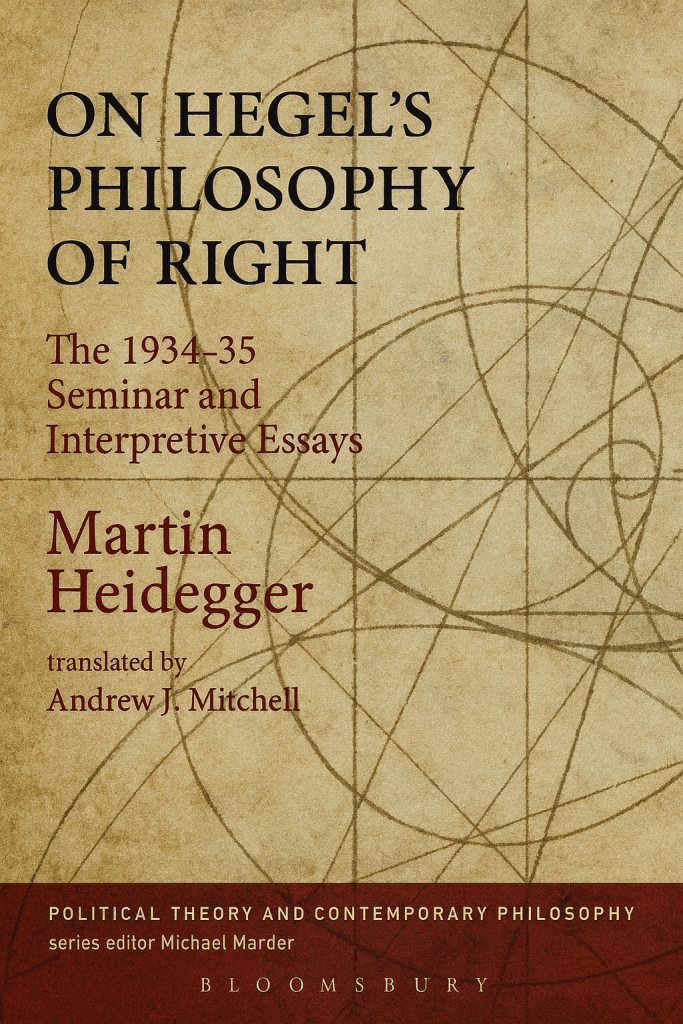
On Hegel’s Philosophy of Right: The 1934–35 Seminar and Interpretive Essays is one of the most unsettling and indispensable documents of twentieth-century philosophy, precisely because it places Martin Heidegger’s thought at the crossroads where metaphysics, politics, and history converge in a moment of fateful intensity.
Emerging from the winter semester of 1934–35 at Freiburg, just months after Heidegger resigned from his controversial rectorship under the National Socialist regime, the seminar represents his only systematic confrontation with a canonical work of political philosophy: Hegel’s Elements of the Philosophy of Right. It is thus both a rare textual testimony and a philosophical experiment in which Heidegger stages a confrontation with Hegel at the very point where ontology, freedom, and the political interlock. The volume, presented here in Andrew J. Mitchell’s lucid translation and supplemented by penetrating interpretive essays edited by Peter Trawny, Marcia Sá Cavalcante Schuback, and Michael Marder, offers readers an unparalleled glimpse into the ambivalent and contested space where Heidegger sought to wrestle with Hegel’s legacy in the midst of a European crisis of civilization.
The seminar circles obsessively around the later paragraphs of Hegel’s Philosophy of Right, particularly §§257–270, where the state is defined as the actuality of the ethical idea, the site where individual freedom is reconciled with collective freedom. Heidegger’s reading is both selective and strategic: he largely neglects the earlier discussions of abstract right, morality, family, and civil society, instead honing in on the state as the decisive metaphysical reality in which spirit, freedom, and will are embodied. Yet, even in appropriating Hegel’s formulations, Heidegger transforms them. For Hegel, the state is the rational culmination of ethical life, a spiritual organism that reconciles universality and particularity. For Heidegger, however, this reconciliation reveals the exhaustion of metaphysical thought, its closure in the bureaucratic rationality of the modern state, which for him had culminated in a form both complete and inadequate. Thus, Hegel appears simultaneously as the consummator of Western metaphysics and as the thinker whose closure signals the need for an entirely new beginning beyond metaphysics.
At stake, then, is not merely a political theory of the state but a metaphysical struggle over the meaning of Being in history. Heidegger situates Hegel within what he calls the “consummation” (Vollendung) of Western philosophy, a consummation that, in his view, reveals itself as both the highest articulation and the exhaustion of metaphysical thought. The dialectical self-closure of Hegelian spirit is interpreted not as the absolute overcoming of finitude but as an endless circling, an “infinite bad infinity” in which everything and nothing is simultaneously political, everything and nothing philosophical. From this diagnosis arises Heidegger’s own attempt to think the political as a being-historical event (Geschick), grounded not in law, rights, or institutional forms, but in the destiny of a people.
The seminar bears the marks of its historical moment. Heidegger is in dialogue, implicit and explicit, with Carl Schmitt and Ernst Jünger, whose writings on sovereignty, movement, and the worker had electrified the intellectual landscape of early 1930s Germany. Schmitt’s State, Movement, People proclaimed the death of Hegel’s bureaucratic state on January 30, 1933, the day Hitler seized power; Heidegger, however, retorted that on that very day Hegel first “came alive.” Yet what “came alive” was not Hegel’s rational state but the question of Being as historical destiny, refracted through the National Socialist seizure of power. This ambivalence suffuses the seminar: on the one hand, Heidegger shows evident attraction to ideas of leadership (Führerprinzip), unity, and the grounding of politics in an originary decision; on the other hand, he distances himself from the reduction of the political to juridical or biological categories, attempting instead to interpret it through an ontological lens. The people (Volk) for him are not defined by race in the biological sense, but by historical destiny and shared existence. And yet, as the editors and contributors rightly emphasize, this move still entangles Heidegger with a form of spiritualized racism and ontological nationalism that cannot be extricated from its proximity to the ideological justifications of the regime.
The interpretive essays gathered in this volume illuminate these tensions with remarkable clarity. Peter Trawny situates the seminar within Heidegger’s broader political entanglements, Susanna Lindberg examines the 1933 horizon in which Hegel was reinterpreted, Michael Marder interrogates the problem of political existence in dialogue with Schmitt, while other contributors explore the seminar’s implications for Heidegger’s notions of self-assertion, spirit, and ontological difference. What emerges is a portrait of a philosopher at once appropriating, contesting, and attempting to transcend Hegel: appropriating his language of freedom and ethical life, contesting the closure of dialectical metaphysics, and attempting to open a path “beyond” toward what he later called the other inception of thought.
This book is not only a scholarly reconstruction of a neglected seminar but also a philosophical provocation. It shows Heidegger struggling to reconcile his ontology with politics, to interpret the state not as a mere institutional apparatus but as the manifestation of Being in historical unfolding, and to measure himself against the philosopher he regarded as both the apex and the limit of Western thought. It reveals the risks and dangers of that endeavor: the temptation to translate ontological categories into political legitimation, the slippage from metaphysical critique into ideological complicity, and the unresolved tension between the aspiration to think historically and the allure of grounding history in a singular leader or destiny.
On Hegel’s Philosophy of Right: The 1934–35 Seminar and Interpretive Essays offers readers a uniquely layered perspective. It is at once a window into Heidegger’s attempt to “overcome” Hegel, a record of his philosophical entanglement with the crisis of his age, and a resource for understanding the deep intersection of ontology and politics in the twentieth century. It compels us to confront the philosophical stakes of the political and the political stakes of philosophy, to ask what it means when thought turns toward the state as the realization of freedom, and to reckon with the ambiguities that ensue when metaphysics, history, and ideology collide. This book is not merely about Heidegger reading Hegel; it is about philosophy confronting its own limits in the face of history’s most unsettling transformations, and about the responsibility of thought when it finds itself caught between consummation and a new beginning.
The volume gathers, with disarming directness, Heidegger’s only systematic confrontation with a canonical text of political philosophy and allows a reader to watch the seminar form itself around an unresolved problem: how to think the state as the actuality of freedom without letting the concept slide into either sociological description or juridical formalism. It frames the 1934–35 Freiburg seminar as a double experiment: pedagogical, because it is “for beginners” and proceeds by relentlessly loosening and refastening the question of the state; and philosophical, because it asks whether Hegel’s definition of the state as the actuality of ethical life can be read as the consummation of Western metaphysics and, at the same time, as the point where thinking must transform its own method. The editors’ interpretive essays and the translator’s preface disclose the textual materials and their lacunae, while Heidegger’s notes—intermittently austere, aphoristic, and schematic—stage a thinking whose center is the volatile conjunction of state, spirit, people, freedom, power, and the political.
The book’s distinctive scholarly stake is its binding of three layers—editorial framing, seminar dossier, and conceptual after-work—into a single problem-sequence. The framing is exacting: this is a Bloomsbury Academic edition (first published 2014), edited by Peter Trawny, Marcia Sá Cavalcante Schuback, and Michael Marder, translated by Andrew J. Mitchell, and furnished with an apparatus (glossaries and index) that makes the fragmentary textual body legible without domesticating it. The editors make clear that Hegel’s Philosophy of Right is the only text from the canon of political philosophy Heidegger ever made the basis of a seminar, a fact that already concentrates the stakes of the dossier and fixes the expectation that what “political” means—if it has a distinctively Heideggerian sense at all—must be legible here.
The outer organization is simple yet charged. Part One presents six interpretive essays that situate, parse, and contest the seminar’s materials; Part Two presents Heidegger’s “Hegel’s Philosophy of Right, Winter Semester, 1934–35,” prefaced by the translator’s methodological remarks, and then proceeds through the headings of the seminar as Heidegger left them, with their abrupt hyphens, ellipses, and interleaved sequences. From the start, the reader is warned that the notes are a distinct genre: half-phrases, lists, and directives whose coherence is neither syntactical nor merely rhetorical, but arises from repeated returns to a small cluster of “load-bearing” concepts (state, spirit, freedom, will, organism, recognition, power, the political) and to a circumscribed textual locus in Hegel (especially §§257–271). Mitchell’s preface is itself methodological: it explains how the hyphen functions as a “thought line,” how missing verbs are handled, and how paraphrastic citations of Hegel have been translated. The guidance prepares the reader to read for conceptual contour rather than for literary completeness.
The dossier’s composition sequence determines the cadence of philosophical claims. The seminar is announced as “for beginners,” and yet its “beginning” is a displacement: it starts by interrogating the words through which Hegel articulates the state’s being—ethical life, freedom’s actuality, organism—and only subsequently turns to the repertory of institutional determinations (powers, constitution, civil society). A first bloc of entries undertakes definitions by interruption: civil society, the ethical, freedom and its actuality, state as will, organism, disposition, appearance, idea, world history, ethics, ideality, negation of negation, the state as organism, the organic, and state and science. The sequence is not a topical survey; it is a methodological probing of each concept for its capacity to bear the sense of “state as actuality of freedom.” The pedagogical form (questions, clarificatory reviews, “loosening up of the question”) is inseparable from the philosophical form (the question of the state is itself a practice of questioning that resists being closed by definitions). The dossier then shifts to the modern problematic of powers and constitution, explicitly including a rubric “Constitution of the National-Socialist State,” and finally threads back into §257ff., recognition, moral subjectivity, and—most decisively—the long bloc entitled “Fundamentals for a Doctrine of the State,” where care (Sorge) is made to intersect with the political, leadership, and “the metaphysical basic power of the future state.” The appendices and index confirm the book’s self-understanding: the state appears across entries as organism, as historical being-in-the-world, as unity, and as the being of a people. The reader receives the dossier as a movement from Hegel’s terms to a proposed metapolitical grounding staged within the seminar.
Two modalities of evidence structure the book. First, there are the seminar notes and the student transcriptions (Hallwachs, Brose) that capture the seminar’s progress and for which the editors supply context; second, there are interpretive essays that argue for specific construals of Heidegger’s intention. Trawny’s introductory essay characterizes the seminar as a key site for any determination of Heidegger’s sense of the political and sets the historical stakes: a seminar in winter 1934–35, after the rectorship, yet still bound to the same years’ Hölderlin lectures and to a persistent confrontation with Schmitt and Jünger. The essay points to a crucial tension between the didactic promise—“for beginners”—and a political-intellectual ambition: to “overcome” the consummation of Western metaphysics by confronting its Hegelian figure, and to connect that philosophical project to what is conceived as a revolution of state-form and people. In this telling, the seminar weaves the methodological necessity of beginning again—learning to “go along” with the oddities of Hegel’s concepts—with an insistence that the question of the state must be grounded in a more originary thinking than liberal, Marxist, or juridical schemas allow.
Mitchell’s preface specifies how to handle the fragmentary: the hyphen as a syntactic conductor; missing verbs supplied where necessary; the open texture of paraphrases whose precision lies in their philosophical targeting rather than in verbatim replication. The preface teaches a style of reading that privileges the momentum of the argument—return, reiteration, and resituating—over linear exposition. The result is that the dossier’s claims often appear as imperatives and sketches rather than as theses or doctrines. This is not a deficit; it is the condition of a teaching text that had to carry the seminar’s movement.
Within that movement, a central claim emerges: Hegel’s determination of the state is legible only when articulated through spirit. Spirit is described as “original unification,” as movement, as concrete freedom, as self-developing self-assertion. Heidegger reads Hegel as thinking spirit “from out of the state,” which means that state and spirit form each other’s access: the state is the actuality of ethical life and thus the region where spirit’s actuality becomes determinately present; spirit is what gives the state its quality as an organism, i.e., a unity that articulates itself from out of its essence rather than a mechanical aggregate of parts. The seminar’s insistence that the state is power because it is spirit condenses this claim into a formula that both honors and alters its Hegelian source. From here the dossier constantly returns to §§257–271, because these paragraphs are where Hegel compresses the rationality of the state—its “Idea”—into a logic of actuality that conjoins universality and individuality without remainder. The seminar makes that conjunction into a radar for misreadings: the state is “no empty ‘universal’ beyond present-at-hand individuals,” nor is it a formal patchwork of abstractly separable levels. The unity is historical and conceptual at once, and can be grasped only as appearing unity, i.e., as identity that traverses its own diremptions. This exegetical rigor, announced didactically as “general remarks for the interpretation,” functions as the seminar’s method: read the is of speculative propositions, read the “Idea” as the very “how” of existence, and do not let the concretion of the state be reduced to a list of competences.
The book’s most unsettling feature is that this exegetical rigor is not isolated from the political horizon of 1934–35; the two are knotted. The dossier includes, almost as a ledger of fact, the titles of the laws through which the new state was being constituted: the Law to Remedy the Distress of State and People (March 24, 1933), the Law for Reich Governors (April 7, 1933), the Law to Ensure the Unity of Party and State (December 1, 1933). The notes mark these as a “degrounding of the previous and founding of the New State,” and they are folded into a subheading on “Constitution of the National-Socialist State.” The presence of these entries neither argues for their content nor suspends judgment; it positions them as indices of a transformation with which the seminar’s conceptual labor is in uneasy proximity. The interpretive essays, especially Trawny’s and Lindberg’s, foreground this proximity and contest its meaning, insisting that the seminar cannot be read without acknowledging the effort to supply metaphysical grounds for a revolution of state-form and leadership. The editorial decision to preserve the ledger-like entries makes the volume a record of entanglement rather than a retrospective quarantine.
A distinctive contribution of the volume is the way it lets a sequence of transpositions come into view. The seminar begins inside Hegel’s vocabulary—Sittlichkeit (ethical life), actuality, organism, recognition—and then repositions the terms within an analysis of the political, a term that for Heidegger names neither policy nor institutional competence, but the structuring origin that makes any politics be political at all. The notes explicitly distinguish politics, the political, and—by implication—metapolitical determinations. The “Fundamentals for a Doctrine of the State” make this most explicit. There, a cluster appears: Care – Dasein – State – Beyng, followed by a rubric on “The Metaphysical Basic Power of the Future State,” and then a sequence on authority, mastery, power, the leader, and the powers that support the state. This is where the seminar ceases to be a commentary and begins to be a construction site. The wager is that the essence of the state must be thought from out of a more originary structure of existence—care—and that this essence governs the meaning of the political as the manner in which being “essences” for a people. The dossiers’ subsequent subheadings—“The Political,” “Care and State,” “Polis and ‘the political’,” “Determining the State in Terms of the Political,” “The Political Person”—turn an exegetical seminar into a program for grounding.
The method here is deliberate and exacting. The notes derive the political from a reading of care as the constitution of being-in-the-world. Care is said to have at least two aspects—letting-reign of the world and competency—under which being-in-the-world is at once an exposure to a world and a capacity to bear it. From this, the dossier proposes to draw the outline of danger and of mastery, suggesting that because existence is care, the political is authoritative in the sense that it bears and leads. “State and People and Care” summarizes the point as a nexus: Dasein’s structures explain why there are organizations, regulation, and institutions; the state is not biologically derivable, because such derivation fails to reach the ontological level at which rules, laws, and freedom-events originate. The claim is textually explicit: care is a more originary ground than biology for the constitution of the political. The method is to transpose Hegel’s organism of ethical life into an existential analytic in which the state’s being is interpreted along the axes of thrownness, understanding, and project—axes that are then intensified into leadership, sacrifice, and rank. The volume allows the reader to see the transposition happen in pieces rather than as a summary doctrine.
Within this construction site, the dossier repeatedly returns to Hegel’s §§257–271 and runs them alongside differentiated problems: unity of universal and individual; disposition and constitution; sovereignty and separation of powers; the “rational and the actual”; speculative propositions; the location of the state within Hegel’s Encyclopedia. This recursiveness produces a distinctive rhythm: every time the seminar pushes toward grounding the political in care or leadership, it doubles back to Hegel to test whether the vocabulary can carry the move without ceasing to mean what it means in Hegel’s text. The technique clarifies why the language of organism and spirit is preserved rather than replaced: only that language keeps the unity of form and actuality in view. The dossier’s recurring formula—“the state only ‘has’ power because it ‘is’ power—and it ‘is’ power because it ‘is’ spirit”—functions as a checkpoint. It is presented as a Heideggerian appropriation of Hegel, and the interpretive essays treat it as such.
A further layer is introduced by the confrontation with Carl Schmitt. The interpretive essays reconstruct how the seminar positions itself in relation to State, Movement, People and to The Concept of the Political. Heidegger is reported as rejecting the theatrical claim that “on 30 January 1933 Hegel died,” insisting instead that in that very historical moment Hegel “first came alive,” because the situation made the question of the state’s metaphysical ground palpable. This is not an antiquarian defense; it is a claim that the decisive question concerns the origin of political unity and its triadic structure (state, movement, people), which Schmitt took to be grounded in the Führer-principle and kinship-of-kind (Artgleichheit). The dossier’s counter-move is to propose that leadership and the bond to a people require grounding in a “metaphysical correspondence” rather than in biology, and that the friend–enemy criterion remains secondary to the deeper origin in struggle (polemos) as a metapolitical condition. The evidence for this counter-move is uneven: in the seminar notes proper there are explicated rubrics on leadership and on the unification of powers in the Dasein of the leader, and there are explicit notes on “The Political,” but the student transcriptions often present the hour as a studious introduction to Hegel with only intermittent forays into contemporary polemics. The interpretive essays therefore take care to distinguish what the master notes aim to do from what the classroom delivered.
The dossier’s treatment of powers and constitution is a second site where method and politics cross. A lengthy sequence works through Hegel’s separation of powers, the origin of Gewalt (force/authority), legislative power, and the “unification of powers in the Dasein of the leader.” The same sequence includes entries on authority, mastery, power, and the temptation to speak of a “total state.” The notes insist that totality is not achieved by addition and therefore warn against a biological or zoological model of the state’s totality. They then list the new regime’s anchoring laws and call the ensemble a degrounding and founding. The juxtaposition is meticulous and disquieting: it keeps alive Hegel’s conceptual distinctions while acknowledging a historical transformation in which the language of leadership is used to compress the structure of the powers. The volume’s contribution is not to arbitrate that juxtaposition but to preserve it as an evidence-problem for any future reading of the seminar.
The heart of the transposition is the long bloc “Fundamentals for a Doctrine of the State.” Here, three strings are woven: (A) Care – State – Beyng; (B) “Authority – Mastery – Power – Powers,” including the leader and the question “What does ‘state-supporting power’ mean?”; and (C) “The Political,” treated through entries on disposition, constitution, custom, sovereignty, the political person, and the historical Dasein of a people. The entries propose—without literary cushioning—that care is the existential structure in which the political as such is grounded, that “being = care of the people” and that “state and people and care” belong together in a single problematic. The dossier extends this to a series of claims: precedence of the state over religion because the state is “actualized spirit”; a sober rephrasing of the cunning of reason as the manner in which the universal imposes itself through passions; the insistence that leadership and following are possible “only metaphysically,” presupposing a people’s spirit and a rank-forming from the mightiness of being; and the articulation of the political as the unity of constitution and disposition—two motifs that in Hegel name, respectively, the powers’ organization and the ethos in which citizens bear the state. The program is austere: there is virtually no rhetorical argumentation, only a series of conceptual proximitizations that are to be filled in by a reader who has lived through Being and Time.
This austerity produces a particular kind of tension. On the one hand, it gives the volume its scientific tone: the claims are put as conceptual necessities, and even provocations (“the state should consist in the fact that one commands and the others obey”) appear as compressed consequences rather than slogans. On the other hand, it leaves unarticulated the mediations by which existential categories would be translated into institutional orderings, and it risks fencing the political within a vocabulary that renders contestation into a failure of metaphysical rank. The interpretive essays name this tension without resolving it. They emphasize that the volume documents an attempt to carry ontology into politics without submitting that attempt to the contradictability that politics demands. The editors’ decision to place next to this attempt the seminar hour’s patient exegesis of Hegel’s speculative is keeps the reader from accepting the transposition as a foregone success.
If one follows the dossier’s own inner checks, two precise methodological commitments stand out, each with its own form of evidence. First, the method binds the interpretation of Hegel’s speculative propositions to the refusal of reduction: “The state is never an artwork,” and the “Idea” is its manner of existence, which is why the speculative “is” matters. The notes go so far as to outline exercises on speculative propositions and on the Hegelian “is,” instructing that the concept’s rigor should arise “from out of the distress of the matter,” that history must be experienced, that the craftsmanship remain invisible, and that “readiness for sacrifice” is part of the seminar’s ethos. This is a striking pedagogy: scientific sobriety and existential testing belong together; philosophical work is to be a form of workmanship and character. The insistence that the seminar is “for beginners” is thus not a lowering of difficulty but a raising of demand.
Second, the method treats the term the political as a concept whose content must be determined by following the state back to its origin in being. The entries “The Political,” “Care and State,” “Polis and ‘the political’,” “Determining the State in Terms of the Political,” and “The Political Person” are short, but their coordination suggests a consistent view: the political is the way in which a people’s historical being-in-the-world comes to unity as an original unification of universal and individual. The dossier’s insistence that spirit is always “spirit of a people” indicates that this is neither a cosmopolitan metaphysics nor ethnobiology; it is a claim about historical destiny (Geschick) as the mode in which freedom is actualized and institutionalized. The essays identify here both the lure and the danger: the lure of grounding politics in a non-sociological conception of existence, and the danger of spiritualizing Volk such that criticism of institution and law appears as a failure to align with destiny. The volume’s merit is to display the conceptual ladder by which the claim is climbed, not merely to assert it.
The dossier never simply abandons Hegel. Its most repeated returns go to three hinge-points. The first is §257’s definition of the state as the actuality of the ethical Idea, where “actuality” is glossed as spirit effective in its essence, and the unity of universal and individual is taken as the thread through all subsequent determinations. The second is the triptych of constitution, sovereignty, and disposition, where the state appears simultaneously as rational organization and ethos, and where the seminar makes explicit the importance of thinking “classification” not as a taxonomy of powers but as the self-articulation of spirit. The third is the relation between family and civil society and the state: the notes emphasize that these are “preliminary forms,” grounded pillars that neither generate the state from below nor function as self-sufficient substrates. The reading of recognition is therefore transposed: recognition is not merely intersubjective struggle; it also names the state’s self-knowing as it actualizes freedom historically. These returns fix the exegesis and prevent the metapolitical program from drifting into free construction.
The interpretive essays—especially those by Lindberg and Trawny—deal directly with the dossier’s political entanglements. They reconstruct how the seminar, while aiming to be an introduction to Hegel, simultaneously acts as a venue for testing a leadership-centered state-form and for displacing Schmitt’s criteria into an ontological register. They stress that while the master notes and several entries in Part Two speak the vocabulary of leadership and power, the classroom record reveals a more measured exegesis, one in which the friend–enemy criterion is treated as insufficiently original and where the final hour raises the question of philosophical foundations with a consciousness of the risk of reduction. The essays’ stance is exact: they avoid turning the dossier into either a straightforward apologia or a mere diagnostic. Their question is: what did the seminar’s conceptual work enable; what constraints did it introduce; and what did it refuse? As a volume, the book makes that question answerable by exposing the materials rather than by fencing them with commentary.
Much of the book’s scholarly value lies in the granular materials that might be missed by a synthetic account. The presence of Erik Wolf in the fourth session, contributing a jurist’s distinctions (dogmatics of right, general doctrine of right, philosophy of right) and separate determinations of law and right, supplies a corrective angle within the seminar’s orbit. The rubric on “Separation of powers [Gewaltenteilung]” is studded with warnings against reading Gewalt as mere “violence,” and is followed by the assertion of a “unification of powers in the Dasein of the leader.” The index catalogs “state” across themes—organism, freedom, will, people, science, social contract—allowing a researcher to reconstruct how the dossier’s internal cross-references operate. The glossaries (German–English and English–German) implicitly instruct the reader in the careful handling of Gewalt, Sittlichkeit, Volk, Führerprinzip, and the semantic range of “power.” Together these features make the book a working archive rather than a closed thesis.
Conceptually, the description that fits the whole is that of a work whose parts congeal into others as the seminar tightens its focus. The first lists and queries congeal into a sustained interpretation of §§257–271; that interpretation is displaced by the block on powers and constitution; the constitutional block is displaced by the entry on the National-Socialist constitution; this block, unsettled by its own historical immediacy, is displaced into the “Fundamentals,” where the dossier seeks a level at which leadership, power, and people can be determined without recourse to sociological givens. The final displacement returns the reader to the beginning, to the speculative “is” and to the insistence that the rational and the actual be read together: the seminar’s last clusters—“speculative propositions,” “the rational,” “absolute thinking,” “dialectic as principle”—reaffirm that any doctrine of the state will be conceptually empty if it fails to traverse the logic in which its terms have their being. The reader leaves with the impression that the dossier is an unfinished machine: it demonstrates what must be thought, supplies some beams and joints, gestures to loads that still need to be borne, and places a moral demand on the reader’s workmanship.
Certain tensions are therefore constitutive rather than accidental. The most basic is between ethical life and care. Hegel’s ethical life is the immanent rationality of institutions; care is the existential structure of being-in-the-world. The seminar tries to let ethical life be read through care without dissolving institutions into moods or rendering ethos an epiphenomenon of decision. A second tension is between spirit as organism and power as mastery. The dossier insists that the state is an organism—self-articulating and internally purposive—yet it also repeatedly speaks of mastery, rank, and leadership. The interpretive essays show how this produces a volatile synthesis: if mastery is thought as the state’s own way of being power, it risks becoming a criterion of right; if leadership is grounded in “metaphysical correspondence,” it risks immunizing leadership from criticism. A third tension is between historical specification and metaphysical generality. The dossier includes the concrete laws of 1933 and speaks the vocabulary of the new state; it also insists on metapolitical grounding and on the refusal of biological derivations. The combination is neither reconciliation nor disavowal. It is the documentary record of a philosophy seeking its object in history while trying to anchor that object in a more originary register.
The volume’s scientific register is maintained by the way it differentiates textually secured content from inferential reconstruction. Textually secured are the seminar’s focus on §§257–271; the insistence that actuality is the unity of universal and individual; the recurrent appeals to organism and spirit; the elaboration of powers, constitution, and sovereignty; the ledger-entry listing of 1933 laws; the late bloc on Fundamentals where care and leadership are linked; and the transcriptions that report the seminar’s didactic tone. Inferential—in the modest sense of interpretive extrapolation—are claims about how the dossier’s program would have reorganized the relation of ethos to institutions, or about whether the transposition of ethical life into care can provide a non-sociological criterion for the legitimate exercise of power. The book does not close those inferences; it compels them and places them under discipline by returning readers to the anchoring passages in Hegel.
A final clarity follows from the editorial architecture. The inclusion of an index that maps “state” across freedom, will, organism, people, and spirit, and that flags entries on “Fuhrerstaat,” friend–enemy distinction, and “fundamentals for a doctrine of the state,” ensures that a scholarly reader can traverse the volume both as a dossier and as a concept-map. The glossaries, too, are part of the argument; they affirm that translation is not a neutral transport but part of the conceptual labor, since the English “power,” “force,” “authority,” “violence,” “people,” “nation,” “custom,” “constitution,” “disposition,” are not interchangeable, and must be aligned with Gewalt, Volk, Sittlichkeit, Verfassung, Gesinnung as they function inside Hegel’s and Heidegger’s constructions. This apparatus turns the book into a working instrument for research rather than a closed commentary.
In closing, the book’s contribution can be stated soberly. It preserves the single place in Heidegger’s corpus where the problem of the state is treated as a first-order philosophical question, and it stages that treatment at the crossing of conceptual exegesis and historical self-implication. It refuses to separate metaphysics from politics in a way that would make either harmless; it also refuses to baptize political decisions by ontological fiat. The dossier shows how the language of organism, spirit, and actuality can be made to carry a program of grounding leadership and political unity; the framing essays show how such a program entangles itself with its time and how the very rigor of a speculative method can slide toward justificatory ambitions that it cannot secure. The most generous reading is that the seminar sought to constrain politics by forcing it to answer to a concept of actuality that exceeds legislation and administration; the least generous is that it offered philosophy as a language in which to articulate new forms of power without sufficient criteria of right. Either way, the book gives scholars an indispensable and unsettling archive for thinking the conjunction of ontology and the political. It is as a working archive—dense, tension-laden, sober in tone—that its value will endure.
 Simon Gros
Leave a comment