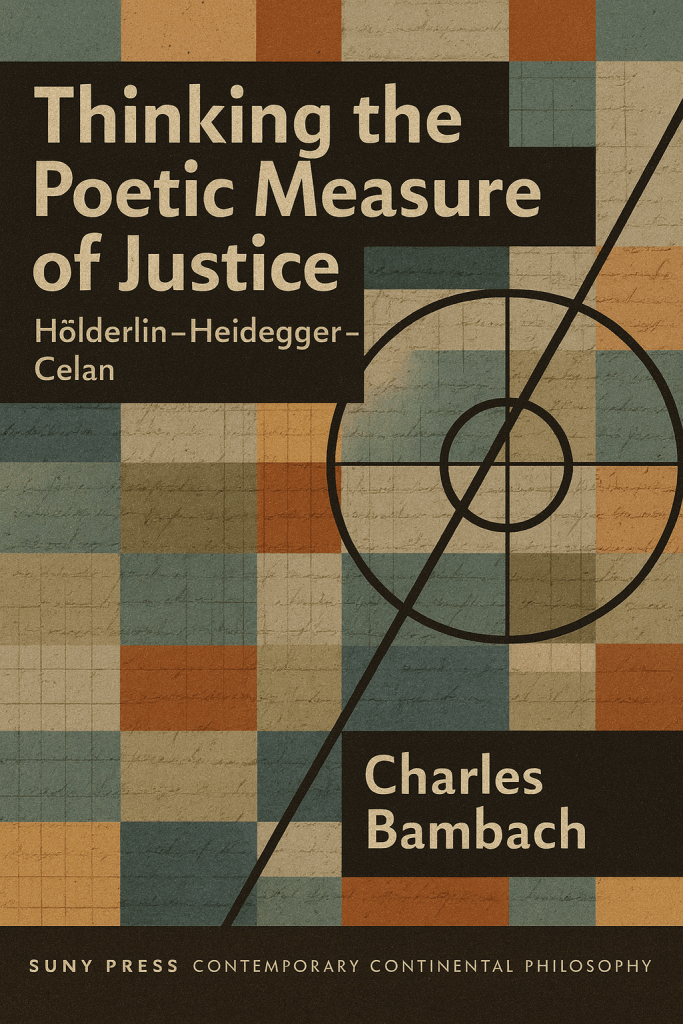
In Thinking the Poetic Measure of Justice: Hölderlin–Heidegger–Celan, the reader is drawn into an unusually deep reflection that insists on bringing poetry and philosophy face to face with the most pressing questions of ethics, law, and the hidden exigencies of what it means to measure the immeasurable. The volume ventures beyond any conventional moral or legal approach to justice and instead pursues its abiding concern as a kind of “poetic measure,” rooted in a thinking that lies at the cusp of archaic Greek insight and the modern quest for authenticity. From the first pages, the author boldly announces that justice, so often circumscribed by codes of law or moral directives, demands a deeper reading that is neither strictly normative nor reducible to a set of rules. Drawing on the elusive voices of Friedrich Hölderlin and Paul Celan, placed in exacting conversation with the thought of Martin Heidegger, the book illuminates the strange middle ground in which modernity unfolds: the tension between the resolute appropriation of one’s own language and the shock of encountering the other as a perpetual source of estrangement.
The distinctive stake of Bambach’s work is to relocate the question of justice at the fault-line where Greek reflection on dike (justice as measure and right ordering), modern thinking about dwelling and ethos, and twentieth-century poetic witnessing converge and resist each other. Bambach’s contribution lies in specifying measure as a poetic operation that both gathers and exposes the unmasterable excess of historical experience, while tracking how that operation becomes legible in the textual afterlives of Hölderlin’s hymnic thinking, in Heidegger’s meditations on measure, abode, and language, and in Celan’s post-catastrophic poetics of address. The book’s method unites philosophical archaeology with philological close reading to show how justice emerges as an event of language—neither a juridical calculus nor a moral prescription—whose “measure” must be found in the very movement of saying that shelters and unsettles what it names.
Bambach’s outer frame begins by restoring the weight of an apparently simple, devastating question that circulates between Hölderlin and Heidegger: Is there a measure on earth? The framing gesture is exacting. In the lectures and essays that gather Heidegger’s prolonged conversation with Hölderlin, measuring is neither a technique nor a metric; it is a way of letting the human stand within bounds that have the character of a showing and a withdrawal. The introductory movement presents a critical scene: modernity multiplies instruments of calculation and codifies norms, yet the capacity to find the measure that grants belonging without domination grows thinner. This is not announced as a romantic lament. It is staged as a problem of thinking in language: measure is at once the gathering (legein, a collecting that brings-to-presence) and the restraint that prevents appropriation from closing its circle. When that gathering-forbearing balance breaks, justice collapses into either procedural formalism or unbounded retribution. The introduction establishes two claims that the rest of the book repeatedly tests against the texts: first, that justice acquires articulation only as a measure enacted in language, a measure that manifests as poetic saying; second, that the very possibility of such saying is threatened by historical devastations that corrupt the mother tongue itself. From the beginning, Bambach situates his project as a response to both claims—stressing the need to read the poems and the philosophical reflections as laboratories in which the measure of justice is both sought and imperiled.
Within this frame, the first sustained movement turns to Hölderlin’s poetological labor as a scene where measure becomes insistently thinkable and insistently unstable. Bambach approaches the hymns and related texts not as heralds of a lost Greek harmony but as sites where the poet undergoes the vexed relation between near and far, homeland and foreign, sanctuary and exposure. The interpretive wager—argued through the very texture of citation and paraphrase—is that Hölderlin’s practice of interpretation (Deutung) names a discipline of attending to what endures in language as “solid letter” and to what exceeds that solidity in caesuras, reversals, and turns. It is measure that binds these—measure as a mode of reading and letting-be that keeps the promise of order while admitting the incursion of strangeness. Bambach emphasizes how this measure already bears the name of justice: the poet’s task is to let be seen what belongs to the gods and what belongs to mortals without confounding the orders. This is textually secured at multiple junctures where the hymns articulate the burden of naming measure as a gift and a risk. The river hymns distribute a topography in which the homeland can no longer be a place of simple possession; it must become a dwelling that bears the foreign at its center. The interpretive claim—explicitly argued and not merely inferred—is that poetic measure keeps open the possibility of belonging without erasure by letting locality be crossed by what cannot be domesticated.
This attention to Hölderlin’s “measure” as both naming and straining carries forward a compositional sequence that is important for Bambach’s whole architecture: he begins from the poet who makes measure a problem for language as such, and only then draws Heidegger into that difficulty. The decision is methodological. Heidegger’s meditations on measure, dwelling, and the essence of language are read as an attempt to think through Hölderlin’s insight into the fragility of measure and the intractability of the foreign. The evidential base is philological: Bambach consistently aligns phrases and motifs in the poems with Heidegger’s formulations, tracking not derivation but a sustained responsiveness. The method abstains from a schematic mapping of “influences.” Instead, it isolates recurring constellations—measure, exile, the unhomely—whose recurrence across poet and philosopher signals both proximity and irreducible distance. Where textual warrant is explicit (terminological convergence, thematic self-commentary in lectures and essays), Bambach marks it. Where the parallel requires associative reconstruction (a resonance between a hymnic turn and a Heideggerian instance of Ereignis as event of appropriation), the inference is declared as such and supported by argumentative scaffolding rather than asserted as fact.
Through an erudite combination of textual close readings, philosophical archaeology, and historical excavation, this book painstakingly locates justice in the very movement of poetic language. Justice ceases to be confined to punitive verdicts or to moral prescriptions; it becomes something embedded in the subtle play of presence and absence, of homeland and exile, of the self in quest of what is radically foreign. On one level, the author tracks Hölderlin’s shift from a classical enthusiasm for the Greek measure of harmony to the tragic recognition of measurelessness at the heart of human endeavors. Hölderlin’s poetological approach wrestles with the disturbing possibility that the home—one’s native ground—contains an abiding strangeness, and that genuine measure arises precisely in acknowledging how one is held by a concealed order that neither belongs to us nor can be mastered by us. The text portrays Hölderlin as the poet who relentlessly explored the precarious limit where the comfort of homeland dissolves into a swirl of historical and mythic forces—an insight that echoes in the Swabian countryside and in the haunting lines of his river hymns, reminding us that the seemingly secure boundaries of identity remain susceptible to reversal, renewal, and a deeper law of cosmic play.
At the book’s center is Heidegger’s mediating role in how poetry might reorient our sense of dwelling upon the earth. Heidegger is presented as a thinker who finds himself caught between a powerful longing for rootedness in the native soil and an awareness of the unhomely—what Hölderlin and the ancient tragedians alike called the uncanny dimension of human being. Yet the text avoids any uncritical repetition of Heidegger’s most dangerous or parochial formulations, drawing instead on his more radical notion that genuine ethos—or a genuine ethics, rethought at its roots—consists in pondering the abode or dwelling place of mortals. This abode is fragile, poised between birth and death, between words that gather the measure of the earth and the silence that withdraws that measure altogether. As the argument unfolds, it refuses to conflate divine justice with theological commands or to reduce mortal justice to jurisprudential norms. Instead, it seeks a deeper ethos that might arise in poetic memory, as if the only way to answer the major devastations of history—especially the twentieth-century catastrophes—were by turning to the word that bears witness, the word that enacts both pain and hope in a language of searing directness.
From here the study reconsiders Paul Celan’s oeuvre, focusing on how his poetry becomes both a lament and a gathering of the unburied ashes of the Shoah. In Celan’s fractured lines, with their unrelenting tension of foreignness and uncertain belonging, one discovers the urgent demand for a measure beyond the conventional. The poems point to a justice that cannot be administered by normal means, a justice in excess of any legal system, at once irretrievable and indispensable. The book shows Celan wrestling with the German language itself, that same language manipulated for hateful ends, struggling to reorient it so that the voices of the silenced might be allowed a resting place in the poem. Drawing on the resonances of Kabbalistic motifs and bridging these to a subterranean dialogue with Heidegger’s meditations on Hölderlin, the work discloses Celan’s acute awareness that the poetic word functions as a crypt and an epiphany at once. Attempting to do justice to the immeasurability of grief, Celan transforms German into a medium in which strangeness and familiarity collide, exposing the raw nerve of an ethicality that defies ordinary boundaries. This summoning of a wholly other dimension—what Celan calls the wholly Other—carries the questioning beyond familiar moral categories. In effect, it demands an approach to justice that pays homage to the ravages of history without presuming any closure or final settlement.
Heidegger enters as the thinker of ethos—ethos glossed at first mention as the dwelling-place of human being—who seeks to prepare a ground where measure might again become possible without appealing to a highest rule or a sovereign tribunal. Bambach’s depiction is neither apologetic nor accusatory; it is diagnostic. The thinking of measure must deal with two interlinked difficulties: the lure of rootedness that risks hardening into parochialism, and the equally dangerous pull of abstract universality that evacuates place, language, and remembrance. The decisive philosophical claim that Bambach attributes to Heidegger (textually secured in the corpus he assembles) is that justice, if it is to be more than enforcement or distribution, concerns the proper site for human dwelling in the vicinity of the gods and earth, sky and mortals. The measure of that site is never simply present; it appears in the rhythm of saying that gathers and withholds. Here Bambach’s analysis stresses how measure as ethos is inseparable from language understood as letting-appear, a legein that collects what presences without reducing it to raw material. The juridical imagination seeks rules; the poetic imagination seeks measures—proportions that keep limit and overflow in tense alliance. The book’s dialectical movement—more accurately, its composed oscillation—renders this alliance as a standing-in-the-between (Zwischen) that defines the human as inhabitant of thresholds.
Collisions with history press this thinking to a breaking point. Bambach does not treat “history” as background; it is a force that deforms language and questions whether measure can survive at all when speech has been pressed into the service of annihilation. The analytic transition to Celan is prepared precisely by this pressure. If Hölderlin allows one to see the foreign at the center of the native, and if Heidegger labors to think ethos as that between which grants measure, Celan brings to speech an epochal devastation that has burned into German the memory of those denied graves and names. What must measure mean in a language that has been used to target and erase? Bambach’s pivot is careful and documented: he follows Celan through the work of address, encounter, and memorialization, in which justice ceases to appear as verdict and becomes, in the strictest sense, a doing of justice to the dead by holding open a space where the silenced may be spoken to without being appropriated. The book’s central chapters—on the dialogical tension with Heidegger, on the poems that stage impossible conversations—demonstrate how the poetic measure becomes a practice of spacing: a restrained movement of words that allows an Other to arrive as wholly other without being subdued by an interpretive embrace. At the heart of this practice lies a refusal to convert the poem into a monument or a system; the poem functions as a crypt and an epiphany, a holding that neither entombs nor exposes to spectacle. These claims are grounded in close readings whose textual fidelity anchors the philosophical reach.
Throughout this interpretive endeavor, the reader encounters moments of startling clarity that give rise to exclamations of insight. Every page, in its way, brings a sense of quiet revelation, as if truths hidden within verse lines suddenly surface, carried by an unerring attentiveness to textual nuance. The investigation shows a thorough and passionate understanding of German intellectual history, uniting a fresh commentary on pre-Socratic notions of dike with an exhaustive grasp of Swabian Pietism, of Romantic philology, and of the crisis that befell Germany in the twentieth century. The carefully woven argument is delivered with contemplative rigor, often provoking an “aha” realization about the nature of language, the function of poetic remembrance, and how we might conceive of ethics when stripped of moralistic scaffolding.
The result is a project that is at once historically rooted—offering close readings of poems by Hölderlin and Celan, linking them to the tragedy-laden inheritance of Greek antiquity—and starkly contemporary. It raises questions of how trauma and destruction have shaped the modern German sense of identity, how the foreign can become one’s own, and how fragile indeed the measure of justice proves to be when entire cultures crumble under violent regimes. The carefully voiced hermeneutics bring to light a deep philosophical perspective on the precariousness of human dwelling. Indeed, the text insists that the measure of ethics cannot be calculated by the yardstick of positive law or enumerated in moral codes, but must be reckoned through the more originary forces of poetic recollection, the searching invocation of language, the abiding recognition that we dwell in an interval marked by absence as well as presence.
With each turn of the page, the writing compels the reader to ponder how the poetic work resists easy assimilation, how it shatters complacent reading, demanding an almost metamorphic shift in our ways of thinking and experiencing. Justice, here, is seen as the dynamic interplay of homeland and exile, the abiding tension of the native and the foreign, the “proper” and the “strange.” That tension unfolds against the background of German history, in which the twentieth century’s destructive impulses suggest that no purely “legal” measure of justice could ever suffice. Instead, the text frames justice in terms of a deeper “metron,” which the poet grasps in fleeting glimpses of tragedy and transcendence, or in the subtle movements of the psyche that Greek tragedy once named as a site of sacred pathos. The conversation orchestrated by Hölderlin, Heidegger, and Celan reconfigures the question of justice so that it no longer subordinates itself to moral verdicts; it becomes, rather, an incommensurable measure that each poet strives, and yet fails, fully to voice.
Everything in this volume—its philological depth, its ambitious philosophical scope, its exacting textual analyses—gestures to a project that is both learned and lucid. It does not dismantle poetry by folding it into a legal or moral treatise; rather, it shines a contemplative light on the irrepressible force of poetic language that demands to speak not only from a vantage of native familiarity but from exilic dissonance as well. This dual vantage compels a new reading of justice, one that draws us into a heightened awareness of the foreignness that underlies what we take to be our ownmost ground. The trauma of the Shoah, the rhetorical fervors of the Swabian homeland, the ancient Greek tragedies, and the pre-Socratic wonder at physis all converge here into a staggering vision of what it might mean to do justice to being itself.
The narrative thus congeals in a sequence that is neither linear development nor circular return: Hölderlin’s measure makes Heidegger’s ethos thinkable; Heidegger’s ethos measures a place for dwelling; Celan addresses that place after its desecration, discovering that measure—if it persists—must be pared down to a word that asks and refuses, names and holds back. This sequence, however, is repeatedly displaced by the texts themselves. Bambach tracks how motifs shift under pressure: the scene of homeland in Hölderlin changes mode when re-articulated after historical catastrophe; the vocabulary of measure in Heidegger must relearn itself in the face of a poet whose mother tongue has been wounded; Celan’s address to the thinker of dwelling bears witness to both proximity and unsayable distance. At each juncture the author distinguishes what the pages explicitly say from what emerges as a disciplined inference. In the Patmos constellation, the insistence on the “solid letter” is a textual datum, while the claim that such solidity prefigures a mode of justice that resists coercive clarity is an argued extrapolation. In the reading of Todtnauberg, the poetic record of encounter serves as evidence, whereas the reconstruction of its dialogical structure as a measure that grants an audience without reconciliation is marked as interpretive.
The book’s opening cadence reads the modern frenzy of measurement against the ancient sense of measure. The difference is not numeric versus qualitative alone; it is the difference between a domination that tallies and a listening that apportions. Bambach makes this difference visible by following the etymological and conceptual threads through which measure, justice, and language tie together. The Greek dike—which, at first mention, he glosses as rightness, distribution, and the just limit—does not yield a legal code; it opens a space where rightness manifests as form in motion. The early poetics of fate and the tragic sense of order become decisive because they paradigmatically enact the measure of limit: to trespass is not merely to violate a rule; it is to break the proportions that let the human stand. The evidentiary basis for this reading is secure in the texts Bambach adduces, both in their explicit evocations of tragic measure and in the structural role that rupture and return play in their stanzaic and syntactic designs. Where his argument moves beyond the letter, it does so by making the minimal commitments possible under conditions of interpretive constraint: measure cannot be a formula; it must be the activity of apportioning in speech that knows itself liable to failure.
Hölderlin’s poems provide a topological laboratory for these commitments. Bambach’s explications follow the rivers, the islands, the mythic coordinates not as emblems but as places where measure becomes visible as relationality. The rivers gather tributaries, shorelines, ships, cities, gods. The poet’s task is to measure along these convergences without erecting an empire of meaning. The homeland appears—Swabian fields and towns—and with it the uncanny disclosure that the most one’s own bears a core of foreignness. The polarity is not resolved; it is the very path where measure must be exercised. The poet’s declarations on interpretation, on the care for the enduring letter, are taken at their word and examined in their consequences: interpretation becomes not an imposition but a holding of the word in its tensions, a justice done to the text and to the world it gathers. Bambach’s philological patience here is one of the book’s enduring strengths. He refuses to extract a thesis from the poem and instead lets thesis-like claims arise from the rhythm of turns, invocations, and silences.
Heidegger’s middle position is decisive less as doctrinal content than as a reconfiguration of the site of ethics. Bambach, guided by the lectures on Hölderlin and by texts that meditate on measure and the essence of language, pursues the claim that ethos is abode—ethos as dwelling in the open that earth and sky, mortals and gods distribute among themselves. The fourfold (named once and then used sparingly) is not treated as a metaphysical structure; it is a diagram of measure. Justice, in this topology, would be the capacity to inhabit the between without rage for closure, to be at home in the unhomely. This is where Bambach’s project makes its most delicate moves. Heidegger’s longing for rootedness is acknowledged as a danger; his capacity to think the unhomely is acknowledged as a resource. The demarcation between explicit textual ground and contextual inference is clear: the danger and the resource are both thematized in the corpus, but their ethical import in the wake of twentieth-century events requires an interpretive burden that the book openly assumes. The result is neither exoneration nor condemnation; it is a specification of the philosophical stakes of measure after the collapse of the metaphysical will to ground.
With Celan, the question of who can speak the measure becomes concrete to the point of pain. Bambach tracks this exigency in poems that make the German language stagger under the demand to remember the unburied dead. A justice that could be administered is rejected as insufficient; what is needed is a justice that attends to absence without converting absence into presence. The poem becomes, in Bambach’s presentation, a crypt that counters oblivion and an epiphany that discloses nothing to consumption—a speaking that lets the dead be addressed without being absorbed. The way to that speaking is exceedingly narrow. Hence the recurrent figure of encounter: to whom does the poem speak, and what happens when the interlocutor is the philosopher who thought language as the house of being? Bambach’s long reading of Todtnauberg is exemplary in its disposition. The poem supplies facts: a place, a hut, an encounter, a well, an implied expectation, an undelivered word. The interpretive movement then measures how those facts can be allowed to resonate without being forced into a verdict. The expectation for a word—understood as acknowledgement, responsibility, or admission—remains unmet; the poem leaves its reader with a measureless appeal. Bambach’s philosophical conclusion, carefully insulated from overreach, is that the measure of justice the poem seeks is neither absolution nor accusation; it is an address that keeps the wound open as the only honest form of memorial relation.
The composition of the book bears within it its own theory of measure. Beginning from Hölderlin is already a claim: measure must be sought in the poem before it can be thought in the concept. Turning to Heidegger second allows ethos to be thought through the measure uncovered by the poems. Moving to Celan third subjects ethos to the trial of historical extremity. The postscript gathers these lines without tying them off. Bambach’s insistence on sequence—and on displacement—manifests in his practice of citation and paraphrase: the early chapters elucidate a measure that appears as care for the enduring letter and for the foreignness within the familiar; the middle chapters radicalize that care into a way of inhabiting language as dwelling; the later chapters contract the ambition of dwelling into a practice of address that grants nothing beyond the possibility of saying you and here in the ruins. Each stage both presupposes and transforms what precedes it. This is as much a claim about the history of thought as it is a method for reading. When later sections return to earlier motifs, they do so to show that what seemed stable (homeland, measure, ethos) is always already fissured by the demand of the Other.
The book’s argumentative rhythm moves along several combined problems. First, the problem of measure without metric: how can justice be measured when the appropriate aids—rules, norms, codes—either fail or turn lethal? Second, the problem of dwelling in a wounded language: what does it mean to say that language houses being when that house has been used as an instrument of expulsion? Third, the problem of address and response: can the poem make a claim on the addressee that is neither reducible to moral injunction nor dismissible as aesthetic play? Bambach answers these through cumulative demonstration rather than through theses. The readings of Hölderlin show that measure is as much a matter of spacing and timing as of content; the readings of Heidegger show that dwelling is a mode of attention that gives place to things and gods; the readings of Celan show that place after catastrophe is a precarious threshold where only a curtailed measure—an almost silence—will not betray the dead. Where the book posits conclusions, they are phrased as constraints: no justice worth the name can bypass the poem’s discipline of listening; no ethics can be reconstructed without learning again how to measure the intervals of speech; no reconciliation can be claimed where the condition of speaking remains a wound.
At the level of conceptual exposition, Thinking the Poetic Measure of Justice develops a compendium of carefully delimited terms. Measure is the central node; it appears as proportion, restraint, apportioning, and as the rhythm of saying that allows something to emerge as itself without being swallowed by the one who names it. Justice is then redescribed as the name for the measure appropriate to mortal existence in its nearness to the gods and in its responsibility to the absent. Ethos is explicated once as dwelling, with a deliberate avoidance of later inflation; it remains the name for the site where justice must be measured. Legein—the Greek for the gathering of language in saying—is introduced in its basic force, then used as a guide to resist the technicized conception of speech that treats words as carriers of information. The foreign/the strange designate the unavoidable otherness that enters the heart of the native and prevents possession from closing upon itself. None of these terms is left in isolation; Bambach makes their coordination visible by showing how each answers a failure in the others. Where there is measure without justice, the book points to the tightness of harmony that refuses suffering; where there is justice without measure, it points to revenge clothed in righteousness; where there is ethos without strangeness, there is only parochial closure; where there is strangeness without ethos, there is exile without place.
The textual ground for these articulations is ample. In Hölderlin, the exhortations to interpret and to care for the enduring word support the primacy of measure as a hermeneutic discipline. Where Bambach infers beyond the letter, he does so to maintain fidelity to what the poems demand: that measure is not imposed but suffered as a task. The homeland’s oscillation in the hymns serves as firm ground for the claim that belonging is internally fissured. The river’s function as both gathering line and vector of departure secures the insistence that measure is a navigation rather than an enclosure. The figure of fate—“it measures us perhaps with the span of being”—is taken literally enough to show that measure comes to mortals from beyond their management. In Heidegger, the lectures and essays on Hölderlin, and the reflections that seek a “measure for measuring,” supply the philosophical workshop in which measure becomes a thinking of ethos. Bambach keeps his distance from any grand system; instead, he locates discrete moments where measure is explicitly thematized, where dwelling is described as a keeping within bounds, and where language is raised to its sheltering function. His interpretive expansions—concerning the risks of rootedness and the danger of abstraction—are marked as contextual and motivated by the ethical horizon of the inquiry. In Celan, the readings are anchored in the poems’ own staging of addressee, place, and expectation. The encounter poems—above all the one that bears the name of the philosopher’s hut—permit precise specification of what a “word” would need to be to count as adequate measure. Bambach notes that no such word is delivered and draws measured consequences: the measure of justice in this topology may be the restraint that refuses to fill the silence with self-exculpation.
One of the book’s more subtle contributions is to show how poetic measure functions as a counter-technique in a world saturated with techniques. The modern disciplines of measuring—statistics, surveillance, procedural rationality—are not demonized; Bambach simply shows that they belong to a different register. They can distribute goods, enforce rules, coordinate actions. They cannot measure grief, guilt, remembrance, or the claim the dead make upon the living. The poem, however, can neither replace the court nor pretend to purity. Its measure does something else: it gives time and space to what cannot be resolved, it holds the address to the other open long enough for a response that may never come. The success criteria for such measure cannot be utility or closure. This reconfiguration of criteria is both philosophical and practical. Philosophically, it protects justice from collapsing into mere legality. Practically, it suggests disciplines of speech—slowing down, care for words, refusal of noise—that can be cultivated. Bambach does not formalize these as prescriptions. He lets the readings teach them.
Attention to composition within each part of the book mirrors the large-scale architecture. In the Hölderlin section, Bambach develops constellations that congeal around particular poems and then displace themselves through the poet’s own turnings. A hymn will gather homeland and god, then twist toward exile and delay; the commentary follows this twist, letting the initial comprehension be undone. The displacement is not a weakness; it is the very sign that measure has occurred. In the Heidegger section, constellations take the form of thought-paths: the thinker proposes a measure, tests it against the requirements of dwelling, discovers its vulnerability to historical distortion, and modifies his vocabulary to accommodate withdrawal. Bambach shows the vocabulary shifting under pressure—measure becoming event, event becoming propriation, propriation bending toward a letting that resists capture. In the Celan section, the constellations are built from scenes of address and from lexical knots—words that split under the strain of bearing witness. The displacement here is often abrupt: a promise of meeting becomes a reminder of non-meeting; a place offered as sanctuary is remembered as compromised. In each section, Bambach’s practice of distinguishing explicit textual force from interpretive elaboration secures the reader’s confidence that the philosophical reach is tethered.
The work’s historical sensibility is conspicuous without being overwhelming. Greek beginnings are recalled only to the extent that they help to mark how dike lived as measure before it degenerated into criterion. The Romantic and post-Romantic fate of the German language is evoked as the medium in which measure must be sought and can be lost. The twentieth century is present as catastrophe and as the stern teacher of restraint. The detail here matters because Bambach’s thesis depends on context without allowing context to suffocate text. The careful allusions to theological motifs—figures of gods who come near and withdraw; the fragile nearness of the divine that cannot be captured—serve to scale the question of justice beyond the polis without sending it into dogmatics. The effect is to return the reader to a task that requires reverence without piety: to measure as the poem measures, which is to keep proportion with what exceeds our grasp.
A further tension that the book surfaces and refuses to resolve concerns the destination of its own practice. If justice as poetic measure refuses program, what, then, is the reader to do? Bambach answers performatively: the book itself measures. Its style—analytic yet patient; close to the line, yet aware of what the line cannot carry—enacts the very ethos it recommends. The documentation of textual claims is thorough; the transitions to larger stakes are signaled; the inferences are named as such. This produces an unusual clarity in a project that might otherwise have dissolved into lyricism or invective. In the pages that treat the encounter between poet and philosopher in the Black Forest, the prose tightens around the conditions of dialogue and the limits of apology. The philosopher’s silence about what the poet needs to hear is neither explained away nor weaponized; it is held as a datum of measure: some words, once withheld, cannot be supplied after the fact without falsifying the relation. Justice in this register is a minute calibration of what can and cannot be asked and what can and cannot be given.
An important implication is that the measure of justice in language produces a revaluation of hermeneutics. Interpretation ceases to be an extraction of meaning or a display of mastery. It becomes a sharing of place with the text, a willingness to be bound by the order the text seeks to articulate, and a readiness to be interrupted by what the text cannot articulate. The old polarity between philology and philosophy weakens. Bambach’s handling of line, word, and historical allusion is as rigorous as his handling of concept. This equilibrium is not decorative; it is ethical, in the book’s sense of ethos. To interpret well is to dwell well, and to dwell well is to distribute one’s attention and speech according to a measure that answers to gods, earth, mortals, and the unspeakable claim of the dead. In such a frame, the usual aspirations for synthesis give way to a practice of conjoining without absorption. Hölderlin and Heidegger touch and recoil; Celan touches and recoils; the reader is asked to sustain the distance as the only truthful intimacy.
There is also a reflexive movement that the book does not hide: to speak about justice through poems is to risk aestheticization. Bambach manages this risk by attaching the claims of justice to the material features of the poems—pauses, enjambments, refusals of closure, naming of places—so that “justice” does not float as noble intent. Where the analysis reads a silence as significant, it supplies the pragmatic background that makes the silence legible; where it reads a turn as measure, it shows how meaning is redistributed across strophic architecture. This refusal of vague elevation is the backbone of the project. Justice remains a great word; the book keeps it small enough to fit inside a line break and heavy enough to resist sloganization. The result is a practical ontology of language: words are places where worlds gather; they can be polluted; they can be cleaned only by use that risks failure.
The postscript does not provide a moral; it clarifies stance. The measure of justice that this triptych—Hölderlin, Heidegger, Celan—allows one to glimpse cannot be institutionalized without remainder. Institutions are necessary; their measures are of another sort. What the poem measures is the interval in which a human being can face another without engulfing or abandoning them. In a time that multiplies verdicts and starves attention, such measure appears almost useless. The book’s closing insistence—quiet but firm—is that this uselessness marks the utility required for living with others without violence. The path made visible is narrow: care for letters, patience with silence, restraint in asking, and a readiness to stand in the exposed space where no measure shows itself until the language—foreign to itself and to us—makes place.
If one asks what is textually secured in all of this, the answer is unambiguous: Hölderlin’s devotion to interpretation and measure; Heidegger’s ongoing effort to think measure as ethos and language as shelter; Celan’s staging of address in a wounded tongue that cannot deliver the word desired and refuses the word that would cheapen desire. If one asks where the argument moves by inference, the author says so: where the measure of justice migrates from poem to ethos to address, the moves are warranted by resonances, by shared crises, and by the stubborn refusal of the texts to permit easy closure. The book is learned, but its learning is harnessed to a task that must remain unfinished: to keep justice thinkable where thinking risks becoming calculation and where speech risks becoming noise. The measure that accomplishes this is poetic in the strictest sense: a making that gathers, a saying that lets be seen, a dwelling that keeps its doors open to the foreign wind that is already inside the house.
In that sense, Thinking the Poetic Measure of Justice is less a thesis about three writers than an exercise in what it describes. It binds together a classical problematic—justice as measure—with the modern discovery that measure is always at risk of becoming measurelessness, and it binds both to a catastrophic century that obliges the poem to become a kind of conscience. Each binding both holds and tears. Bambach’s refusal to heal the tears is his fidelity to the measure that the poems themselves enact. The closing clarification is exact: justice, if it is to have substance in our languages after what our languages have done, must be reconceived as the delicate practice of apportioning words and silences so that an Other can appear. This is the measure that poetry keeps—Hölderlin’s measured hymn, Heidegger’s measured thinking, Celan’s measured wound—and it is the measure that keeps justice from dissolving into code or rage.
The book, in the end, proves profoundly eloquent. It indeed offers moments of illumination and well-placed exclamation, combining together thorough scholarship with a stirring philosophical sense of purpose. Its grand ambition is to provoke the reader to see that ethics and law must be re-founded on a level deeper than moral or juridical codes, that justice must be measured against a poetic sense of the immeasurable, and that the foreign has always secretly animated one’s own identity. It is, by all accounts, essential reading for anyone seeking a rigorous, inspiring, and genuinely transformative approach to the poetic dimension of ethics in the modern world. The thoroughness of its method, the passion of its clarifying insights, and the sheer range of its contemplative reach all confirm that this is a work worth reading—and reading again—for the ever-new revelations that it so deftly draws forth.
 Simon Gros
Leave a comment