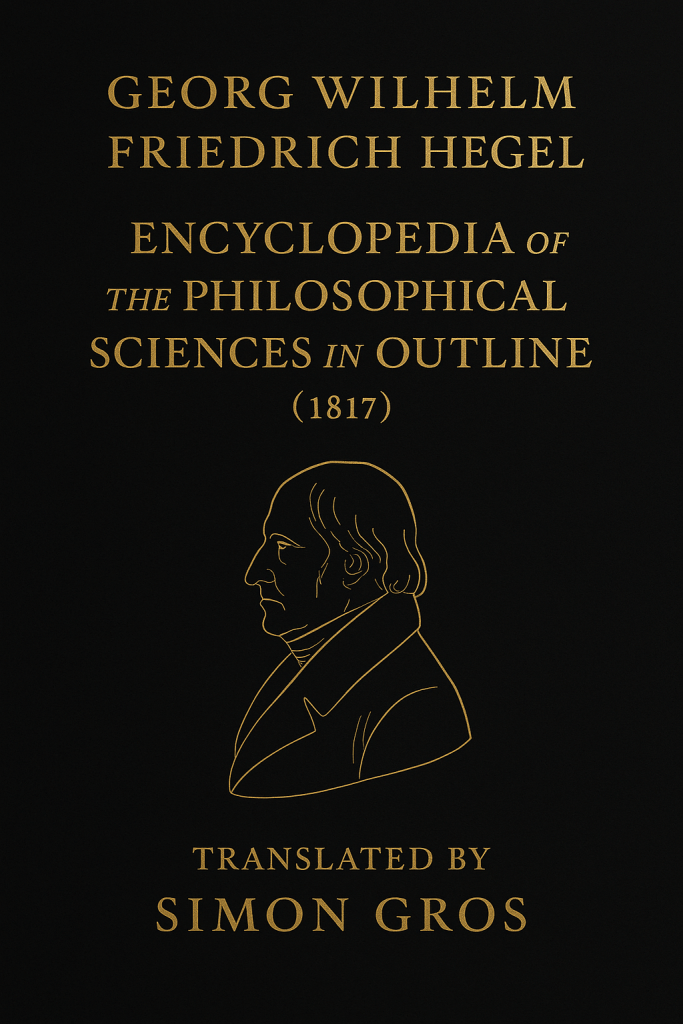
GEORG WILHELM FRIEDRICH HEGEL
ENCYCLOPEDIA OF THE PHILOSOPHICAL SCIENCES IN OUTLINE
(1817)
Preface
The need to place a guiding thread into the hands of my listeners for my philosophical lectures is the immediate reason that I let this overview of the entire scope of philosophy appear earlier than I had otherwise intended.
The nature of an outline not only excludes a more exhaustive elaboration of the ideas according to their content, but in particular also constrains the development of their systematic derivation, which must contain what is otherwise understood as proof, and what is indispensable for a scientific philosophy. The title was meant partly to indicate the scope of a whole, and partly to indicate the intention of reserving the details for oral presentation.
In the case of an outline, however, only an external expediency of arrangement and structure comes into consideration, when it is a content already presupposed and known, which is to be presented in deliberate brevity. Since the present exposition is not of this kind, but instead sets forth a new elaboration of philosophy according to a method which, as I hope, will still be recognized as the only genuine one, identical with the content itself, I might have considered it more advantageous for the public if circumstances had allowed me to let a more detailed work on the other parts of philosophy precede, such as the one I have already given to the public on the first part of the whole, logic.
I believe, moreover, that although in the present exposition the side by which the content lies closer to representation and empirical acquaintance had to be restricted, I have nevertheless, with regard to the transitions, which can only be mediated through the concept, made sufficiently clear that the methodical progression is distinguished both from the merely external arrangement sought by other sciences, as well as from a manner that has become common in philosophical subjects, which presupposes a schema and then aligns the materials to it just as externally, and even more arbitrarily than the first way, and through the strangest misunderstanding claims to have satisfied the necessity of the concept with the contingency and arbitrariness of these connections.
We also saw this same arbitrariness seize upon the content of philosophy and venture forth on adventures of thought, imposing itself for a time upon genuine and earnest striving, but otherwise being regarded as an absurdity heightened even to madness. Instead of the imposing or the mad, the content more often and more properly offered well-known trivialities, while the form showed nothing more than the mannerism of a deliberate, methodical, and easily fabricated wit of baroque combinations and of a forced distortion, and in general, behind the appearance of seriousness, a deception both of oneself and of the public could be discerned.
On the other hand, we also saw shallowness, the lack of thought, turn itself into a self-satisfied skepticism and a reason-modest criticism, and with this emptiness of ideas, in equal measure, increase its arrogance and vanity. These two tendencies of spirit have for a considerable time mocked German seriousness, have wearied its deeper philosophical need, and have resulted in an indifference, indeed even in such contempt toward the science of philosophy, that now even a so-called modesty dares to pass judgment on and deny the deepest matters of philosophy, and presumes to reject from it the rational cognition whose form was formerly understood as proof.
The first of the phenomena mentioned can in part be regarded as the youthful exuberance of the new epoch which has arisen in the realm of science as in the political realm. When this exuberance greeted the dawn of the rejuvenated spirit with intoxication, and without deeper labor immediately hastened to the enjoyment of the Idea and, for a time, reveled in the hopes and prospects which it offered, it is easier to be reconciled with its excesses, since a genuine core underlies it, and the superficial haze it spread around it must of itself dissipate. The other phenomenon, however, is more disagreeable, because it betrays exhaustion and lack of strength, and strives to cover this with a conceit that misunderstands itself above all, while pretending to master the philosophical spirits of all centuries.
All the more gratifying, then, is it to observe, and also to acknowledge, how philosophical interest and the earnest love of higher cognition have been preserved against both tendencies, unpretentiously and without vanity. If this interest sometimes directed itself more toward the form of an immediate knowledge and of feeling, it nevertheless bears witness, in contrast, to the inner and further-reaching impulse of rational insight, which alone gives man his dignity. This dignity is realized most fully when even that standpoint itself becomes for him only the result of philosophical knowledge, and thereby what it seems to disdain is at least acknowledged by it as a necessary condition. To this interest in the cognition of truth I dedicate this attempt, as an introduction or contribution to its satisfaction; may such a purpose secure for it a favorable reception.
Heidelberg, May 1817
TABLE OF CONTENTS
Introduction
A. THE SCIENCE OF LOGIC
Preliminary Concept
First Part. The Doctrine of Being
A. Quality
a. Being
b. Dasein (Determinate Being)
c. Being-for-itself
B. Quantity
a. Pure Quantity
b. Quantum
c. Degree
C. Measure
Second Part. The Doctrine of Essence
A. The Pure Determinations of Reflection
a. Identity
b. Difference
c. Ground
B. Appearance
a. Existence
b. Appearance
c. Relation
C. Actuality
a. Substantiality
b. Causality
c. Reciprocity
Third Part. The Doctrine of the Concept
A. The Subjective Concept
a. The Concept
b. The Judgment
c. The Syllogism
B. The Object
a. Mechanism
b. Chemism
c. Teleology
C. The Idea
a. Life
b. Cognition
c. The Absolute Idea
B. THE PHILOSOPHY OF NATURE
First Part. Mathematics
Second Part. The Physics of the Inorganic
A. Mechanics
B. Elementary Physics
a. Elementary Bodies
b. The Elements
c. The Elementary Process
C. Individual Physics
a. Form
b. Specification of Bodies
c. Process of Individualization
Third Part. The Physics of the Organic
A. Geological Nature
B. Vegetative Nature
C. The Animal Organism
C. THE PHILOSOPHY OF SPIRIT
First Part. The Subjective Spirit
A. The Soul
a. The Natural Determination of the Soul
b. Opposition of the Soul to its Substantiality
c. The Actuality of the Soul
B. Consciousness
a. Consciousness as such
b. Self-Consciousness
c. Reason
C. Spirit
a. The Theoretical Spirit
1. Feeling
2. Representation
3. Thinking
b. The Practical Spirit
4. Practical Feeling
5. Drive and Inclination
6. Happiness
Second Part. The Objective Spirit
A. Right
B. Morality
C. Ethical Life
1. The Individual Nation
2. External Public Law
3. Universal World History
Third Part. The Absolute Spirit
a. Religion of Art
b. Revealed Religion
c. Philosophy
ENCYCLOPEDIA OF THE PHILOSOPHICAL SCIENCES
INTRODUCTION
§1
All other sciences, unlike philosophy, have such objects as are immediately accepted by representation, and are therefore presupposed at the beginning of the science, just as the determinations regarded as necessary in its further progress are likewise taken up from representation.
Such a science does not have to justify itself with respect to the necessity of the object it treats. Mathematics in general, geometry, arithmetic, jurisprudence, medicine, zoology, botany, and so forth, are allowed to presuppose that there are magnitude, space, number, a right, diseases, animals, plants, and so on. That is to say, they are assumed by representation as existing; one does not think of doubting the being of such objects, nor of demanding that it should be demonstrated from the concept that there must be in and for itself a magnitude, space, disease, the animal, the plant.
With such an object, the known name is first mentioned. This name is the fixed element, but at first it only provides the representation of the thing. Further determinations of it are then to be given. These too may likewise be taken from immediate representation. Yet here the difficulty readily arises, namely, that determinations are taken up of which it is just as immediately admitted that they are present in the object, as also that they are essential.
As far as the formal aspect is concerned, logic — the doctrine of definitions, divisions, and so forth — is presupposed; but with regard to the content, it is permitted to proceed in an empirical way, seeking in oneself and others what marks of this kind are in fact found in the representation of the general object. But this factual basis can then be something very much subject to dispute.
§2
The beginning of philosophy, by contrast, has the inconvenience that already its very object is necessarily subjected at once to doubt and dispute: first, with regard to its content, since if it is to be indicated not merely as an object of representation, but as an object of philosophy, it is not to be found in representation at all; indeed, the mode of cognition of philosophy is opposed to it, and representation must rather be carried beyond itself through philosophy.
§3
Secondly, with regard to its form, philosophy is exposed to the same difficulty, because in beginning it appears as something immediate, yet by its very nature it must present itself as mediated, be recognized through the concept as necessary, while at the same time the mode of cognition and the method cannot be presupposed, since their consideration belongs within philosophy itself.
If it were a matter of nothing more than showing representation within itself the wholly indeterminate object of philosophy, one could resort to the usual appeal that man, beginning with sensuous perception and desire, soon feels himself driven beyond them, toward the feeling and foreboding of something higher than he is — an infinite being and infinite will — toward that general interest expressed in the questions: what is the soul, what is the world, what is God, what can I know, what ought I to do, what may I hope, and so forth. One could point more directly to religion and its object. Yet apart from the fact that such questions and such objects can themselves at once be met with doubt and negation, even immediate consciousness in part, and still more religion in its own way, already contain the resolution of those questions and a teaching about those objects. But the distinctive character by which they are the content of philosophy is thereby not expressed.
For this reason one cannot, concerning the object of philosophy, appeal to authority and general agreement as to what is to be understood by philosophy. The requirement already made in §1, of knowing necessity through the concept, is not granted, since there are many who believe they possess philosophy even though they explicitly abstract from the cognition of necessity, and instead take their objects from immediate feeling and intuition, and even call such immediacy of perception reason. In this sense Newton and the English also call experimental physics philosophy, and thus designate electrical machines, magnetic apparatus, air pumps, and so on, as philosophical instruments — although it is surely not a composition of wood, iron, and the like, but thought alone, that can rightly be called the instrument of philosophy.
§4
Because the object of philosophy is not something immediate, its concept, and likewise the concept of philosophy itself, can only be grasped within philosophy. Whatever is said here in advance about it as well as about philosophy itself is therefore something anticipatory, in itself still unfounded, yet for that very reason also indisputable, and is to be taken with the intention of providing only an indeterminate, merely preliminary, historical acquaintance.
§5
Philosophy is therefore here presented as the science of reason, namely, insofar as reason becomes conscious of itself as all being.
All other knowledge, in contrast to philosophical knowledge, is knowledge of the finite, or finite knowledge, because in it reason, as something subjective, presupposes a given object, and thus does not recognize itself within it. Even when the objects are found within self-consciousness, such as right, duty, and so forth, they are still particular objects, alongside and outside of which — and thus also outside of self-consciousness — lies the remaining wealth of the universe.
The object of religion is indeed in itself the infinite object, which is supposed to encompass everything within itself. Yet its representations do not remain true to themselves, since for it the world remains independent outside of the infinite, and what it proclaims as the highest truth is at the same time unfathomable, mysterious, and unknowable, something given, and intended to remain for distinguishing consciousness only in the form of something given and external. In religion, truth exists in feeling, intuition, foreboding, representation, and devotion in general, also interwoven with thoughts, but truth not in the form of truth. Religion thus constitutes a separate region, distinct from the rest of consciousness, even if its spirit is all-embracing.
(* The journal currently published by Thomson also bears the title: Annals of Philosophy or Magazine of Chemistry, Mineralogy, Mechanics, Natural History, Agriculture, and the Arts. One can easily imagine from this how the subjects that are here called “philosophical” are actually constituted.)
Philosophy, on the other hand, may be regarded as the science of freedom, because in it the strangeness of objects, and thereby the finitude of consciousness, disappears. Only in philosophy does contingency, natural necessity, and the relation to an externality in general — and thus dependence, longing, and fear — fall away; only in philosophy is reason entirely with itself. For this very reason, in this science reason does not have the one-sidedness of a merely subjective rationality, as if it were the property of a peculiar talent, or the gift of a special divine fortune — or misfortune — like the possession of artistic skill. Rather, since it is nothing other than reason in the consciousness of itself, it is by its nature capable of being universal science.
Nor is it idealism, in which the content of knowledge has only the determination of something posited by the I, a product confined within subjectivity and self-consciousness. Because reason is conscious of itself as being, subjectivity — the I that knows itself as a particular opposed to objects, and its determinations as distinguished from what is in and from something else outside or above it — is sublated and immersed into rational universality.
§6
Philosophy is the encyclopedia of the philosophical sciences, in so far as its entire scope is presented with the specific articulation of its parts, and it is a philosophical encyclopedia in so far as the separation and the connection of its parts are exhibited according to the necessity of the concept.
Since philosophy is throughout rational knowledge, each of its parts is a philosophical whole, a circle of totality that closes upon itself; yet within it the philosophical idea appears in a particular determination or element. Because each individual circle, being totality within itself, also breaks through the boundary of its element, it thereby establishes a further sphere. The whole thus presents itself as a circle of circles, each of which is a necessary moment, so that the system of their distinctive elements constitutes the entire idea, which likewise appears in each individual one.
§7
Philosophy is also essentially encyclopedia, since the true can exist only as totality, and only through the differentiation and determination of its distinctions can their necessity and the freedom of the whole be realized; it is therefore necessarily system.
A philosophizing without system cannot be anything scientific. Beyond the fact that it expresses more a subjective disposition, its content is contingent, since it finds its justification only as a moment of the whole, whereas outside of it, it remains an unfounded presupposition or a merely subjective certainty.
§8
By a system of philosophy one falsely understands only a philosophy based on a determinate principle, distinguished from others. In truth, the principle of genuine philosophy is to contain all particular principles within itself. This is shown both in philosophy itself and in its history, which demonstrates that the different philosophies appearing are partly only one philosophy at different stages of development, and partly that the particular principles, each of which once formed the foundation of a system, are but branches of one and the same whole.
Here the universal and the particular must be distinguished according to their proper determination. Taken merely formally and set alongside the particular, the universal itself becomes something particular. Such a position would in the sphere of ordinary life immediately appear inappropriate and clumsy — as if, for example, one who asked for fruit were to reject cherries, pears, grapes, and so forth, because they were cherries, pears, grapes, and not fruit.
But with regard to philosophy people allow themselves both to justify their disdain of it by claiming that since there are so many different philosophies, each one is only a philosophy, not philosophy itself — as though cherries were not fruit — and also to place one philosophy whose principle is the universal alongside those whose principle is something particular, indeed even alongside doctrines which assure us that there is no philosophy at all, and which use this name for a mere movement of thought that presupposes the true as something given and immediate, and makes reflections upon it.
§9
As encyclopedia, however, the science is not to be presented in the detailed development of its particular divisions, but is to be limited to the beginnings and fundamental concepts of the particular sciences.
How much of the particular parts is required in order to constitute a particular science is, in this respect, quite indeterminate, except that the part must not be an isolated moment but a totality, in order to be true. The whole of philosophy therefore truly constitutes one science, yet it can also be regarded as a whole composed of several particular sciences.
§10
What is true in any science is true by virtue of philosophy, whose encyclopedia therefore embraces all genuine sciences.
The philosophical encyclopedia distinguishes itself from an ordinary, common encyclopedia in that the latter is merely an aggregate of sciences, taken up in a contingent and empirical manner, among which are also those that bear only the name of sciences but are in fact nothing more than a collection of pieces of knowledge. The unity in which, within such an aggregate, the sciences are brought together is likewise external, because they are externally assembled — a mere order. For this reason, and because the materials are themselves of a contingent nature, such an order must remain an attempt, always showing inappropriate aspects.
The philosophical encyclopedia, however, excludes:
- those mere aggregates of knowledge — philology, for example — which do not constitute science at all,
- those that have mere arbitrariness as their foundation, such as heraldry; sciences of this kind are thoroughly positive,
- and further, other sciences that are also called positive, yet which nevertheless have a rational ground and beginning. That part of them belongs to philosophy, but their positive side remains their own. Such are the sciences that exist outside philosophy in independence. The positivity of these sciences, however, is of various kinds.
First, their beginning in the truly true ends in contingency, since they have the task of bringing the universal down into empirical individuality and actuality. In this field of changeability and contingency, it is not the concept that can prevail, but only reasons. Thus jurisprudence, for example, or the system of direct and indirect taxation, requires final and precise determinations that lie outside the being-in-and-for-itself of the concept, and therefore allow a breadth in the determinations that can be taken one way according to one ground, and otherwise according to another, without being capable of any definitive finality.
In the same way, the idea of nature, in its individuation, disperses into contingencies, and natural history, geography, medicine, and so forth, fall into determinations of actuality, into species and distinctions that are determined not by reason but by external accident and by play. History also belongs here, in so far as its essence is the idea, but its appearance lies in contingency and in the field of arbitrariness.
Secondly, such sciences are also positive in so far as they do not recognize their concepts as finite, nor indicate the transition of these concepts and of their entire sphere into a higher one, but instead take them as absolutely valid. With this finitude of form — just as the first case was the finitude of content — there is connected, thirdly, the finitude of their ground of cognition, in that sciences conduct themselves partly by reasoning, but partly also in that feeling, belief, the authority of others, or, in general, inner or outer intuition is taken as the ground of cognition. Religion belongs here as well, along with those philosophies which seek to base themselves on anthropology, on facts of consciousness, on inner intuition, or on outer experience, as does natural history and so forth.
Fourthly, it may also occur that only the form of scientific presentation is empirical and without concept, while otherwise sensible intuition arranges appearances — which are only appearances — in a manner corresponding to the inner sequence of the concept. It also belongs here that through the opposition and variety of the assembled appearances, the external, contingent circumstances of the conditions cancel each other out, whereby the universal comes to appearance before the mind. A thoughtful experimental physics, or history, and so forth, would in this way present the rational science of nature and of human events and actions in an external image that reflects the concept.
§11
The whole of science is the exposition of the Idea; its division can therefore be grasped only from the Idea itself. Since the Idea is reason identical with itself, which, in order to be for itself, sets itself over against itself and is an other to itself, yet in this other remains identical with itself, science divides into three parts:
- Logic, the science of the Idea in and for itself.
- The philosophy of nature, as the science of the Idea in its otherness.
- The philosophy of spirit, as the science of the Idea returning from its otherness into itself.
- The division of a science which is prefixed to it is, at first, an external reflection on its object; for the distinctions of its concept can only arise from the cognition of it, but this cognition is itself the science. Thus the division of philosophy is an anticipation of what is generated by the necessity of the Idea itself.
- As already noted above in § 6, the distinctions of the particular sciences are merely determinations of the Idea itself, and it is only the Idea that presents itself in these various elements. In nature, what is known is nothing other than the Idea, but in the form of externalization; just as in spirit it is the same Idea as being-for-itself and as becoming in and for itself.
Such a determination in which the Idea appears is further a flowing moment; thus each individual science is just as much this — to recognize its content as a being-object — as also this, at the same time and immediately, to recognize in it the transition into its higher sphere. The representation of the division is therefore incorrect in that it places the particular parts or sciences side by side, as though they were fixed and substantial in their distinction, like species.
PRELIMINARY CONCEPT
A. THE SCIENCE OF LOGIC
§12
Logic is the science of the pure Idea, that is, of the Idea in the abstract element of thought.
Concerning the determinations contained in this preliminary concept, the same holds as for the concepts set forth in advance regarding philosophy in general: they too are anticipations, or, what is the same, determinations indicated from and according to the survey of the whole. One may indeed say that logic is the science of thought, of its determinations and laws; but thought is at first the pure identity of knowing with itself, and therefore constitutes only the general determinateness or the element in which the Idea, as logical, is. The Idea is indeed thought, but not as merely formal, rather as the totality of its specific determinations, which it gives itself.
Logic is in this respect the most difficult science, since it deals not with intuitions — not even, as geometry does, with abstract ones — nor with sensuous representations of any kind, but with pure abstractions. It requires the strength to withdraw into pure thought, to hold to it firmly, and to move within it. On the other hand, it could be regarded as the easiest science, since its content is nothing but thought itself and its familiar determinations, and these are at the same time the simplest.
The usefulness of logic concerns its relation to the subject, in so far as the subject acquires through it a certain cultivation for other purposes. The cultivation through logic consists in being exercised in thinking, since this science is the thinking of thought. In so far, however, as the logical is the absolute form of truth — and still more than this, pure truth itself — is something altogether different from being merely useful.
§13
The logical has, in respect of form, three sides:
a) the abstract or understanding side,
β) the dialectical or negatively rational side,
γ) the speculative or positively rational side.
These three sides do not constitute three parts of logic, but are moments of every logical-real, that is, of every concept or of every truth whatsoever. They may again be placed under the first moment, the understanding, and thus be distinguished and held apart; but in that way they are not considered in their truth.
§14
a) Thinking, as understanding, remains fixed upon determinate definiteness and upon the difference of this from others, and such a limited abstraction counts for it as something subsisting and being in itself.
§15
β) The dialectical moment is the self-sublation of such determinations and their transition into their opposite.
- Taken in isolation, apart from understanding, the dialectical — especially when demonstrated in scientific concepts — constitutes skepticism; it contains the mere negation as the result of the dialectical.
- Dialectic is usually regarded as an external art, which through arbitrariness produces a confusion in determinate concepts and a mere appearance of contradictions within them, so that not the determinations themselves but only this appearance is taken as null, while understanding is held to be the true. But dialectic is rather to be considered as the very nature of the determinations of the understanding, of things, and of the finite in general. Reflection is at first the going-beyond of isolated determinateness and a relating, through which it is set in relation, yet otherwise retained in its isolated validity. Dialectic, however, is this immanent going-beyond, in which the one-sidedness and limitation of the determinations of the understanding presents itself as what it is, namely, as their negation. Dialectic therefore constitutes the moving soul of progress, and is the principle through which alone immanent connection and necessity enters into the content of science, just as in it lies, in general, the true, not external, elevation above the finite.
§16
γ) The speculative or positively rational grasps the unity of the determinations in their opposition, the positive that is contained in their dissolution and their transition.
- Dialectic has a positive result because it has a determinate content, or because its result is truly not the empty, abstract nothing, but the negation of determinations which are precisely contained in the result, since it is not an immediate nothing but a result.
- This rational is therefore, although it is something thought and also abstract, at the same time concrete, because it is not a simple, merely formal unity but the unity of distinct determinations. Philosophy, therefore, has in general nothing to do with mere abstractions or merely formal thoughts, but only with concrete thoughts.
- In speculative logic, the mere logic of the understanding is contained and can at once be derived from it; nothing more is required for this than to omit the dialectical and the rational. It then becomes what ordinary logic is, a history of variously arranged determinations of thought, which in their finitude are taken as something infinite.
§17
With respect to its content, in logic the determinations of thought are considered in and for themselves. In this way they are the concrete pure thoughts, that is, concepts, with the value and significance of being the in-and-for-itself ground of everything. Logic is therefore essentially speculative philosophy.
In the speculative, form and content are not separated as they were in this and the preceding §. The forms of the Idea are its determinations, and it would not be possible to say where any other true content could come from than from these determinations themselves. The forms of the mere logic of the understanding, by contrast, are not only not something true in themselves, but cannot even be forms of the true at all; rather, since they are merely formal and tainted with the essential opposition against content, they are nothing more than forms of the finite, of the untrue.
But because logic, as pure speculative philosophy, is at first the Idea in thought, or the Absolute still enclosed within its eternity, it is on the one hand the subjective, and hence the first, science; it still lacks the side of the complete objectivity of the Idea. Yet it remains not only the absolute ground of the real, but precisely by showing itself as such, it proves itself equally to be the real-universal and objective science. In the first generality of its concepts it appears for itself, as a subjective and particular activity, outside of which the entire wealth of the sensuous as well as of the more concrete, the intellectual world, pursues its course. But when this too has been recognized in the philosophy of the real part, and has shown itself to return into the pure Idea and to have in it its ultimate ground and truth, then logical universality presents itself not any longer as a particularity opposed to that real wealth, but rather as containing it, as true universality; it then acquires the significance of speculative theology.
§18
Logic, in the essential meaning of speculative philosophy, takes the place of what was formerly called metaphysics and treated as a separate science. The nature of the logical, and the standpoint at which scientific cognition has now arrived, receives its closer preliminary clarification from the nature of metaphysics and then from critical philosophy, through which metaphysics has reached its conclusion. For this purpose the concept of these sciences, and the relation of logic to them, must be more fully set forth. Metaphysics, however, is relevant only in relation to the history of philosophy; taken in itself, as it has become in more recent times, it is nothing but the standpoint of the understanding applied to the objects of reason.
§19
This science, then, considered the determinations of thought as the fundamental determinations of things. By this presupposition — that what is, is thereby known in itself by being thought — it stood higher than the newer critical philosophy. But:
- it took these determinations in their abstraction as valid in themselves, and as capable of being predicates of the true. It presupposed in general that knowledge of the Absolute could be effected by ascribing predicates to it, and it examined neither the determinations of the understanding according to their proper content and value, nor this form of determining the Absolute through the ascription of predicates.
Such predicates are, for example, existence, as in the proposition “God has existence”; finitude or infinitude, in the question whether the world is finite or infinite; simple or composite, as in the proposition “the soul is simple”; or again “the thing is one, a whole,” and so forth.
§20
2) Its objects were indeed totalities which in and for themselves belong to reason — soul, world, God — but metaphysics took them up from representation, presupposed them as ready-made given subjects, and applied the determinations of the understanding to them, having as its measure only that representation, whether the predicates fitted and were adequate to it or not.
§21
3) It thereby became dogmatism, since, according to the nature of finite determinations, it had to assume that of two opposed assertions, such as those propositions were, the one must be true and the other false.
§22
The first part of this metaphysics, once it had taken on an ordered form, was ontology, the doctrine of the abstract determinations of being. For these determinations, in their manifoldness and finite validity, there is no principle; they therefore have to be taken up empirically and contingently, and their closer content can only be grounded upon representation, upon the assurance that one has precisely this in mind when one uses a word, perhaps also upon etymology. The concern can then only be with the correctness of analysis according to usage and with empirical completeness, not with the truth and necessity of such determinations in and for themselves.
The question whether being, existence, finitude, simplicity, composition, and so on are in and for themselves true concepts may then appear striking, if one thinks it possible only to speak of the truth of a proposition, and only to ask whether a concept can truly be predicated of a subject or not (as it was then called); falsehood being thought to depend on the contradiction arising between subject and predicate. In such a conception, the concept is taken as a simple determinateness. But the concept is in general something concrete, and every determinateness is essentially a unity of distinct determinations. If truth were nothing more than the absence of contradiction, then one would first have to examine every concept to see whether it did not contain such an inner contradiction.
§23
The second part was rational psychology, or pneumatology, which concerned the metaphysical nature of the soul, that is, of spirit as a thing. Immortality was investigated within the sphere where composition, time, qualitative change, and quantitative increase or decrease have their place.
§24
The third part, cosmology, dealt with the world — its contingency, necessity, eternity, limitation in space and time; the formal laws of its changes; and further, the freedom of man and the origin of evil.
Here absolute oppositions were especially considered: contingency and necessity; external and internal necessity; efficient and final causes, or causality in general and purpose; essence or substance and appearance; form and matter; freedom and necessity; happiness and pain; good and evil.
§25
The fourth part, natural or rational theology, treated the concept of God or his possibility, the proofs of his existence, and his attributes.
a) In this mode of understanding God, the concern is primarily with what predicates are fitting or unfitting to what we represent to ourselves under the name God. The opposition of reality and negation, or of positive and negative, is here taken as absolute. For the concept, as the understanding conceives it, there remains at last only the empty abstraction of the indeterminate essence, of pure reality or positivity.
b) The proving of finite cognition contains either the perverse assumption that an objective ground of God’s existence must be given, so that this existence is presented as mediated; or, in so far as the ground is supposed to be only a subjective one for our cognition, such proving, which proceeds by the understanding’s identity of determinations, cannot accomplish the transition from the finite to the infinite, and thus cannot free God from the positively persisting finitude of the existing world. He must then be determined as its immediate substance, or else remain as an object over against the subject, and thus in this way finite.
c) The attributes have in fact disappeared into the just-mentioned abstract concept; but in so far as the finite world still remains in representation as a true being, and God is represented as over against it, so too does the representation of different relations of God to that world arise. These relations, determined as attributes, must on the one hand be relations to finite conditions themselves of a finite kind (for example, just, good, powerful, wise, and so forth), and on the other hand be supposed at the same time to be infinite. This contradiction can be resolved, on this standpoint, only by the meager and nebulous expedient of a quantitative heightening — namely, of pushing the finite determination into the indeterminate, into the sensum eminentiorem. But in this way the attribute is in fact annulled for representation, leaving it only a name.
§26
This metaphysics succumbed to two attacks, which came from opposite sides. The one was the kind of philosophizing grounded in empiricism, which takes not only all the content of representation but also all content and determinateness of thought in the way in which it finds them in sensuous perception, in feeling, and in intuition, as outward or inward facts of consciousness, or believes it can derive them from these. It regards these empirical facts in general, and their analysis, as the source of truth, while denying altogether, or at least denying all knowledge of, the supersensible, and allowing to thought only the form of abstraction or of identity of positing.
§27
II) The view directly opposed to this is contained in Kantian philosophy. It subjected to closer examination the value of the understanding-concepts used in metaphysics and asserted of them that they do not stem from sensibility but belong to the spontaneity of thought, and that they contain relations which have universality and necessity, that is, objectivity: synthetic judgments a priori.
§28
As the determinate ground of the understanding-concepts, this philosophy posits the original identity of the I in thinking (the transcendental unity of self-consciousness). The representations given through feeling and intuition are, in their content, a manifold, and, equally by their form—by the externality of sensibility in its two forms, space and time. This manifold, in that the I relates it to itself and unites it in itself as in one consciousness (pure apperception), is thereby brought into identity, into an original synthesis. The determinate modes of this relating are now the pure concepts of the understanding, the categories.
§29
On the one hand, mere perception is raised to experience by the objectivity of the categories; on the other hand, these concepts, as unities of merely subjective consciousness, are conditioned by the given material, are empty in themselves, and have their application and use only in experience.
§30
Because of this finitude, they are incapable of being determinations of the Absolute, which is not given in any perception; thus the understanding, or cognition through the categories, is incapable of knowing things in themselves.
§31
It is reason—as the faculty of the unconditioned—that recognizes the conditioned character of this cognition of experience and thereby sees that it yields only appearances. But when reason, in accordance with its nature, would make the infinite or the thing-in-itself the object of cognition, and would apply the categories to it—since it has nothing else for this purpose—it becomes transcendent, commits paralogisms, and falls into antinomies. Hence it yields nothing but the formal unity for the simplification and systematization of experiences; it is a canon, not an organon of truth, and is capable not of a doctrine of the infinite, but only of a critique of cognition.
§32
This philosophy rightly recognizes the determinations of the understanding to be finite and therefore incapable of grasping the true; but it is one-sided in that it does not consider them in and for themselves, and thus views their finitude not as lying in the nature of their content, but in the opposition that they belong to the thinking self-consciousness, and it maintains them within this opposition. As a particular deficiency in Kant’s execution of the foregoing theses, it is to be noted that the categories—besides being, even from the side of enumeration, quite incomplete—were taken empirically from common logic, without showing how the so-called transcendental unity of self-consciousness determines itself at all, and likewise how it proceeds to the manifold determinations that the categories are. In other words, the categories were not deduced in their determinateness. In the so-called paralogisms and antinomies of reason, that table of categories is again presupposed; and there was employed the then so favored manner of bringing an object under an already prepared schema instead of deriving it. What is otherwise lacking in the treatment of the antinomies I have indicated on occasion in my Science of Logic (Nuremberg, Schrag, 1812–1816). In and for itself, however, the thought that the contradiction set up in the rational by the determinations of the understanding is essential and necessary is to be reckoned among the most important and profound advances of modern philosophy—even though in the Critique of Pure Reason it is presented as if this contradiction did not lie in these concepts themselves, but entered in only with their application to the unconditioned. Equally to be acknowledged is the high merit that Kantian philosophy has brought the I into prominence as pure apperception, and no longer based the cognition of it on the soul-thing and on metaphysical predicates—whether it is material or not—but on its true essence, namely on the pure identity of self-consciousness with itself, freedom. In grasping this as the essence and substance of the so-called soul, the absolute ground for philosophical cognition has been laid.
§33
Kantian criticism is therefore only a philosophy of subjectivity, a subjective idealism. It departs from empiricism merely with respect to what constitutes experience, but fully agrees with it that reason knows nothing supersensible, nothing rational and divine. It remains standing within the finite and the untrue, namely in a cognition that is only subjective, has an externality and a thing-in-itself as its condition—which is the abstraction of the formless, an empty beyond.
§34
At the same time, it goes beyond both sides of the opposition, which it assumes as something ultimate, precisely in that it recognizes the cognitions of the understanding only as appearances, the product of reason only as a one-sided, formal unity, while the thing-in-itself is recognized as a determinationless emptiness which, as the in itself, is at the same time to be the true and thus to contain the concept. It is the greatest inconsistency to concede, on the one hand, that the understanding knows only appearances, and, on the other, to assert this cognition as something absolute by saying: cognition cannot proceed further; this is the natural, absolute limit of human knowledge. As a limit, as a lack, something is recognized only through comparison with the present idea of the whole and the complete; it is therefore a lack of awareness not to see that precisely the designation of something as finite or limited contains the proof of the actuality and presence of the infinite, the unlimited. One need only recall the religious and the ethical, wherein there is a knowledge of the Absolute—indeed, not a developed knowledge, but still always a knowledge—which does not, immediately, stand as a here-below over against the in-itself as an unknown and indeterminate beyond, but has abandoned that opposition by whose retention cognition remains subjective and the Absolute a negative. People are accustomed, especially as concerns the ethical but partly also the religious, to regard the theoretical and the practical as two distinct faculties or powers, as if they were two kinds of dwellings—an outlook that generally hangs together with the representation of the soul as a thing that is originally manifold within itself in just the same way as atomistic matter is thought. But this separation also belongs among those presuppositions and assurances that have become fixed in representation and are taken as true without further critique—even though it is easy to see that they contradict the equally presupposed unity of self-consciousness, and that it could not be said what a practical faculty without a theoretical one, without cognition, should be.
§35
To place oneself on the standpoint of science, it is necessary to abandon the presuppositions contained in the subjective and finite modes of philosophizing that have been mentioned:
- the fixed validity of limited and opposed determinations of the understanding in general;
- the presupposition of a given, represented, already finished substrate which is to serve as the standard for whether one of those determinations of thought fits it or not;
- the notion of cognition as a mere relating of such ready-made and fixed predicates to some given substrate;
- the opposition of the cognizing subject and its object, which is not to be united with it—where, as with the just-named opposition, each side is likewise supposed to be something fixed and true in itself.
§36
To abandon these presuppositions cannot yet be demanded on the ground that they are false—for that the science, within which the aforementioned determinations must occur, has first to show from them themselves—but on the ground that they belong to representation and to immediate thinking, that is, to opinion, which is entangled with something given; in general, because they are givens and presuppositions, whereas science presupposes nothing except the will to be pure thinking. I formerly treated the Phenomenology of Spirit—the scientific history of consciousness—as the first part of philosophy, in the sense that it should precede pure science, since it is the generation of its concept. But consciousness and its history, like every other philosophical science, are not an absolute beginning, but a member in the circle of philosophy. Skepticism, as a negative science carried through all forms of finite cognition, would likewise present itself as such an introduction. But it would be not only an unpleasing path; it would also be superfluous, because the dialectical is itself, as said above, an essential moment of positive science; besides, skepticism would have only empirically and unscientifically to find the finite forms and to take them up as given. The demand for such a completed skepticism is the same as the demand that doubting about everything—or rather despair about everything, that is, complete presuppositionlessness in respect to everything—should precede science. It is in truth fulfilled in the resolve to think purely, through the freedom that abstracts from everything and grasps its pure abstraction, the simplicity of thinking. The demand—made current by Kantian philosophy—that before actual cognition the faculty of cognition should be critically examined offers itself at first glance as something plausible. But this examination is itself a cognition; that it should be undertaken without cognition is senseless. Besides, the assumption of a faculty of cognition prior to actual cognition is a presupposition—both of the unjustified category or determination of faculty or power, and of a subjective cognition: a presupposition belonging to those mentioned above. Moreover, logic is indeed that required examination, but in a truer way than the critical procedure, which, above all, ought to have examined its own presuppositions—those it straightforwardly makes—and the nature of its activity.
§37
Pure science, or logic, divides into three parts: the logic of being, of essence, and of the concept—or of the Idea: that is, of thought as immediate, as reflecting, and as having returned out of reflection into itself and being with itself in its reality.
Translator’s Chapter Summary
Philosophy, unlike other sciences that freely presuppose their objects, must justify both its object and method rather than borrow them from representation; it is the science of reason—and thus of freedom—in which reason knows itself as all being, overcoming the subject–object split and giving truth in the form of concept rather than the feeling and imagery of religion. As system and encyclopedia, the true exists only as totality: each part is a self-contained circle that also opens into the next, forming a circle of circles, and the philosophical encyclopedia grounds genuine sciences in reason while leaving positive sciences their contingent empirical side.
The Idea itself divides the whole into logic (Idea in and for itself), nature (Idea in otherness), and spirit (Idea returning to itself), with parts flowing into higher spheres rather than standing side by side. Logic studies the pure Idea—difficult because it moves only in abstraction yet easiest because it thinks thought—and its value is pure truth, not mere utility; every logical reality bears three inseparable moments: understanding (fixity), dialectic (self-sublation), and the speculative (affirmative unity).
Hence logic is speculative philosophy where form equals content; it becomes the absolute ground and, once the real is shown to return to it, universal and even theological science. Against old metaphysics, which dogmatically predicated abstract determinations of ready-made subjects (ontology, rational psychology, cosmology, natural theology), and against empiricism, Kant rightly located a priori categories in the unity of apperception yet confined them to experience, rendering reason merely regulative and knowledge finite, while recognizing contradiction without deriving it from the concepts themselves.
To enter science we must abandon presupposed oppositions (fixed determinations, given substrates, predicate-model of knowing, and the rigid subject/object divide); the only presupposition is the will to think purely, and the genuine critique is logic itself, which articulates as the logics of being, essence, and concept/Idea—immediacy, reflection, and the return to self-unity.
First Part
THE DOCTRINE OF BEING
A. QUALITY
a) Being
§38
Pure being makes the beginning, because it is both pure thought and simple immediacy; but the first beginning can be nothing mediated and further determined.
The truly first definition of the Absolute is therefore: it is pure being.
This definition is the same as the well-known statement that God is the sum of all realities — namely, that from determinateness, which every reality contains, abstraction is to be made, or that God is only the real in all reality, the most real of all. Since reality contains a reflection into itself, this has been expressed more immediately in the statement: God is being in all existence.
All doubts and objections that might be raised against beginning science with abstract, empty being are dispelled by the simple consciousness of what the nature of the beginning entails. Being may be determined as I = I, as absolute indifference or identity, and so on. These forms may be taken, in view of the necessity of beginning with something absolutely certain, that is, with the certainty of itself, or with the absolute true, as the first. But since in each of them mediation is already present, they are not truly the first; mediation is a progression out of distinctions.
If I = I, or also intellectual intuition, is truly taken only as the first, then in this pure immediacy it is nothing other than being, just as pure being, conversely, is not merely this abstract, but as containing mediation within itself, is pure thinking or intuition. Moreover, the form of the definition, “The Absolute is being,” or “is absolute indifference,” arises solely because a substrate of representation, here under the name of the Absolute, is presupposed — a substrate whose thought, which alone is at issue, is contained solely in the predicate; the subject as well as the form of a proposition is therefore entirely superfluous.
§39
This pure being is now pure abstraction, and thereby the absolutely negative, which, taken likewise immediately, is nothing.
- From this follows the second definition of the Absolute: that it is nothing. In fact, this is contained in the statement that the thing-in-itself is the indeterminate, the absolutely formless and thereby contentless; or also in the statement that God is only the highest being, for as such he is expressed as this very same negativity. One may take this negativity perhaps as the indeterminateness of a positive; but the positive itself is a determinateness, which is therefore equally supposed to be annulled. Furthermore, indeterminateness itself is again annulled, since the thing-in-itself and God are not supposed to be this emptiness, but to have a substance and content; thus neither determinateness nor, conversely, indeterminateness is to be ascribed to them.
- If the opposition is expressed in this immediacy as being and nothing, it seems too striking that being is nothing, for one not to try to fix being and to preserve it against this transition. Reflection must, in this respect, fall into seeking for being a fixed determinateness through which it would be distinguished from nothing; one takes it, for example, as that which endures through all change, the infinitely determinable matter, and so forth, or also, without reflection, as some particular being. But all such further and more concrete determinations no longer leave being as pure being, as it is here at the beginning, immediate. On account of its pure indeterminateness, it is nothing — an unsayable; its difference from nothing is a mere opinion.
It is only the consciousness of these beginnings that must be held fast: that they are nothing but these empty abstractions, and each of them is just as empty as the other. The drive to find in being, or in both, a fixed meaning is itself precisely this necessity which carries them further and gives them a true meaning. This progression is precisely the logical development, and the course that unfolds in what follows. The reflection that finds deeper determinations for them is logical thinking, through which such determinations are produced — not in an accidental, but in a necessary way.
Every subsequent meaning they acquire is therefore to be regarded only as a further determination and truer definition of the Absolute; such a definition is then no longer an empty abstraction like being and nothing, but rather something concrete, in which both being and nothing are moments. In so far as in such a concrete the distinction emerges, this distinction is likewise a further determinate within itself. The highest form of nothing taken by itself is freedom, but it is negativity in so far as it deepens itself to the highest intensity within itself, and is itself also affirmation.
§40
Nothing, as this immediate self-sameness, is, conversely, the same as being. The truth of being as well as of nothing is therefore the unity of both; this unity is becoming.
- The proposition being and nothing are the same appears to representation as so paradoxical a statement that it may hardly believe it to be meant seriously. In fact, it is one of the hardest things thought imposes upon itself, for being and nothing are the opposition in its complete immediacy, that is, without any determinateness being set in the one that would contain its relation to the other. But, as shown in the preceding §, they do contain this determinateness—the determinateness which is in both the same; and the deduction of their unity is therefore entirely analytic, just as the whole progression of philosophizing, insofar as it is methodical, that is, necessary, is nothing other than the mere positing of what is already contained in a concept. Just as correct as the unity of being and nothing is, so is it also that they are simply different, that the one is not what the other is. But because the difference has not yet determined itself here—since being and nothing are still immediate—the difference, as it is in them, is only an unsayable, a mere opinion.
- It requires no great expenditure of wit to make the proposition that being and nothing are the same ridiculous, or rather to bring forward absurdities with the false assurance that they are consequences and applications of that proposition—for example, that it would then be the same whether my house, my property, the air for breathing, this city, the sun, right, spirit, or God is or is not. Here, in part, special purposes, the usefulness something has for me, are smuggled in, and it is asked whether it is indifferent to me that this useful thing is or is not. In fact, philosophy is precisely this teaching that frees man from an infinite multitude of finite purposes and aims, and renders him indifferent to them, so that it is indeed the same to him whether such things are or are not.
Further, as to air, sun, right, God: it is thoughtlessness to consider such essential purposes, absolute existences, and ideas merely under the determination of being. Such concrete objects are something quite other than merely beings or also nothings; meager abstractions like being and nothing—and since they are only the determinations of the beginning, the most meager that exist—are not sufficient to express the nature of those objects. When therefore such a concrete is smuggled in, the ordinary thoughtlessness occurs: that one brings before representation something entirely other, and speaks of it, instead of what is at issue; here the issue is solely abstract being and nothing.
- It can easily be said that one does not comprehend the unity of being and nothing. But the concept of it has been stated in the preceding §§, and it is nothing more than what has been stated; to comprehend it means nothing else than to grasp this. What is really meant by “comprehend,” however, is more: namely, to have a richer, more manifold consciousness of it, so that such a concept is presented as a concrete instance with which thought, in its ordinary practice, would be more familiar. As already noted, the whole of philosophy is nothing other than this more concrete development of the same. Insofar, however, as the inability to comprehend expresses the unfamiliarity with holding fast abstract thoughts without all sensuous admixture, with grasping speculative propositions, there is nothing more to say than that the mode of philosophical knowing is indeed different from the mode of knowing to which one is accustomed in common life, as well as from that which prevails in other sciences.
Here, not being able to comprehend often means nothing more than not being able to imagine the unity of being and nothing. But this is not actually the case; everyone has, rather, infinitely many representations of it, and a lack of such a representation can only mean this: that one does not recognize the given concept in any one of its representations and does not know them as an example of it. The example that lies closest is becoming. Everyone has a representation of becoming and will likewise concede that it is a single representation; further, that if one analyzes it, the determination of being is contained in it, but also that of the sheer vanishing of it, nothing; further, that these two determinations are inseparably in this one representation. Becoming is thus the unity of being and nothing.
A likewise obvious example is beginning: the thing is not yet in its beginning, but the beginning is not merely its nothing, it is already also its being. The beginning already expresses the reference to further progression; becoming is in fact only a beginning, and it must go further; it becomes, because it is contradiction in itself, into something that has become—into determinate being (Dasein).
b) Determinate Being (Dasein)
§41
Being in becoming, as one with nothing, and nothing as one with being, are only vanishing. Becoming collapses, through its contradiction, into unity, in which both are sublated; its result is therefore determinate being (Dasein).
What alone can ground a progression and development in knowledge is to hold fast to the results in their truth. When in any object or concept contradiction is shown (and there is nothing at all in which contradiction—that is, opposed determinations—must not be shown; the abstraction of the understanding is the violent clinging to one determinateness, an effort to obscure and remove the consciousness of the other that lies within it), when, then, such contradiction is recognized, the customary conclusion is drawn: therefore this object is nothing. Thus Zeno first showed of motion that it contradicts itself, and therefore is not; or as the ancients recognized coming-to-be and passing-away, the two forms of becoming, as unreal determinations, expressed in the saying that the One, that is, the Absolute, neither comes-to-be nor passes-away.
This dialectic, however, remains standing only with the negative side of the result and abstracts from what is equally present, namely a determinate result—here a pure nothing, but a nothing that contains being, and equally a being that contains nothing within itself.
Thus:
- Dasein is the unity of being and nothing, in which the immediacy of these determinations, and with it their contradiction in their relation, has vanished—a unity in which they are now only moments.
- Since the result is the sublated contradiction, it is in the form of simple unity with itself, or itself as a being, but a being with negation or determinateness.
§42
Dasein is being with a determinateness, which, as immediate or existent determinateness, is quality. Yet because nothing constitutes its ground, non-being is thereby equally posited in Dasein, as likewise an immediate—an other-being. Quality is therefore in itself relation to another, since this relation is its own moment. In this being-for-another, which is at the same time a being, relation to itself, it is reality.
§43
Reality, as pure relation-to-itself, immediate and indifferent toward other-being, is a something, which has qualities or realities that are distinguished from it as an extension of its Dasein, namely as relations to another.
§44
But in something, determinateness is one with its being, and hence other-being is not an indifferent outside it, but its own moment. Through its quality, it is therefore, first, finite, and second, changeable, so that changeability belongs to its very being.
§45
Something becomes an other, but the other is itself a something; thus it likewise becomes an other, and so on into infinity.
§46
This infinity is the bad or negative infinity, inasmuch as it is nothing but the negation of the finite, which, however, equally re-emerges and thus is just as much not sublated—or this infinity expresses only the ought of the sublation of the finite. The progression into infinity remains at the mere expression of the contradiction contained in the finite: that it is both a something and its other, and is the perpetual continuation of the alternation of these mutually engendering determinations.
§47
What truly exists is that something becomes an other, and that the other generally becomes an other. (Something, in relation to an other, is already itself an other in respect to it.) Thus, since that into which it passes is entirely the same as that which passes over—both having no further determination than to be an other—it follows that in its passing over into an other, something only unites with itself. And this relation in the passing-over and in the changing, as relation to itself, is the true infinity. Or, considered negatively: what is changed is the other, it becomes the other of the changing. Thus being, but as the negation of negation, is restored, and this is being-for-itself (Fürsichsein).
§48
Being-for-itself (Fürsichsein), as relation-to-itself, is immediacy, and this immediacy, as the relation of the negative to itself, is the being-for-itself or the One.
§49
The relation of the negative to itself is negative relation: the absolute repulsion of the One, that is, the positing of many Ones. By virtue of the immediacy of being-for-itself, these many are beings; and the repulsion of the Ones is, insofar, their repulsion against one another as existents—or, their mutual exclusion.
§50
Yet the many are the one what the other is; they are therefore one and the same. Or, if repulsion is considered in itself, then as the negative comportment of the many Ones toward one another, it is just as essentially their relation to one another. Since those upon whom the One repels are themselves Ones, it thus relates to itself in them. Repulsion is therefore equally attraction; and the exclusive One, or being-for-itself, cancels itself. The qualitative determinateness, which in the One had reached its being-determined-in-and-for-itself, has thus passed over into determinateness as sublated—that is, into being as quantity.
The standpoint of atomistic philosophy is precisely this one, where the Absolute is determined as being-for-itself, as One, and as many Ones. As its fundamental force, the repulsion manifest in the concept of the One has been assumed. Attraction, however, was not conceived as equally essential, but rather left to chance—that is, to the thoughtless—so that it should bring them together. Insofar as the One is fixed as One, its uniting with others is indeed regarded as wholly external. The void, which was assumed as the other principle alongside the atom, is nothing other than repulsion itself, represented as the existent nothing between the atoms.
Modern atomism—and physics still retains this principle—has partly abandoned the atoms and turned to small particles, molecules. In doing so, it has come closer to sensuous representation, but has abandoned conceptual consideration. Moreover, by placing an attractive force alongside the repulsive force, the opposition has indeed been made complete, and much has been made of the so-called discovery of this natural force. Yet the relation of both to one another—which constitutes their concrete and real unity—has remained a murky confusion.
B. QUANTITY
a) Pure Quantity
§51
Quantity is pure being in which determinateness is no longer posited as one with being itself, but rather as sublated or indifferent.
- The expression magnitude (Größe) is not entirely suitable for quantity, insofar as it primarily designates the quantum.
- Mathematics usually defines magnitude as that which can be increased or diminished. This definition is faulty, since it already presupposes what is to be defined; nevertheless, it conveys that the determination of magnitude is one set as alterable and indifferent, so that despite changes in it—whether of extension or of intensity—the thing (for example, a house, or the color red) does not cease to be a house, or to be red.
- The Absolute, taken under the standpoint of pure indifference, is pure quantity. This standpoint has been adopted insofar as the Absolute has been conceived as matter, in which form is indeed present but only as an indifferent determination. For in quantity, determinateness is not absent; rather, it is one of the very moments out of which quantity results.
Quantity thus constitutes the fundamental determination of the Absolute under the notion that in it, all difference should be merely quantitative.
As examples, one may point to pure space, or to light, insofar as in space reality is apprehended as indifferent filling, or in light, form as well as shading and opacity appear as purely external distinctions.
§52
The moments within quantity are sublated in it; thus, as its determinations, they exist only in their unity. In the determination of equality with itself posited by attraction, quantity is continuous; in the determination of the One, it is discrete magnitude. Yet the continuous is likewise discrete, for it is only the continuity of the many; and the discrete is likewise continuous, for its continuity is the One as the sameness of the many ones—the unity.
- Continuous and discrete magnitude should therefore not be regarded as distinct kinds, as though the determination of the one did not also belong to the other. Rather, they differ only in this: the same whole is posited now under the one, now under the other of its determinations.
- The antinomy of space, of time, or of matter, concerning their infinite divisibility or, conversely, their constitution out of indivisibles, is nothing other than the claim of quantity—taken at one time as continuous, at another as discrete. If space, time, etc. are posited only with the determination of continuous quantity, then they are divisible to infinity; but with the determination of discrete magnitude, they are in themselves divided and consist of indivisible ones.
§53
In the immediate simplicity of quantity, the negative of the One is therefore limit, and quantity is essentially quantum.
§54
Quantum finds its complete determinacy in number, since its element is the One. From the side of discreteness, it is multitude (Anzahl); from the side of continuity, it is unity. This qualitative distinction is sublated in the One itself, which is at once the whole number, the multitude and the unity—the essence of quantum that is identical with its limit.
§55
This limit, insofar as it is manifold within itself, is extensive magnitude; but insofar as it is a simple determinacy within itself, it is intensive magnitude or degree.
The difference between continuous and discrete magnitude on the one hand, and extensive and intensive magnitude on the other, consists in this: the former refer to quantity as such, while the latter refer to the limit or determinacy of quantity as such. Likewise, extensive and intensive magnitude are not two kinds such that each contained a determinacy absent from the other.
§56
In degree, the concept of quantum is posited: quantum is magnitude as for-itself and simple, but whose determinacy lies wholly outside it, in other magnitudes. By this indifference of quantum—as determinacy whose being-for-itself is absolute externality—the infinite quantitative progression is posited.
Number is indeed a thought, as the identity of the self-related determinacy with itself, yet it is thought as a being wholly externalized. It does not belong to intuition, because it is thought, yet it is thought which contains within itself the externality of intuition. Hence quantum can not only be increased or decreased to infinity; rather, by its very concept it sends itself beyond itself. The infinite quantitative progression is nothing other than the thoughtless repetition of one and the same contradiction, which is quantum itself, and, in its determinacy, degree. Concerning the superfluity of expressing this contradiction in the form of infinite progression, Zeno rightly says in Aristotle: it is the same to say something once, and to say it always.
§57
This externalization of quantum in its self-related determinacy constitutes its quality. In it, quantum is both itself and referred back to itself. Or, it is precisely the externality—i.e. the quantitative—and the being-for-itself—the qualitative—united within it. So posited, it is no longer something immediate, but rather a quantitative relation.
§58
The sides of the quantitative relation are themselves still only immediate quanta, and their relation is therefore likewise something indifferent—merely another quantum (the exponent). In this way, the qualitative and quantitative determinations still remain external to one another.
But in their truth—namely, that the quantitative itself is a relation to itself in its externality, that is, that being-for-itself and the indifference of determinacy are united—the quantitative relation becomes measure.
C. MEASURE
§59
Measure is qualitative quantum—first of all, as immediate: a quantum to which a determinate being or a quality is bound.
Modality, or the manner of being, could seem to be a third category alongside quality and quantity, insofar as quality, through its unity with quantity, has become an external and indifferent being. Yet the modus only expresses this indifference or contingency in general. This external way of being is, however, also at the same time an expression of qualitative being—as when one says of a matter that everything depends upon the way in which it is done. Still, the modus, in this qualitative sense, is only the indeterminate way or manner; in its true determinacy it is measure.
§60
Since in measure quality and quantity are united only in an immediate way, their distinction emerges within it just as immediately. The specific quantum is therefore, on the one hand, mere quantum, capable of increase and decrease without thereby abolishing measure—which in this respect acts as a rule. On the other hand, however, the alteration of quantum is at the same time an alteration of quality.
§61
The measureless is, first, this surpassing of a measure beyond its qualitative determinacy through its quantitative nature. Yet since the other quantitative relation—the measureless of the first—is just as much qualitative, the measureless is likewise itself a measure. Both transitions—from quality into quantum and from quantum back into quality—can therefore be represented as an infinite progression.
§62
What is in truth established here is that this passing-over is itself canceled. Since quality and quantity are themselves qualitatively distinct, but quality is just as much annulled in the indifference of quantum as it is also posited within it, and in this its externalization returns only into itself, negativity is thereby posited as that which, in its otherness, just as much cancels this otherness. Being, thus relating itself to itself in this way, is essence.
Translator’s Chapter Summary
Hegel begins with pure being—the simplest, immediate thought—then shows it is indistinguishable from nothing; their truth is becoming. Becoming collapses into determinate being (Dasein), where being bears negation as quality: something is finite and changeable, passes into its other (bad infinity), and returns to itself as true infinity, yielding being-for-itself (the One). The One’s self-relation repels into many Ones (exclusion) but equally attracts (relation), so qualitative determinateness cancels itself and becomes quantity. Quantity contains continuity and discreteness together; with limit it is quantum, fully specified as number, with extensive and intensive magnitude, whose indifferent alterability drives the empty infinite progression. Recognizing that quantitative externality already includes self-relation, Hegel passes to quantitative relation and then to measure, where quality and quantity are united. Because altering quantum can preserve or transform quality, the measureless appears, but the very passage between quality and quantity cancels itself, and being’s self-relating negativity turns into essence.
Second Part
THE DOCTRINE OF ESSENCE
§63
Essence, as being mediated with itself through its own negativity, contains the negative as determination immediately sublated—as semblance—and is reflection: a relation to itself only inasmuch as it is relation to another, which itself is nothing but something posited and mediated.
The Absolute is essence. This determination is in one respect the same as that of being, insofar as being is likewise the simple relation-to-itself. Yet it is at the same time higher, for essence is being that has gone back into itself: its simple self-relation is this relation through the negation of the negative, or as pure negativity. When the Absolute is determined as essence, negativity is often taken only in the sense of an abstraction from all determinate predicates. This negative activity is then placed outside of essence, and essence itself becomes nothing more than a result without its premises—a caput mortuum of abstraction.
But since this negativity is not external to being, but rather its own dialectic, its truth is essence as being returned into itself, being-in-itself. Its distinction from immediate being is made precisely by this reflection, which is the proper determination of essence itself.
§64
In the sphere of Essence, relativity constitutes the prevailing determination. In the sphere of Being, identity was immediate self-relation, and negativity appeared merely as otherness. In the present sphere, however, everything is posited as being only in such a way that it simultaneously transcends itself; it is a being of reflection, a relation.
A.
THE PURE DETERMINATIONS OF REFLECTION
a) Identity
§65
Essence, in so far as it shines within itself, or is pure reflection, is identity with itself—self-relation, but not immediate, rather reflected.
- Formal or understanding-identity is this identity insofar as it is held fast in abstraction from difference. Abstraction itself is nothing other than positing this formal identity: it transforms something concrete into the form of pure simplicity—either by omitting part of the manifold belonging to the concrete and retaining only one aspect, or by reducing the manifold differences into a single determination, so that in content nothing has really changed. In truth, both procedures are the same; for every being, or every universal determination, is as concept concrete in itself. It is therefore arbitrary and contingent whether one allows what appears to representation or thought as a simple identity to stand as such, or whether one compresses what appears concrete into the form of a single determination.
- When identity is combined with the Absolute as subject in a proposition, the statement reads: The Absolute is identical with itself. While this is indeed true, it is nevertheless ambiguous whether the abstract understanding-identity is intended—i.e. identity in opposition to the other determinations of essence—or the richer, concrete identity which, as will appear, is the ground, or in its higher truth the concept. Even the word Absolute itself often signifies nothing more than the abstract: “absolute space,” “absolute time” means no more than abstract space and abstract time.
- The determinations of essence may also be taken as essential determinations, that is, as predicates of a presupposed subject; but insofar as they are determinations of essence itself, they are essential in themselves, universally essential. The subject assigned to them is therefore all things, and the propositions arising from this have been stated as the universal laws of thought. Thus the law of identity reads: Everything is identical with itself, A = A; and in negative form: A cannot at the same time be A and not-A. Yet far from being a genuine law of thought, this is nothing other than the law of abstract understanding. Indeed, the very form of the proposition contradicts it, since a proposition promises a distinction between subject and predicate, but here the predicate contributes nothing beyond the subject. Most notably, the so-called other laws of thought, placed with equal validity alongside this first one, in fact sublate it.
b) Difference
§66
Essence is only pure identity and semblance within itself, insofar as it is the negativity of being, or negativity that relates to itself, thus the repelling of itself from itself. It therefore essentially contains the determination of difference.
Being-other is here no longer the qualitative, the determinacy, negation, boundary, but rather determinacy as it exists within essence, which relates to itself; thus negation is posited as relation, as difference, positedness, mediatedness.
§67
Difference is a) immediate difference, or, since immediacy and being are sublated within essence and exist only as posited, a merely posited difference; diversity, in which the things that differ are each what they are in themselves, indifferent to their relation to the other, which is therefore external to them.
It can also be said that diversity is positedness as positedness, i.e. as mere semblance, just as difference within essence is only a semblance. Yet because positedness as positedness is negativity as negativity, the diverse is self-subsistence, and thus rather the opposite of semblance. The self-subsistent, in despising relativity and refusing to be only within difference, which nonetheless constitutes its essence, is thereby not posited as it truly is, and is thus only the semblance of difference.
§68
Because of the indifference of diverse things toward their difference, this difference falls outside them into a third, a comparing. This external difference is, as the identity of the related, equality, and as non-identity, inequality.
- Equality and inequality are the ways in which identity and difference appear for the understanding; both are contained in the concept of difference, for difference is relation: it contains the side of equality, while difference itself as such constitutes the side of inequality. But since equality and inequality are nothing more than externalized difference, what is posited in them is indifferent to whether it is equal or unequal, and these determinations themselves fall apart: the equal is only equal, the unequal only unequal. Even if the comparison refers to one and the same substratum for both equality and inequality, the aspects and respects in which it is equal are different from those in which it is unequal.
- Diversity has likewise been turned into a proposition, namely, that everything is different, or that there are not two things completely alike. Here, everything is given the predicate opposed to the identity ascribed to it in the first proposition. Insofar as only the diversity belonging to external comparison is meant, something is supposed to be in itself only identical with itself, and this second proposition therefore does not contradict the first. But then diversity does not belong to the thing or to everything itself; it constitutes no essential determination of this subject. Strictly speaking, this second proposition therefore cannot be said at all. Insofar as diversity means wholly indeterminate difference, mere multiplicity, the proposition is anyway tautological: that everything, i.e. the many things in their total multiplicity, are many. But if the thing itself is different, then it is so through its own determinacy; thus what is meant is no longer diversity as such, but determinate difference.
§69
Equality is an identity only of those that are not the same, not identical with one another, and inequality is the relation of the unequal. Thus, the two do not fall apart into different sides or aspects that would stand indifferently beside one another, but each is rather a seeming into the other. Diversity is therefore difference of reflection, or difference in and of itself.
§70
ß) Difference in and of itself is the essential one: the Positive and the Negative, such that the former is the identical relation to itself only insofar as it is not the Negative, and the latter is the distinct only insofar as it is not the Positive. Inasmuch as each is what it is only as not being the other, each seems in the other and is only insofar as it is the other. The difference of essence is therefore opposition, in which the distinct does not have just any other over against it, but rather its own other; that is, each has its determination only in its relation to the other, is reflected into itself only insofar as it is reflected into the other.
Difference in itself gives the following proposition: everything is essentially differentiated—or, as it has also been expressed, of two opposed predicates only one belongs to something, and there is no third. This proposition of opposition contradicts the proposition of identity, in that according to the one, something is to be taken only as relation to itself, while according to the other, it is to be taken only as relation to another. It is the peculiar thoughtlessness of abstraction to place such contradictory propositions side by side without even comparing them.
The law of the excluded middle is the law of determinate understanding, which seeks to ward off contradiction, but in doing so commits it: for the predicate, precisely insofar as it is opposed, is itself the third in which it, along with its opposite, is contained. A is supposed to be either +A or –A; but thereby the third, namely A itself, is already posited, which is neither + nor –, and yet is equally set as both +A and –A.
§71
The Positive is that differentiated which is for itself, and yet at the same time is not indifferent toward its relation to its other. The Negative, likewise, is supposed to be self-subsistent, that is, the negative relation to itself, for itself. But as sheer negativity, this relation to itself—its Positive—exists only in the other. Thus both are the posited contradiction: each is in itself the same as the other, yet each is also for itself, in that each is the cancellation both of the other and of itself. In this way they perish.
Or, put differently, the essential difference, as difference in and for itself, is only difference from itself, and therefore already contains the identical. As difference relating to itself, it is equally already expressed as identical with itself; and the opposed is, in general, that which contains both itself and its other, itself and what stands opposed to it.
c) The Ground
§72
Ground is the unity of identity and difference; it is the truth of that into which both difference and identity have resolved themselves—the reflection-into-itself which is equally reflection-into-another, and conversely. Ground is essence posited as totality.
The proposition of ground is: Everything has its sufficient ground. This means that the true essence of a thing is not its determination as merely identical with itself, nor merely as different, nor as purely positive or purely negative, but rather that its being lies in an other, which, as identical with itself, is essence. Yet this essence is just as little an abstract reflection into itself alone; it is reflection into another as well. Ground is essence existing in itself, but it is essence only insofar as it is the ground of something, that is, of an other.
§73
Essence is, in the first place, shining within itself and mediation within itself; the determination of reflection is the determinateness of mediation and is therefore essentially what is mediated. Since this mediation annuls itself, it is the restoration of immediacy, or of being—but being insofar as it is mediated precisely through the annulment of mediation; this is existence.
Ground has as yet no content or purpose, and is therefore not active, not productive; rather, existence only proceeds forth from ground. Determinate ground is for this reason something merely formal, because the content of existence and of its ground is not one with its form, and the ground is not the determinate in-and-for-itself. A ground can therefore be found and given for everything, and a “good ground” (for example, a good motive to act) may or may not bring something about, may or may not have a consequence. A motive only becomes effective when it is taken up into a will, which alone makes it active and into a cause.
Thus ground as such does not remain enclosed within itself, opposed to the existence that proceeds from it, but passes wholly over into that existence. It is reflection-into-itself which is immediately reflection-into-other; and existence is this immediate unity of both, in which the mediation of ground has annulled itself.
B.
THE APPEARANCE
a) Existence
§74
The existent is the immediate unity of reflection-into-self and reflection-into-other. For this reason it is not merely as unity, or as reflection-into-self, but is at the same time distinguished into these two determinations. As the former, it is the thing; and when fixed in its abstraction, it is the thing-in-itself.
The thing-in-itself, which in Kantian philosophy became so renowned, here shows itself in its true origin: namely, as abstract reflection-into-self, in which one holds fast against the differentiated determinations, as though upon their empty foundation. Thus the ground is thereby posited as the thing-in-itself — but only as it is in its truth: as the indeterminate and inactive, since it is nothing but the cancelled mediation, without content and without purpose.
§75
The thing, as reflection-into-other, has distinctions within it, by which it is a determinate thing. These determinations are distinct from one another; it is in the thing, not in themselves, that they possess reflection-into-self. They are the properties of the thing, and their relation to it is expressed as having.
Having thus takes the place of being as the relation. Something indeed also has qualities; but this transfer of the notion of having to what simply is is imprecise, for determinateness as quality is immediately one with the something, and the something ceases to be if it loses its quality. The thing, however, is reflection-into-self, as the identity distinguished from the difference.
The form of having is in many languages used to designate the past — and rightly so: for the past is cancelled being, and spirit is its reflection-into-self, in which it has its only subsistence, though this subsistence is at the same time distinguished from the cancelled being itself.
§76
Reflection-into-other is, in its truth—that is, in the ground itself—also reflection-into-self. Hence, the properties of the thing are equally self-subsistent and freed from their attachment to the thing. Yet since they are only the determinations of the thing as reflected-into-self, they are not so much things which, in relation to reflection-into-other, stand in the relation of having, but rather things as abstract determinations, as matters.
Thus, for example, magnetic or electric matter is not ordinarily called a thing. They are genuine qualities, one with their being: determinateness which has attained immediacy, but an immediacy that is existence.
§77
Matter is abstract or indeterminate reflection-into-other, or reflection-into-self which is at the same time determinate; it is therefore the existent thinghood, the ground of the thing. Confronting it, however, stands determinate difference, which, in this respect, is form.
§78
Form and matter, the thing-in-itself and the matters of which the thing is composed, are one and the same opposition between non-essential and essential existence—differing only in this: that form, taken by itself, is the abstraction of reflection-into-other, while the thing-in-itself is the abstraction of reflection-into-self. Yet matter, as opposed to form, is essential existence, since it contains reflection-into-self while also containing determinateness within itself. Likewise, the many matters of which the thing is composed are also its essential existence, since they are reflection-into-other, but at the same time reflection-into-self.
§79
The thing, whose essential existence lies both in one matter and in many self-subsistent matters—where the latter, insofar as the former is the essential existence, collapse into mere form, while insofar as they are themselves essential existence, they reduce the one matter to abstract empty thinghood—in this way is appearance.
b) The Appearance
§80
Essence must appear. Its seeming within itself is the sublation of itself into the immediacy of existence—yet this is not the immediacy of being, but one that has reflection as its ground. Existence, in this sense, is something that is immediately sublated, something whose ground lies in a non-being identity-with-itself, an inwardness that is at the same time reflection-into-other, and thus existence, but an existence other than the first. In the fact that something exists more truly in another than in itself, and that it is mediated, essence is appearance. Essence is therefore not behind or beyond appearance; rather, because it is essence itself that exists, existence is appearance.
§81
The existent, in its truth, is thus something self-standing, but which immediately exists as an other; it exists immediately as mediation. It is therefore one and the same that is the distinction and relation of this double mode of existence. These modes, as the difference of reflection, are determined against each other in such a way that one is reflection-into-self, and the other reflection-into-other.
§82
The existent, or appearance in its determinateness, is therefore the relation in which one and the same constitutes the opposition of self-subsisting existences, while at the same time being their identical relation—the unity in which the differences are only what they are.
c) The Relation
§83
1) The immediate relation is that of the whole and its parts. The whole consists of the parts, which are its opposite. The parts are the self-standing distinct elements; yet they are parts only in their identical relation to one another, or insofar as they are taken together as constituting the whole. But this “togetherness” is itself the opposite of being a part.
§84
2) The one and the same unity of this relation is thus immediately the negative relation-to-self, but set forth as mediation: namely, as one and the same, indifferent to the difference, and as the negative relation-to-self which, as reflection-into-self, repels itself and posits itself as reflection-into-other, and vice versa. This is the force and its manifestation.
The relation of whole and parts is the immediate relation—thus a thoughtless relation and a simple oscillation of identity-with-itself into difference. One passes from the whole to the parts and from the parts back to the whole, each time forgetting the opposition to the other and taking each side as if it were an independent existence. In this way, sometimes the whole is taken as the truly existent and the parts as unessential, and sometimes the reverse. The mechanical relation consists in this superficial form of taking the parts as independent, without their unity with one another or with the whole.
The regress into infinity regarding the divisibility of matter can also take this relation as its basis. Then it becomes the endless alternation between the two sides of the relation: first a thing is taken as a whole, then divided into parts; the parts are then taken as wholes, and once more divided, and so on without end. But this infinity, when grasped as the truly negative, is the negative relation of the relation to itself: force, the self-identical whole, which is inward being, but also cancels itself and externalizes itself, and conversely, the manifestation which vanishes and returns into force.
Force, although infinite in this sense, is nevertheless finite: it requires a solicitation from outside in order to manifest itself, is blind in its activity, and has only a determinate, finite content. Like the relation of whole and parts, it has a content, because one and the same unity places itself in the differentiated determinations of form, appearing as the unity of those determinations while remaining indifferent to the difference itself. Yet this one and the same unity is here only “in itself” this identity, since the two sides of the relation are not yet each for itself the concrete identity of the relation, nor yet the totality. They are therefore different for one another, and the whole relation remains finite.
Hence force requires solicitation from outside, and the determinacy of its content is contingent. It lacks the infinity of the concept and of purpose, which is determined in-and-for-itself. Thus it is commonly said that the “nature” of force is unknown, and only its manifestation is known. In part, this is because the entire determinacy of the content of the force is identical with that of the manifestation; to “explain” a phenomenon by a force is therefore an empty tautology. What is said to be unknown is merely the empty form of reflection-into-self, through which alone force is distinguished from its manifestation—a form that is itself perfectly well known. On the other hand, the nature of force is indeed unknown, because its relation, though infinite according to its abstract negativity, remains finite in its content; it therefore demands a necessity of connection and origin which is wholly lacking. Thus it contains the contradiction between the appearance of self-sufficiency which force seems to have and its inherent finitude, which requires conditions that lie outside of it, and which for that reason are not recognized within it.
 Simon Gros
Leave a comment