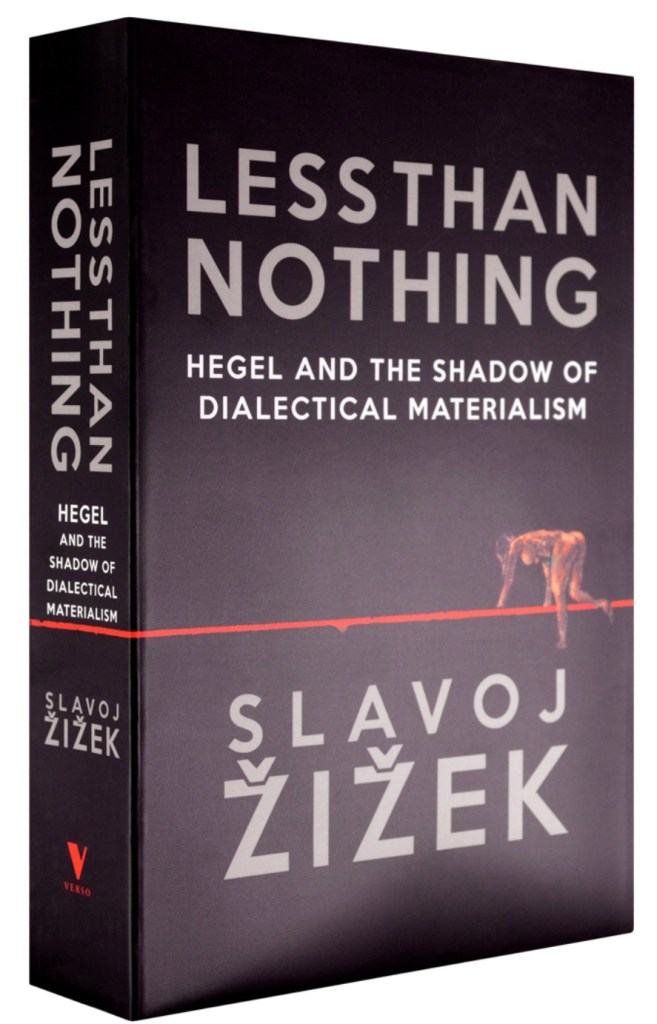
Less Than Nothing: Hegel and the Shadow of Dialectical Materialism presents itself less as a commentary redundantly installed upon the edifice of German Idealism than as the staging ground for an experiment in the conditions of thinking when the ground itself is withdrawn.
The book’s wager holds that the only way to register the philosophical present—its technological acceleration and exhausted historicisms; its psychical fragilities and confident physicalisms; its political cynicism and ethical catastrophes—is to reenact, under pressure, the most recalcitrant gesture of dialectical thought: the affirmation of negativity as ontological principle. In this sense, the work turns to Hegel not as a system-builder whose speculative circle finally gathers all determinations into a reconciled whole, but as the thinker in whom what unbuilds the system from within becomes legible: the incessant, internally generated breakdowns by which the concept moves, fails, repeats, and from which it draws its only—and entirely fragile—claim to truth. The name of this broken movement, the Absolute, designates less a completed totality than the exposure of a retroactively constituted closure: every apparent completion presupposes a prior incompletion—an unruly remainder that the system itself both produces and cannot domesticate. The book dares to name this remainder not the subjective distortion of an otherwise consistent reality, but reality’s own minimal feature: a less-than-nothing that subtracts even from the void the presumption of neutrality and reveals, in the heart of emptiness, an active torsion.
If Hegel functions here as the irreplaceable matrix for thinking this torsion, Lacan furnishes the operational diagram. The principal move avoids eclectic decoration and aims instead at structural precision. When Lacan reformulates psychoanalysis as a science of the subject founded on the structural failure of signification, the non-rapport of sexual relation, the insistence of the drive, and the not-all of the symbolic, he does not simply add psychological seasoning to speculative salt; he provides a translation of speculative negativity into the register of subjectivation. The result is neither harmonization of two traditions nor a mere juxtaposition. It is a crossing at the level of their shared impossibility: Hegel offers the intelligibility of negativity as the engine of the concept; Lacan renders that engine as the topological disruption of every consistency claim the subject makes about itself. The hinge is the status of the Real: no brute material substratum imagined by precritical metaphysics, and no residual limit that language fails to capture, but the formal name for that internal fissure by virtue of which any capture takes place at all. Hence the book’s guiding ontology favors not a materialism that opposes matter to spirit or nature to history, but a dialectical materialism affirming the real of matter as the formalization of inconsistency—an ontology of the void in which every positivity appears as the retro-effect of its own failure to coincide with itself.
The elaborate exordium—ostensibly preparatory, actually decisive—thus performs a twofold displacement. First, Hegel is wrested from clichés that alternately enthrone or dismiss him: neither the architect of totality who reconciles difference in the smooth curve of the Absolute, nor the rhetorical ironist whose dialectic is merely a style of oscillation. In this reading, Hegel becomes the thinker for whom negativity is no stage to be aufgehoben, but the very substance of motion: contradiction constitutes the path rather than an obstacle along it. Second, Lacan is re-situated away from clinical anecdote and ethical vignette toward the place of a logic-machine: the theory of desire, of the object a, of the barred subject, of the non-All, of the drive’s circuit, all untethered from anthropological horizons and demonstrated to be—quite strictly—diagrams of speculative movement. To approach Hegel through Lacan is to discover that the speculative Absolute names not a being that includes all beings but the vanishing mediator that, by disappearing, causes the series of determinations to appear. To approach Lacan through Hegel is to discover that the psychoanalytic Real does not sit inertly outside the symbolic but names the torsion internal to the symbolic by which the order engenders a surplus it cannot swallow. Their convergence is exact: no positive ground secures the edifice of meaning, and this lack—far from nihilating the edifice—organizes its consistency.
The claim arrives not as a thesis submitted to a tribunal of classical objections, but as a drama distributed across the book’s architecture, a temporal machine whose parts and interludes interlock only retroactively. The formal figure is Hegel’s lesson that any beginning comes marked by false immediacy, that the first assertion is structurally premature, that the opening gesture necessarily presupposes what it cannot yet avow. Consequently, only at the book’s end does the true beginning appear; the “cigarette after” confirms that the drink before already belonged to the same circle in which “the thing itself” becomes thinkable only by exposing, as its internal motors, figures that seem external to it—madness, rabble, war, sexuality, signification’s slippages, theology’s scandal, science’s paradoxes. The movement from semblance to negativity, from ideology’s closures to the parallax of the cut, from the object’s opacity to the void’s productivity, gradually undermines the descriptive rhetoric of a book about Hegel and Lacan and replaces it with an enactment of negativity’s work.
Hegel’s dictum that the whole is true acquires a decidedly unsentimental timbre. Truth emerges to the extent that the text traverses the non-coincidence of each element with itself and refuses to arrest that traversal prematurely. The statement reads less like an invitation to reconciliation than like the bleak demand to follow contradiction where it leads—through breakdowns of identity, repetitions of failure, and the becoming-necessary of contingency. The Absolute ceases to function as the highest positive entity and comes forward as the name of a process that is ab-solute: unbound, released from any presupposed substance, effectuated only in the reflexive loop by which a position internalizes the negativity generated by its own positing. When the book turns to Hegel’s theology and insists that Christianity’s core lies not in the consoled plenitude of the God-Man but in the traumatic message of divine self-abandonment—the death of God as the truth of God—the point is neither edification nor scandal. The argument presses the least sentimental implication of speculative logic: reconciliation amounts to acknowledging that no Other guarantees reconciliation. In consequence, the only universality a philosophy can defend today would be a universality that posits itself without support; its subject aligns with the subject of the act, not of identity.
At this juncture the book’s refusal of easy polemics becomes most unforgiving. Gestures that typically resolve tension—historicist humility before the multiplicity of contexts, naturalist subtraction of subjectivity in favor of mechanisms, existential acquiescence to finitude, Buddhist resignation before impermanence—display a shared devotion to a ground they can no longer justify. Historicism venerates the seamless productivity of history; naturalism venerates the causality that supposedly dispenses with appearance; invocations of finitude venerate the pathos of the human condition; meditative acceptance venerates the flatness of contingency. The realities these gestures register remain undeniable; what slips past them is the crack that produces those very realities. The dialectical materialism proposed here does not crystallize as a dogma or an anti-dogma; it functions as a procedure. It proceeds by showing how the only way to secure a phenomenon—concept, institution, subject, political formation, scientific law—consists in formalizing the manner in which its own consistency is sustained by the internal remainder it cannot absorb. To think does not mean climbing out of contradictions into the sun; it means organizing the contradictions that already organize us.
Within this framework, the notorious object a appears as the decisive index. No positive thing hides beneath symbolic forms; the remainder emerges from the symbolic itself, and in failing structurally, produces the lure of an object that would complete the series. The subject’s economy of desire thus becomes a logical economy: desire does not chase the object so much as it sustains the lack of the object; drive does not pursue a thing so much as it insists on a circuit that repeats loss as gain. The materialist accent of the account can be heard in this insistence: the subject’s restless self-division should not be taken as a contingent psychological feature but as the trace of reality’s incomplete topology. The void does not wait passively for inscription as a neutral space. The void results from inscription, from the cut enacted by the signifier in substance—an incision substance cannot heal. Because the cut is productive, because failure generates, because the not-all offers the only mode of universality, the book ventures a counterintuitive formula: reality presents itself as less than nothing. The point is not a facile reversal (“there is nothing rather than something”), but a claim about form: the positivity of something counts only by virtue of a retroactive effect that subtracts from the void the immobility we ascribe to it. Subtraction here does not deplete; it confers the positivity of form.
Familiar interpretive antagonisms shift accordingly. The prevalent opposition between a speculative metaphysics that hypostatizes totality and a post-metaphysical sobriety that fragments it into discourses, practices, and contexts loses urgency. What matters is the capacity to formalize the failure at the heart of totalization and at the heart of fragmentary pragmatics alike. Likewise, the hoary choice between transcendental correlationism—the circle binding thought and being—and an ontological realism that annuls the circle by positing an absolute outside no longer sets the terms. The book neither resigns itself to correlation (the circle does not function as a prison) nor leaps outside (no exterior ground awaits). Instead, it asks how the circle twists from within, how the point that should close it fails to match the point that opens it, how a minimal misfit offers the only non-metaphorical way to speak of exteriority. The “outside” persists internally as the circle’s impossible point of coincidence with itself. Insisting on this point also entails that event need not be set over against structure and contingency need not be set over against law. An event reveals, in the form of rupture, the structural impossibility upon which law relies; contingency, when grasped at the level of form, becomes the historical mode of necessity rather than its negation.
The book’s patient return to logic—the paratactical articulations of the Science of Logic, negativity’s shapes and reversals—never reads as scholastic drill. It amounts to reconnaissance of the minimal syntax by which one can generalize the procedure beyond philosophical texts. Hence the reach into literature, theology, film, political economy, cognitive science, and quantum physics—not as analogical ornament, but as scenes in which the minimal syntax reenacts itself. From tragedies of recognition in which the subject finds itself only by losing itself, to theological cruxes in which divinity is thought as the negation of plenitude, to cinematic structures in which the gaze’s stain reorganizes the field of vision, to economic contradictions in which exchange generates a spectral surplus no labor theory can simply absorb, to neuroscientific attempts to reduce subjectivity that stumble into the formal limits they deny, to quantum entanglements whose indeterminacy expresses structure rather than ignorance—the same diagram is forced to show itself. The wager states that one can track a single logic—strictly neither monism nor pluralism—across these scenes without homogenizing their differences or relativizing their claims.
This is why the work’s most irreverent engagements with contemporary philosophy are also its most exact. The formal ontology that declares being as multiple and evental gains rigor the moment it accepts a void conceived not as static nothingness but as dynamic inconsistency formalized in a signifying system. The speculative realism that sets itself against correlationism secures its object to the extent that it grasps impossibility as internal to objects—not a mere epistemic failure of access but an ontological failure of self-coincidence. The Heideggerian mobilization of finitude deepens where it refuses to transpose the pathos of human exposure to being into a muted piety before withdrawal; withdrawal does not serve as the last word once withholding is recognized as an effect of the signifying cut. The cognitive sciences approach their most demanding self-critique when explanatory protocols—operational closure, computational description, neural modeling—acknowledge a formal void that none of the models can eliminate without erasing their own conditions. At every turn, the book shuns the satisfactions of a conclusive refutation and instead installs a discipline of forcing: not compulsion, but fidelity to the structural remainder any position generates and cannot metabolize.
Nowhere does this discipline tighten more visibly than in the analyses of ideology and political form. The familiar wisdom that ideology today manifests as cynicism rather than credulity, flexibility rather than dogma, is taken seriously only to be exceeded: cynicism displaces belief rather than dissolving it; flexibility multiplies bonds instead of ending subjection. The result looks less like a post-ideological situation and more like a saturated scene in which enjoyment—jouissance—binds subjects more effectively than any declarative creed. Contemporary capitalism therefore cannot be deciphered primarily by unmasking hidden beliefs; the emphasis falls on circuits of enjoyment organized by the commodity-form and by the administrative management of life—circuits in which transgression figures as an already included mode of control. Rethinking political action accordingly requires more than ethical rectification of wrongs by a subject who “knows better.” What comes into view is a decision that suspends the very coordinates by which wrong and right are administered. The name for such a decision is not moral heroism but symbolic destitution: a cutting of the subject’s moorings in the big Other so that a new consistency can be forced. Destitution here does not function as destruction; it operates as subtraction. It does not purify the field; it changes the field by introducing a point the field cannot account for on its own terms.
The theological detours matter precisely because they supply the most scandalous version of this subtraction. To say that the truth of Christianity resides not in the triumphant deity of metaphysics but in the abandonment of that deity in the death of Christ need not amount to a counter-theological frisson. It indicates that the religious narrative itself contains a formalization of the same negativity that speculative logic discovers and psychoanalysis operationalizes: reconciliation arrives through recognition that no secret consolation lies behind the cross; spirit does not rehabilitate substance as higher harmony, but pulverizes substance into the reflexive loop of a community that binds itself without external guarantee. The Holy Spirit—“undead drive,” in one of the book’s polemical flashes—names not an otherworldly entity but the subjectivated remainder by which a community persists in the absence of its support. The result is neither secular humanism nor theologized politics; it amounts to a militant formalism that defines emancipation as fidelity to an inconsistency rather than allegiance to a content.
Aesthetic consequences follow with equal sharpness. If the Real marks the cut and the object the stain that indexes the cut, representation cannot be dismissed as simple falsity. Representation becomes the site where the impossibility of total symbolization is staged. Prohibitions on representing the worst—injunctions to silence where speech fails—presuppose the unrepresentable as an underived outside and thereby miss the point: representation fails from within, and that failure gives form to what cannot be said. Insisting, with almost embarrassing exactness, that art “only” represents the unrepresentable—because what it represents is the structural impossibility of representation—does not aestheticize horror; it clarifies the formal condition by which horror appears as an experience at all. The issue is not that everything becomes art, but that art, when it works, functions as a laboratory for negativity’s shapes.
Within the Hegelian materials, this insistence reorganizes topics too often relegated to the margins: rabble, madness, war, the police, the family, sexual difference. In each case the system’s smooth surface is fissured by an element that may look like dysfunction yet signals the system’s truth. The rabble signifies more than a sociological class of the economically dispossessed; it stands for the structural remainder political economy cannot reduce to labor-power or citizen-subjectivity. Madness exceeds a medical pathology annexed to the preface of spirit; it marks the impossibility of a seamless transition from nature to spirit. War cannot be counted as a mere outlier to ethical life; it indexes the non-coincidence of ethical universality with its empirical embodiments. Sexual difference, in Lacan’s formula, registers a non-relation; it thereby offers the most brutal reminder that the not-all should not be lamented as limitation but embraced as the very logic by which universality persists. Read in this light, the Hegelian system is neither exploded nor sutured; it is shown to be animated by its own fractures.
For all its combative energy, the work resists the cheap satisfactions of polemical closure. Inconsistency does not become a new metaphysical idol, and nostalgia for lost grounds finds no harbor. The book trains its readers to inhabit contradiction without converting it into a lifestyle. The temptation to leap too quickly from acknowledging inconsistency to prescribing pluralism, or from discovering contingency to endorsing contingency as a normative ideal, receives careful scrutiny. Those moves tend merely to transpose trauma into a worldview. The demand issued here is more severe: formalize the trauma, organize the inconsistency, locate the operation that changes the field by positing a point the field cannot internalize as one option among others. In this sense the old language of act, fidelity, event, truth, and subject remains in play—neither abandoned nor romanticized—tightened until it creaks, so that each term names an operation rather than a substance.
The political consequence announced at the end avoids both apocalyptic voluntarism and gradualist reformism. What comes forward is the slow violence of subtraction. Against the fantasy of revolution as a single purifying blaze—and against the counter-fantasy of managed change without rupture—the book reimagines militancy as the practice of installing within the present an inconsistency that forces new sequences. This militancy takes no fuel from indignation, however justified, and declines guidance by an ethical code that simply distributes guilt and innocence. Its orientation arises from an austere insight: the administration of social reality today depends upon the capture and modulation of enjoyment; a politics equal to this capture must displace the coordinates within which enjoyment circulates. A politics of destitution—of the big Other as administrative fiction, of the subject as capable of an act—does not produce therapeutic reconciliation; it produces new consistencies, precarious and real.
In the shadow of its most controversial gestures, the book delivers an almost classical lesson about reading. Engaging a tradition neither amounts to memorialization nor revelry in failure. It means reconstructing, with the patience that does justice to philosophical labor, the internal necessity by which positions exhaust themselves, turn into their opposites, and demand a repetition that never collapses into a return. This reconstruction defines what the book calls a repetition of Hegel. Fidelity manifests precisely at the point where fidelity risks appearing as betrayal: where logic must be pushed against the grain of its canonical comfort. Hence the scandalous crossings—with speculative realists, with the formal ontology of the multiple, with Heideggerian withdrawal, with the neurosciences’ eliminativist fantasies, with quantum theorists’ austere counterintuitions—do not arise opportunistically; they represent the price of fidelity. Remaining with commentary alone would betray the dialectic. Risking the distortion that thinking requires keeps faith with it.
All this justifies the book’s size and manner. The scale rejects excess for its own sake and instead aims to construct an atmosphere in which the reader experiences the retroactive logic of the whole: the “before” that belongs to the “after,” the interlude that supplies the missing cause of the main argument, the detour that reconfigures the destination. The style, for all the author’s polemical flashes and comic interjections elsewhere, is here disciplined by a quasi-scientific neutrality that seeks, whenever possible, to replace ridicule with reconstruction. The result feels paradoxical: a work at once saturated with citations across discourses and committed to a single, austere line—the formalization of negativity as the only materialism that meets the moment with rigor.
If the final pages call for an ethics of the act and a politics of subtraction, they do so without eschatology. No promise that the void will redeem us animates this appeal; rather, the exacting thought that procedures can be extracted from the void—procedures that produce truths. Such procedures will have to be local, organized, technical, patient. They will mobilize a subject who is neither sovereign over decisions nor merely swept along by structure: a subject that “does” an operation of which it is the effect. They will work with institutions and against them, with language and at the point where language knots into silence. They will court failure, repetition, and the sterile comfort of cynicism. Above all, they will refuse the consolation that our inconsistency shelters a secret harmony. No such harmony waits in reserve. Yet that very refusal grants thinking its chance.
This, finally, is the claim a book like this can own without melodrama: thinking becomes possible precisely where thought is tempted either to abdicate before the sciences or to retreat into the humanities’ melancholias. Dialectic does not present itself as a method applied to ready-made topics; it names the site where topics become thinkable. A philosophy that begins from less than nothing does not come impoverished; it comes exacting. Between the drink before and the cigarette after, between the parataxis of failures and the logic of their retroactive construction, between Hegel’s uncompromising intelligence and Lacan’s meticulous cruelty, Less Than Nothing earns the right to say, without triumphalism and without despair, that thought still moves—eppur si muove—and that its movement will have been the name of the crack in being by which we are permitted to act.
 Simon Gros
Leave a comment