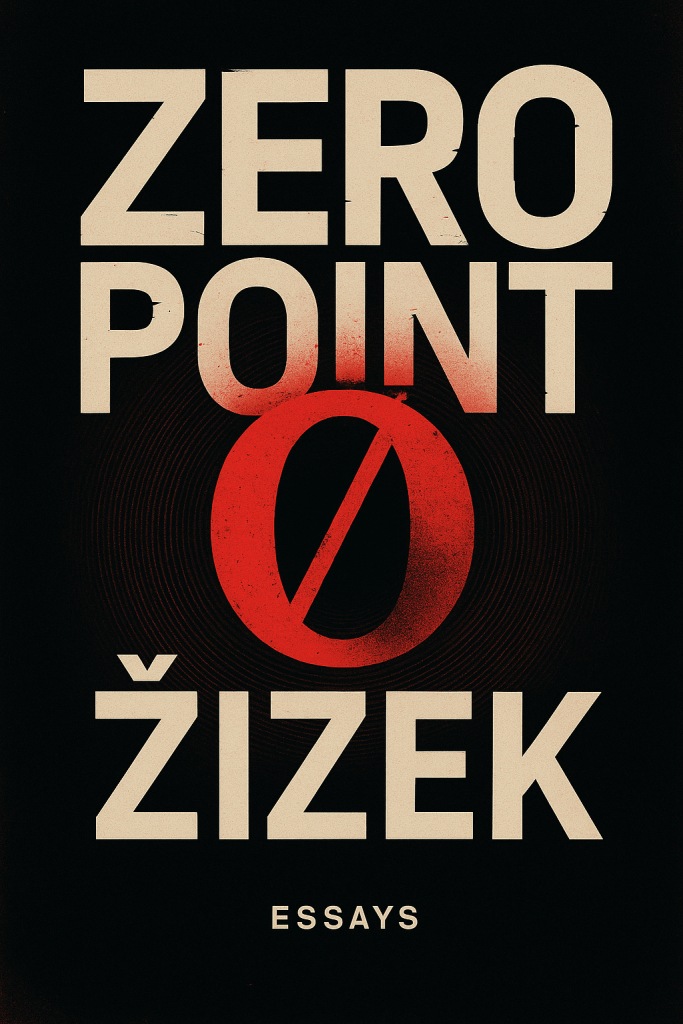
The title announces a limit-experience and a method at once. Zero point here names neither a melodramatic terminus nor the consoling trough before an inevitable rebound; it names the station where the fantasy of uninterrupted progress collapses, and the temptation to disavow collapse by acting out — in moralistic fury or cynical resignation — is suspended long enough for thought to find traction again. In Žižek’s formulation, the term inherits a double valence: ground zero as annihilating low and as base camp for a renewed ascent. The collection is organized around this paradox. It neither promises deliverance through edifying morale nor luxuriates in declinist catastrophe; it works at the precise juncture where the exhaustion of revolutionary imagination can become an analytic resource, and where the only realistic strategy, once the fog of “permanent, low-level dread” has been pierced, is the strangely sober imperative to become utopian again.
This framing is not an afterthought added by an editor seeking a marketable hook; it is integral to the way the book binds its disparate occasions. The paratext is explicit: zero point can only be postponed, not escaped. The fear that drives frantic attempts to outrun defeat — whether by punitive securitization or by intoxicating cycles of “speaking truth to power” that harden into gestures — is, on this view, an index of the remedy: only at rock bottom, where illusions no longer prop up moral self-images, can the minimal foothold be cut. What appears as despair therefore names an epistemic gain: to begin from the beginning, as Lenin has it, not by nostalgic restoration, but by retuning praxis to the intransigent antagonisms that the present order converts into ceaseless crisis-management.
The programmatic articulation of this double meaning opens the book proper, where Žižek’s reprise of Lenin’s 1922 mountain simile is less a talismanic citation than a methodological wager: retreat to zero-point is not opportunistic capitulation, because only the withdrawal from ideological overreach allows fidelity to its object to be renegotiated in the face of failure. The invocation of Beckett’s “Fail again. Fail better” is not a cult of failure; it is a warning against the theatrical substitution of performative transgression for strategy, and a way to name the interval wherein conceptual clarity can be won precisely by refusing premature resolutions. The point is not to heroize defeat; it is to neutralize the libidinal economies that convert defeat into ressentiment, an aggression that displaces the real difficulty of an antagonistic social formation onto convenient enemies.
Because the essays are occasional, written in the pressure chamber of accelerating events, their unity can only be conceptual. The unity, however, is real. The horizon is planetary: the spiral of war in Eastern Europe and the Middle East, the recrudescence of metaphysical justifications for annihilatory violence, the neo-feudal consolidation of platformed capital, the libidinal appetites harnessed by neo-populisms that stage obedience as rebellion, and the breakdown of timing in public speech acts. The leitmotif is philosophical without abstraction: to register zero point is to register the exhaustion of a historical form of the political, including the Left’s own repertoire of self-exculpating explanations, and to test whether a rigorous confrontation with failure can be converted into a new starting-point that neither relapses into a theology of catastrophe nor mistakes policy tinkering for transformation. The editorial apparatus underlines the wager by situating the second half of the volume as a lived traversal of this station: a chronologically arranged sequence of responses to the Frankfurt Book Fair controversy, written in the moment rather than mastered by retrospective composure.
That lived traversal matters because the book is not content to denounce the hypocrisy of opponents; it targets the considerate complacency by which liberal-centrist rationality naturalizes the very order it mournfully deplores. The essay on the 2024 U.S. election does not flatter those who would outsource explanation to macroeconomic indicators; it shows how the social link now binds itself through obscene transgression, how enjoyment is re-routed so that identification proceeds through weakness and insult, and how the spectacle of shamelessness functions as a mechanism of repression rather than liberation. The scene of carnival is instructive not because it excuses illegality as exuberance, but because it discloses how pleasure in transgressing decorum can fuse with a punitivist agenda that protects entrenched power. When obscenity saturates the public field, ideology does not dissolve; it is fortified, precisely because the “truth” of vulgarity carries a moralizing charge that occludes the structuring antagonisms of production, property, and policing.
This analysis is not freewheeling rhetoric; it is anchored in a psychoanalytic account of how subjects metabolize humiliation and project a fantasy of stolen enjoyment onto political enemies. The insistence is that the obscene element elevating a leader to the status of transgressive superego does not contradict the “Christian” veneer; it is its torsion. The oscillation between declared piety and public crudity is not a contradiction to be resolved; it is a libidinal mechanism that binds followers in a ritual of collective permissions and collective denials. This is why the repeated announcements of the leader’s political demise, each new scandal touted as self-immolation, fail to bite: the more his limitations are mocked, the tighter the identification for those who hear the mockery as a classed insult to their own wounded dignity. As the book insists, we identify with others’ weaknesses. The obscene return does not liberate repressed content; it intensifies repression and repurposes it, making transgression the vehicle for moralistic enforcement.
If the American scene repeatedly serves as a laboratory of libidinal politics, the Middle East is treated as the condensed point at which every structural duplicity converges: “humanitarian corridors” that channel forced displacement; performative affirmations of universal norms that suspend their universality where it would be costliest to honor it; the instrumentalization of atrocity as absolution; the replacement of legal form with ethno-theological sovereignty. The book refuses the easy consolation of symmetrical denunciation and the quietist mystique of tragic undecidability; it shows instead how ideological elevation of sacred claims and security pretexts works in tandem with the banal routines of dispossession, settlement, and administrative strangulation, and how the discursive center migrates so that practices previously denounced as extremist come to be normalized as explicit surplus enjoyment. The result is to unmask a transition: from the coy double game of a state that maintained the appearance of neutral legality, occasionally reprimanding extremist violence, to the open articulation of a halachic-theocratic logic in which that violence is no longer an obscene underside but an avowed norm.
The Frankfurt material is crucial here not because it licenses a self-pitying narrative of persecution but because it exposes timing as a political problem in its own right. A speech deemed intolerable in the moment becomes, within months, retrospectively tame against the escalating devastation in Gaza; the moralistic grammar of too soon turns out to be a policing of articulation that mistakes the management of affects for the measure of truth. The interruption by a state functionary under the banner of democratic fairness, the congratulatory celebration of that interruption as proof that “we listen to each other,” and the theatrical assurance that condemnation equals solidarity—these are not marginal anecdotes but examples of how institutions metabolize dissent when the cost of substantive reorientation is judged unacceptable. To insist on speech under such conditions is not heroic; it is a way to test whether the public sphere retains any capacity to accommodate contradiction without converting it into the occasion for reputational cleansing.
Žižek’s treatment of the Israeli–Palestinian caesura avoids the prophylactic comforts of choosing a single moral protagonist and proving its innocence once and for all. It dwells instead on the structure that makes every “red line” simultaneously absolute in rhetoric and endlessly violable in practice; on the semantic deceit whereby “self-defense” expands to cover wars of conquest; and on the way metaphysical justifications build affective immunity to empirical refutation. The shift from “land for peace” to expansive, normalized annexation; the emergence of political figures once formally excluded as terrorist or racist into guardians of national security; and the collapse of intra-Israeli democratic protest into the unity forged by external war—all these are read as the index of a process by which legal forms are hollowed out while the obscene surplus becomes explicit and proud. The concluding admonition is neither prophecy nor despair: there will be “no peace” without facing the Palestinian question, which is to say, without facing the structural conditions that produce the compulsion to repeat violence under the cover of necessity.
The war in Ukraine is approached with equal refusal of comforting binaries. The book tracks how a conflict presented as geostrategic realism is sacralized into a metaphysical crusade, how nuclear doctrines are loosened at the level of discourse in ways that do not merely describe but actively reshape the field of action, and how the rhetoric of civilization versus decadence plays the role of master-signifier that permits every escalation to be retroactively baptized as defense. The philosophical point is not a scholastic gloss: when the war is framed as a wager on who will avert their eyes at the brink of apocalypse, “words are never only words.” They are conductors of threshold behavior. Under such conditions, the nostalgia for the “wisdom” of the old Cold War—where the unacceptability of first strike was a shared axiom—is less a plea for moderation than a recognition of how quickly the normalization of absolute threats corrodes the very space in which bargaining can proceed.
Even the most baroque declarations by political and ecclesiastical authorities are not dismissed as mere theater. When “traditional values” are marshaled to designate enemy states and when eschatological comfort is offered against nuclear fear, Žižek does not reduce the rhetoric to alibis for resource control; he insists we take the metaphysical claim seriously enough to follow it to its consequences. The book depicts a propaganda machine not as a monolithic deception but as a compound of magic tricks: accuse the opponent of your own strategy to distract from the fundamental theft (territory renamed destiny), expand the conditions under which annihilatory force is said to be justified, and repackage conquest as spiritual self-defense. Peace under such conditions cannot be entrusted either to “peaceniks” who disavow asymmetry or to absolutists who erase the political in favor of theological clarity; it demands the slow, exacting labor of disentangling the rhetorical knots that convert offense into necessity.
The philosophical through-line—Hegelian, Lacanian, materialist—does not arrive as scholastic apparatus; it is a way of thinking about sovereignty, recognition, and the subject of desire at war. The reading of master and servant is not there to dignify commentary with classic references; it names the paradox by which appeals to sovereignty collapse when they refuse recognition and risk, and the paradox by which the politics of spiritual vocation deteriorates into a fetish of purity. The same conceptual clarity that rejects a folkloric “traditionalism” uncovers a modernizing brutality: the regime that claims to defend eternal values operates as the latest installment of a modernization-through-violence lineage, a project that has long absorbed Western techniques and fantasies even as it denounces the Enlightenment. That duplicity is not an exposure; it is the condition of our predicament, and any emancipatory strategy that fails to register it will be appropriated by the very logics it opposes.
Against this planetary backdrop, the essays on digital capitalism are no excursus. The variegated phenomena—platform enclosures, surveillance reputational economies, influencer “publicity” as self-valorizing organism—are read under the sign of neo-feudalism. The point is not that capitalism disappears; it mutates, transposing wage-discipline into dependence relations structured by data rents and gatekeeping infrastructures, while masking these as entrepreneurial freedoms. The hybrid alliance that binds “digital lords” to strata of workers who fantasize themselves as vassals rising by proximity is structurally unstable, but its instability is a resource for domination so long as the antagonism is misrecognized as a culture war between cosmopolitan elites and “ordinary people.” The moral here is not to scold the duped; it is to specify how the scene of enjoyment is composed so that emancipation appears as expropriation and expropriation as emancipation.
If there is a signature move throughout, it is the refusal to disjoin ethics from strategy. The book’s severe account of liberal hypocrisies does not recuperate a soothing radicalism of denunciation; it measures how denunciation itself can be incorporated into the reproduction of the order it abhors when it stops where the property relations and extractive logics begin. The insistence that the Enlightenment is neither to be mythologized as purity nor jettisoned as colonial poison belongs to this refusal. The question is whether the formal universals that have been so easily instrumentalized can be made to bind where they cost, and whether a politics that names itself emancipatory can afford to forego the radical edge of equality in order to appease the guardians of stability. Žižek’s answer is not a catechism; it is a test: if universal claims cannot be cashed in against “our side,” they are not universal.
The second half, “When is the right time to speak?”, is not a theoretical annex but the place where the book risks its own premises. The pieces, preserved in the order of their composition, enact the oscillation they diagnose: from the compulsion to say the intolerable now, to the shame of misrecognizing a conjuncture, to the stubborn effort to maintain two pains at once without collapsing them into a false equivalence. The question of timing here is not etiquette; it is the politics of heeding a catastrophe while refusing to expel the contradictions that make solidarity more than slogan. That contradictions are uncomfortable is the banal truth; that they structure the possibility of thinking and acting at all is the non-banal one. Under the pressure of polemical misreading, the book declines both the role of the martyr and the comfort of the cynic; it asks instead whether speaking too soon may sometimes be the only way to speak at all when institutions are invested in deferring articulation until it cannot matter.
At its most demanding, Zero Point wagers that despair, strictly encountered, is not a mood but a cognition. To refuse the consolations of fatalism and optimism alike requires a kind of courage that is not theatrical: the courage to read defeats without ecstatic compensation and to read victories without moral self-exemption. The middle distance of the essays—close enough to events to feel their blast, far enough to analyze their structuring fantasies—produces a style that alternates dark comedy with icy inventory. The comedy does not trivialize; it punctures the dignified masks behind which obscene satisfaction consolidates itself. The inventory is not fetishistic; it assembles the moving parts without dissolving them into an all-purpose indictment. The consistent target is the illusion that the nightmare will be dispelled by more indignation or that crisis management is a substitute for transformation.
The reader hoping for a program will be disappointed; the reader hoping for a permission slip to abdicate will be disappointed as well. What one receives instead is a set of coordinates for working where we are: an analysis of how red lines become both absolute and routinely crossed; a demonstration of how obscene transgression props up puritanical governance; an anatomization of how metaphysical appeals lubricate material annexations; a reminder that the European legacy must be fought over rather than either canonized or anathematized; and an insistence that psychoanalysis is not an optional vocabulary but a description of the energetic economy by which politics binds bodies to signifiers. None of this relieves anyone of the burden to choose; it clarifies why the choice is not between cleanliness and contamination, but between different ways of bearing contamination without converting it into license for cruelty.
If one sought a single sentence to condense the book’s ethic, one could do worse than the following: do justice to your desire. The point is not to romanticize transgression but to unmask how fantasies screen desire from itself and convert acts into symptoms. Justice here means neither the procedural fairness to which institutions pay lip service nor the holy fury by which opponents are crushed in the name of purity; it means attending to the object cause of political compulsion—those disavowed losses and humiliations that reappear as hatred—and binding them to a project that does not require sacrificial offerings of the vulnerable. To the extent that psychoanalysis can be ethically demanding, it is because it refuses both excuses: it refuses the excuse by which cruelty becomes a shortcut to authenticity, and the excuse by which humility becomes a pretext for inaction.
To call Zero Point a “book about our moment” risks domesticating it as timely commentary. It is less a commentary than an assay: a stress-test of whether a certain critical intelligence can still operate without self-anesthetizing consolations and without succumbing to the narcotic of scandal. The wager is that the zero point will recur—personally, institutionally, geopolitically—and that the task is not to deny recurrence but to traverse it, to refuse the twin idolatries of apocalypse and managerialism, and to hold open the narrow pass where resolve is distinguished from fury and strategy from theatrical righteousness. The book’s audacity lies in its refusal to flatter even its most sympathetic reader: it presumes that anyone who picks it up has already known defeat, already felt the humiliation of misrecognition, already recognized the seductions of despair; and it asks whether, starting from there, one can still make plans. Not plans that guarantee success, but plans that do not outsource their necessity to Providence or technocracy, and that understand why “beginning from the beginning” is not a rhetorical flourish but the sole political literacy available at the bottom.
That this wager is articulated in a volume that records, without alibi, the author’s own embroilment in a public scandal is not a coincidence. It is the condition that rescues the book from the safety of diagnostic hauteur. If the Frankfurt sequence sometimes reads like a diary, it is because the zero point is being endured, not illustrated. If some of the geopolitical pages read like forensic case files, it is because the polemic must not outpace the facts it needs to transform. If the chapters on digital feudalism and the “heroes of the metaverse” read like a diagnosis of a regime rather than a jeremiad, it is because the point is to treat the libidinal economy as an infrastructure, not as a matter of taste. If the pages on populist obscenity circle back again and again to the riddle of enjoyment, it is because the culture war is a misdirection that dissimulates a class war, and because enjoyment is the medium in which that misdirection pays dividends.
There is, finally, a temper of hope, but it is not an optimism about trends or a faith in the educative power of catastrophe. It is the stubborn hypothesis that, precisely when the arguments point to paralysis, a small remainder of agency can be wrung from the unwillingness to lie to oneself. The remainder is not much; it might be just enough to refuse the next easy hatred, to repudiate the next redemptive cruelty, to insist that universals bind where it hurts, and to discover, in the rubble of spent fantasies, the difficult pleasure of acting without guarantees. In that sense, Zero Point deserves the old name critique: not a ritual of indictment, but a discipline of discrimination, a refusal of false clarity, a readiness to begin again where beginning seems least plausible. The book never says that this will suffice. It says that nothing else can.
Bibliographical note: Zero Point is published by Bloomsbury Academic (2025) in the series “Žižek’s Essays”; its first part explores the political and psychoanalytic architecture of the present crisis under the sign of ground-level reassessment, while its second part inhabits the ordeal of public speech and misrecognition in the wake of the 2023 Frankfurt Book Fair controversy, reproducing the temporal stagger by which events outstrip thinking even as thinking struggles to re-enter the scene. The documentary scaffolding—dates, editorial framing, and the appended speech—secures the book’s claim to speak in and through the conjuncture rather than about it from a hygienic distance.
 Simon Gros
Leave a comment