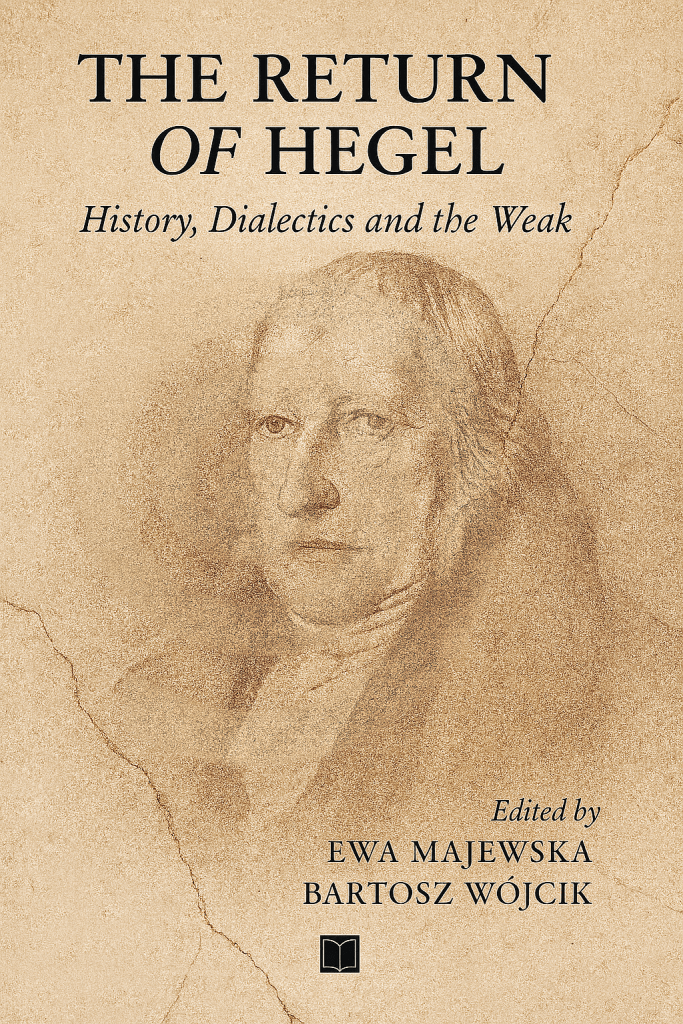
There are works whose apparent modesty—an introduction to a special issue, a framing essay for a post-conference collection—conceals a more demanding wager, namely, to test whether philosophy can still organize experience without doing violence to what is fragile, fractured, and historically scarred in that experience.
The Return of Hegel: History, Dialectics and the Weak: Introduction by Ewa Majewska and Bartosz Wójcik belongs to this latter, risk-embracing genre, because its thesis is not simply that Hegel “returns,” but that his return must be staged under conditions that make any totalizing gesture suspect while making any abdication of universality irresponsible. The editors’ text is not a pious preface but a carefully tensioned proposal: that a renewed Hegelianism is thinkable if and only if it learns to speak from within weakness, to register the grain of the unhappy, the dispossessed, the unheroic, and to build institutions for a common future precisely where immediacy promises satisfaction without duration.
Their wager is formal as much as substantive, since they treat the introduction not as a taxonomy of contributions, nor as a celebratory monument to the 250th anniversary of Hegel’s birth, but as a dialectical experiment: a reflexive mapping of the conditions under which reason can once again become historically adequate without reinstating the fantasies of closure that past anti-Hegelianisms rightly feared. In this sense the book description must do justice, not to a catalog of topics, but to an ethos that articulates, with equal sobriety and audacity, why a Hegelian framework continues to provide concepts commensurate with our contradictory present and why that framework must be reshaped by the figures of vulnerability it once marginalized.
The scene of enunciation matters. The volume emerges from the Warsaw conference of October 2020—The Return of Philosophy of Hegel: History, Universality and the Dimensions of Weakness—co-organized by the Goethe-Institut Warsaw and the Institute of Philosophy and Sociology of the Polish Academy of Sciences. This provenance is not just academic datum; it marks the project with the stamp of a region that, after the long freeze of anti-communist common sense, has experienced a thaw in which the question of mediation, institution, and collectivity can be posed again without the reflex of denunciation. The editors acknowledge that a single issue cannot exhaust the task, promising a second volume and thereby acknowledging finitude as a structural condition of the return itself rather than as a regrettable limitation. Their citation of Žižek’s provocation—if the twentieth century was Marxian, the twenty-first may yet be Hegelian—functions less as a slogan than as a diagnostic: the crises that now globalize macro-history also globalize the demand for concepts that hold together contingency and necessity, subjective striving and objective constraint, negativity and formation. The wager is that Hegel’s apparatus remains one of the few whose scale and plasticity can meet that demand.
The editorial voice entertains no mystique of neutrality about its own becoming. The first attempt at an introduction was, they confess, a six-hour recorded conversation that failed to become a text. Rather than melancholy, the admission delivers a methodological lesson: contingency governs even the reflective labor that intends to grasp contingency; the failure to convert speech into script allegorizes the dialectic of intention and realization, plan and outcome, that Hegel names when he tracks how purposes are re-inscribed by the path of their execution. The anecdote is carried further into an intellectual genealogy. The editors evoke their two teachers at the University of Warsaw, Marek J. Siemek and Aleksander Ochocki, not as ornamental dedications but as indices of a living polarity: the systematic, state-oriented transcendental social philosophy of the former and the sharp, historically materialist, comic negativity of the latter. This polarity is not resolved by synthesis; it is curated as a fertile contradiction that keeps the editorial program from hardening into either procedural rationalism or ecstatic negation.
If the twentieth century saw Hegelianism split into existential and Marxist tracks—stabilizing antinomies of necessity and particularity that then fed postwar critiques of the grand récit—Majewska and Wójcik insist that this lineage does not condemn us to the antinomies’ repetition. The well-known anti-Hegelian episodes (Deleuze’s tactics against the One-all, Foucault’s genealogical suspicion, Derrida’s ordeal of différance) succeeded in exposing closure where closure was dogmatically asserted, yet in doing so they often installed Hegel as the negative theological figure whose banishment guaranteed their own legitimacy.
Once the inevitability of that banishment was dissolved by geopolitical and intellectual changes—perestroika in the East, new forms of systemic inquiry in the West—the space re-opened in which Hegel could again be read as a resource rather than a threat. It is not nostalgia but a changed problem-situation: a renewed macro-history that demands more than local genealogies, a planetary entanglement that makes doxa about the end of history ring hollow even as irony about its premature proclamation remains justified. Here the editors’ list of contemporary articulations—of subjectivity (Malabou, Nancy, Butler, and the Slovenian school), of colonial history (Mbembe, Buck-Morss), of capitalist dynamics (Ruda, Jameson), of new materialist ontologies (Žižek, McGowan, Johnston)—functions as evidence that Hegelian frames now host heterogeneous, even adversarial, projects, precisely because of their elasticity at the juncture of negativity and formation.
If this were all, the return would still risk being a restoration. Here the editors push a second, decisive displacement: from heroic histories and sovereign subjects to the figures of weakness—slave, housewife, the oppressed, the unhappy, the rabble—whose endurance, resistance, and obstinacy generate the very energies of emancipation that heroic historiography retrospectively appropriates as its own. This is not an external correction applied to Hegel; it is a re-reading that develops latent lines of force within his texts (not least Phenomenology of Spirit) in a horizon transformed by feminist, psychoanalytic, postcolonial, and queer theory. The effect is not merely to diversify a canon; it is to reconfigure the fundamental site where the dialectic moves: no longer only at the heights of world-historical individuals or the pathos of ethical life, but within the repetitive, reproductive, structurally vulnerable labors that history both exploits and forgets. The demand is methodological: to compose universal claims that do not float above materiality but are tested against its disciplines, its deadlocks, its irritations. To pursue universality without the impunity of the abstract universal is to insist that Antigone’s claim cannot be heard without Ismene’s, that bourgeois legality cannot be stabilized without the voice of the rabble, that resistance only endures where care organizes its reproduction.
This turn toward weak strength is not a politics of resignation; it is a politics of mediation. The editors’ polemics against capitalist immediacy, with its shock-doctrine experimentalism and its regression to the patronizing pater familias, is not nostalgia for bureaucracy. It is a defense of procedures, institutions, and laws as the fragile sedimentations through which universality can be partially embodied and protected from caprice—state or market alike. In this register Hegel’s concept of the corporation assumes contemporary urgency.
Neither private interest nor state diktat, it names a communal form of self-organization within civil society whose capacity to articulate needs and stabilize solidarities renders it a hinge between singularity and the universal. The editors do not romanticize this form; they retrieve it as a neglected radicality of Hegelian political philosophy that can be re-read alongside present discourses on the common (Hardt and Negri) as a repertoire of institutional imagination. The alternative—fetishizing the event, immediate connection, flash-mob intensity—is judged as a refusal of historicity and a betrayal of togetherness by gratification without duration. If anything lasting is to be built, it demands structure; if structure is to be just, it demands reflexive governance by those for whom it works.
The volume’s contents, as staged by the introduction, instantiate this double movement: an expansion of Hegelian reason under the sign of weakness, and a re-institutionalization of critique under the sign of mediation. Oxana Timofeeva’s experimental essay on Enlightenment and the dialectics of the v***a is situated between those movements: once a reflection on Kantian limits and the vagabond intellect of Rameau’s Nephew, it becomes, under the conditions of Russia’s war against Ukraine, a dissident call for revolution, demonstrating how a Hegelian seminar can become a political nerve. The essay’s relocation by history proves the editors’ thesis: dialectics remains alive when it registers transformations of its conjuncture at the level of its own form.
Joanna Bednarek’s contribution, by contrast, recasts anthropocentrism through a post-humanist lens, showing that even Deleuze’s anti-Hegelian difference remains in complex debt to Hegel, and that the critique of “Man” can be articulated as a re-reading of Hegel’s concept of nature rather than a simple rejection. This is exemplary of the editors’ method: to displace dogmatic oppositions (Hegel versus Deleuze) with traversals that recover submerged proximities without erasing asymmetries. Hegel’s anthropocentrism is thus criticized from within, sharpened by a planetarian horizon, and made responsive to the Anthropocene without discontinuity from his conceptual grammar.
Agata Bielik-Robson’s reworking of the katechontic restrainer into a dialectics of attenuation widens the theological aperture of the project. The eschatological charge is not expelled; it is harnessed, distributed into the immanence of creation and investment. If catastrophe has become our atmospheric condition, attenuation is not quietism but the name for a practice that refuses both paralyzed restraint and ecstatic apocalypse—an ethics of distance tuned to a world whose fuses are short and whose charges are high. The editors’ decision to place this meditation in the same discursive field as Čakardić’s political economy of poverty indicates their conviction that the speculative and the material converge where a politics of mediation is at stake. If for Hegel pauperization and social alienation are endemic to capitalism’s reproduction, then neither moralizing charity nor voluntarist insurrection will suffice; only institutions that metabolize negativity into determinate counter-powers can prevent poverty from becoming the universal solvent of ethical life.
The narrative turn that Joseph Grim Feinberg performs—reframing dialectics through the trickster tale and returning history to the perspective of the slave—works not as an anecdotal embellishment but as a critique of historicity’s grammar. If dialectics has often been narrated as the march of Spirit toward self-transparency, Feinberg suggests that the very forms of narration (who counts as a narrator, who as a listener, which temporalities can be told) are dialectical operators that determine what emancipation can be named. To write the story from the excluded perspective is not to add a chapter; it is to re-parameterize the logic of the story’s movement. In parallel, Andrzej Leder’s psychoanalytic de-sublation insists that regression is not an empirical backslide but a moment structurally thinkable within a Hegelianism retooled by trauma theory. Here the integration of Benjamin, Žižek, Lacan, and Husserl is not ornamental; it specifies a dialectics that can include catastrophe without annulling the concept of progress—provided that progress is purged of teleological innocence.
Majewska’s own essay on the slave, Antigone, and the housewife anchors the collection’s signature move. By reinterpreting the figure of Unhappy Consciousness through the repetitive temporality of reproductive labor, she dislodges the romantic and religious framings that have often mystified that stage, and she forces a reckoning with the corporeal, vulnerable, life-maintaining strata of Spirit. The dialectics of the weak is not a sentimental politics of suffering; it is a theory of how negativity is distributed across bodies, tasks, and meditations, and of how recognition is sabotaged precisely where the world is being reproduced. Under these conditions, universality cannot be the predicate of a sovereign voice; it must be an effect of institutions that make care and resilience co-determinable.
Marcin Pańków’s reconstruction of violence and law, returning to Kant and Hegel at a time of liberal democracy’s putative fall, demonstrates that the juridical is not an external container for politics but a site where the dialectic of modality (possibility, actuality, necessity) scripts the horizons of collective action. By situating anticolonial insights (Mbembe, Buck-Morss) within a Hegelian understanding of futurity, the essay refuses both the pacifying legalism that ignores violence’s generativity and the anti-institutional romanticism that cannot sustain normativity. The law can bind a future only if it is built as a field where negativity can be worked through without being domesticated into pure order.
The editors’ decision to include the debate around Adam Leszczyński’s The People’s History of Poland—in dialogue with Howard Zinn’s classic—compels the methodological claim to confront a millennium of peasant, serf, patriarchal, and nationalist histories in a single national frame. The point is not nationalist; it is experimental: to test whether a Hegelian universalism can be composed from the archives of those usually omitted from history, and whether the form of the people’s history can act as a laboratory for dialectical narration that refuses both hagiography and cynicism. The editors’ invitation to controversy here is principled. A return to universality that will not risk controversy is a return to abstraction; a universality that does not pass through polemical testing is only a change of costume for the old sovereign.
Across these constellations the introduction returns, insistently, to mediation. To defend procedures, laws, state institutions against neoliberal immediacy is to risk misunderstanding. The defense is not for their own sake; it is for the sake of time. Only institutional times—durations that outlast shocks and pleasures—can host practices of universality that are not merely rhetorical. The critique of ecstatic eventalism is sharp precisely because the editors take joy seriously: they know how quickly jouissance curdles into exhaustion when it is not composed by forms capable of bearing conflict. Hegel’s claim that nothing is free of contradiction thus becomes an ethic rather than a metaphysical theorem. If there is no authority that rescues us from freedom, then the task is neither submission nor flight; it is the continuous invention and repair of fragile common institutions by weak beings who cannot afford to wait for heroes.
This work, therefore, describes a style of dialectics that neither abandons system nor worships it, that neither idolizes the subject nor dissolves agency into dispersed flows, that neither renounces universality nor repeats its colonial abstractions. It is to follow the editors as they assemble, from teachers and dissidents, from theologians and economists, from psychoanalysis and legal theory, a dispersed but determinate image of reason’s present tasks. The return of Hegel is not a homecoming; it is a difficult passage through weakness. That passage requires a curatorial intelligence that can hold together what refuses identity, and a political intelligence that can bind conflict to durable forms without suppressing its negativity.
The result is a programmatic sensibility rather than a platform. A Hegelianism for the present must be reflexive enough to know it speaks from a situated place; historical enough to refuse the romance of rupture; feminist enough to see reproduction as the skeleton of Spirit; decolonial enough to treat the universal as a claim that is earned, not presumed; psychoanalytic enough to integrate regression without despair; juridical enough to value forms; and economic enough to insist that poverty is not an accident but a function. It must be speculative enough to convert apocalypse into attenuation, and material enough to locate that attenuation in institutions that can withstand shocks without becoming prisons. It must be narrative enough to retell history from the position of the trickster and the slave, and conceptual enough to prevent that retelling from dissolving into relativism. It must be patient enough to build corporations—as Hegel understood them—as mediations between state and market, and bold enough to reinvent them for a world of platforms, supply chains, and algorithmic command. It must be modest enough to admit that its first attempt may fail to become a text, and stubborn enough to write the text anew.
Read in this light, The Return of Hegel: History, Dialectics and the Weak is not a gateway text that one skips once inside; it is a summary of the conditions under which one can be inside at all. The editors don’t apologize for the audacity of their orientation nor protect it with scholastic hedges. They expose it to dispute and invite readers to test it against their own archives and urgencies. In a time when the allure of immediacy drains political will and the fatigue of systems breeds cynicism, this insistence on mediated universality is bracing. If there is a single sentence that condenses their wager, it is their reminder that nothing will save us from freedom and that the only rescue available is the one we imperfectly provide each other by building and repairing the fragile institutions of the common. The dialectic, on this account, is not a ladder to a final vantage. It is a pedagogy of forms for beings who are finite, conflictual, and yet capable of making a world together that lasts longer than a moment.
In that sense the introduction deserves to be read as a book in miniature: a complex organon condensed into a set of propositions that cannot be reduced to either orthodox Hegelianism or fashionable anti-Hegelianism. It will be of particular interest to scholars who, weary of false alternatives, seek conceptual tools that tolerate contradiction without fetishizing it, and institutional imaginaries that domesticate neither conflict nor time. It will also be of interest to those who, coming from feminist, queer, postcolonial, ecological, or psychoanalytic traditions, suspect that systematic reason is their adversary, and who may discover here that a renovated dialectics can be an ally in the struggle to construct a universal that does not erase them. Above all, it will matter to readers willing to endure a discipline of mediation in an era of shortcuts. For such readers, the return of Hegel is not a historiographic curiosity; it is a practical orientation toward survival with dignity.
If the editors’ hope is that the volume will provoke debate about universality’s resurgence, then this review mirrors that hope not by keeping open the very problem the book opens: how to speak universally from within weakness without elevating weakness into a new sovereignty; how to institutionalize care and resistance without converting them into decorum; how to move between law and violence without idolizing either; how to narrate the world from the underside without re-inscribing the myth of the underside’s purity. The work teaches no doctrine; it demonstrates a discipline. The test for readers is whether we can practice it where we stand.
 Simon Gros
Leave a comment