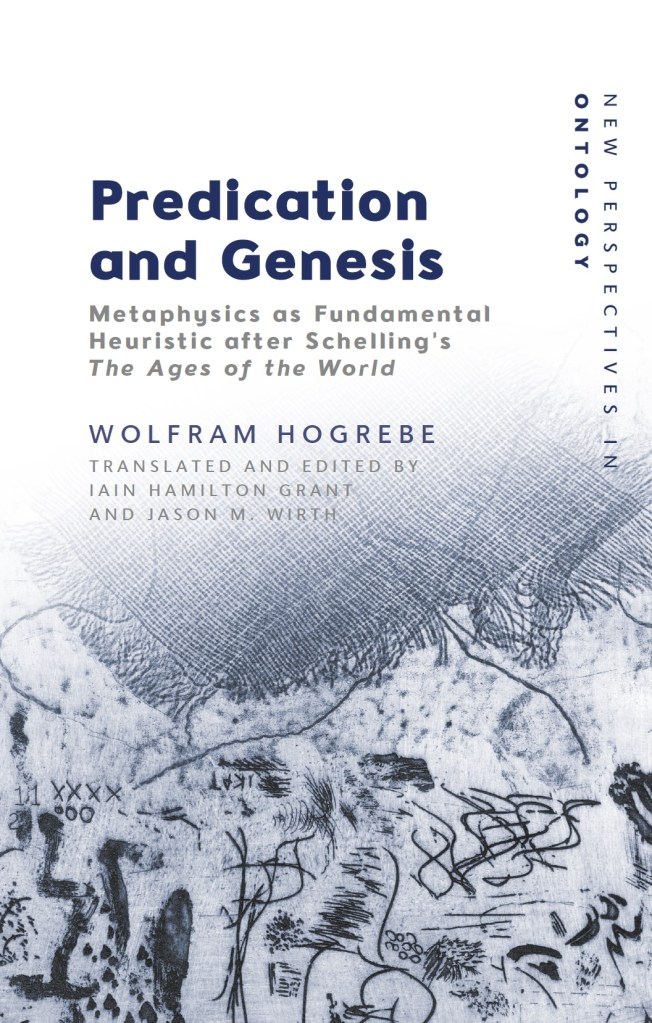
Wolfram Hogrebe’s Predication and Genesis: Metaphysics as Fundamental Heuristic after Schelling’s The Ages of the World appears, in its English incarnation, as a work whose object is nothing less than to teach contemporary philosophy to hear again what it no longer quite knows how to ask: by what pre-predicative tumult does a world attain to predicability at all, and how does the grammar of the singular judgment, far from being a mere didactic convenience, disclose a deep structure of world-formation at the point where being organizes sense and sense returns upon being?
The book proceeds from a provocative wager that a rigorous, even uncompromisingly metaphysical reading of Schelling’s unfinished Die Weltalter can be made commensurate with the idioms of predicate logic and analytic semantics without remainder or loss of speculative power, and indeed that only such a translation into the idiom of predication can defend the very metaphysical claims at stake by exhibiting the logic internal to their genesis. In this respect it is at once a far-reaching study in epistemology and metaphysics and a polemical intervention in our conception of philosophical method; it treats Schelling’s epic of autogenesis as the locus in which contemporary philosophy of language, logic, and ontology must, if it is to be contemporary with itself, rediscover its own conditions of possibility. That this English edition frames Hogrebe’s program with a new Author’s Foreword, the earlier Italian Foreword, an extended translators’ introduction and guide, and a postface by Markus Gabriel is no mere editorial adornment; the ensemble stages the very Mitwissenschaft the book argues for—an interknitting of speculative biography of being, formal reflection on predication, and a renewed, technically equipped metaphysics—while also mapping a reader’s path through the conceptual decisions whose consequences cascade across ontology, cosmology, psychology, and theology alike.
What makes the book continually arresting is the tenacity with which it refuses a consoling choice between the mytho-poietic and the formal: where commentary often domesticates Schelling into either a poet of nature or a forerunner of historicized phenomenology, Hogrebe insists that the authentic object is a structure of formative process with universal significance, intelligible only if we think a self-generating singularity whose internal dynamics include their own logical articulation. The Author’s Foreword thematizes this as a “structure susceptible of biography”: a living, onto-creative syntax that cannot be justified a limine by static axioms, since what must be explained is precisely how there comes to be one structure at all that is capable of harboring everything and everyone, without thereby being reducible to an already-given identity. Hence the striking formal contrast: the harmless generality, “everything is,” co-exists with the impossibility, “there is at most one,” at the syntactic level; yet the world we inhabit requires both, which is why Schelling’s model is neither axiomatics nor totalizing definition but the organism, a figure of unity that unfolds only evolutionarily and, crucially, generates itself out of preconditions that cannot be finally subsumed—an internal duality whose obscure side is, as Hogrebe says, an “abyss within the space of reasons.” The point is not decorative paradox but structural necessity: if there is to be a world whose sense can be predicated as a world, predication must be generated by what it cannot itself predicate, and the biography of this genesis must include, as intrinsic, the non-transparent remainder upon which both clarity and self-consciousness subsist.
This abyssal remainder—Schelling’s Ungrund transposed into the semantics of predication—reappears throughout Hogrebe’s reconstruction as the indispensable and unassimilable precondition of identity-claims, of the copula’s binding power, of the unity that singular judgments perform. The terminological economy that orients the book—original negation and original affirmation, predicative rotation, self-organization, world-formula—names not a set of “topics” but the phases of this formative process as it circles from pre-predicative positivity through the proto-logical distinctions that make predication possible, to the iterative stabilization of order and the emergence of reason and its pathologies within that order. Hogrebe’s translators, Iain Hamilton Grant and Jason M. Wirth, succinctly indicate the methodological commitment: metaphysics cannot be a nominal science of essences or a catalogue of necessary features, for “there is no essential definition” that would fix, once and for all, the essence of the world; the only form adequate to its object is a fundamental heuristic—a disciplined set of practices whose task is neither to legislate the given nor to renounce the question of essence, but to approach the world’s essence as enigma, a closure that solicits ever further determinations without being exhausted by them. The point is not agnosticism but an epistemology that is native to genesis: metaphysics concerns the essence of the world precisely as the enigma by which predication is set to work.
Within this heuristic, one of Hogrebe’s most consequential translational moves is the insistence on “pronominal being”—that in every predication there is a pre-predicative it, the “something-whatever” that resists identification with any quiddity yet without which no identification would be possible. Rather than a mystifying remainder or a romantic fog, pronominal being signals the condition that the very attempt to refer to pure positivity literalizes the Orpheus myth: to turn and fix what the “it” is as such is to lose it; pure positivity recedes from verification, and yet all oblique reference—nominal identification—traffics in its wake. It is this “orphic reference,” as Hogrebe calls it, that grounds the genetic unthinkability of the totality of thinkable and sayable things: the maximal range of predicate logic presupposes an unpredicable positivity that does not not exist, though it is no “kind of being” in the taxonomic sense. A semantics that would abolish this underworld abolishes the condition of its own applicability; conversely, a metaphysics that refuses the rigors of predication loses its claim to be of the world. The book’s achievement is to show that these two dangers are one and the same danger viewed from different sides of the copula.
From here it becomes intelligible why Hogrebe might venture the scandalous formulation that being, considered in its emergence to meaning, is meaningless—Sein ist Unsinn—not because meaning is illusory, but because meaning is consequent upon being, and the inquiry into the grounds of meaning faces, at its root, the non-obtaining of the very thing it seeks as the enabling condition of its obtaining. The paradox is diagnostic: if the Principle of Sufficient Reason had final satisfiers adequate to render being fully transparent to reason, the story of predication would be tautological repetition. But if genesis is real, then the auto-epistemic structure of the world—its reflexivity, its becoming-known—arises from, and continually bears, an original negativity that can be neither canceled nor mastered. In this sense, the work clarifies how a scrupulous attention to formal semantics converges with Schelling’s speculative naturalism: the truth-theoretic absurdity of a perfect equivalence of object-language and meta-language—Tarski’s productive impossibility—doubles the impossibility of bringing reason’s net over the whole without remainder.
The result is a renewed picture of how metaphysics and logic share a source. The center of gravity is not the predicative scheme Fa as a schematic proposition about particulars, but the genetic transition from a pre-predicative positivity—pronominal being—to a predicatively available world. Hence Hogrebe’s schematic triad—pronominal, predicative (quiddative), and propositional being—names a stratification of being by which the copula’s power to bind emerges from antecedent modalities of unity, distinction, and dependence. This is why the book’s seemingly esoteric inventions—“predicative rotation,” “beginning potentials,” “protodynamics”—are not ornaments but reconstructions of the way early, restless differentiations turn into usable distinctions such that a world acquires predicates and predicates inherit the inertia of what has, through rotation and repetition, stabilized into order. The index of the volume, unusually philosophically expressive, makes plain how tightly these terms are integrated: pronominal being appears wherever original negation and original affirmation configure, through self-organization, toward a “world formula” and an economy of time and unity powerful enough to generate both rationality and its madness.
That “world formula,” as Hogrebe reconstructs it, must not be mistaken for reductionist physics; it is a name for the invariants of the form of genesis as they reappear across orders—ontological, cosmological, psychological, theological—because the same onto-creative structure makes them possible. The Author’s Foreword is explicit: Schelling aims at nothing less than a “complete biography” with nothing outside it, a structure in which what becomes is each time a self, such that the biography of the world is at once ours and God’s. That such a claim invites vertigo is not a criticism but a criterion: it is only by admitting the obscurity in the heart of reasons that Schelling can integrate, under a single dynamic, ontology and psychology and theology, and only by insisting on this ambitious scope can Hogrebe justify the remapping of analytic themes in the light of speculative history.
The book’s bridge between analytic and continental manners of thought, then, is neither ecumenism nor compromise; it is the effect of treating logic historically and history logically. When Markus Gabriel’s postface re-locates the problem of identity at the center of Schelling’s project, it is to show that if identity is understood as strict oneness—A = A as absence of information—then the copula can only be trivial where it is not contradictory, and metaphysics empties out. Schelling refuses this alternative by requiring a non-tautological identity operative within predication itself, an identity that is not “one-and-the-same” but the achievement of a dynamic that makes the unity of subject and predicate intelligible without erasing their difference. The question becomes how an identity-claim can be simultaneously informative and non-contradictory—a question whose answer presupposes the very genetic pathway Hogrebe charts, since only a rotating, self-organizing predicative order can sustain identities that are neither vacuous nor impossible. If the equals sign falters as a metaphysical operator, predication, on this account, inherits the work of identity by way of genesis.
Seen from the vantage of this heuristic, Schelling’s putative “abandonment” of the tripartite Dantean architecture of The Ages of the World—past, present, future—appears less a failure than a profound reconsideration of what an anamnetic past can contain. Hogrebe carefully suggests that an “anamnetically recovered past” might, in principle, be entirely complete—containing present and future in itself—such that the absence of developed “present” and “future” drafts does not so much mark incompletion as a revaluation of what “past” means when it is the name for genesis as such. This is not to legislate a textual history lost in the Second World War but to insist that, conceptually, the Past—so far as it is origin—does not remain behind; it perseveres as the living contemporaneity of what we call present and future. That instruction is decisive for any contemporary epistemology that would abstain from myth of givenness while refusing the fiction of a world without origin: to know genesis is to know a past that is structurally present and futural.
The translators’ introduction names this stance “synthetic mantics,” and the phrase is apt. The “mantics” signals that cognition, on Hogrebe’s account, cannot be purified of its prognostic, conjectural, divinatory elements; the “synthetic” insists that these are not irrational residues but the very form of a rationality adequate to becoming. It follows that metaphysics cannot be secured by essential definitions—no inventory of essences could, in principle, do the work of genesis; rather, the task is to elicit the image of thought as the world’s auto-poiesis in and as thinking. If some of the book’s formulations invite scandal—“being is meaningless,” “verification liquidates positivity,” “metaphysics is heuristic”—it is because Hogrebe prefers to risk invention over an orthodoxy that would, through the rhetoric of method, insulate philosophy from the very dynamism it exists to articulate.
To call this a “contemporary epistemology” is therefore not to subordinate metaphysics to method but to argue that every method tacitly presupposes an account of how predication became possible, and that our time will not have a concept of rationality equal to its own practices unless it allows the auto-epistemic structure of the world to re-enter the field of formal reflection. The readers’ guide to Hogrebe’s work makes the point in another register: constructivisms that treat construction as a uniquely cognitive achievement overlook that self-construction is distributed across nature, such that epistemic construction is a special case of a more general autogenesis. The very outline of a “transcendental semantics” in Hogrebe’s earlier work resurfaces here as the claim that transcendental conditions are themselves historical, that is, genetic; the a priori is synthetic because it is made.
The implications for analytic philosophy of language are twofold. First, if we think the singular judgment as the site where the world’s structure comes to articulation, the copula is no mere grammatical link; it is the trace of a deeper binding that could not be if the pre-predicative it had not furnished the indifference out of which difference can be drawn. Second, if the context principle—names have meaning only in the proposition—holds, then propositions themselves bear the mark of genesis, since there can be no context without the prior work of differentiation into subject-regions and predicate-spaces. The index’s cross-references tacitly instruct us here: “predicative time,” “predicative space,” “dimension of distinction,” “reduplication of the copula,” “regress of judgment”—these are not decorations but signposts for a semantics that takes seriously how time and space themselves emerge within the predicative order as effects and preconditions of what can be said.
On the other hand, those trained in post-Heideggerian speculative thought will recognize a deep consonance that nevertheless reassigns responsibilities: if the essence of the world is enigma, the task is to produce a logic in which enigma can be handled without being erased. Hence the methodological choice for heuristic discipline over dogmatic deduction. The poem of nature that Schelling sought—Hogrebe recalls his attention to Dante not for humanistic ornament but as a model of an epos that composes a world by narrating its initial conditions—is not the abdication of logic but its maximum extension. Where the Principle of Sufficient Reason lapses into a static ground, the epos must invent origins compatible with the world we in fact have; where logic declines into tautology, predicative rotation renews differences that preserve identity as a living, informative bond. The point is not that mythology is truer than logic, but that logic achieves its truth only as a disciplined mythology of genesis.
It is in this sense that the book bridges philosophical cultures: not by translating Schelling into analytic shibboleths, but by showing that the object analytic philosophy has specialized—predication—carries within it a speculative burden that cannot be discharged without transforming analysis into a thinking of genesis; and not by dissolving Schelling’s pathos into historicist empathy, but by exhibiting that the only way to take seriously the claim that metaphysics “has to do with the whole” is to accept that the whole is made, is making, and cannot be made present except by the very operations that bring it about. If this sounds like an extravagant demand, Gabriel’s postface demonstrates its precision: the identity that predication accomplishes is neither the vacuity of tautology nor the violence of contradiction; it is the ontological purchase of a copula at work in a field where predicative unity is an achievement of genesis, not a gift of essence.
A book description, to be faithful to its object, must be a description of a method whose object is to describe a world that has not finished being made. Hogrebe’s method is to treat Schelling’s text as a theorem about this making and to test it at every point against the demands of predication. Thus, “original negation” is not a mood; it is the logical operator that renders possible the non-coincidence by which predicates can attach; “original affirmation” is not optimism but the proto-copular bonding without which nothing would endure long enough to be said; “predicative rotation” is the iterative movement by which differences are maintained across time, rendering identity informative; “self-organization” names the internal economy by which the world’s pronominal it congeals into domains, things, and laws; and the “world-formula” is the invariance of this itinerary across orders, guaranteeing that what is at stake in a singular judgment is not only the felicity of a sentence but the echo of the world’s own construction. The unavoidable sequel—the passage to reason and madness—registers that any auto-epistemic world admits breakdowns inherent to its very reflexivity; reason’s excess is not external perturbation but an immanent phase of predication’s self-doubling, and madness is not merely clinical but a structural exposure of predication to the abyss it requires and cannot master.
If the tone of the book is fearless, that is because it recognizes that the price of modesty—of confining metaphysics to “dry-cleaning” arguments without metaphysical bite, as the Foreword mordantly puts it—is the loss of philosophy’s object. To contemplate the possible, as Schelling counseled, is not a license for fiction but an obligation to generate models whose possibility is tested against their power to produce a world fit to bear predication. In this sense, Hogrebe’s reconstruction participates in a larger reorientation: the sobriety of analytic method and the audacity of speculative invention cease to be rivals because they are recognized as moments in a single discipline whose subject is genesis.
The English edition’s architecture underscores this claim. The Author’s Foreword frames the project with a compact statement of its stakes; the Italian Foreword discloses the gestation of the work and its original intention to reconnect Schelling to “modern philosophical discourse,” emphasizing, against the grain of received divides, that logic and metaphysics “have the same basic source”; the translators’ introduction supplies a conceptual map, situating pronominal being, orphic reference, and the heuristic conception of metaphysics within a broader twentieth-century context in which Tarski, Frege, Wittgenstein, and Quine are not external to Schelling but the contemporary idioms in which his ambition can be revoiced; Gabriel’s postface redraws the contours of predication as identity-work within a field of sense that is neither numerically one nor indifferent multiplicity. Together with a reader’s guide that arrays Hogrebe’s oeuvre as variations on the same question—how does the world’s auto-epistemic structure show itself within and as thinking?—the volume invites a reading that is less commentary than apprenticeship.
It would misdescribe the book to call it prescient simply because it anticipated a “bridge” between traditions before such bridges were fashionable; its prescience lies rather in the clarity with which it discerned that the analytic and the continental are false alternatives where the object is genesis. A philosophy of language that cannot say how language became about worlds is condemned to micrology or quietism; a speculative metaphysics that cannot submit its claims to the grammar it presupposes is condemned to nostalgia or edification. Hogrebe’s refusal of this choice equips the reader with a grammar of genesis: the world appears as a predicative space-time in which the copula is the signature of an achievement always underway, never secured, renewing itself as it rotates differences into identities and identities into differences without end. This grammar is not a reduction of nature to syntax but an expansion of syntax to the scale of nature: the singular judgment, properly understood, is nothing less than the contraction of world-formation into a sentence.
What, then, is the book’s contribution as a contemporary epistemology? Not a new rubric for justified belief, nor a taxonomy of cognitive states, but a re-foundation of epistemology on genesis. If cognition is itself a worldly outcome, then every claim to know carries the trace of the past that made it possible; but if the past is the name for genesis, then cognition is anamnetic, not archival: to know is to retrieve, in the present tense, the pre-predicative processes that have organized the conditions of predication. Epistemic humility, on this picture, is not skepticism but the recognition that clarity lives off what it cannot clear; the positivities that give themselves as facts are stabilized precipitates of a work that verification cannot verify without liquidating its object. The operative virtue is not resignation but heuristic boldness: to ask after origins is to participate in the world’s self-making as the kind of being that can be said.
The best description is therefore also an invitation to experiment. To read Predication and Genesis as a book “on Schelling” is to undersell it; to read it as a proposal for how to do metaphysics now is closer to the mark. If the essence of the world is enigma, then the measure of a metaphysics is the finesse with which it keeps enigma in play—neither fetishizing opacity nor forcing a transparency that annihilates the very positivity at stake. If predication is the site where the world’s auto-epistemic structure becomes articulate, then the measure of an epistemology is the ingenuity with which it traces, in the copula’s quiet work, the rotation and repetition by which identities endure and differences become sayable. If logic and metaphysics share a source, then the measure of a bridge between philosophical idioms is not agreement but shared exposure to genesis. On these measures, Hogrebe’s book remains ahead of its time not as a museum piece of reconciliation but as a living instrument for thinking the world in the key of its formation.
It follows that the volume’s scholarly apparatus is not mere scaffolding. The table of contents is a cartography of the argument’s phases—from a Dantean overture to the reconstruction of predication’s conditions and onward to the genesis of world, unity, and reason—and the inclusion of paratexts is itself philosophical, modeling the communal labor of Mitwissenschaft that the book thematizes: translation as transformation, introduction as staging of method, postface as opening into adjacent lines of thought, guide as re-entry into a body of work whose coherence lies in the constancy of its question. To read the book is thus to inhabit a heuristic discipline that refuses the choice between commentary and invention, insisting that fidelity to Schelling is measured by the audacity with which one continues his project where the text leaves off: at the conjuncture of pronominal being with the copula’s work, there where the world’s biography is also ours.
One can, of course, dispute particular reconstructions: whether “predicative rotation” captures the precise dynamics Schelling had in view, whether the emphasis on the organism risks re-naturalizing what Schelling placed under the sign of Ungrund, whether the translation into formal idioms introduces a modern clarity that obscures the baroque intensity of the original. But such disputes presuppose the truth of Hogrebe’s meta-thesis: that the only meaningful way to argue about Schelling’s metaphysics is to reconstruct its genesis in concepts we can use now. To that extent the book has succeeded before it has been judged; it has already modified the field of sense in which judgments about it can be offered. Gabriel’s insistence that predication reworks identity, not by eliminating it but by making it occur as informative unity, makes the point orthogonally: the judgment that a reconstruction is faithful is itself a predicative event in a field that the reconstruction has altered. The critique belongs to the same world-formula.
Thus a faithful description of Predication and Genesis will end as it began, by remarking that Hogrebe’s Schelling instructs us to think the copula not as a mark between two already finished terms, but as a sign of the world’s own power to bind itself into identities that can bear predicates. The consequence is both methodological and existential. Methodologically, metaphysics is redefined as heuristic because the world is not done; existentially, self-knowledge is inseparable from a recognition that the clarity by which we know ourselves is lifted by preconditions we cannot own. To sustain both recognitions at once—to speak in a grammar that remembers its genesis—is the work this book performs with remarkable confidence and care. It is not only a description of a book on Schelling; it is a description of how philosophy might again become equal to what it claims to be about: the becoming of a world in which the sentence Fa is the contracted biography of being.
If the description here has been problematic, convoluted, and complex, that is because Hogrebe’s object demands it. Where philosophy has preferred docility, he demands invention; where method has preferred modesty, he restores scale; where discourse has preferred specialization, he remembers the whole. The gift of this English edition is to make that demand audible in idioms capable of bearing it, and to assemble around the demand a chorus—authorial, translational, exegetical—whose harmonics invite the reader not to adjudicate a quarrel between schools but to enter a discipline where predication is not a tool among others but the very theater in which the world’s genesis is still taking place.
See also:
 Simon Gros
Leave a comment