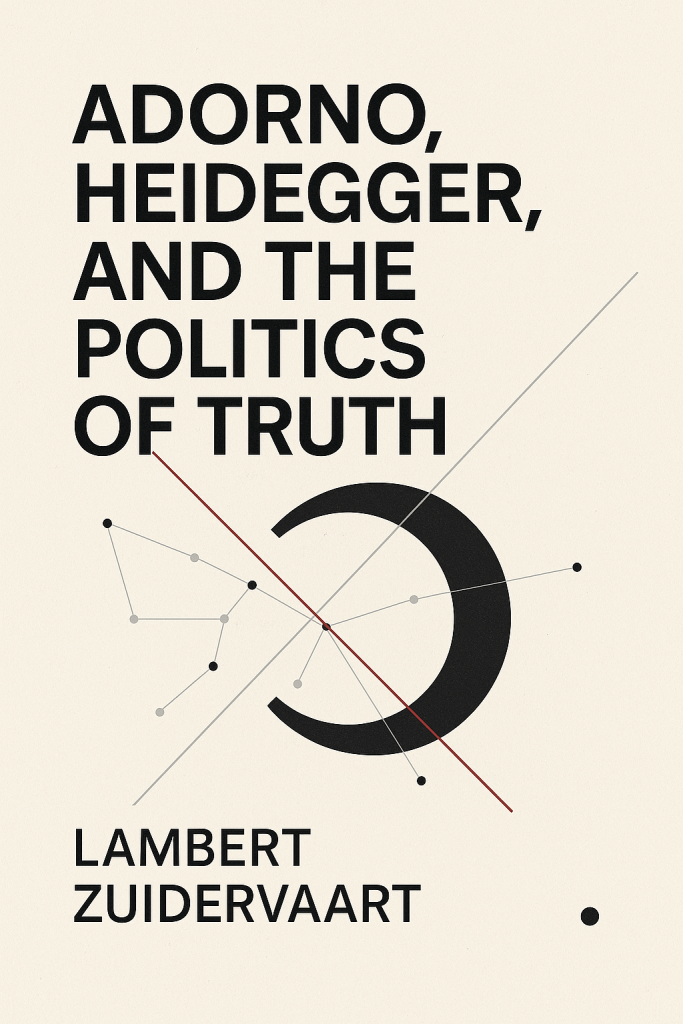
An elusive and recalcitrant conception of truth, scattered in aphorisms and mobilized as a methodological demand rather than codified as a thesis, stands at the core of Theodor W. Adorno’s philosophical project. Yet Adorno never provides a canonical doctrine of truth. The interpretive risk this absence creates—between mistaking negativity for skepticism and canonizing critique into a doctrine—frames the problem to which Lambert Zuidervaart’s Adorno, Heidegger, and the Politics of Truth is expressly addressed.
The book undertakes a sustained reconstruction of Adorno’s dispersed reflections in Negative Dialectics, Aesthetic Theory, and closely related lectures and essays, and then sets this reconstruction into a three-cornered conversation with Martin Heidegger’s thinking of aletheia and Michel Foucault’s analyses of truth-power regimes, in order to clarify not only how Adorno thinks truth but also why, for contemporary theory, art, and politics, truth must be thought in this way. The guiding claim, developed with exegetical patience and conceptual rigor, is that Adorno treats truth as a dynamic constellation—a configuration in which dialectical polarities are made to intersect without being sublated, so that the object’s nonidentity with the concept becomes legible as more than an episodic failure of knowledge. On this reading, the most decisive polarity for Adorno—the one that silently orients the others—lies between society as it has developed and the historically mediated possibility of its complete transformation. Truth, critically reconstructed, turns out to be neither a property of propositions nor a revelation of timeless being, but an unstable nexus of objectivity, negativity, and futurity whose claim on us is inseparable from determinate social suffering and the promise that this suffering might cease.
Zuidervaart’s reconstruction is neither a synoptic report nor a formal theory grafted onto Adorno’s texts. It proceeds as what Adorno himself might have called a constellational elucidation: patiently circling recurring motifs—nonidentity, determinate negation, constellation, truth-content, mimesis, natural history, semblance, reconciliation—while testing their mutual illumination across disciplinary and generic borders. In Negative Dialectics Adorno undermines the identification of philosophical truth with conceptual mastery. Concepts, in their very success at organizing experience, efface what they cannot contain; they are instruments of domination because their identity-function compresses what exceeds identity.
At the same time, critique of identity does not license mere relativism or quietism. Adorno’s notorious dictum that the whole is the false is not a metaphysical claim but a socio-historical diagnosis: the present totality is constituted through a domination that falsifies what it organizes, and thus every claim to systematic unity risks complicity in that domination. Yet the experience of conceptual failure does not end in skepticism; it compels philosophical attention to the object’s priority, to those moments in which what is encountered exceeds what can be said of it. Truth, then, is signaled not by closure but by a friction—by a pressure exerted upon thought from the side of what the concept organizes, a pressure that thought can neither dispel nor successfully master, yet cannot responsibly ignore. Zuidervaart gathers these dispersed lines into a single argumentative thread: truth is constellational because it emerges in the tensioned relation between concept and object, subject and world, history and possibility, where the aim is not to dissolve tensions into higher identity but to hold them in a configuration that lets the object’s nonidentical “speak.”
This constellational account, however, remains indeterminate if it is left at the register of epistemology. What compels constellations to form? What makes the excess of the object more than a merely negative reminder? Here Zuidervaart stresses the peculiar normativity in Adorno’s talk of truth: the truth of an experience or work of art or critical insight is never simply a matter of accuracy; it bears a promise. Adorno’s scattered formulations suggest two converging aspects of this promissory structure. First, the experience of resistance—the felt friction of the nonidentical—reveals the incompleteness of what is given, the fact that what exists is not yet what it could be. Second, that very incompleteness is legible only because historical subjects are oriented toward the abolition of unnecessary suffering.
Truth thus has a teleological negativity: it negates what is in the name of what could be otherwise, without short-circuiting negativity into a picture of the end-state. Zuidervaart captures this dynamic by retrieving Adorno’s own idiom of a “humanly promised other of history,” emphasizing that the promise is not externally appended to truth but woven into its very occurrence. When the object pushes back against its concept, what becomes faintly audible is not simply “otherness” but the demand for a world in which the object would no longer need to press back in this way—no longer need to cry out against its distortion. Truth is thus implicated in a politics it cannot disavow; it not only contests, it hopes. Yet the hope at issue does not justify any image of reconciliation, and Zuidervaart’s reading scrupulously protects Adorno’s suspicion of pictures of redemption: promise is retained only as negativity’s orientation—as orientation, not as projected content.
The book’s sustained confrontation with Heidegger illuminates this orientation by contrast. Heidegger’s account of truth as aletheia—the unconcealment of beings as such in a world disclosed by poetic naming—seems, at first glance, to share with Adorno an anti-foundational, anti-representational impulse. Truth is not correspondence but event; meaning is not an aggregate of propositions but a world. Yet Adorno’s criticism, carefully reconstructed here, is that Heidegger’s transformation of truth into world-disclosure displaces the social and material mediation of appearing into a quasi-mythic history of being. The shift from propositional correctness to ontological disclosure risks severing truth from injustice, because it treats the shape of disclosure as fated and demands from thinking not critique but docile attentiveness.
Adorno’s indictment of “onto-theology,” rhetorically fierce though often caricatured, gains systematic content in Zuidervaart’s retelling: Adorno targets not piety but the annulment of suffering in an appeal to a higher order, and he reads in Heidegger’s pathos of disclosure an aestheticization of domination that softens the force of social critique. At the same time, Zuidervaart avoids simplifying Adorno’s stance into an external moralism; he shows how Adorno takes over crucial Heideggerian insights—about worldhood, about pre-predicative comprehension, about the poverty of representational epistemology—only to insist that the truth of disclosure is indispensable yet insufficient unless disclosure is confronted by what it conceals: the social facticity of suffering.
This insistence leads Zuidervaart to the notion that becomes pivotal in his reconstruction: surplus beyond the subject. Adorno’s many defenses of the object’s priority are not simply romantic gestures toward mute otherness; they elaborate a structural claim about how knowledge and truth actually function when identity thinking is constrained by experience. If truth is constellational, then subjects must be affected by what they cannot appropriate, and they must permit this affect to reconfigure the very space of reasons within which claims of truth are articulated.
This is why Adorno’s aesthetics occupies such a central place in any account of his truth-concept: experiences of art, in their ambivalent autonomy and semblance, dramatize a logic of encounter in which form does not merely organize material but is itself interrogated by material’s resistance. On Zuidervaart’s reading, modern artworks achieve truth not by stating propositions about the world but by configuring materials in ways that make audible, visible, or thinkable what the reigning order occludes, precisely because what is configured cannot be reduced to its organizing form. In this sense, the “surplus” is not a metaphysical remainder but a performative remainder—the difference that remains when form tries to capture content. To the extent that philosophy aspires to truth, it becomes answerable to this remainder and must adopt procedures—constellations, allegory, montage—that let the nonidentical appear without annihilating it in the very gesture of articulation.
Zuidervaart’s emphasis on promise and surplus positions Adorno’s thought in a complicated proximity to Foucault’s analyses of truth and power. Foucault’s genealogies dislodge the view that truth is timeless by showing how regimes of veridiction are entwined with dispositifs of power; he gives determinate shape to the intuition that truth is historical. Adorno would agree that truth’s history is inseparable from domination; indeed, the critique of identity thinking presupposes a long prehistory in which rationality has become an instrument of self-preservation and control. But if Foucault’s courage of truth valorizes the transgressive parrhesiast who speaks frankly against instituted regimes, Adorno’s negativity refuses to treat transgression as its own justification.
The point is not merely to escape disciplinary normalization but to mourn and undo the suffering that normalization both produces and disavows. Zuidervaart therefore reads Adorno as offering a politics of truth that cannot be reduced to regime-analysis: truth does not emerge only at the edges of discourse where power is risked; it is borne in the very experience of a world whose organization is violence, and it claims us precisely because that violence is not necessary. A critical politics of truth, on this view, intertwines genealogical suspicion with a non-sacrificial normativity, denying both the comfort of foundations and the thrill of pure transgression.
That interconnection helps explain the peculiar status Adorno accords to philosophical concepts. They are neither sovereign nor dispensable. Zuidervaart is particularly acute in showing how Adorno’s use of dialectical categories differs from Hegel’s speculative logic while refusing the Kantian dualism of concept and intuition. Concepts do not lawfully legislate the manifold; they are instruments that must continually be reworked under pressure from what resists them. If we say, with Adorno, that what is, is more than it is, we register not an ontological exuberance but the fact that every determination is at once necessary and violent, and that the “more” in question points not beyond the world to another world but beyond this order to a transformed order within which what now must be constrained might be allowed to flourish otherwise. In such a framework, truth cannot be a stable predicate; it is a temporal and social event whose intelligibility depends on the way concepts are compelled to change in the face of their objects. Zuidervaart, refusing both empiricism and idealism, articulates this as an account of objectivity without ontology: objectivity is real, because objects push back; ontology is suspended, because any account of “what there is” that reconfirms the present totality risks repeating the violence that calls for transformation.
The payoff of this reconstruction becomes most visible where Zuidervaart turns explicitly to aesthetics, and especially to Aesthetic Theory. If all truth is constellational, artworks are privileged laboratories of constellations because they are sites where form is both sovereign and under duress. Adorno’s notorious theses—the autonomy of art, the primacy of the artwork’s internal lawfulness, the indispensability of semblance, the truth-content that inheres in successful works—can mislead if torn from their dialectical context. Zuidervaart restores their unity by showing that art’s autonomy is not a flight from society but a non-identical stance toward it: by refusing immediate service to the existing order, artworks make room for a constellational exposure in which the order’s exclusions can appear as exclusions.
The truth of a work is bound up with its capacity to let suffering speak—Weh spricht—without translating that speech into a message the order can promptly assimilate. Where there is truth, there is an echo of reconciliation, but only as the pressure of the not-yet: the work is truthful insofar as it enacts negatively what a different world would make positively possible—relations among particulars that are not organized by domination. Zuidervaart’s reading is at once scrupulous and generous here: it neither romanticizes art’s power nor reduces it to cultural critique; rather, it elucidates the precise logical role artworks play in a theory of truth whose normativity is promissory and whose ethics is non-sacrificial.
A persistent objection haunts any attempt to reconstruct Adorno’s truth-concept along these lines: does not the emphasis on negativity, nonidentity, and promise threaten to dissolve truth into mood or attitude, leaving no criteria by which we might distinguish persuasive constellations from self-indulgent ones? Zuidervaart faces this challenge not by thinning normativity but by thickening it. Constellations are not arbitrary juxtapositions; they are disciplined by the object’s priority and by the requirement that the configuration respond to determinate suffering in determinate historical conditions. The promise that orients constellations is not a moral absolute shine; it is the trace, in experience, of social needs that could be otherwise.
In exemplary constellations—whether philosophical, political, or artistic—this trace is made legible without being converted into a blueprint. Criteria for truth, then, have the character of immanent critique: they test whether a configuration lets the object’s resistance be felt and whether, in doing so, it discloses the contingency of what presents itself as necessity. Zuidervaart is careful not to codify such criteria into a method, precisely because method would here be the enemy of responsiveness; but he equally refuses to abandon the thought that better and worse constellations are possible, and that our judgments about them—fallible, revisable, contested—are the medium in which truth’s claim circulates.
In this light, the comparison with Heidegger and Foucault acquires a diagnostic function for the present. A discourse that calls itself post-truth marks at once a collapse of confidence in institutional veridiction and a cynical opportunism that weaponizes skepticism to protect domination. Against this double bind, Zuidervaart’s Adorno does not propose to revive correspondence theory or to abandon truth for power analysis; he proposes instead to reinvest in practices where truth appears as constellational event: in social movements that articulate unmet needs without fantasizing an immediate closure of history; in critical scholarship that receives the object’s pressure instead of imposing scholastic order upon it; in artworks that estrange us from what we have learned to accept. The decisive polarity here—the one that silently orients and tests claims of truth—remains that between the society we inhabit and the historical possibility of one in which unnecessary suffering would be abolished. Because this polarity is internal to our practices, its orientation can guide judgment without founding dogma: faithful constellations are those that intensify the sense in which what is could be otherwise, and that do so by giving determinacy to the suffering that otherwise dissolves into mere complaint.
Zuidervaart’s exposition of this polarity does more than offer a hermeneutic for reading Adorno. It reframes in Adornian terms the desire, widespread in contemporary theory, to unite critique with hope without allowing either to consume the other. If hope dissolves negativity into program, critique loses its traction on what resists; if negativity refuses hope, critique dwindles into melancholic style. Adorno’s truth, read as Zuidervaart reads it, treads a narrow path between these dangers. Its negativity is not a pose but an acknowledgment that every positive articulation implicated in the present order risks repeating the violence it contests; its hope is not a picture but an orientation that compels us to receive the object’s demand to be otherwise.
Such truth is inseparable from politics, not because it takes partisan positions but because its claim materializes in practices that change what counts as necessity. It is inseparable from art, not because art transmits messages but because art stages, with formal precision, the difficulty of letting the object speak. And it is inseparable from philosophy, not because philosophy legislates meaning but because philosophy can hold together, with argumentative patience, configurations that keep faith with what exceeds them.
The argumentative patience of Zuidervaart’s book is worth emphasizing in its own right. Rather than extracting slogans from Adorno’s prose or juxtaposing adversaries for polemical effect, the study attends to the labor of reading—how Adorno’s insistence on linguistic exactitude belongs to the very content of his thought; how the refusal of definitive doctrine is consistent with providing higher-order guidance; how aesthetic concepts, far from being merely analogical, supply the grammar for thinking truth without domination.
Even in the critical engagements—especially in the extended confrontation with Heidegger—the tone is diagnostic rather than denunciatory, grounded in a conviction that Adorno’s disagreements speak most clearly where their force can be measured by their capacity to do justice to shared problems. The same is true of the conversation with Foucault and with strands of feminist critical theory that, in Zuidervaart’s hands, underscore truth’s entanglement with embodied vulnerability and situated knowledge without renouncing the aspiration to objectivity. The result is not a doctrinal synthesis but a careful cartography of convergences and impasses that makes possible a use of Adorno that neither fetishizes his idiom nor domesticates his demands.
That use has consequences for how we think about the very grammar of truth. Zuidervaart’s Adorno does not ask us to choose among correspondence, coherence, and pragmatic success, because he refuses the idea that truth is the name of a property that attaches to propositions as such. Truth, in this reconstruction, is a mode of appearance inseparable from the practices that make appearance legible; it is borne not by sentences alone but by configurations in which sentences, forms, materials, affects, and institutions interact.
A philosophical claim can be true only within such a configuration; an artwork can be true only insofar as its formal lawfulness organizes material in a way that lets the not-yet be felt; a political judgment can be true only insofar as it grasps how a determinate organization of life produces suffering that could be otherwise. None of these truths is timeless; each is historical not because truth has become relative but because what needs to be negated and what can be promised are historically constituted. In this sense, Negative Dialectics and Aesthetic Theory belong together: the first disciplines thought to receive the object’s claim; the second exhibits practices in which such reception attains exemplary form.
It is tempting to ask, at this point, whether the promissory structure Zuidervaart attributes to Adorno’s concept of truth does not smuggle in precisely the kind of utopian image Adorno forbids. Zuidervaart’s answer is to insist on the grammar of orientation. Promise, in Adorno’s usage, is an index internal to experience: what calls for transformation is not a beyond we imagine but a not-yet we undergo. The “humanly promised other of history” is legible only in and through the suffering that the current order makes necessary; it names not a picture of the end but the claim that suffering not be necessary. Because that claim is unconditional, promise can function as a criterion; because it is historically mediated, promise cannot be cashed out as a blueprint.
The politics of truth that follows from this is neither revolutionary maximalism nor reformist minimalism; it is a politics of constellations, which depends on practices that intensify our receptivity to what the object demands while refusing to canonize that demand into substantive doctrine. In literature, music, and visual art, this politics appears as a discipline of form that breaks with affirmative culture without sacrificing the work’s internal lawfulness; in social movements, it appears as an organizational intelligence that refuses both purity and accommodation; in philosophy, it appears as an argumentative technique that learns from its failures, refusing to subordinate recalcitrant particulars to the beauty of order.
What, then, is the relevance of such a conception for a world that calls itself post-truth? Zuidervaart’s concluding reflections suggest that the epithet post-truth misdescribes our condition if it is taken to mean that truth has become irrelevant. What has happened, rather, is a widespread implosion of confidence in institutions that certified truth, combined with an ever more sophisticated apparatus for managing appearances. In that setting, a return to facts—however necessary—remains insufficient, because what is at stake is not only accuracy in reporting but the historical shape of objectivity itself.
Adorno’s concept of truth, critically reconstructed, offers a way of inhabiting this crisis without surrendering to cynicism: it demands that we seek configurations—critical inquiries, institutional designs, artistic practices—that expose the contingency of what presents itself as necessary and that register, in their very form, the pressure of what would be otherwise. Such configurations are fragile, contestable, and local; they do not resolve the crisis but keep faith with what the crisis makes palpable. They are “hopeful critiques,” not because they deny darkness but because they convert the felt weight of nonidentity into orientation, and thereby give content to the thought that truth remains thinkable where the object is allowed to speak.
If Zuidervaart’s study is persuasive, it is because it demonstrates that Adorno’s scattered remarks about truth can be made to hang together without being systematized and can be made philosophically productive without being moralized. The elusive center of Adorno’s thought—the sense that philosophy must make room for what eludes concepts without abandoning concepts—turns out, in this reading, to be a plausible grammar for thinking under conditions that have rendered both orthodoxy and skepticism inert. That grammar refuses to relieve us of difficulty. It makes thought answerable to suffering without reducing suffering to a theme; it binds truth to promise without picturing the end of history; it entrusts art with a vocation it cannot fulfill without betraying itself; it asks politics to improvise constellations that are simultaneously disciplined and inventive.
In a period prone, on the one hand, to the nostalgia of foundations and, on the other, to the euphoria of unmasking, this refusal is not a defect but the condition of a thinking that would not repeat what it criticizes. Zuidervaart’s book, by patiently reconstructing this refusal and articulating its stakes, provides not a formula but a practice, a way of reading that resonates with the very conception of truth it explicates: constellational, negative, promissory, and—because oriented by a humanly promised other of history—irreducibly political.
 Simon Gros
Leave a comment