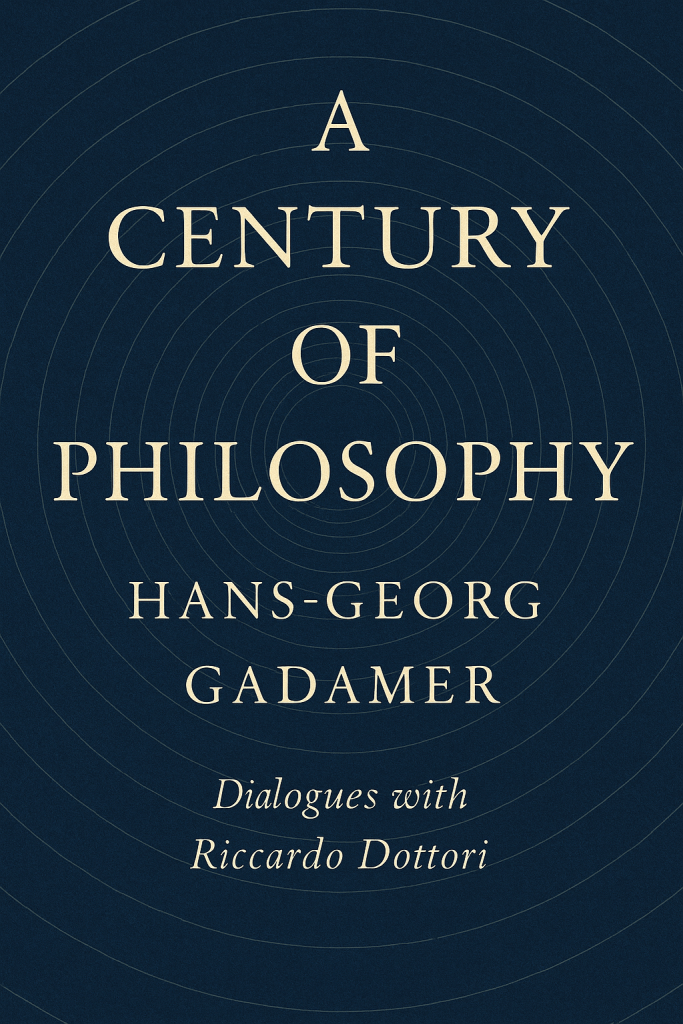
A Century of Philosophy is neither a mere memoir nor simply a late summa, rather it’s a deliberately refracted self-portrait by way of conversation, it exposes the inner grammar of Hans-Georg Gadamer’s thought under the pressure of historical catastrophe and intellectual dispute. It takes the shape of ten dialogues recorded in 1999–2000 between the centenarian hermeneut and his long-time collaborator Riccardo Dottori, rendered into English by Rod Coltman with Sigrid Koepke.
The English edition follows an earlier German publication under the telling title Die Lektion des Jahrhunderts, a phrase that already displaces the reader’s expectation from tidy retrospect to a chastening pedagogy, as if an epoch instructs only by wounding those who live through it. The book’s frame matters: Dottori’s autobiographical introduction stages thirty years of shared questioning and debate, while the closing Portrait and Dialogue takes a literal portrait as the cue for a final meditation, so that portraiture, conversation, and philosophical recollection intertwine as the true media of understanding. The result is a slow, exacting distillation of a life into a method, and a method into a stance toward finitude, authority, and hope.
The architecture of the volume discloses a program rather than a miscellany. Its chapter headings—Phronesis: A Philosophy of Finitude, Ethics or Metaphysics, Utilitarianism, Pragmatism, Pluralism, Ethics or Rhetoric, Metaphysics and Transcendence, Ethics and Politics, Tradition and Emancipation, Philosophy in the Eye of the Storm, Between Heidegger and Jaspers, and The Last God—trace a sequence in which questions of practical reason, dialogical procedure, and historical consciousness fold into the most fraught coordinates of twentieth-century thought: the fate of metaphysics, the crisis of political legitimacy, the struggle between emancipation and inheritance, and the religious residue of philosophy after nihilism. These are not thematic islands but a path whose way-stations are marked by interlocutors—Vico, Nietzsche, Rorty, Popper, Derrida—and by names from Gadamer’s lived canon—Heidegger, Jaspers—that the dialogues return to with a measured, sometimes merciless, sobriety. Even the index, thick with classical figures and modern disputants alike, signals that what is at stake throughout is not an author’s doctrine but the recommitment of philosophy to a form of life sustained by disputation, memory, and rehearsal.
That recommitment is named phronesis, a word that in Gadamer’s hand becomes neither an ancestral Greek ornament nor a polite deflation of theory into common sense, but a principle of intellectual conscience adequate to our condition as historical beings. The opening dialogue sets a tone: if metaphysics collapses when it pretends to stand nowhere, historicism paralyzes when it forgets that understanding, because finite, must still decide. Phronesis is thus not a substitute for truth but the only credible bearer of truth once truth is recognized to arrive through application, in the court as in interpretation, where the general only lives by way of a judgment responsible to the singular case. The judge, the citizen, the reader—these are the exemplary rational agents, bound by what they inherit yet obligated to let the matter itself instruct them in how the rule must bend. In this register, Gadamer’s notorious “fusion of horizons” ceases to be a soft metaphor; it becomes a discipline of self-suspicion and self-exposure under the claim of what is before us, a manner of reasoning that can be learned only in practice and that will never be finished.
By placing phronesis first, the book tacitly rewrites the map of twentieth-century philosophy. The canonical alternatives—Heidegger’s existential analytics on one side, the post-Kantian metamorphoses of value, logic, or language on the other—are not dismissed; they are submitted to a hermeneutic conversion. From Heidegger, Gadamer keeps the dissolution of a spectator’s ontology and the discovery of temporality as the medium of meaning, but he refuses to let Mit-sein remain an ontological afterthought; the other, he insists, is not a faint corollary of my being-there but the place where my thrownness is most unavoidably addressed. And from the moderns—Kant, Hegel, and their critics—he keeps the demand that reason justify itself without falling back on the empty authority of fact, while redirecting that demand through the dialectical training of dialogue: the rule of understanding is not a method applied from above but the readiness to pursue a claim beyond one’s horizon until one’s horizon shifts. The interpretive maxim follows: there is no interpretation immune to history, and there is no history that absolves us from the responsibility to interpret.
Against the often repeated charge that hermeneutics sanctifies tradition, these conversations exhibit something sharper: a theory of authority that abjures appeal while acknowledging the slow emergence of what binds. “One has authority,” Gadamer remarks, “but one can never appeal to it.” There is nothing mystical in this paradox; it describes the labor by which practices, laws, and words endure criticism without collapsing, and so acquire the right to be recognized. When Habermas, in the long Frankfurt debate, insisted that critique must displace hermeneutics, Gadamer answered that critique itself presupposes a shared measure, otherwise argument cannot get started; the better argument is only audible within a common speech that both sustains and exposes us. Later, Habermas’s own confrontation with jurisprudence and civil rights would force a concession: the legitimacy of norms is not secured by rational procedure alone but also by the continuity of a legal and linguistic life-world, the learned trust that what is handed down can be held to account. It is not a surrender to the past but the condition for its transformation.
This adjustment in the account of authority is inseparable from the book’s persistent defense of rhetoric as the other of ethics rather than its enemy. When Gadamer pairs Ethics or Rhetoric in a title, the “or” is Socratic: it is the provocation by which the dialogue tests and rescues both terms. Rhetoric, in the Platonic sense that Gadamer favors, is not manipulation but the art by which what is at stake becomes sayable in the time available, before those who must decide. It binds cognitive humility to civic courage. This is why the later exchange with neopragmatism—exemplified by Rorty’s restriction of politics to the better rather than the true—is conducted without rancor: Gadamer can grant that politics rarely touches the good in itself without letting go of the claim that practical reason always carries an orientation to the good, since “the better” is only intelligible against a horizon of ends we do not invent at will. So if philosophy cannot dictate political outcomes, it can still teach the internal measure of political intelligence, a discipline of judgment that hears the claim of the better as more than the arithmetic of preferences.
From here the dialogues pivot to the century’s furnace: ethics and politics under regimes that make philosophy appear either impotent or complicit. The exchange on Tradition and Emancipation is emblematic. Habermas’s early accusation—that hermeneutics hardens into conservatism whenever it legitimates authority—meets Gadamer’s counterclaim, that emancipation which knows nothing of what binds degenerates into abstract critique and misses the slow, communal disciplines by which a polity learns to hear reasons. The autobiographical threads matter. Gadamer speaks as one who kept his intellectual poise across Weimar, the Third Reich, and the East German interregnum, not by hiding, but by exercising a diplomatic phronesis that refused spectacular opposition as it refused servile agreement; and he does not sentimentalize that posture. He insists, instead, that the only honest self-description of such survival is a humility about what philosophy can do directly in politics and a renewed insistence that rhetoric—understood as the responsibility to speak aptly to the occasion in the language a people can hear—remains indispensable.
Precisely because the book refuses to lose itself in programmatic slogans, its pages on the Heidegger–Jaspers constellation do not conduct a trial; they reconstruct how two temperaments, two vocations for philosophy, responded divergently to the same pressure and then corrected themselves with unequal success. The narrative does not acquit by pathos. It emphasizes Heidegger’s misplaced hopes, his provincial mysticism without God, the humiliations of Berlin, and the philosopher’s nine months as rector at Freiburg; it notices Jaspers’s moral fastidiousness and the limits of his political judgments in the immediate postwar years; it records reconciliation without forcing symmetry. The insistence throughout is that the twentieth century refuted the fantasy that philosophy can become a politics without remainder; what remains is more exacting and more fragile: the formation of judgment, the refusal to disown conversation, the ability to keep contact even when contacts are dangerous. That is what it meant, Gadamer suggests, to bear responsibility in Leipzig in 1945: not to win a thesis, but to defend a university’s life under the eyes of soldiers, with words measured enough to save a space for thought.
To call such work accessible—as the dust-jacket blurb might—would be to mistake clarity for concession. The interviews here are unusually lucid, but they do not simplify; they redistribute difficulty, moving it from scholastic puzzles to the exemplary cases in which justice, truth, and memory are shown to be indivisible. It is here that the volume’s method, conversation, discloses its necessity rather than its charm. Because no interpretation can claim a God’s-eye priority, philosophy restores itself as dialogue or it abandons its vocation. The work’s most provocative pages say, in effect, that the twentieth century forced this alternative upon us: either the liquidation of metaphysics lapses into quietism, or the end of foundationalism becomes the chance to retrieve metaphysics otherwise, as a discipline of finite reason’s willingness to be answerable—to texts, to practices, to persons, to the recalcitrant matters we do not control. In that register, “ethics or metaphysics” shows itself as a bad disjunction; the moral seriousness of hermeneutics is its metaphysical seriousness under the sign of finitude.
The book’s last movement, The Last God, intensifies this retrieval by asking whether, after the “death of God” and the exhaustion of metaphysical systems, anything like a binding symbol of solidarity remains thinkable. Gadamer does not erect a theology in exile, nor does he sentimentalize religiosity as vague comfort. The wager is more austere: in a world capable of self-destruction by technical means, perhaps only a shared awakening to our finitude—our birth without consent, our death without consent—can found a consensus that is not merely procedural. This “last god” names neither an ecclesial dogma nor an aestheticized transcendence but the minimal acknowledgment that astonishment and anxiety are not eliminable by knowledge and that human beings, because of this, require forms of common life hospitable to reverence. Such a claim refuses both apocalyptic consolation and technocratic complacency; it asks whether philosophy, when stripped of consolations it cannot honestly retain, may yet point toward the conditions under which the human can be preserved.
Notice how this concluding note retroactively clarifies the book’s earlier insistence on rhetoric, on tradition, and on the dialogical form. If there is to be any “last god,” it will not arrive as a doctrinal victory but as the grudging convergence of long-separated languages of the sacred upon their common core—the acknowledgment that the admirable and the terrible exceed us, and that humility before this excess disciplines both politics and thought. Gadamer refuses to polish this into certainty. He concedes that only shock—perhaps catastrophe—will instruct us, not because he desires it, but because the human propensity to trust technique over judgment appears incorrigible. Philosophy’s task then is small and immense: to keep the question of transcendence intelligible without tyranny, to let religious sentiment be criticized without being extinguished, and to defend a civic space in which persuasion, not compulsion, bears whatever authority we can still recognize.
Throughout, Dottori’s presence is not just that of an interviewer but of a philosophical partner who pushes the conversation toward its pressure points. It is he who insists that Gadamer face the early accusations of romanticism, the putative quietism of the aesthetic defense of truth, the suspicion that hermeneutics secures consensus at the price of justice. And Gadamer answers not by retreat into autobiography—though his memories are everywhere instructive—but by returning to the inner discipline of application: show me the case, and we will see what the rule requires. It is this insistent sobriety that makes the volume, for all its grave subjects, surprisingly serene. The serenity is not a mood; it is an ethical style won by decades of refusing to confuse impatience with radicality. One feels, in the unhurried sentences, the patience of someone who has learned to hear a position until he can state it better than its advocate, and only then to disagree. That habit, the book quietly teaches, is the only non-nostalgic form of reverence a late modern intellectual can afford.
Readers who come looking for verdicts about Heidegger’s culpability or Habermas’s mistakes will find, instead, a subtler instruction: judgments are unavoidable, but the worth of a judgment is proportional to the fairness with which it can preserve what it rejects. So Heidegger’s “mysticism without God” is not stigmatized in order to dismiss his questioning, and Jaspers’s political rectitude is praised without letting it harden into moralism. Rawls appears not as a foil but as an occasion to refine how norms actually claim us; Rorty is not an antagonist but a limit case that helps verify how far a politics of the better can travel without a teleology of the good. The book’s argument thus proceeds by a sequence of conversions: enemies become tutors, slogans become problems, histories become obligations. If these dialogues feel “accessible,” it is only because they are so meticulously unafraid to keep separate, for as long as needed, the matter at hand and the anxieties that press upon it.
The result is an unusual kind of accessibility—one that presupposes a reader willing to be slowed down by finitude rather than sped up by method. That is why the volume may be, as the publisher’s copy claims, the most approachable entrance to Gadamer’s work in English: it offers the conceptual itinerary of Truth and Method without turning it into a catechism; it gives you the disputes with critical theory, analytic philosophy, and deconstruction without stylizing them into team jerseys; it takes the political disasters of the twentieth century neither as occasions for self-congratulation nor as excuses for quietism, but as the painful tuition by which a culture might relearn how to argue without despair. In that spirit, the “lesson of the century” is neither an aphorism nor a formula. It is the refusal to abandon the slow arts—listening, application, persuasion—by which finite beings, bound to traditions they did not choose and exposed to futures they cannot predict, nevertheless make and remake a common world.
What makes this book worthy of the title it bears is not merely that a philosopher lived to a hundred and then opined about the age. It is that the form of speech it preserves—sustained, courteous, probing, occasionally obstinate—becomes itself a wager about how truth can still circulate after the collapse of grand guarantees. Gadamer takes as axiomatic that truth must be able to circulate; otherwise philosophy becomes either aggression dressed as certainty or melancholy disguised as subtlety. The dialogues, in their very texture, decline both temptations. They embody the hope, faint and stubborn, that under the words of those who disagree sincerely there is still enough common air for argument to be binding. If that hope is what Gadamer means, finally, by a “last god,” it is a god without cult and without idols, a name for the venerable but always endangered fact that we can still meet each other in speech and find that our horizons have shifted. If one wants to say what this book is about, one could do worse than answer: about that shift, how to deserve it, and how to go on.
 Simon Gros
Leave a comment