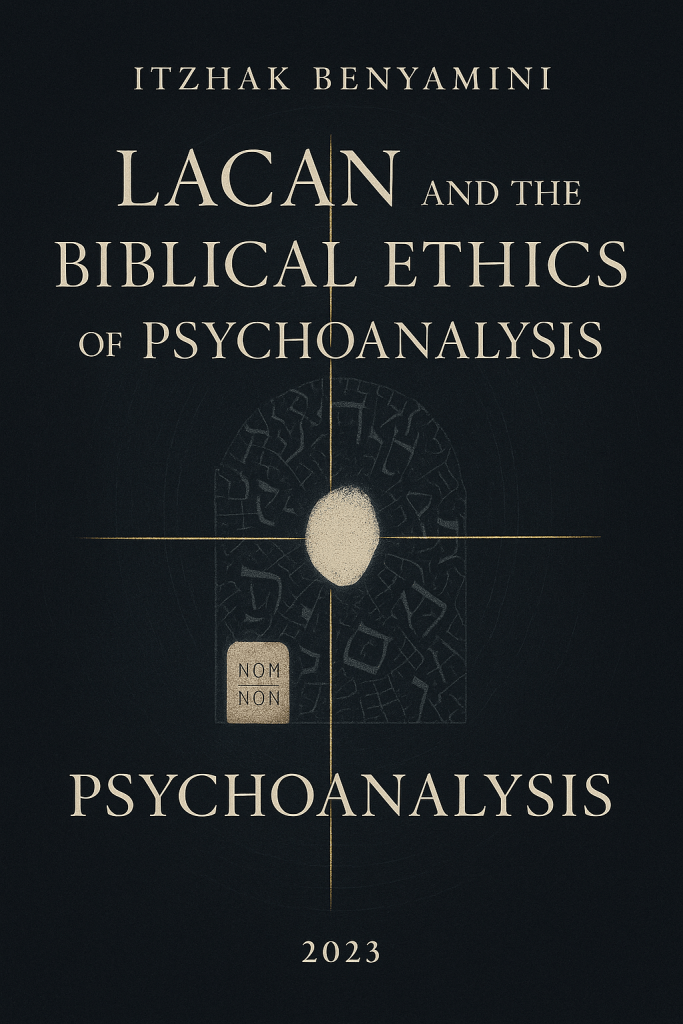
Itzhak Benyamini’s Lacan and the Biblical Ethics of Psychoanalysis advances a thesis at once straightforward in its declaration and difficult in its execution: that the self-proclaimed “return to Freud,” which ordered Jacques Lacan’s trajectory across the mid-twentieth century, never proceeded in a strictly secular key, never unfolded as a merely technical renovation of Freudian metapsychology, and certainly never severed itself from the sedimented theological diction—and the ethical urgencies—of the Biblical tradition that had already saturated Western discourse by the time Freud and Lacan began speaking in its wake.
What gives the book its distinctive pressure is not the biographical truism that Lacan was born into a Catholic milieu and that his brother Marc-François became a priest, nor the oft-remarked proximity of Lacan’s institutional voice to Jesuit pedagogy and to Catholic intellectual life in France, but the exacting way Benyamini reconstructs how, text by text and seminar by seminar, the central Lacanian operators—the mirror stage, the Imaginary and its misrecognitions; the Symbolic as the order of law and language; the Real as the impassible kernel of disturbance; the Name-of-the-Father and the paternal metaphor; the Other as locus of speech and address; the partial object and objet a; jouissance and the command of the superego; das Ding as the unassimilable Thing—are progressively composed in tension with an ethical horizon that is legible only if one keeps the Biblical canon in view, above all the Pauline letters where law, sin, sacrifice, grace, and neighbor love are knotted in ways that psychoanalysis cannot simply adopt yet cannot finally ignore.
In other words, Benyamini proposes a reading of Lacan in which the analytic clinic refracts a Biblical problematic rather than suspending it: law and desire serve as cognate names for the binding of the speaking animal to what exceeds it; commandment and prohibition amplify the paradox of an injunction that simultaneously constrains and incites; fatherhood functions as a symbolic operator and as a historical-theological trace; the “Other” cross-writes the place of God and the place of language, the impossibility of the One and the insistence of the letter; and the ethics Lacan pursues—famously neither utilitarian nor humanist, neither eudaimonistic nor Kantian in any conventional sense—must be heard alongside the Apostle’s attempt to articulate an ethical life no longer under the law and yet not outside it, an ethical life that risks being named love without relinquishing the structural severity of prohibition, lack, and limit.
From the first pages, Benyamini frames his questioning with a methodological wager that refuses the usual disjunction between intellectual history and conceptual analysis. The wager is not that Lacan secretly smuggles religion into psychoanalysis, nor that his doctrine collapses into theology once one tilts it in the right way; rather, the wager is that psychoanalysis, as an inquiry into how subjects are bound by speech, interdiction, and desire, is coextensive with the ethical problematic that Biblical discourse made articulate in the West, so that the “religious” overtones in Lacan are neither accidental nor merely private, but structurally required by the kind of questions psychoanalysis asks when it takes its own concepts seriously.
That is why the book does not begin with a polemic about faith but with close reading: of early texts, where the mirror stage binds the infant to an image that compensates for motor impotence and inaugurates a misrecognition constitutive of the ego; of the turn toward structural linguistics, where the signifier and the law of the signifying chain subject the speaking being to a logic it does not master; of the ethics seminar on das Ding, where the Good is staged as that unlocatable object whose approach risks the annihilation of the subject; of the recurrent motif that there is no metalanguage and no Other of the Other, a motif that both negates and preserves the monotheistic ache for a final, guaranteeing authority. The sense in which Benyamini insists on a Biblical ethics, then, is neither confessional nor reductive. It is diagnostic: to grasp why Lacan’s “ethics of psychoanalysis” is not a humanistic ethic of well-being, one must see how it perpetually dialogues with a prior tradition that already knew that law binds and arouses, that the neighbor is a scandal rather than a solace, that love cannot be commanded without contradiction, and that sacrifice interests ethics not for its piety but for its structure.
Because Benyamini’s analysis operates on this double register—Lacan’s doctrinal elaboration in its own idiom, and the long horizon of a Biblical ethics that refracts it—the book sustains a kind of conceptual double vision that is not gratuitous complexity but thematic necessity. Consider the Name-of-the-Father: at once the emblem for the paternal metaphor by which the child’s desire is buckled to the speech of the adult world; the index of a prohibition that inaugurates symbolic law and enables desire as such; and the cipher for a vacancy at the heart of authority, for the Name functions as a signifier that posits its own ground by not having one. Benyamini traces the arc by which Lacan insists that the family romance is not the origin of law, only the scene where the structural necessity of law writes itself with contingent names.
Yet if the Name-of-the-Father operates in Lacanian theory to limit incestuous fusion and to orient desire within a law that produces lack, it also recapitulates a theological history in which the divine Name marks both prohibition (the unspeakable tetragrammaton) and the possibility of address (the God who speaks the law and receives the plea). Theologically, the Name both forbids idols and founds a people under a law; analytically, the Name interdicts the fantasy of completeness and installs the subject within a signifying economy. The ethical upshot is not that psychoanalysis silently installs God, but that the logic of naming, prohibition, and desire makes the tradition of the Name an unavoidable intertext for any ethics that eschews eudaimonistic closure. There is a reason that Lacan’s insistence that there is “no Other of the Other” plays, in Benyamini’s reading, as a negation that preserves: it negates any theological guarantee while preserving the theatrical space of address, the fact that the subject is formed in relation to a locus of speech that it cannot ground.
A parallel complexity attaches to jouissance, that notorious term by which Lacan names an enjoyment that exceeds pleasure principle calculation, that breaks utilitarian measure, that attaches the speaking animal to its symptom with a tenacity that confounds ideals of health. Benyamini’s account insists on the Biblical counterpoint: an ethics that does not resolve into happiness but into a topology of limit, prohibition, and transgression, is already legible in the Pauline problematic of law and sin. The Apostle’s paradox—that the law awakens sin, that commandment incites the very transgression it proscribes—furnishes, in Benyamini’s reconstruction, a strong analog for Lacan’s superegoic imperative that commands one to enjoy and thus provokes guilt not as the affect of wrongdoing but as the mark of structural impossibility.
If the Letter to the Romans stages a subject split by the law such that it does the evil it would not and cannot do the good it would, Lacanian ethics restages that split as constitutive, not curable: jouissance is not a moral failure but an economy by which the subject is bound to its symptom and by which the analytic process aims not at relief but at a reconfiguration of one’s relation to that binding. The point of the analogy is not to subsume Lacan under Paul but to let the Pauline analytic give conceptual traction to Lacan’s claim that, in ethics as in the clinic, the subject’s relation to the law cannot be imagined as a path toward contentment; it is rather a relation in which the law both installs desire and denies total satisfaction, such that an ethics of psychoanalysis must think beyond the dualisms of license and restraint.
The density of Benyamini’s argument comes into relief where he refuses any naïve genealogy of influence. Surrealism and psychiatry, structural linguistics and phenomenology, Catholic pedagogy and French philosophical debate—these are stipulated not as a list of tributaries but as an ensemble of problem-settings within which Lacan had to articulate the claims of Freudian causality and the structuring function of language. Benyamini shows how the early clinical casework with paranoia and the fascination with the mirror stage converge with a cultural moment in which the image had become a privileged arena for thinking the human; how the turn to Saussurean linguistics and to Lévi-Straussian structuralism furnished not only a new vocabulary for re-inscribing desire as the effect of differential positions but a new understanding of law as structural before it is moral; how the Catholic idiom in which Lacan was conversant compelled a sensitivity to the drama of confession, absolution, and the burden of the superego as an internalized command that is not reducible to conscience; and how, in the mid-century French nexus of theology and philosophy, any thinking of ethics had to articulate itself against Kant, with and against Hegel, and in dialogue with the phenomenological reappropriation of the neighbor—matrices to which Lacan returns when he treats the Good as a structural lure and the neighbor as an unbearable proximity rather than an ethical consolation. The return to Freud, in Benyamini’s telling, is also a return to this entire network of conceptual possibilities, which is why the book insists that Lacan’s “Catholic” tonality is not a matter of doctrinal assent but of inherited forms of ethical interrogation.
This insistence that the ethical is inseparable from the signifier’s order furnishes the book’s leitmotif: law as signifier; prohibition as the structural precondition of desire; the father as operator of symbolic placement rather than as biological progenitor; the neighbor as that impossible object whose space is neither absorbed by charity nor dissolved by distance; the command to love as analytically undecidable. Benyamini does not, therefore, collapse Lacan’s ethics into a Pauline morality; he deploys Pauline structures to clarify why Lacan’s ethics is uninterested in the Good life and everywhere interested in the structural bind.
It follows that where reading habits sometimes domesticate Lacan’s ethics of desire into a permissive celebration of singular wants, Benyamini re-establishes the intransigence of Lacan’s claim: desire is ethical not because it is authentic but because it is the index of a subject’s relation to lack; its path is marked by renunciations that are not moral but structural; and its terminus is not plenitude but a modification of how one speaks one’s symptom. That is why das Ding—the Thing as the tantalizingly close and forever foreclosed object of the Good—is for Benyamini the Lacanian name for the Biblical prohibition’s kernel. The ethics of psychoanalysis does not ask us to abandon the Thing any more than Paul expects the law to vanish; it asks whether one can live in the knowledge that the Thing cannot be possessed without annihilation, that the law cannot be abrogated without producing worse servitudes, and that jouissance can only be redirected, never extirpated.
A crucial benefit of Benyamini’s approach is that it rescues Lacan’s theology-adjacent idiom from two opposed misreadings. Against the romanticizing reading that treats Lacan’s God-talk as a sign of metaphysical yearning, and against the deflationary reading that treats it as merely rhetorical ornament, Benyamini shows how the discourse of the Name, the law, and the Other is internally required by the logic of the signifier. The Other is not a hypostasis but the formal place from which the subject receives its message; the Name-of-the-Father does not guarantee meaning but punctuates the chain where meaning stalls; the barred Other is not a nihilist gesture but a rigorous way of insisting that there is no master signifier that could finally ground the series.
It is in this sense that Biblical motifs become analytically pertinent: negative theology’s refusal of a final concept expresses, in theological idiom, something like Lacan’s insistence that there is no meta-language, no final guarantee external to the signifying chain. Where Paul speaks of weakness, Benyamini hears not only a spiritual motif but the analytic correlative: that the subject is decentered by the signifier and can no more master the law than it can master its own desire. And where the tradition treats love as the fulfillment of the law, Benyamini generates the analytic question: what could it mean to speak of a love that does not cover over lack but bears it, a love that does not erase the neighbor’s alterity but insists on it as the very scandal that gives ethics its difficulty?
The book’s atmosphere is one of controlled provocation: every clarifying move risks complication because the very objects of clarity—law, desire, fatherhood, love—are cross-written by discourses that make contradictory demands. If the paternal metaphor is necessary to describe how the subject is positioned within language, can one separate that function from the sociopolitical history of “the father,” or from the patriarchal theology with which the term is entangled? Benyamini refuses a false resolution: he documents Lacan’s insistent structuralism—father as function, not person—while underscoring that structures are never without historical residue and that the ethical questions provoked by the Name cannot be settled by declaring that the Name names only a function.
If the dream of reconciliation persists in religious idioms—Jerusalem above, charity realized—what would it mean, in analytic terms, to resist the dream without denying the desire that animates it? Again, Benyamini eschews pieties. He reads in Lacan’s ethics not a declaration of despair but an acceptance of non-relation, of the fact that there is no sexual relation as formula, and no final unity without remainder. That acceptance, far from cynical, names the minimal condition under which love can be distinguished from imaginary fusion: love as the giving of what one does not have, as a speaking relation in which the lack is neither denied nor fetishized but allowed to articulate itself without promise of closure.
Because Benyamini is attentive to the formation of Lacan’s vocabulary across the 1930s, 1940s, and 1950s, the book also displays a precise sense of intellectual milieu. Surrealism’s preoccupation with the image and with automatism clarifies why the mirror stage could be grasped as a drama of seduction and alienation; French psychiatry’s clinical categories offered Lacan a terrain for thinking delusion not as cognitive failure but as a structurally coherent reorganization of reality under the pressure of the signifier; the engagement with Jesuit discourse made available a rigor of casuistry and a pedagogy of exercices that, without importing doctrine, informed the tone of the clinic; and the postwar French constellation, in which de Certeau and others negotiated the fraught crossings of theology, anthropology, and psychoanalysis, supplied a field in which to test whether the language of the Other could be used without theological guarantees.
Benyamini’s particular gift is to show how these contexts do not dilute the specificity of Lacan’s innovations but help us understand why the insistence on the law’s primacy over the ego, on the signifier’s priority, on the constitutive non-relation in sexuation, on the impossibility of the Good as object, could appear both timely and scandalous. It is not that Lacan Catholicizes Freud; it is that Lacan discovers, in the Biblical tradition, a set of articulated aporias—commandment and transgression, sacrifice and grace, neighbor and enemy—that resonate with analytic structures and that sharpen the ethical profile of the clinic.
The thread that binds the book is the vexed relation of law and subject. Benyamini refuses to permit the law to simplify either into moral statute or into sociological norm; he follows Lacan in treating the law first as signifier, the nom that is also the non in the French play Lacan loved, and thus as an operation that institutes prohibition as the precondition of desire. But if prohibition installs lack, then the law is not the enemy of desire but its condition, and the Pauline paradox—“I had not known sin but by the law”—is less a theological oddity than a structural insight: speech introduces interdiction; interdiction conjures desire; desire sustains the subject in the absence of the Thing; the superego commands enjoyment and punishes the subject for its impossibility; jouissance becomes the index of the subject’s intimate entanglement with its symptom. Ethics, on this view, cannot be the science of right action; it is the topology of the subject’s relation to its lack. If the subject seeks a Good that would dissolve lack, it will encounter the Thing and court death; if it succumbs to the superego’s cruelty, it will chase an enjoyment that punishes as it promises. The analytic task, in Benyamini’s reading of Lacan’s ethics, is therefore paradoxically modest and radical: to lead the subject to know something about its desire, to consent to the non-relation that structures sexuation, to articulate love as a saying that does not claim to fill the lack but speaks around it with precision.
One of the most fertile consequences of Benyamini’s project is the reconstrual of “ethics” itself. If biblical idioms are not imported into the clinic but already present as the inherited ethical language of a culture in which analysis is practiced, then the analyst’s speech cannot avoid theological proximities even when it refuses theological commitments. The analyst’s neutrality cannot mean moral suspension; it names a structural posture: the analyst occupies, for a time, the place of the subject supposed to know, a place that must be evacuated for analysis to finish. Within that economy, love appears as transference, and thus as both engine and obstacle, and forgiveness appears as an analytic permutation of repetition, not as pardon from a sovereign. Benyamini’s biblical ear helps him to clarify why these are not metaphors but structural analogs: the religious ceremony both acknowledges the lack and tries to stage its resolution; analysis acknowledges the lack and refuses any ceremony that would pretend to close it. Yet the refusal is not hostility to religion; it is a fidelity to the structure of the signifier and to the impossibility that gives ethics its contour.
Here the book takes its most provocative turn: by insisting that Lacan’s famed “anti-philosophy” is not a rejection of philosophical thinking but a reorientation of it toward the limits set by the signifier, Benyamini suggests that the place where Lacan is closest to theology—thinking the Name, the law, the Other—is the place where he is most rigorous about the impossibility of a last word. Negative theology knows that God cannot be said, but must be spoken toward; Lacan knows there is no meta-language, but one must speak. The barred Other does not liberate the subject into anarchic freedom; it binds the subject more tightly to the speech that constitutes it. The ethics of psychoanalysis is ascetic not because it renounces pleasure but because it renounces the fantasy of closure. If this sounds like an arid rigorism, Benyamini shows that it is anything but: the result is an unexpected tenderness toward love and neighbor, precisely because love is not tasked with saving the world and the neighbor is not conflated with the self. The neighbor is difficult because the neighbor is the site of an unknowable jouissance that resists my categories and threatens my stability. An ethics that knows this cannot sanctify “care” as a resolution, but it can ask for a more truthful speech about what relations demand and destroy.
In refusing any simple reconciliation between Lacan and the Biblical traditions he anatomizes, Benyamini also refuses the consolation of antagonism. He neither celebrates a religious Lacan nor prosecutes a secular one. He composes, instead, a theory of proximity: the places where analytic speech and Biblical ethics occupy adjacent conceptual space and, by occupying it, force each other’s questions to sharpen. When Lacan says there is no “Other of the Other,” he dismantles any appeal to a higher court of meaning; when Paul says that love fulfills the law, he discovers a paradoxical ethical supplement that neither abrogates the law nor leaves it untouched. Reading them in counterpoint produces neither a synthesis nor a disciplinary skirmish but a map of the difficulties that any contemporary ethics must face if it is to honor the structure of speech and desire. The contemporary subject, formed by images and commands, by the anonymity of systems and the intimacy of family romance, cannot be treated by a therapy that promises harmony nor by a morality that promises virtue without remainder. To that subject, Benyamini argues, Lacan offers an ethics that does not promise relief but offers lucidity about the conditions of speech; the Biblical archive offers a language for conflict and commandment that subtends any discourse on responsibility. Their intersection is not a program to be implemented but a site where one can think what remains intractable in desire and law.
This is why the book is, finally, a description in the strongest sense: not a synopsis but a rendering of a field so the reader can inhabit it. Benyamini’s descriptive phrasings are elaborate not to inflate difficulty but to be faithful to a situation in which every clarifying gesture produces a new complication. To say that the Name-of-the-Father is a function is already to raise the question of how functions accumulate historical residues; to say that jouissance exceeds pleasure is already to require a topology of bodies and speech beyond hedonism and beyond asceticism; to say that love is a giving of what one does not have is already to demand an economy of gift that does not erase lack by a fiction of plenitude. The descriptive labor is ethical because to simplify the field would be to betray both Lacan’s and the Bible’s insistence that ethics is born where the subject confronts, and does not dissolve, contradiction. Benyamini’s sentences are long because there is no short way to speak the noncoincidence of desire and law, and no short way to indicate the place where love must admit failure without abdicating responsibility.
To read the book as a recent contribution to psychoanalytic literature is to see how pointedly it addresses the current climate in which the language of ethics is either moralized into codes of conduct or psychologized into techniques of flourishing. Against both tendencies, Benyamini places us in the scraping friction of a discourse that refuses to collapse ethics into either compliance or optimization. He recalls, with Lacan, that the subject is not the ego and that any ethics that caters to the ego’s projects is an ethics of avoidance; he recalls, with the Biblical archive, that commandment binds a people together in speech but does not reconcile them to an achieved Good. The very gesture of returning to the 1930s–1950s corpus, to the seminar on ethics and to the letters of Paul, is a polemic against the amnesia that would make of analysis a wellness practice and of ethics a checklist of behaviors. It is also a wager that the most durable resources for thinking our impasses were forged in the previous century where the failures of civilization, religion, philosophy, and politics were at once undeniable and inassimilable, and where psychoanalysis had to articulate an ethics that could afford to be sober about what it cannot promise.
If there is a single throughline in Benyamini’s project, it is the insistence that ethics begins where mastery ends. That is a psychoanalytic truism made fresh by the biblical counterpoint. Mastery’s fantasies saturate both discourses: law as the fantasy of a rule that would finally accord intention and action; love as the fantasy of a unity that would finally silence lack; knowledge as the fantasy of a meta-language that would finally guarantee truth. Against these, Lacan installs the signifier’s autonomy, the subject’s division, the impossibility that structures sexual relation; Paul installs a paradox of law that cannot deliver life and yet gives form to responsibility, a paradox of grace that cannot be earned and yet must be lived. Benyamini lets these paradoxes sharpen each other. The ethics of psychoanalysis is not a denunciation of law but a refusal to expect from the law what the law cannot give; it is not a replacement of love by desire but a refusal to expect from love what love cannot deliver. To practice analysis in this key is to practice a kind of fidelity: fidelity to the speech of the analysand as the only place where desire can be known, fidelity to the limit as the place from which responsibility can be spoken, fidelity to the neighbor as the figure of an alterity that cannot be comprehended without violence.
There is no tidy conclusion to an inquiry that accepts non-relation as structural and that takes as its archive two discourses—Lacanian analysis and Biblical ethics—that are allergic to placebo reconciliations. Benyamini closes less with theses than with an attunement: to how the Name both forbids and enables, how the law both binds and incites, how the Other both constitutes and fails, how love both gives and withholds, how the Thing both fascinates and destroys. The result is not a code but a description of the space in which a subject might learn to speak without illusions of fullness and yet without surrendering the demand that speech make a difference. This is why the book, while addressed to scholars of psychoanalysis and religion, obliquely serves the clinic: it thickens the background against which analytic practice can hear the resonances of words like guilt, forgiveness, sin, grace, father, neighbor, love—and “ethics” itself. If those words echo across traditions, the analyst who knows their double resonance will hear more, not to import theology but to register the weight of a culture whose subjects are still formed by Biblical cadences they may not consciously avow.
The complexity and convolution that mark Benyamini’s description are not defects but a mode of fidelity to the material. To reduce Lacan to a religious thinker would be to ignore the rigor with which he evacuates the Other of guarantees; to reduce the Bible to a prepsychoanalytic archive would be to ignore the subtlety with which its ethics already thinks desire under the sign of law and love under the sign of impossibility. By staging a conversation that never collapses into identity, Benyamini pries open the interval in which psychoanalysis can say what it means by ethics: not prescriptions for conduct but a rectification of the subject’s relation to its lack; not the dismissal of love but its de-idealization; not the destruction of law but its displacement from the moral to the structural. That such a statement had to be made in 2023 is an index of both our confusions and our needs: confusions about what analysis promises, needs for a discourse that can endure the noncoincidence between what we can will and what we can say. In this respect, the book earns the right to its title. It does not merely append “Biblical” and “ethics” to “psychoanalysis”; it shows that ethics, so understood, has always already been Biblical in the sense that it is bound to a discourse of command and promise that analysis cannot efface but must rearticulate under the sign of the signifier. And it shows that psychoanalysis, so practiced, has always already been ethical, not because it is moral but because it refuses to lie about what speech does to us and what we do to each other with speech.
What remains after such a reading is not agreement but a clarified difficulty. The difficulty is that nothing here can be settled once and for all, and that is precisely the point. One learns, with Benyamini and with Lacan, to resist the desire for a last word; one learns, with Paul and with the prophets, that judgment without love crushes and love without judgment sentimentalizes. In the interval between these two ruins, an ethics of psychoanalysis sets up its fragile architecture: names that do not guarantee, laws that do not save, loves that do not fuse, desires that do not heal. The architecture is fragile because it must be spoken into existence each time, in each analysis, in each description that dares to face the contradictions without metabolizing them into “lessons.” What Benyamini offers is a vocabulary for that courage: a way of saying why the mirror’s promise is treacherous, why the father’s name is necessary and insufficient, why the command to love terrifies as much as it consoles, why the Thing lures unto death, why the Other both founds and fails, and why an ethics that acknowledges all this is not a counsel of despair but a discipline of lucidity. That lucidity is the gift of this book. It is also its demand. It invites the reader to linger where doctrine falters and where speech must do what it can do—articulate the limit so that life might be lived without guarantees and without lies.
 Simon Gros
Leave a comment