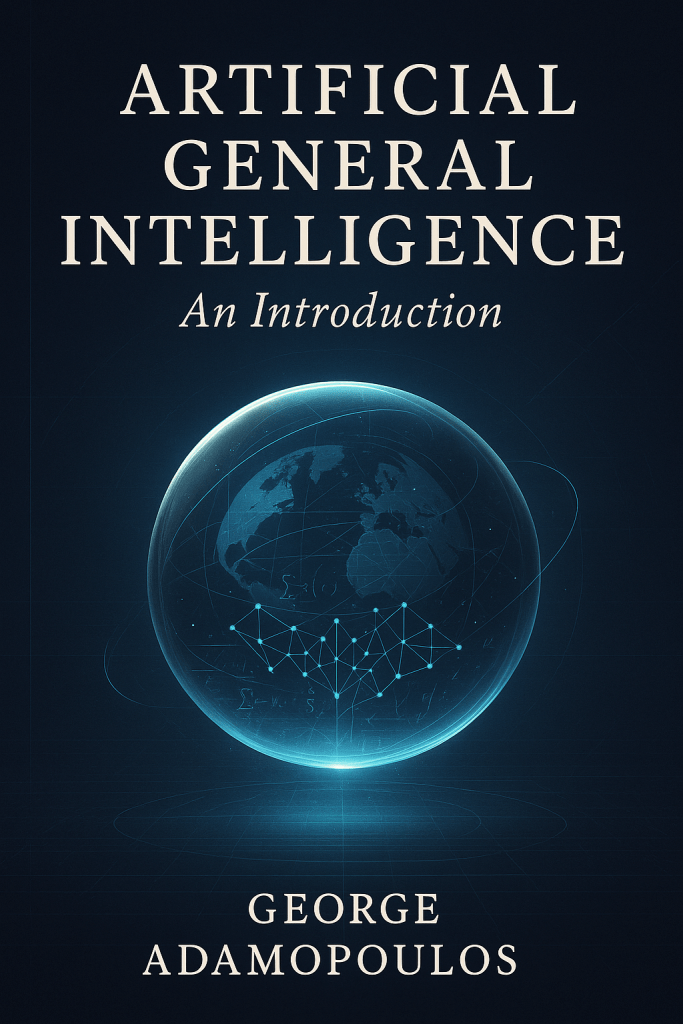
Artificial General Intelligence: An Introduction presents itself as a primer, yet in practice it occupies a more intricate space: it is at once an entry point and a provocation, a clarified map of canonical distinctions and a deliberately unsettled itinerary through the philosophical and political stakes of building minds. George Adamopoulos writes from a first-principles sensibility—plainspoken when defining terms, insistent when drawing boundaries, unusually candid about how much of contemporary discourse on artificial general intelligence operates under anticipatory conditions rather than completed proofs.
What distinguishes the book is not only its coverage—running from rudiments of machine learning through neural scaling, from computational hardware to landmark case studies like AlphaGo and Watson, from alignment anxieties to geopolitical competition—but also the way those topics are repeatedly folded back into a set of meta-questions: what, exactly, is generality in intelligence; how do we know that a system’s competence is not merely a collage of narrow proficiencies; which historical analogies illuminate and which mislead; and to what extent does the aspiration for generality import covert value claims about human flourishing that technical recipes alone cannot adjudicate.
The exposition proceeds by sharpening the well-known trichotomy—artificial narrow intelligence, artificial general intelligence, artificial superintelligence—while refusing the complacency that often accompanies textbook definitions. Narrow systems resolve sharply delimited tasks and are evaluated by external metrics tied to those tasks; their success indexes the conferral of structure by the problem designer. General systems, by contrast, promise transfer across tasks, robustness to distributional shift, and a capacity for open-ended skill acquisition without bespoke scaffolding for each new domain. Superintelligence—here given the familiar intelligence-explosion gloss—names not a different species so much as a different regime of improvement, one where iteration loops, hardware multipliers, and software-driven recursive self-optimization transform incremental competence gains into discontinuous leaps. Adamopoulos treats these as analytic markers, but the argument is not classificatory for its own sake. The categories are mobilized to interrogate how we infer generality from behavior, how we distinguish genuine world-modeling from prompt-bound pattern recovery, and how we would know, under conditions of partial observability and limited interpretability, that a system’s capacities are organized by internally coherent abstractions rather than by brittle overfitting to the artifacts of our benchmarks.
Across definitions and demonstrations the author takes pains to keep the register accessible without surrendering nuance. He does not smuggle in the aura of inevitability that often trails AGI rhetoric; instead he places the claim of imminence—often moored to a horizon like 2050—against a triad of constraints: data (availability, quality, diversity), compute (raw throughput, memory bandwidth, communications latency, energy budgets), and algorithmic priors (architectural inductive biases, optimization dynamics, and the shape of generalization in high-dimensional function classes). In that triad lies the book’s central didactic device: at any given time the frontier is bound by the narrowest of these three channels, and progress tends to occur in pulses when innovations widen one channel faster than the others. The result is a historical narrative that is neither triumphalist nor skeptical, but diagnostic. It explains how seemingly sudden breakthroughs—superhuman game-play; cross-domain language competence; few-shot generalization—are the visible edges of compounding improvements in data curation, hardware specialization (notably the repurposing of graphics processors for tensor workloads), and algorithms that capitalize on parallelism and gradient-driven search.
The sections on computational infrastructure translate the otherwise abstract accelerations of learning into concrete constraints. While the book outlines the now-familiar story of GPUs becoming the workhorse of deep learning, it underlines the more granular truth: that neural training is a pipeline bounded by memory hierarchies, interconnect topologies, and synchronization overheads, and that scaling laws are social facts as much as mathematical artifacts because the cost-curves of hardware and cloud allocation determine which experiments can be run. This view preempts a common simplification—that more parameters and more data uniquely guarantee more intelligence—and instead replaces it with a layered picture in which architectural choice (what kinds of invariances are built into the network), training regime (supervised, self-supervised, reinforcement learning, population-based search), curriculum (task sequencing and augmentation), and evaluation (out-of-distribution stress tests, adversarial probes, interpretability diagnostics) interact to make generality an empirical achievement rather than a metaphysical predicate. The framing matters because it anchors the book’s thesis that AGI is not a singular device waiting to be turned on, but a moving boundary in a space whose axes are technical, institutional, and normative all at once.
That boundary is probed through canonical case studies. AlphaGo’s trajectory—pretraining on human games, reinforcement learning from self-play, and the subsequent alpha-to-zero shift that discarded human priors—illustrates how world-models can be learned implicitly through policy iteration and value estimation constrained by a simulator. IBM Watson’s Jeopardy run dramatizes a different lesson: the asymmetry between retrieval at scale with probabilistic synthesis and the fragile semantics of natural language understanding in open-ended contexts. These episodes are not deployed as hagiography. They are read symptomatically: each success disclosed not only a region of competence but also its scaffolding—structured simulators in the case of Go, curated corpora and compositional search in the case of Jeopardy—and thereby clarified what remains to be achieved for systems that must act in the unsimulated world. The pedagogical arc leads from these landmarks to the more general insight that “data is a world in miniature.” Whenever our data’s miniature distorts causal structure, a system will be rewarded for modeling superficial correlations; whenever the miniature preserves the counterfactual invariances of the target domain, self-supervision can bootstrap high-level abstractions from low-level regularities. The point is methodological: world-modeling is not a metaphoric snow globe, it is a measurable joint between representation and intervention.
Where the text becomes philosophically most charged is precisely here, at the hinge between representation and action. Adamopoulos argues—carefully, but with conviction—that general intelligence is not exhausted by function approximation at scale; it requires the right kind of control over uncertainty. This is not simply the Bayesian platitude that beliefs should track evidence; it is the claim that an intelligent system must structure its ignorance by querying the world in ways that enlarge its future action set more than they narrow it. That claim refigures exploration in reinforcement learning from a hyperparameter of curiosity to an ethical and political question: which experiments are permissible, on whom, with what consent, and under what distribution of risk. The book insists that as soon as we embed learning systems into public infrastructures—credit, mobility, health, information—they cease to be mere technical artifacts and become rule-generating institutions. Their “loss functions,” once a term of art in optimization, double as constitutional texts that allocate harms and benefits across populations.
This doubling informs the treatment of alignment and safety. The author is attentive to the common rhetorical trap by which existential risk is set against proximate injustices, as if attention to automated harms today precluded care for catastrophic harms tomorrow. The analysis instead takes alignment to be multi-scalar: robustness and monitoring against specification gaming and reward hacking; governance of deployment and feedback channels to keep socio-technical systems corrigible; and the longer-horizon question of whether, once systems exceed human cognitive bandwidth, they will retain de facto incentives to keep humans in the loop, or whether loop-closure will occur at machine timescales that erode human interpretability. The bird-nest analogy—humans clearing an impediment without malice—works in the book as a deliberately austere parable of misalignment through indifference. Its force does not depend on the dramatic hypotheticals of self-replication or nanofactories; it rests on the more sobering observation that objective-pursuing agents indifferent to unencoded values are structurally disposed to treat unrepresented interests as noise. In that sense, alignment is less an engineering add-on than a claim about representational adequacy: until we can model human stakes with the same fidelity as we model task outcomes, optimization will be blind where it most needs sight.
The geopolitical chapters extend this structural analysis into the grammar of strategy. If AI capability now functions as a power-multiplier for state and corporate actors alike, then the race dynamics that follow are not reducible to slogans about “AI supremacy,” but are downstream of coordination failures and assurance problems characteristic of dual-use technologies. The book’s utility here is its refusal to aestheticize great-power narratives. It parses why cyber operations, information shaping, drone swarms, and automated logistics alter deterrence and escalation ladders; it links chips, data localization, export controls, and research openness to a foggier but no less real cartography of influence; and it argues, without theatricality, that treating AGI as a purely domestic industrial policy question misreads the degree to which model training pipelines are transnational—born of multinational supply chains, global compute markets, diasporic talent flows, and cross-border data regimes. The upshot is sober rather than alarmist: absent instruments for verification and reciprocal monitoring, actors will rationally accelerate, project worst-case intentions on rivals, and narrow the policy space for safety-first constraint. A politics adequate to AGI is therefore neither unilateral pause nor laissez-faire escalation, but institutions capable of making restraint incentive-compatible.
Despite the global frame, Artificial General Intelligence maintains a resolute focus on the near-term texture of automation. The author’s treatment of labor displacement resists both catastrophism and complacency. On one page we encounter the familiar Schumpeterian trade—task substitution against task augmentation—and on the next an insistence that the cadence of displacement matters because retraining friction, geographic immobility, and the stickiness of social roles convert even temporary shocks into long-term scarring. The historical analogies—to electrification, to the internet, to aerospace—are not offered to guarantee that a long-run “better job” equilibrium will arrive automatically; they are offered to sharpen the conditional: such equilibria have previously been social achievements, realized when complementary investments—education, safety nets, diffusion of gains, worker bargaining power—kept pace with technical adoption. In the absence of those complements, the same technologies that reduce drudgery can intensify precarity. The normative claim is stark in its simplicity: it is not anti-technology to insist that the distributional curve of benefits be a design parameter rather than a nostalgic afterthought.
What might count as evidence that a system is traversing from narrow to general? Adamopoulos proposes criteria that, while not formal, are at least testable: systematic transfer to previously unseen tasks with minimal task-specific finetuning; retention of performance under shifts in the input distribution; emergence of internal variables with interpretable structure that correlates with latent factors in the environment; ability to plan over temporally extended horizons; and self-monitoring of uncertainty that calibrates exploration and abstention. This catalog reads like an evaluative manifesto because it rejects the seduction of benchmark theater while preserving the indispensability of measurement. Benchmarks are neither irrelevant nor sufficient; they are better understood as adversaries designed to probe where the purported generality fractures. When, for example, a language model fluent across many tasks hallucinates confidently under contradictory prompts, the failure is not merely a bug to be patched; it is a symptom that the model’s generalized competence remains decoupled from the kinds of causal and normative grounding that humans deploy when they suspend judgment.
In a move that gives the book philosophical traction beyond its introductory label, intelligence itself is historicized. The evolutionary arc—from hominin social cognition through symbolic culture—anchors a reflection on the ways in which human brains, tuned for survival in small-band settings with short feedback cycles, now confront long-horizon externalities (climate, biosphere management, nuclear risk) for which our native heuristics are poorly calibrated. This is not a paean to machine salvation. It is, rather, a reminder that if artificial general intelligence is to assist on those fronts, it must be designed to reason counterfactually, to incorporate delayed and diffuse feedback, and to maintain commitments under sparse reinforcement—capacities that are as much ethical as they are statistical, because they presuppose obligations to future others and to non-human stakeholders. The book’s insistence on these temporal and moral dimensions protects it from the all-too-familiar conflation of intelligence with performance on flash-card tasks.
Readers looking for a catalog of algorithms will find enough to ground their intuitions—discussions of supervised and unsupervised regimes, reinforcement learning and its exploration-exploitation dilemmas, the role of architectural priors and inductive biases, the importance of data augmentation and transfer learning, the leverage of specialized hardware and distributed training. Yet the real interest lies in the book’s repeated return to world models: not as a buzzword, but as a claim about how systems compress experience into state, how they learn causal structure rather than mere association, and how planning is implemented as inference over those internal models. By pairing indoor successes (simulated domains like games) with outdoor brittleness (open-world robotics, messy language use, high-stakes decision support), the text avoids overreadings. It shows that sample efficiency, generalization under intervention, and value-conditioned planning remain the bottlenecks, which is precisely why claims about imminent AGI must always be indexed to credible demonstrations on those fronts, not only to parameter counts or pretraining corpora size.
In its treatment of governance the book is admirably plural. It neither fetishizes centralized control nor romanticizes decentralized anarchy. Instead it inventories the spaces where rules can operate: model-development practices (red-teaming, interpretability tools, provenance tracking), deployment contexts (sectoral standards for audit and recourse), market structure (competition policy as it applies to compute and data), and international coordination (export regimes, shared safety baselines, incident reporting). The geopolitical names that appear—placed as markers for how leaders currently narrate AI’s stakes—are less important than the deeper claim that governance must be coextensive with capability. As systems become more general, their failure modes become less legible; as their economic returns grow, the incentives to rush intensify; as their strategic value increases, the temptation to weaponize mounts. The only stable response is to build institutions that make it cheaper to behave well than to behave dangerously, and to do so without choking off the open science that made the field dynamic in the first place. This is a delicate balance, and the book refuses to pretend otherwise.
One of the text’s virtues is its epistemic humility. Where many introductions adopt a tone of confident synthesis, this one insists on the penumbra of uncertainty that surrounds any timeline. To argue that AGI could arrive by mid-century is, here, not an actuarial forecast but a conditional: if algorithmic advances continue to extract generalization from self-supervision; if hardware continues to provide scale at cost; if data curation learns to prioritize diversity and causal coverage over sheer volume; if incentives can be aligned to make safety and verification intrinsic rather than bolt-on disciplines. Those ifs are not hedges, they are coordinates for research and policy. They convert a speculative horizon into a structured workplan, and they acknowledge another of the book’s recurring themes: that beliefs about AGI timelines are themselves causal variables, because they shape investment, regulation, and the public imagination.
The prose, though intentionally clear, is conceptually dense. It often moves from a definition to a critique of that definition’s hidden norms in a single paragraph, which can make the text feel, at moments, like a dialogue between the engineering mindset and the philosophical conscience. For example, when the author addresses the now-ubiquitous language of “values,” he resists anthropological vagueness and instead treats values as constraints codified in loss functions, as rights embedded in access and redress procedures, as power asymmetries visible in who sets objectives and who bears the cost of failure. In this vocabulary, the “ethics of AI” is not an external overlay but a series of design claims about what kinds of errors are permissible, how uncertainty is signaled, what kinds of explanations count as legitimate, and when abstention is the only honest output. The treatment is not moralizing; it is structural, and therefore actionable.
If there is a signature gesture in Artificial General Intelligence: An Introduction, it is the oscillation between optimism and caution without rhetorical whiplash. The optimism emerges wherever the text presents the historical record of human coordination—moon landings, global networks, international laboratories—not as guarantees but as counterevidence to defeatism. The caution surfaces whenever the book turns to institutional dynamics—arms races, enclosures of knowledge, the privatization of public goods through proprietary models—and notes how easily they can outpace the slower work of building norms and verification regimes. The synthesis is a kind of practical hope: not the confidence that things will go well, but the insistence that how we build and where we deploy can still be steered by intelligible choices, that we are not passengers on a vehicle with a preprogrammed destination.
As an introduction authored from a student vantage point, the book has a distinctive energy: the willingness to articulate what experts often assume, the capacity to ask unembarrassed first questions about familiar practices, and the refusal to pretend that clarity about fundamentals is unsophisticated. This vantage does not diminish rigor; it changes its vector. The result is a text that can be read profitably by novices—because it grounds terminology and organizes the space of problems—and by practitioners—because it reminds them which premises they have silently accepted and which alternatives remain available. That bidirectional readability justifies the author’s choice to center first-principles explanations rather than a fast tour of fashions. It is also what allows the book to be used as a civic artifact: a thing capable of helping the non-specialist public decide which visions of an AI-suffused society they wish to authorize.
There is, finally, a sense in which the book is itself a world model—a compact representation of how the field’s tasks, risks, and possibilities fit together. In that compactness (despite its breadth) lies its normative wager: that by exposing readers to the dependencies between technical choices and ethical outcomes, between hardware limits and labor markets, between simulation wins and real-world brittleness, it will produce not passive spectators but interlocutors—citizens who can interrogate claims of inevitability, demand mechanisms of accountability, and participate in the long argument about which futures count as progress. That is the work of a genuinely introductory volume in a field where introductions often function as catechisms. Adamopoulos has instead written a book that treats readers as partners to be equipped rather than as recruits to be marshaled.
To recommend Artificial General Intelligence: An Introduction is not to endorse a particular timetable or a particular research programme; it is to endorse a habit of thought. It is to prefer definitions that cash out in measurable claims over slogans that inhibit scrutiny; to insist that optimism about capability does not license indifference to distribution; to treat safety not as a brake but as a discipline of design; and to admit, without melodrama, that the possibility of superhuman optimization is both an intellectual marvel and a governance problem of the first order. The book’s most durable contribution may be that it refuses to domesticate that tension. It leaves readers with a picture in which AGI is neither myth nor fait accompli, but an unfolding negotiation among algorithms, institutions, and the moral imagination—one in which our choices will matter precisely to the extent that we can explain, and therefore contest, the assumptions on which we build.
 Simon Gros
Leave a comment