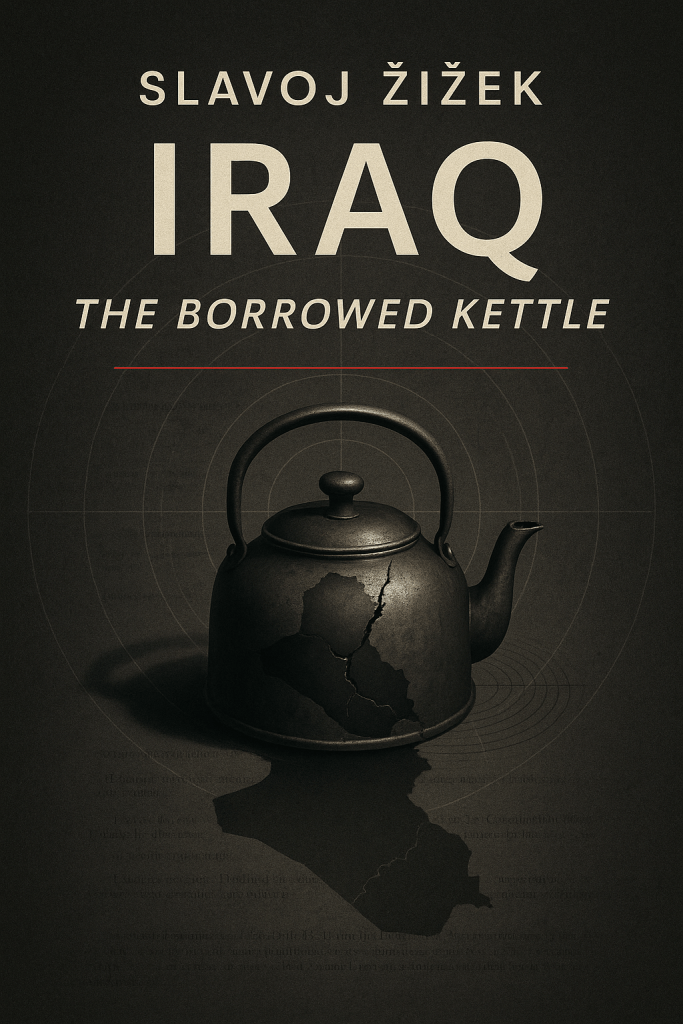
The provocation of Iraq: The Borrowed Kettle is announced in its title, and the title in turn is anchored in the old Freudian joke that stages denial by multiplication rather than refutation: I never borrowed your kettle; I returned it unbroken; it was already broken when I borrowed it. The enumeration negates nothing; it confesses through inconsistency. Slavoj Žižek places this paradox at the center of his inquiry, not to rehearse a clever anecdote but to formalize a logic that, he argues, structured a war’s public rationale and revealed an unconscious of policy. The incompatible claims about links to al-Qaeda, regional threat, global threat, weapons of mass destruction, and finally the moral duty to depose a tyrant amount not to a sequence of reasons but to a symptom formation whose very excess testifies to the absence of the cause it loudly proclaims to secure. In Žižek’s hands, the borrowed kettle stops being a mere joke; it becomes an operator for reading justificatory speech as a displaced admission that what is said to be present is structurally missing. By taking Freud literally—by treating the joke as a miniature of dream logic—he lets the reader see how contradiction is not a flaw that reduces credibility but a function that generates ideological effect. This is why Iraq: The Borrowed Kettle is not, as he emphasizes, a book “about” Iraq in any straightforward empirical sense; it is a book about what the figure of Iraq enabled others to do and to see, about how a war can be the most concentrated index of a world’s unconscious premises and of a discourse that cannot control the knowledge it disavows but nonetheless enacts.
Žižek’s opening pages crystallize this operation through a second emblem: the MacGuffin. He invokes Hitchcock’s well-known device—a pure pretext whose purpose is only to set the plot in motion—and identifies the Iraqi WMD as precisely this kind of empty center that stiffens narrative urgency while resisting determinate content. The more inspectors searched, the more the object receded, becoming omnipresent as menace and absent as fact; the less was found, the more the search itself had to be sacralized, differently rationalized, or transferred to the plane of faith. The MacGuffin thus names a peculiar dialectic: non-discovery intensifies conviction; the object’s voided content becomes the engine of a plot and the guarantee of its momentum. Žižek notes the paradoxical religiosity of this posture—credo quia absurdum—not to offend piety but to register the structural role of belief when evidence fails and narrative must continue. He catches the metamorphosis by which the MacGuffin’s emptiness becomes the ritual that binds a public to an operation. The point is not to mock but to diagnose a logic in which, having treated absence as proof of cunning concealment, the search for the holy grail of evidence legitimates the sequence by which the initial claim is replaced by new ones, each “truer” because each is less refutable and more general.
This forensic rhetoric is not a side question for Žižek; it marks the loop in which policy and fantasy interpenetrate. He underscores this by recalling Donald Rumsfeld’s taxonomy of knowables—known knowns, known unknowns, unknown unknowns—and then introduces the one term excluded by the Secretary’s schema: the unknown knowns, the unacknowledged background suppositions that silently orient judgment. For Žižek, these disavowed premises are not mere background noise; they are the powerful “kettle” returned broken—what cannot be consciously owned yet nonetheless directs perception, selection of facts, and the very criteria for what will count as a reason. The consequences are not merely epistemological but political, because the field of argument is already traversed by the presuppositions that decide which contradictions will be tolerated, which evidence can be accepted, and which outcomes can be rationalized as collateral to a higher good. In this way Iraq: The Borrowed Kettle foregrounds the psychoanalytic category of denial as the motor of a public sphere that pretends to transparency while relying on what it must neither think nor name.
The book’s overt analytic structure is correspondingly twofold. First, it tracks the ideological choreography by which justification shifts registers without changing direction, and second, it elevates those shifts into an anatomy of our political modernity—how “preemption,” “exception,” and a new imperial pragmatism saturate the very coordinates within which “moral clarity” is enunciated. This is why Žižek insists that the “true reasons” of the war—sincere democratizing belief, assertion of hegemony, and control of strategic resources—must be read parallaxically, not as layers behind which one could finally discover “the real” motive, but as perspectives that are each partially true and whose truth is their very noncoincidence. To privilege one as essence would miss how ideological efficacy arises from the knotting of the three registers—Imaginary idealism, Symbolic sovereignty, and Real economy—so that the scene is stabilized not by a single cause but by a triadic bind in which each element supports the others’ partial blindness. The effect is to replace suspicion’s impatience (“the oil is the real reason”) with a structural reading in which “reasons” are not free-floating propositions but functions whose interlock is the content to be grasped.
Žižek dramatizes this parallax by juxtaposing two representational regimes that dominated post-9/11 war coverage: the Gulf War’s video-game abstraction and the Iraq invasion’s “embedded” intimacy. He refrains from humanist nostalgia for closeness and instead maintains a materialist insistence that both modes are “abstract” in the Hegelian sense. Where the digital targeting footage foregrounded the disembodied projectile, the soldier’s diary cam and the journalist in the Humvee offered emotional proximity that could occlude the structural horizon. The truth, he suggests, lies not in choosing one perspective over the other but in fixing attention on their irreducible split, since that very incommensurability—rather than any imagined synthesis—reveals how war’s sense is produced by a discontinuity between the local and the systemic, the affective and the logistical. It is this refusal of sentimental resolution that enables him to keep both lenses in play and thus to resist the opportunistic oscillation in which each is invoked as needed to neutralize the other.
At the level of geopolitical form, one of the book’s most incisive theses is that the United States is not the Roman Empire it is sometimes said to be; the scandal is not imperial universality but a nation-state that claims imperial prerogatives without assuming the universal form of law that true empire—if such a thing is thinkable—would at least profess to uphold. The formula Žižek proposes—act globally, think locally—is meant to capture this structural contradiction: a power that intervenes beyond borders while reserving for itself juridical exemptions at home and abroad. He exemplifies this with the paired pressure on Balkan states: on the one hand, demands for cooperation with a transnational court; on the other, bilateral immunity for American nationals from that same court’s jurisdiction. The point is not to rehearse anti-Americanism but to show the way a new exceptionality is institutionalized as norm, so that “preemption” becomes a name for policing anticipation while remaining immune to reciprocal application. The “rule” that emerges is one that repeats the logic of the borrowed kettle as legal doctrine: universalism asserted in the act that simultaneously suspends it.
What follows is a corollary on the economy of exception in global capitalism: the very system that celebrates circulation and uniform rules multiplies exemptions at crucial nodes of enforcement and risk. Outsourcing becomes the emblem of this Weltgeist in logistics: production is displaced where regulation is weak, responsibility is diffused along chains of subcontracting, and ethical violations dissolve into the anonymity of a brand that owns the logo rather than the factory. Žižek suggests that torture has been “outsourced” in homologous fashion, not as a single conspiracy but as an intelligible strategy of moral laundering: a liberal state preserves its self-image by locating the dirty work just outside the juridical fence, thereby maintaining the letter of its values while supplying the violence those values are taken to require in emergencies. What makes this observation more than a denunciation is precisely its system-character: it names an intrinsic tendency of a market order to push costs and violations to the periphery while enjoying their dividends at the center.
Crucial to the book’s argumentative rhythm is that it refuses the moralistic comfort of certain well-worn positions. Žižek resists the idea that the war’s central wrong lies in harm to Iraqi civilians alone, not because harm is negligible but because such a focus can become a way to miss the institutional transformation the war enabled: the codification of preemptive sovereignty as a standing doctrine and the normalization of an exception that retrofits law to its own suspension. When he claims that the true “victims” of the war are “elsewhere,” he is not counting corpses across borders but triangulating a different loss: a change in our political form of life that redefines what counts as legal, rational, and sayable, a “silent revolution” that reconstitutes the horizon of the possible. This is what it means to claim that the war’s target was, in part, domestic: the reorganization of social space through a permanent alert that discharges public freedom in the name of its security.
That claim folds into a third analytic arc: Europe. Žižek’s question “Which Europe?” refuses the consoling fiction of a unified ethico-political subject cohering around rights, tolerance, and welfare nostalgia. The Habermas–Derrida call is, in his account, symptomatically noble yet insufficient: it wants to defend a legacy without refounding it, to invoke Europa as a moral counterweight to American unilateralism without asking how that very legacy incubated the possibilities it condemns across the Atlantic. Thus he advances a paradoxical counsel: a left Eurocentrism that neither fetishizes identity nor dissolves into multicultural relativism, a posture that identifies American globalism and premodern fundamentalisms as two sides of a post-modern pact that erodes the project of modernity from above and below. The alternative to McWorld and jihad is not a third civilizational bloc but the reactivation of a modern universality that can face its own violent potential and perverse outgrowths without retreating into the technocratic administration of inevitabilities.
Europe’s own slide into exception is diagnosed with the same materialist bluntness as Washington’s: walls, border police, and a racism legitimated not by claims of nature or culture but by unapologetic economics—a division between those included in prosperity and those structurally excluded. Žižek’s provocation is not rhetorical; it distills an ideological mutation in which things—commodities, capital—circulate ever more freely while persons are tracked, filtered, and arrested by new apparatuses that translate fear and scarcity into policy. He insists that if Europe wants to “defend” itself, it must do so by a self-critique sufficiently ruthless to admit that the United States is not an alien deformation but a mirror that shows what Europe has also become. To criticize the Empire, one must criticize the metropolis in oneself. Only then can the defense of “European values” avoid being the very means of Europe’s ethical defeat.
The book’s internal montage reinforces these theses. Žižek explicitly styles the composition as a bric-à-brac of immediate reflections followed by two appendices that abstract from events without losing them. He invokes E. L. Doctorow’s Lives of the Poets to indicate a method: disparate fragments whose unity emerges afterward in the conceptual work distilled from them. This compositional self-consciousness is not an indulgence; it marks the argument itself, which maintains that today’s politics is best grasped not by a single theory that subsumes the manifold but by a post-Hegelian dialectic in which perspective shift becomes the datum of analysis. The result is not relativism; it is a disciplined parallax that insists that the “object”—war, empire, democracy—has no single vantage point adequate to its reality because it is the very play between vantage points that constitutes the reality in question.
This methodological fidelity is nowhere more striking than in Žižek’s handling of the doctrine of preemption. He shows how the future becomes retroactively present to justify the present’s violence: a speculative risk is treated as if it had already happened, and thus the temporality of danger is folded into the immediacy of an act that is declared to be something like defense in advance. When read through the “unknown knowns,” preemption discloses a fascination with control that binds sovereignty to a fantasy of total foresight. The more uncertain the world, the more the sovereign demands that uncertainty be mastered by transforming it into a certainty of threat. This is not a mere policy error but a structural response to the post-Cold War void: in the absence of a symmetrical rival, the asymmetry of power seeks its object in a floating futurity that must be perpetually converted into present targets. The consequence is not only strategic instability but a juridical mutation in which exception acquires the dignity of norm.
From here Žižek turns to what might be called the intimate geopolitics of images, in which acts of seeing are not afterthoughts but preconditions of what can be done and justified. He cautions against celebrating the embedded reporter’s human closeness or the guided-missile camera’s techno-omniscience, insisting instead on the irreducibility of their split. The lure of identification that the embedded lens invites is as ideological as the cold abstraction of the distant cursor. It is the oscillation that produces assent by giving the spectator both a liberal reassurance (“we see the soldiers up close; we feel with them”) and a managerial guarantee (“we see the target so clearly; everything is precise”). In restoring the split to visibility, Žižek asks the reader to occupy neither position, because choosing is how the ideology works; critique must keep the disjunction active as disjunction.
Those who seek in Žižek a simple “anti-war” posture will not find it. Indeed, he honors the hard argument often made by supporters of the invasion—that a ruthless dictator’s fall could be welcomed by those he terrorized—only to insist that this recognition must not function as absolution for institutionalized exception. The displacement from “human rights in Iraq” to the reorganization of the international order does not trivialize Iraqi suffering; it refuses to instrumentalize it. It is part of the book’s intellectual honesty that he persistently asks the naïve question: do we seriously believe that democratization was the war’s primary motor rather than a rescue narrative grafted onto the apparatus of preemption and hegemony? The insistence on this question is not cynicism; it is a refusal to let moral vocabulary be conscripted into the service of an exceptional sovereignty that must name itself humane to maintain its self-image.
On Europe’s side of the ledger, the portrait is no more flattering. The “old” and “new” Europe opposition is treated as a symptom of great-power woundedness as much as of principle. Western reluctance to act, he suggests, is not pacifist virtue but often a procedural deferral that masks complicity elsewhere; indignation can coincide with colonial habits, and the language of multilateralism can function as a way to refuse responsibility for past entanglements. Žižek’s anecdote about Slovenia’s attempt to thread the needle—signing declarations, denying intention, then protesting at being thanked—becomes a comic microcosm of a larger European ambivalence, a theater of gratitude refused and responsibility disavowed that illustrates how a continent gestures toward principle while navigating advantage. The comedy is not cruel; it is diagnostic of a split subject that wants to be recognized as both dissenter and partner and so cannot avoid performing both roles at once.
The book’s first appendix, with its heading “Canis a non Canendo,” pushes beyond immediate geopolitics to the conceptual architecture that allows liberal conscience to misrecognize its own complicity. Žižek tracks the oscillation between a liberal “fake”—the tolerance that presides over structural violence by minimizing it as a necessary cost—and a tragic ethics that is willing to risk an act that interrupts the calculus. The point of evoking Antigone is not to celebrate civil disobedience sentimentally but to insist on the constitutive antagonism that a purely administrative politics cannot metabolize. When politics is reduced to managerial expertise—the University discourse, in Lacan’s schema—the Master’s signifier does not vanish; it returns as charisma on the Right, which seizes the “passion” that technocratic centrism has renounced. The failure to politicize enjoyment (jouissance) leaves the field open to those who will politicize it in reactionary forms. The more the center prides itself on post-ideological competence, the more it cedes the rhetorical and affective ground on which collective purpose can be articulated, thereby missing the very terrain on which democracy is now fought.
The second appendix, “Lucus a non Lucendo,” stages a difficult intervention in the contemporary rhetoric of “ethical violence.” Against the sensibility that dreams of a frictionless ethics, Žižek insists that every ethics worthy of the name must face the constitutive violence of universality—the way an imperative compels and so wounds the narcissism of particularity. He ties this to Lacan’s four discourses, not as scholastic exercise but as a map of how authority circulates today when the Master and the University exchange masks. “Decaffeinated” reality names a culture that wants the benefits of the act without its risks, the appearance of rupture without the cut. Žižek’s rejoinder is not to glorify transgression but to restore the political thickness of decision where management has colonized it, a move that also requires confronting the Benjamin-Schmitt problematic of exception. If the law grounds itself in an exception that suspends law in the name of law, then pure revolutionary violence would be the act that refuses this ground, not by a fantasy of absolute purity but by a break that interrupts the loop of self-legitimating suspension.
That thread leads directly to a long reflection on biopolitics and pure life—an engagement with Agamben meant to bring into a single frame the otherwise disparate phenomena of humanitarian administration and sovereign killing. The state of exception that suspends rule of law to save it produces a subject of politics whose very life has been stripped to administration and exposure. The scandal is not only that the law may take life without censure but that life becomes the privileged object of a politics that is, in reality, post-political: hygiene, risk, and securitization displace contestation over ends. Žižek’s reading here is not reducible to a warning; it is a reinterpretation of how the categories of modern political theory must be rewritten when “protection of life” is both the justification for and the mechanism of unprecedented encroachments on autonomy. The concluding analytic move is hard to miss: to get beyond exception we must stop asking the law to save itself from its own suspension and instead articulate a politics in which universality is not grounded in an exception that both guarantees it and eats it from within.
The book is studded with smaller case studies that reconcretize its theoretical line. The International Criminal Court becomes a parable of universalism undermined by the very power that performs it most loudly: a tribunal established to enact a cosmopolitan justice meets refusals that show how “universality” can be an instrument in one direction and an intolerable imposition in the other. Žižek lingers on this friction, not to moralize about hypocrisy but to expose a systematic production of inequality through the juridical form itself—how sovereignty keeps for itself what it demands of others, how legal universals are differentially attachable to some bodies and not to others. The point is that new forms of inequality are generated not outside the juridical space but by its varying degrees of application and exception across the globe.
All of this helps explain the text’s peculiar timbre. It is written with a diagnostic coldness that refuses the comforts of righteous anger and the consolations of procedural idealism. This stance is not indifference but method, because the target is not the moral failure of this or that actor but the conceptual poverty of the frameworks within which moral judgment is made. In that sense, Iraq: The Borrowed Kettle is a contribution to the critique of political metaphysics under the conditions of late capitalism—where images bind more tightly because they are experienced as intimate, where law claims universality precisely by making exceptions to itself, where “humanitarianism” and “security” are two registers of a single administrative imaginary, and where enjoyment is a political operator seized by those who promise immediacy after the apparatus has trained citizens to expect none.
It would be possible to object that this analysis risks the very paralysis it decries by taking too much pleasure in paradox. Žižek anticipates the charge by insisting on the difference between dissolving action in aporia and clarifying the conditions under which any action would count as political rather than managerial. That is the sense in which the book’s fascination with Lenin’s State and Revolution is not antiquarian nostalgia but a wager that utopia names not a blueprinted end-state but an urgent inflection point—the madness of the moment—when the parameters of the “possible” can no longer sustain life or meaning. Utopia, on this account, is not the evasion of violence but the condition for a different accounting of it, a shift from a policy of infinite small cruelties to an act that reconfigures the field of costs and subjects alike. This is why the book’s final movement, seemingly far from Baghdad, returns to the kernel of the title: the act that stops returning the broken kettle with ever new reasons and instead changes the scene in which kettles must be borrowed and returned at all.
For readers coming to the book now, two decades after its publication, the question of relevance is not rhetorical but constitutive. To claim continued pertinence is, for Žižek’s conceptual style, to show that the logical operators he analyzes have only intensified: the MacGuffin’s empty urgency, the unknown known’s coercive hush, the preemptive folding of futurity into the present tense of force, the nation-state that enacts empire while rejecting universality, the border that polices persons while celebrating the borderlessness of things, the humanitarian device that normalizes exception by invoking life. That Iraq: The Borrowed Kettle was first published in 2004 (the paperback follows in 2005) does not weaken its argument; it offers a vantage from which to see how a certain grammar of justification solidified into the everyday. The book’s insistence that one must refuse both the sentimental fetish of “concreteness” and the cynic’s reduction of motives remains instructive because neither mistake has gone away; if anything, the culture has refined them. The reader who expects case updates and catalogues of new scandals will not find them; what one finds is an anatomy of how reasons are made to hang together and a theory of how a politics of exception reproduces itself by persuading us that nothing else is possible or today thinkable.
Stylistically, the description the work invites is consciously untidy in the best sense: it piles scene upon reflection, analytic lemma upon media image, laconic diagnosis upon irony, and then, in the appendices, reverses direction to present a formal line that retrospectively makes the fragments intelligible as a coherent if non-totalizing critique. This is not a bug. It performs the very thesis it defends: that the truth of a constellation lies not in its synthesis but in the tension that keeps its elements from collapsing into one another. If the reader sometimes feels the dizziness of a problematic that refuses to resolve into clarity, it is because clarity would be false to the materials. The argument’s neutrality—its objective, almost scientific tone that prefers structure to indignation—should not be confused with detachment; it is a discipline fashioned for a messy object. The rhetoric is convoluted and deliberately so, because the object is not reducible to single-line causation or moralism.
The book’s exemplary figures—the MacGuffin, the borrowed kettle, the unknown known—are not ornaments but methodological levers. The MacGuffin shows how empty signifiers mobilize bodies; the borrowed kettle shows how inconsistency testifies to a missing cause; the unknown known shows how repression speaks in every proclamation of certainty. Together they amount to a grammar of contemporary sovereignty: a power that must narrate itself as reluctant while embracing anticipation as necessity; a law that must suspend itself to save itself; a Europe that must defend values by means that undermine them; a market that must universalize exchange by multiplying the sites of exception that make exchange profitable.
Among the most powerful pages are those that turn a cold eye on the way enjoyment has been evacuated from democratic rhetoric, ceded to the Right’s capacity to organize passion. Here Žižek’s psychoanalytic ear proves decisive. A politics that renounces affect does not become purified; it becomes impotent. The old promise that procedure alone will deliver legitimacy founders in a media ecology that is all medium and no message. This is not a counsel to demagogy but a call to recognize that administration cannot substitute for meaning. Where liberalism offers endless small improvements in the name of safety and compassion, someone will offer the thrill of purpose, however destructive. The question is whether a universalism can be imagined and enacted that speaks to desire without reverting to the exception it claims to transcend. That is the book’s difficulty and its wager.
By the last pages, the reader should not be asking whether the Iraq War was “worth it”—Žižek refuses the arithmetic—but how that war served as the hinge by which a set of categories traveled from debate to doctrine, from doctrine to habit, from habit to infrastructure. If the result is that we now live inside the “silent revolution” he sketched then, it is not because history has vindicated any one of his empirical judgments but because the devices he isolated have proven to be the long-term machinery of a world that prefers exception to contradiction, management to politics, and justification to reason. In that sense the book’s continued relevance is exact: it is a description of the rules of our present, and not merely a chronicle of their origin.
A final word about the text’s self-positioning. It insists that it is “not a book about Iraq,” and in doing so it violates expectations that a description should embrace its object. The apparent paradox dissolves when one sees that the refusal of concreteness is the recovery of the real. To make Iraq stand for Iraq alone would be to succumb to the very displacement that ideology demands. By reversing that displacement—by making Iraq the kettle whose inconsistent returns expose the secret of the hand that returns it—Žižek practices the only kind of objectivity still possible in an age where images have become the conditions of politics. One need not agree with every provocation to recognize that the conceptual apparatus on display remains, even now, one of our few available ways of thinking how war justifies itself, how universality compromises itself, how freedom legislates its limits, and how we, as subjects of a post-political administration, might again become capable of an act that changes the coordinates rather than endlessly explaining them.
Žižek’s book is thus best described not as an argument to be supported or refuted, but as a machine for reading contradictions as evidence—an analytic of borrowed kettles wherever they appear, an instruction in how to hear denial not as error but as confession. In refusing to stabilize its object, it restores to political philosophy the critical function too long ceded to moral fervor on the one side and technocratic realism on the other. That this intervention dates to 2004–2005 does not make it obsolete; it makes it diagnostic of the very world that took shape as those pages were written. The kettle is still in our hands, and it is still broken; the question is whether we can now do more than offer a more refined list of reasons for returning it as if it were not.
 Simon Gros
Leave a comment