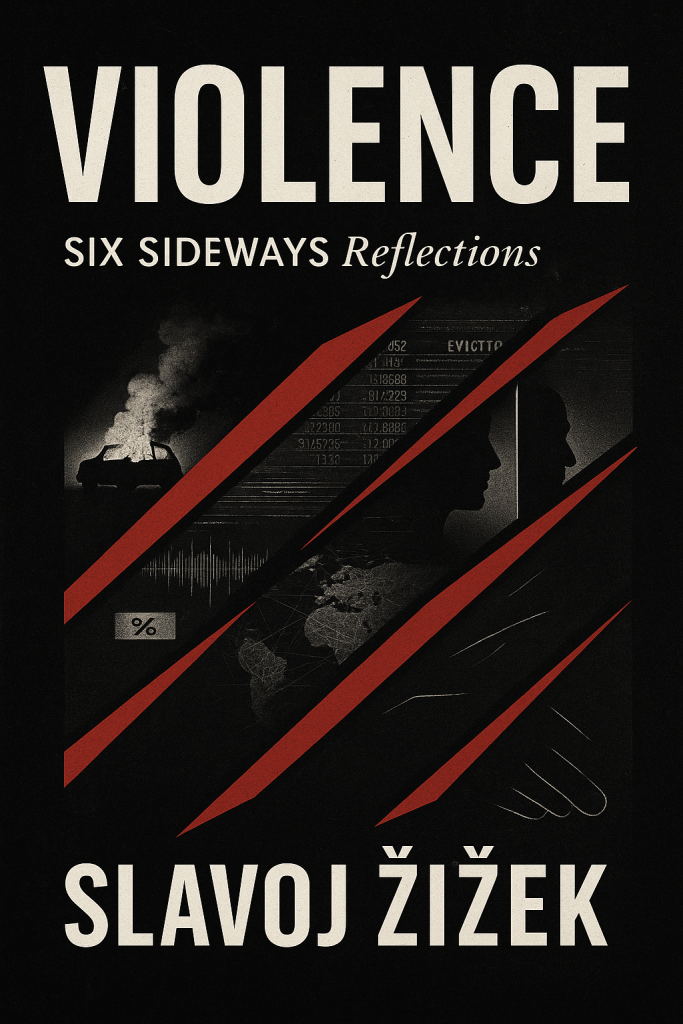
Using history, philosophy, books, movies, Lacanian psychiatry, and jokes, Slavoj Žižek examines the ways we perceive and misperceive violence. Drawing from his unique cultural vision, Žižek brings new light to the Paris riots of 2005; he questions the permissiveness of violence in philanthropy; in daring terms, he reflects on the powerful image and determination of contemporary terrorists.
Violence, Žižek states, takes three forms—subjective (crime, terror), objective (racism, hate-speech, discrimination), and systemic (the catastrophic effects of economic and political systems)—and often one form of violence blunts our ability to see the others, raising complicated questions.
Does the advent of capitalism and, indeed, civilization cause more violence than it prevents? Is there violence in the simple idea of “the neighbour”? And could the appropriate form of action against violence today simply be to contemplate, to think?
Beginning with these and other equally contemplative questions, Žižek discusses the inherent violence of globalization, capitalism, fundamentalism, and language, in a work that will confirm his standing as one of our most erudite and incendiary modern thinkers.
There is a familiar parable about a factory worker who leaves each evening pushing an empty wheelbarrow. The guards dutifully inspect the wheelbarrow—its tray, its handles, its visible contents—and find nothing to confiscate, until, belatedly, they realize that what has been stolen all along is the wheelbarrow itself. Slavoj Žižek’s Violence: Six Sideways Reflections organizes its argument around an analogous displacement of attention. We are trained to fasten our gaze upon conspicuous acts, the clustered flashes and audible detonations of what the media calls “violence,” while the form in which violence is most continuous, most banal, most constitutive, passes with the wheelbarrow through the checkpoint of our moral vocabulary. The book insists that to speak coherently about violence is to examine not simply what is perpetrated by agents against victims, but the underlying semantic and institutional scaffolding that renders agents into agents, victims into victims, and renders certain distributions of material and symbolic life so normal that any attempt to interrupt them appears itself as violence. The project is neither a plea for leniency nor a paradox for its own sake; it is a call for conceptual exactitude in a field saturated with indignation, sensationalism, and the false relief that comes when the cause of an anxiety is misrecognized as the effect of a person’s will.
The tripartite distinction is deliberately simple: subjective violence, the immediately visible acts of crime and terror; objective violence, the unremarked violence sedimented in social relations and their symbolic forms (racism, discriminatory discourse, the coercive texture of everyday life); systemic violence, the anonymous, necrotic logic of economic and political arrangements whose aggregate effects dispirit, exclude, and periodically destroy. The simplicity is tactical, because what is to be shown is not merely a taxonomy but an optical law: one register becomes salient in inverse proportion to our grasp of the others. When subjective violence is foregrounded in lurid color, the monochrome of systemic and objective violence fades behind it; when a society’s symbolic order is experienced as neutral grammar rather than as an apparatus with winners and losers, the harm appearing on the surface gets moralized into individual vice. Žižek will pursue this law across literary examples, jokes, philosophical arguments, filmic episodes, and political episodes, not to enumerate curiosities but to draw one inference again and again in mutually clarifying forms: moralistic panics over isolated acts are often the screen through which a culture reassures itself that its background is pacific. The result is not a refusal of judgment, but an insistence that judgment without structural reflection is comfortable illusion.
The book’s dates matter for appreciating both its method and its pertinence. Composed in the late 2000s, with sustained reflection on the 2005 Paris banlieue riots and other emblematic episodes of the period, it is now an older work by any calendar, yet it reads with unsettling freshness because the operations it explicates have not receded; they have been normalized, automated, and distributed across domains that, in 2005 and 2008, were still gathering their momentum. The systems that organize production, circulation, enjoyment, and speech have become more fluid and more encompassing; what Žižek names objective and systemic violence consequently becomes more “natural,” more atmospheric, more difficult to interrupt without one’s interruption being coded as pathological will. It is in this sense that the book’s insistence on conceptual patience—its willingness to suspend the immediate injunction to act so as to discern how the background reproduces itself—has grown rather than diminished in relevance. To read it now is to read a guide to our own astonishment: why the spectacular continues to mystify precisely when it shouts, and why our penchant for denunciation often leaves the coordinates of the denounced intact.
Žižek’s point of departure is not the legalistic attention that sorts authorized from unauthorized force. He begins with the violence of a situation—the way a symbolic order scripts the possibilities of speech and recognition—then inquires into the violence of interruption. When the cameras fixate on broken windows and burning cars during the Paris riots, they show subjective violence; but the images are undecidable without their absent ground, the daily insult in which housing projects, schools, hiring practices, and police intercourse conspire to produce an existence experienced as surplus. To call this “context” can sound like exculpation; Žižek’s vocabulary resists that trap by arguing that the posited normality was never neutral, that it is not a canvas on which violence is painted but a tone that saturates every stroke of the scene. The images are vivid because they draw their color from an invisible dye; the “sudden” event is slow. Rather than conclude that the “root cause” explains everything and individual acts nothing, Žižek proposes a more difficult symmetry: the isolated act is real, but it is legible only within the logic of a background that trains the eye to perceive it as rupture.
From here, the book moves decisively through the philosophical problem of the neighbor. The command to love one’s neighbor, when approached through the psychoanalytic lens, is not a simple advertisement for benevolence. The neighbor is the figure who carries a kernel of opacity, a remainder of enjoyment that cannot be symbolized without coercion. This is why, Žižek argues, liberal discourses of tolerance are frequently both necessary and insufficient. They mediate differences by prescribing mutual forbearance, yet they can leave untouched the hard kernel that incites hatred, envy, or disgust—not because one party is ignorant of the other’s customs, but because there is an inassimilable surplus of enjoyment ascribed to the other, the “subject supposed to enjoy.” In this sense, the injunction to tolerate can itself become a form of symbolic violence, an administrative buffer that allows the underlying fantasy to persist by denying it conceptual exposure. To fear one’s neighbor in this psychoanalytic sense is not a moral failure but a structural datum; ethics begins when we stop pretending that the fear is curable by etiquette.
Language is accordingly not a neutral medium through which we denounce violence; language administers violence under the banner of description. Naming cuts; classification excludes and ranks; the politeness of euphemism anesthetizes conflicts that might otherwise have to be confronted as conflicts. The category of “illegal” is not simply a label affixed to an act, it is a sovereign act that brings into being a particular subject, with an array of sanctioned responses; to be “excessively sensitive” is not a trait but a censure that delegitimizes an experience before it appears. Žižek’s case is not that discourse is a veil; it is that discourse is the field in which force organizes itself into intelligibility. Therefore the question is not whether speech can hurt, as if hurt were a purely psychological effect, but how speech orders the distribution of speech, who gets to be recognized as speaking in their own name, and what a culture treats as “mere words” when words decide access to life-chances.
What renders the book philosophically resolute rather than diagnostically pious is its refusal to accept urgency as an argument. The performative rhetoric of contemporary philanthropy and ethical consumption is one of Žižek’s targets, precisely because it instructs the subject to execute micro-gestures of goodness whose moral aura legitimates the very circuits they adorn. The ostentatious promise that a small portion of a purchase will be redistributed to the distant poor does not simply fail to alleviate structural harm—it allows the consumer to enjoy consumption as such while narrating the act as piety. The relief is not the end of the cycle but its libidinal supplement; the injunction to act now, to donate instantly, to click before reflecting, functions as an immunization against the question of how the situation has been arranged such that the poor appear to us primarily as beneficiaries of our curated benevolence. Žižek does not propose cynicism in place of generosity; he proposes that generosity be metabolized as a politics of production rather than a balm applied to circulation. In the meantime, the frantic paces of moral messaging supply a tempo of action that annihilates thinking while priding itself on the opposite.
If there is a single misunderstanding that the book tries to disarm, it is the view that the “true” violence is subjective and that the systemic is a philosophical abstraction. The wager is reversed: the systemic is violently real, and the subjective is frequently its displaced representation. The violence of a financial instrument that expels populations from dwellings without a single door being kicked is no less violence for lacking a face; the violence of a bureaucratic rule that disqualifies many from medical care or education is no less violence for being printed on paper; the unemployment produced by a “market correction” is not fate simply because it is anonymous. To separate the anonymous from the culpable is tempting, because accountability and punishment are our most familiar forms of moral repair; but Žižek forces the reader to acknowledge that the structure that renders accounts possible is the very terrain on which subjectivity is distributed, and that a politics restricted to accounting can reinstall the terms of distribution under the promise of fairness. The point is not to excuse individuals; it is to deny the ideology that excuses systems by making responsibility a property of persons alone.
The argument draws strength from its theory of ideology. Ideology is not a detachable illusion that we can refute by introducing correct information; it is a matrix of practices and fantasies that organizes enjoyment. One of Žižek’s sharper theses is that we are no longer in the age where people “do not know what they do”; we are in the age of the “unknown knowns”—the presuppositions, attitudes, and fantasies we have already internalized and live by, the implicit injunctions that teach us how to desire the world we otherwise denounce. This is why a mere “raising of awareness” has limits: awareness is itself a commodity, and awareness without a transposition in the circuitry of enjoyment often stabilizes the very routines we swear to challenge. The liberal subject loves its complicity as a drama; the confession of privilege can become yet another opportunity to savor an edifying self-image. Ideology is not a lie we tell ourselves so that we can be immoral; it is the story we inhabit so that our morality can be satisfied while the foundational distribution of harm remains intact.
The book’s reflections on terror are deliberately discomfiting. To interpret the terrorist as a pure embodiment of evil meets a psychological need, but it also precludes analysis. Žižek asks the more frightening question: what symbolic economy renders terror meaningful to its protagonists? The answer, he suggests, is not a thirst for cruelty in the abstract but a devotion to the Real—to a kernel of truth or justice experienced as so absolute that the world of compromise appears profane. This passion of the Real can take religious form, but it can equally take secular form; it is characteristic of modernity as such that the sublime object of fidelity is purified of all the impurities of negotiation. Once one sees this, the standard oppositions between fanaticism and moderation become unstable. Moderation, in the wrong register, is not practical wisdom but the sold-out language of a system that allows any injustice to persist provided it is administered soothingly; fanaticism, in the wrong register, is not an excessive tone but the refusal to inhabit the world’s ambiguity. Neither posture is adequate to the task at hand, which is to create forms of life in which the Real can be honored without authorizing the annihilation of those who stand in its way.
The detours through film and literature do not distract from the thesis; they exhibit it. A cinematic sequence or a joke does not serve as decoration but as a miniature laboratory in which the relations between law and its obscene underside, between public injunctions and private enjoyment, can be made palpable without theoretical preamble. The chasm between what a culture officially commands and what it tacitly solicits—between the pedagogical “be respectful” and the market’s “enjoy without remainder”—is nowhere clearer than in our entertainments, where transgression is sold as a lifestyle, and where the injunction to be authentic coexists perfectly with the expectation that authenticity will be aesthetically formatted. Žižek’s rhetoric is playful because the phenomena demand it; to insist on the dignity of examples is to refuse the false solemnity in which “serious” analysis feigns neutrality while suppressing the libidinal economies that make what is serious tolerable.
Nowhere is the book more precise than when it returns to the language of tolerance. Tolerance is better than hostility, but as a category for politics it is perilous, because it converts antagonism into a managerial problem. To say that we must tolerate the other’s difference is to treat differences as private properties to be mutually insured, as if the problem were simply that we are clumsy neighbors in a crowded house. The psychoanalytic reminder is that what we cannot “stand” in the other is not their belief or habit as such; it is the unconsciously ascribed surplus of enjoyment that we project onto them. This surplus is the source of ressentiment: we narrate that the other steals our enjoyment (by violating our customs) or enjoys improperly (by refusing our customs), while the possibility that our own enjoyment is structured around the fantasy of the other’s enjoyment remains unanalyzed. In this light, “respect” risks becoming the etiquette of disavowal, a choreography that spins around the void. The question, then, is not how to police speech so that no one is displeased; it is how to bring into the open the dynamics of enjoyment that give speech its force.
The book’s discussion of globalization and capitalism is conducted in this same register of enjoyment rather than in the thin language of efficiency and choice. Globalization is not only the extension of markets across borders; it is the universalization of a certain command to enjoy through consumption, with an appended apparatus of guilt discharges that allows the subject to experience purchasing as participation in redemption. The logic of “buy and also help” is not merely hypocritical; it is structurally perverse, in the technical sense that enjoyment works through the very mechanisms that declare themselves to be disinterested. A poster that informs me that a fraction of my coffee pays for healthcare in the faraway country where the beans were grown invites me to displace my political responsibility into a curated consumption that preserves both the coffee and the structure that renders the growers precarious. Not relief but pleasure is optimized here, and pleasure is rationalized by a provocatively “ethical” narrative. The ease with which this logic has migrated into digital platforms and “social responsibility” branding since the book’s initial appearance is, if anything, a vindication of Žižek’s diagnosis that capitalism’s cultural moment is moralized enjoyment.
Because the book refuses to fetishize acts of violence or the moral vocabulary that pursues them, it is equally unsparing toward projects that sell democracy as a technical fix. “Democracy promotion,” when it arrives from the outside as a sanitized enterprise justified by the reduction of violence, can perpetuate systemic and objective violence under the benevolent sign of security. The crucial problem is not that democracies are hypocritical, though many are; it is that democracy as a procedure can be implemented without transformation of the socio-symbolic background, producing what appears as an inclusive order while the parameters of inclusion and the price of belonging remain under the custody of the same forces. The insistence on reflection appears here not as an alibi for indecision but as a necessary condition for preventing a well-intentioned activism from replicating the very violences it abhors at the level of spectacle.
Žižek’s reading of Walter Benjamin’s notion of divine violence occupies one of the volume’s most demanding passages. Divine violence is not a sacred mandate to purge the world; it is a name for an interruption that does not reinstall the logic it destroys. It is violence that does not legislate a new order in its own image, that refuses the cycle in which every overthrow becomes the seed of a new domination. This is a stringent standard and not a program; it is a lens through which to view the difference between revolts that create space for the unheard and revolts that mobilize the unheard only to impose another language of authority. The effect within the book’s economy is salutary: it disciplines the reader’s instinct to translate every analysis into a recipe, reminding us that sometimes the most consequential action is the preservation of a space in which thinking can oppose the false alternative between apathy and frenzy.
What about religion? Žižek resists the easy options here, too. On the one hand, religion can provide the symbolic and communal resources with which the neighbor’s opacity is approached without annihilation; on the other hand, the erection of an absolute that cannot be negotiated easily becomes a resource for sanctifying the destruction of those who differ. The interest is not in the denunciation of belief but in the anatomy of how belief is woven into social practices, how communities manage enjoyment, anxiety, and authority. Once again, the language of tolerance can prove thin, as it treats doctrine as an item to be shelved next to cuisines and garments, thereby refusing the very intensity that makes doctrine existentially decisive.
The book is acutely aware of its own rhetorical position. It argues that reflection can be a form of action, not because it flatters the intellectual but because the speed of moral urgency has been co-opted as a technique of depoliticization. When a society’s every outrage is manipulated into an instant demand to “do something,” the space in which one might examine the wiring that always already constrains what can be done collapses. The injunction to think is thus less contemplative retreat than a wager that without analysis, action will obediently confirm the field of options provided by the situation. To ask the reader to slow down is to propose a different tempo for politics, one that refuses the false romance of immediacy in order to reconstruct the conditions under which freedom is not a brand.
It will be said that this emphasis on structures can slide into a pious distance from suffering. Žižek anticipates the charge by returning obsessively to the local, the concrete, the felt. But unlike sentimentalism, which uses affect to certify its virtue, these returns do not ask to be praised for empathy; they are experiments designed to show how affect and structure are mutually implicated. A joke about a theft can be cruel; it can also be the only means by which a certain unsaid becomes sayable. A film scene can be manipulative; it can also crystallize a contradiction that diplomatic prose must blur. The point is not to elevate popular culture to the dignity of theory but to deprive theory of its escape hatch—the place where it might pretend that what people actually laugh at, desire, and fear is noise beneath its discourse.
Everything in this book finally rotates around a single hard lesson: that we cannot abolish violence by denouncing it in the key of spectacle. The triad subjective–objective–systemic is not a slogan to be repeated; it is an instruction for reading. If we apply it to our present environment, the conclusion is chastening. The mechanisms that render certain lives disposable do not require a single perpetrator; the vocabularies that grant some voices a presumption of reason and others a presumption of hysteria do not announce themselves as weapons; the flows of capital that decide which neighborhoods flourish and which police precincts acquire military gear do not call themselves coercion. To call them out as violence is to strip away the alibi that says only what bleeds on screen counts as harm. Moreover, once the background is named as violent, the comfortable differentiation between “violent radicals” and “nonviolent common sense” begins to look like an instrument for preserving the background.
The insistence that this older work remains pertinent is not a curatorial courtesy; it is the consequence of what has transpired since its appearance. The banalization of moral messaging through platforms, the diffusion of philanthropic consumption as an operating system for social life, the rise of ever more automated and data-driven ways of sorting persons for opportunity and risk, the intensification of a security discourse that can add a humanitarian adjective to any intervention without touching its form—all of this confirms the thesis that objective and systemic violence flourish when subjective violence is staged as the entire content of politics. The book’s vocabulary helps one resist this staging without lapsing into nihilism: it makes possible a politics of naming that is neither hysterical nor serene, neither punitive nor sentimental, a politics that understands interruption not as a tantrum but as a craft.
Critics sometimes fault Žižek for provocation, as if his tone were a substitute for argument. In this volume the provocation is largely strategic, and the argument is stubbornly sober. The play of jokes and the detours through film amount to a pedagogy that treats the reader as an intelligent participant, someone entitled to see the hidden wheelbarrow once it is pointed out. To accept the invitation is not to become a convert to every polemical flourish. It is to acknowledge that the common habit of condemning violence as if it were always elsewhere lends itself to the perpetuation of a world in which the unremarkable daily degradations never acquire a name. The sideways perspective promised by the subtitle is not a coy posture; it is an epistemological demand. We need the oblique angle because the straight-on view is part of the trap.
One of the unexpected strengths of the book is its attention to ambivalence. The same act can be both emancipatory and cruel; the same discourse can heal and humiliate; the same institution can shelter life and ration it. The point is not to endorse paralysis but to prevent the conceptual laziness that eliminates ambiguity in order to act without scruple. To hold together the fact that violence may be required to interrupt a distribution of life that is itself violent, while also refusing the glorification of violence as such, is to occupy the difficult middle where politics is not an algebra of pure means. Žižek’s refusal to offer a prophylactic formula—for example, that “nonviolence” as a property of acts guarantees just outcomes—gives the book an integrity that much moralizing literature lacks. The emphasis is on the calculus of situations, not the self-image of actors.
The recurring return to the neighbor condenses the book’s ethical stakes. Love of neighbor is not a wallpaper for the household of humanity; it is a discipline that acknowledges that the neighbor is precisely the one whose enjoyment is opaque to me and whom I am tempted to erase symbolically so that I can feel at home. This is why the rhetoric of hospitality, in its liberal form, is insufficient; it pictures the host as the owner of a house who magnanimously allows the stranger to sit at the table, when the truth is that the house exists only because strangers have always already set its table and built its walls. To “love” under these conditions is not to congratulate oneself for kindness; it is to relinquish the fantasy of sovereignty that structures the very gesture of invitation. The violence that such a relinquishment interrupts is subtle but profound: the violence that makes of the other a prop in the play of my moral identity.
When the book turns explicitly to law and order, it refuses both romanticization and cynicism. Law can be the instrument by which objective violence is masked, particularly when legal equality is trumpeted as an achievement while material inequality is intensified. Yet law can also be a resource by which the weak secure a minimal protection against the immediate force of the strong. The key is to demystify law’s claim to universality without surrendering the universality of the claim that all be protected. To put it in Žižek’s idiom: the legitimacy of the law is not the opposite of the law’s obscene underside; the two form a circuit. To clean the circuit is not to destroy law; it is to break the complicity between legality and privilege. The task is more subtle than denunciation can acknowledge and more urgent than reformism can manage.
It would be a misreading to extract from these reflections a counsel of despair. The author’s wager is that clarity can be militant. To see that a society’s most conspicuous condemnations of violence are often part of how it reproduces violence is not to abandon the project of change; it is to undertake it at the level where its conditions are set. In this spirit, the book’s refusal to provide a utopia is itself a utopian gesture, insofar as it preserves the possibility that political imagination might be freed from the alternating cycles of hysterical condemnation and managerial tweaking. The point is to keep open the space in which new articulations of the social can be proposed without being instantly filed under the headings that the present supplies.
Because Violence is written sideways—through digression, anecdote, and the montage of disciplines—it models the reading practice it recommends. To attend to a joke seriously, to read a philanthropic poster as a condensed social text, to treat a riot not as a pathology but as a symptom that cannot be reduced to pathology, is to cultivate a literacy adequate to the complexities of modern harm. The reward is not agreement with any given policy prescription; it is the cultivation of a sense for where prescriptions derive their force, and for how our compulsion to feel moral has been captured by systems that do not need us to be good, only to remain predictable.
If one were to summarize what this book offers now, two decades on, it would go like this. First, it provides a vocabulary for seeing forms of harm that thrive on our refusal to call them violence because they resemble the air we breathe. Second, it offers a corrective to the saturation of political life by spectacle, reminding us that indignation without analysis is a renewable resource for institutions that have learned to survive indignation. Third, it resists the quietism of mere contemplation by insisting that contemplation is a practice of resistance when action has been pre-scripted by the very forces it seeks to oppose. Finally, it returns again to the neighbor, not as a romantic figure or an ethical ornament, but as the intractable knot around which fantasies of purity and fantasies of tolerance both twist themselves into coercion.
That the book is “older”—that it draws its most vivid early examples from the mid-2000s and was first published soon after—proves to be one of its virtues. Its distance from the latest news cycle frees it from the chore of adjudicating the daily scandal, and allows it to torque our attention back to the regimes of attention themselves. If anything has changed since the time of its composition, it is the acceleration and trivialization of moral messaging, the invasion of life by platforms that monetize the very urge to be just, and the smooth cohabitation of righteous speech with institutions whose ongoing reproduction depends on the invisibility of their objective and systemic violence. In such a landscape, a book that dares to tell us to think before pressing the button is not retreating from politics; it is refusing to let politics be dictated by the alibis of an order that has learned to sell indignation back to the indignant.
To describe Violence: Six Sideways Reflections as erudite and incendiary is accurate, but the incandescence is in the reader, not in the page. The writing irritates in order to let something be seen that politeness and panic hide in equal measure. The erudition—spanning philosophy, psychoanalysis, theology, film, literature, and political theory—is not a display of mastery but a set of tools deployed to pry loose the self-evidences that console us. To finish the book is to have one’s moral reflexes complicated without being disabled, sharpened without being narrowed, humbled without being instructed to abdicate judgment. It is to become suspicious of one’s relief at having named the bad thing, and to learn to ask which naming practices themselves distribute pain and privilege.
In this sense, the book is not merely about violence; it is about what we do with the desire to be against violence. There is no neutral space from which to speak that desire. There are only positions, each complicit with some aspect of the order it opposes, each capable of being reworked. Žižek’s contribution is to give that work a language and a rhythm: step aside, look awry, name the background, distrust urgency when it demands obedience to the terms of the situation, and do not mistake the comfort of condemnation for transformation. The wheelbarrow still rolls past the checkpoint every day. Having read these reflections, one is less likely to stare into its empty tray.
 Simon Gros
Leave a comment