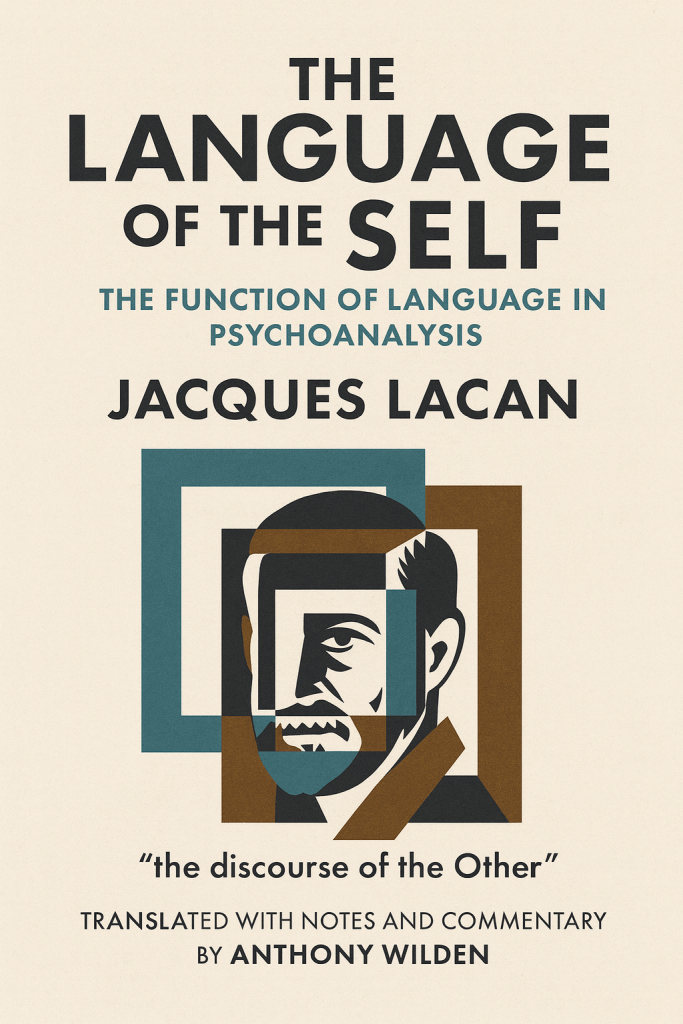
In Lacan’s The Language of the Self: The Function of Language in Psychoanalysis, one encounters a work that is at once a return to Freud’s original texts and an unprecedented venture into the very conditions that shape the analytic encounter. This book exists in a space where French philosophical thought, Freudian psychoanalysis, structural linguistics, and literary criticism meet and collide, and it stands as one of the pivotal moments in the evolution of psychoanalytic theory. Lacan’s text, carefully translated and expanded by Anthony Wilden, does not merely offer a commentary on Freud’s legacy; it re-inaugurates that legacy by recognizing the unconscious as something fundamentally linguistic rather than merely symbolic or instinctual. In doing so, Lacan takes the Freudian discovery of the unconscious—the intersections of meaning, desire, defense, and dream—and places it firmly in the realm of the signifier, the signified, and the connections of discourse. The result is a text that requires the reader to appreciate that the unconscious, if it exists, speaks; it is not a silent storehouse of primal energies but a kind of discourse, a set of articulations, and what Lacan famously calls “the discourse of the Other.”
This volume, initially published in paperback under the title Speech and Language in Psychoanalysis, and now introduced under the more resonant title The Language of the Self, draws on Lacan’s seminal 1953 article “Fonction et champ de la parole et du langage en psychanalyse,” whose delivery at the Congrès de Rome marked a watershed moment for psychoanalysis, a manifesto that influenced a generation eager for a new reading of Freud. Anthony Wilden’s translation and commentary are themselves a major intellectual achievement, providing extensive notes, clarifications, and contextualizations that place Lacan’s arguments within the broader frameworks of epistemology, linguistics, structural anthropology, philosophy, and literary criticism. Wilden’s introduction does more than simply translate Lacan’s notoriously dense and allusive style into English; it offers a key to understanding Lacan’s preoccupations with language’s role in psychoanalysis, and it highlights why Lacan’s text demanded such extraordinary hermeneutic care in order to be received by an Anglophone audience shaped by its own intellectual traditions and limitations.
The essence of Lacan’s project, as revealed in The Language of the Self, is to demonstrate that the analytic situation is irreducible to the mere interplay of instincts and drives, or even to the complex networks of image-laden fantasy that psychoanalysts previously thought were the pillars of psychic life. Rather, Lacan insists on understanding the subject’s discourse—the spoken articulation, the word addressed to an Other, the subtle registers of meaning and misrecognition—which is central to the analytic work. He does not reduce psychoanalysis to a simple “talking cure” as a matter of convenience; he recognizes instead that the patient’s speech, the “parole,” is the very terrain upon which transformations occur. This speech is not simply the emission of words but a structured discourse that points toward underlying linguistic patterns, symbolic structures, and signifying chains. In Lacan’s formulation, the subject’s desire emerges not from some brute psychic force but from the field of differences and displacements in language itself. The unconscious—so often misconstrued as a dark repository of ancestral images or raw impulses—must be approached, in Lacan’s view, as a text that can be read, a discourse that can be interpreted, a system of signifiers that conceals and reveals meaning through metaphor and metonymy.
Lacan engages directly with Freud’s original writings—often poorly understood in their time because of insufficient translations or simplified readings—and re-reads them with the tools offered by structural linguistics and modern philosophy. He shows how Freud’s insights, such as the importance of dreams and slips of the tongue, can be better understood as linguistic phenomena: dreams become a kind of rebus, a message written in the language of the unconscious. The patient’s resistance ceases to be a purely instinctual defense and becomes readable as a function of how the subject’s speech is intertwined with attempts to master or elude meaning. Through a return to Freud, Lacan signals the profound inadequacy of “orthodox” or “classical” techniques that had become ossified, reduced to set formulas and routines, no longer sensitive to the real stakes of the analytic encounter. Lacan’s reading dislodges psychoanalysis from the simplistic conceptualization of an ego that needs mere strengthening or adaptation, or of therapy as a set of behavior-modifying instructions. Instead, he demands that the analyst be a careful and erudite reader of the subject’s speech, attending to nuances and ambiguities, recognizing that what is not said is as important as what is said, and that the silence of the analyst is never the absence of response but itself a structured form of discourse.
Because the analytic medium is speech, the analytic encounter must be specified as a relation to an Other who is not reducible to a person. The Other is the locus of the signifier, the place where meaning circulates, the site that guarantees—in the minimal sense of “anchors”—the possibility that what is said can be heard as something other than noise. In this way, transference is not a personal attachment but the structural condition under which truth effects become possible; it is the field in which the subject’s Word, addressed beyond the ego’s imaginary coherence, can encounter the knowledge it does not know it bears. The analytic task then is neither interpretation as message-delivery nor suggestion as ego coaching, but an intervention into the signifying chain that introduces a difference—timed, cut, or equivocal—capable of retroactively altering the sense of what has been said. The temporality implied by this description is not chronological but retroactive (what Freud named Nachträglichkeit and Lacan formalizes as après-coup). Effects arrive belatedly; meaning is fixed after the fact by the introduction of a signifier that re-reads what precedes it. The volume’s opening pages underline this temporality by framing the argument in images of orbital distance and heat: we must determine our matter at aphelion, Lacan writes, because at perihelion the heat would make us forget it. What follows is a practical logic of delay and scansion; the intervention must be timed so that the cut—of the session, of the silence, of the equivocation—produces a reading that was structurally impossible a moment before.
If the analytic medium is the Word, the Word is not a neutral conduit. Wilden’s Translator’s Introduction therefore refuses to translate away the conceptual apparatus that makes Lacan legible. Terms are capitalized—or, just as importantly, not—for reasons that signal conceptual registers rather than stylistic affect. “Word” is used for parole not because the English fits neatly, but because no English noun captures the dual status of parole as concrete utterance and ethical avowal, as the speaking of a subject and the pledge implied by giving one’s word. “Language” appears in two distinct senses, corresponding to langage and langue, and the triad “the Symbolic,” “the Imaginary,” “the Real” appears with capital initials to indicate that these are not empirical kinds but structural orders that distribute functions and positions. Likewise, “signification” is distinguished from “meaning,” not to be precious but to preserve a difference between the objective function of pointing or definition and the subjective sense that belongs to enunciation. The rigor of these choices is inseparable from the analytic object itself: to collapse them would be to install a false equivalence between the level of code and the level of message, as if a dictionary could substitute for a topology of speech.
This technical insistence has immediate consequences for the clinic. The patient’s “free associations” cease to be a stream of interior content and become the hard labor of a discourse without escape, a work whose difficulty lies in the fact that there is no external vantage point from which a subject can survey its own speaking as if it were an object. To enter analysis is to abandon the compensatory fiction of the monologue and to accept that the analyst’s silence is not emptiness but a device that forces speech to reveal its own laws—its repetitions, its displacements, its puns, its symptomatic substitutions. This is why Lacan treats durcharbeiten (“working through”) not as a patient’s industrious self-management but as the analytic process by which the signifying chain is allowed to organize itself under the gaze of the Other, producing recognitions that cannot be induced by exhortation. That this work often resembles apprenticeship testifies less to technique than to the novelty of the object: we must learn to hear speech as structure, not as self-report.
In this regard, the book’s famous distinction between the “empty word” and the “full word” should be understood as a differential of address and truth rather than a moralizing contrast. The empty word is speech that circulates within imaginary confirmation: it fills the session but avoids the function of reply, staging instead a seduction that attempts to transgress the void of desire by narcissistic amplification. The full word is speech that, precisely because it addresses the Other as locus of law and truth, becomes capable of producing an event of recognition, not in the sense of mirroring what the subject already knows, but in the strong sense of instituting a knowledge that becomes true only as it is said. When Lacan remarks that every Word calls for a reply, he names the structure in which such transformation can occur; if the reply is silence, it is because silence—timed, cut, held—can itself be a reply that protects the place of the Other from being filled by suggestion. The book’s initial articulation of this problem refuses the romanticism of introspection and the pragmatics of behavior; it situates the analytic effect at the level of the Word’s function in a discourse organized by lack.
In this, Lacan’s perspective revolutionizes not only psychoanalysis but also its relationship with philosophy and literary criticism. Philosophy enters the scene because we must grapple with categories like the Symbolic, the Imaginary, and the Real, conceptual domains that help us understand the various registers of human existence. The Imaginary is the realm of identifications and mirror-images, that child’s primordial encounter with his own reflection which Lacan famously theorized as the “mirror stage,” a cornerstone that explains how the subject’s ego is formed through alienation and the interplay of images. The Symbolic is the order of language, kinship, social structures, and laws—those fundamental structures uncovered by anthropologists like Marcel Mauss and Claude Lévi-Strauss, and by linguists like Saussure and Jakobson. By situating the subject’s unconscious within the Symbolic order, Lacan grants language and signification a pivotal role. Literary criticism, too, finds in Lacan’s approach a powerful framework for interpreting texts and narratives, for understanding how meaning flows through linguistic signifiers and how the reader (like the analyst) must discern resonances, echoes, and displacements within a text.
This structural insistence is not a withdrawal from social or institutional reality. On the contrary, Lacan’s introductory pages diagnose the historical shifts by which psychoanalysis, particularly in the United States, drifted toward techniques of adaptation, behavioral description, and “human relations,” often under the auspices of a behaviorist psychology that considered itself scientific precisely by ignoring the very dimension—the Word—in which analytic truth appears. The result is not merely theoretical confusion but a practical eclipse of the signifiers “unconscious” and “sexuality,” whose degradation into euphemism drains the practice of its specificity. Lacan’s corrective is deliberately impersonal: he analyzes not the motives of individuals but the Symbolic, Imaginary, and Real conditions under which a discipline could lose sight of its object. The diagnosis names behaviorism as a native mental form that suppresses the historical dimension of communication and finds itself at antipodes to the analytic experience; it tracks how this suppression couples with a managerial discourse of human engineering to produce a fantasy of technical mastery that cannot admit the place of the Other.
The reorientation that follows is not a polemic against therapy but a detailed reconstruction of the analytic field as a configuration of three orders—Symbolic, Imaginary, Real—whose distinctions are pragmatic: they indicate the level at which an intervention can be made and the kind of effect such an intervention can produce. The Imaginary is the order of specular identification; it confers coherence at the cost of misrecognition. The Real is not the empirical residuum of experience but the structural impossibility internal to symbolization, that which returns to the same place and resists capture. The Symbolic is the order of law, kinship, and rule, structurally homologous to what Lévi-Strauss delineated as the “world of rules.” To say that the unconscious is the Symbolic is, for Lacan, to say that it is constituted by chains of signifiers—some elements of which, such as certain somatic manifestations, function as signs rather than signifiers—organized around a law that precedes the subject and inscribes its desire within a system of differences. The law in question is not a moral norm but the prohibition that founds exchange and filiation; its psychoanalytic name is the Name-of-the-Father, the signifier that authorizes and bars and through whose metaphorical substitution desire is distinguished from demand. This is the point at which Wilden’s long essay, “Lacan and the Discourse of the Other,” becomes decisive for an English-language audience: it maps the structural function of the Symbolic father and explicates the conceptual route by which a failure of the paternal metaphor—foreclosure rather than repression—can lead to psychosis.
The consequences of this mapping are concrete. When the Name-of-the-Father is foreclosed (not repressed), the subject cannot install the signifier that inaugurates the law; the Symbolic order collapses, and the subject attempts to repair the hole by inventions that may show great ingenuity but that cannot maintain the distinction between symbol and thing. Such a subject may, for stretches, produce discourses that resemble the autonomous messages of linguistics—messages about words rather than messages that use words—but eventually metalinguistic capacity is lost, and with it the ability to keep signifier from coalescing with signified. The clinical and theoretical point is exact: foreclosure is not a local deficit; it is a structural failure that reorganizes the entire field. Without the paternal metaphor, there is no Symbolic guarantee for the cutting function of the signifier, and delusional constructions take on the burden of what the Symbolic could not install. Wilden’s exposition distills Lacan’s elaborations from the mid-1950s to the late 1950s and clarifies how castration, identification, and the child’s accession to a position from which he can become a father are functions mediated by the Other; the real father’s intervention matters, but only as it takes up and relays the Symbolic function that, strictly speaking, is “nowhere” and cannot be fully incarnated.
Having set the frame, the book proceeds by staging what might be called a pedagogy of reading rather than a sequence of doctrines. The opening movement takes aim at the temptation to fill the analyst’s silence with a compensatory reality—behavioral observation, image catalogues, or pedagogical suggestion—rather than to maintain the place where truth seeks its articulation through address. To analyze an action because speech seems empty is to forget that even an empty word is still a word, that is, an invocation that calls for a reply at the level of the function of the Word. In analytic terms, the void that appears at first contact is not a deficit to be filled but the structural place of desire; to respond by installing content is to refuse the logic that gives the session its object. It is here that the book’s rigor is most uncompromising: what is sought in analysis is not an inventory of motives but a reconfiguration of the subject’s relation to its own saying. The only way to produce this reconfiguration is to treat the signifier as cause—not in a mechanistic sense, but in the structural sense by which the introduction of a signifier retroactively constitutes the meaning of earlier material. The demand that analysis be “practical,” “helpful,” or “efficient” is not refused; it is re-specified as the demand that the setting allow for the temporality of après-coup, which means that the practical effect cannot be measured by immediate agreement or adaptation.
The second movement elaborates the thesis that the unconscious is structured like a language by reading the formations of the unconscious (dreams, slips, jokes, symptoms) through the mechanisms of metaphor and metonymy. Condensation is treated as a metaphorical substitution by which a signifier stands in for another in a way that produces a new meaning; displacement is treated as a metonymic shift by which meaning slides along a chain that preserves contiguity while altering emphasis. From this perspective, the dream is not a pictorial diary of wishes; it is a rebus straddling two orders of determination: the iconic appearance that seduces vision and the signifying chain that must be read. This is not literary embellishment. It secures the analytic method against impressionism by providing rules for what counts as a relevant intervention. To respond to a dream image with an interpretation of the image’s “meaning” without locating its place in a chain is to mistake the Imaginary for the Symbolic. To produce a punctuating word at the right time—often homophonic, often equivocal—is to operate in the medium that can actually change the subject’s position. That this operation must frequently be less than fully explicit prevents neither its rigor nor its accountability; on the contrary, it is accountable precisely because it is keyed to determinate points in a chain whose logic the session itself exposes.
A third movement, explicit in the table of contents and implicit throughout the text, concerns interpretation and temporality. Interpretation is not commentary; it is an act that intervenes in enunciation. Temporality is not linear; it is organized by logical moments (in Lacan’s vocabulary, the instant of the glance, the time for comprehending, the moment of concluding) that compress chronological duration and reveal how decision and recognition depend on a certain haste. This logic of intersubjective time, illustrated elsewhere by an exemplary sophism, is not an abstract curiosity: it clarifies why the session can be effectively ended at a moment of maximal intensity, why a short session can be more productive than a long one, and why the ethical form of interpretation is to produce the conditions for an act rather than to supply a meaning. Even when the book speaks the language of pedagogy—outlining headings, marking shifts—it seeks to install a reader in whom these logics can be practiced rather than merely known. The Prefatory Note goes so far as to justify haste as a condition under which truth finds its unsurpassable moment: nothing created appears except in urgency, nothing created in urgency that does not engender its own surpassing in the Word. The statement is not romantic enthusiasm; it is a principle of method.
Anthony Wilden’s commentary is indispensable for a deep comprehension of Lacan’s work. He does not simply translate Lacan’s often elliptical French prose, but also elucidates the cultural and intellectual background required to follow Lacan’s argument. Wilden’s notes guide the reader through Lacan’s references to Hegelian dialectics, the philosophy of Heidegger and Sartre, the structural anthropology of Lévi-Strauss, and the early structural linguistics of Saussure and Jakobson. Wilden takes special care to highlight how Lacan’s “return to Freud” is in fact a critical endeavor, one that discerns new dimensions in Freud’s concepts now that his texts can be appreciated in their original German lexical richness rather than through distorting translations or secondary commentaries. Wilden frequently reminds the reader that Lacan’s linguistic turn does not reduce psychoanalysis to a mere code. Rather, it shows that the unconscious is structured like a language precisely because it involves the chains of signifiers that produce meaning through their differences and relationships, not through any intrinsic essence.
Wilden’s long essay, appended to Lacan’s text, performs two essential functions for an English-language readership. First, it gathers the dispersed indications through which Lacan had, by 1953–1958, articulated the laws of the Symbolic and the status of the paternal metaphor; second, it situates these laws in a comparative frame by drawing on Lévi-Strauss’s notion of symbolic function and kinship structures. The effect is to show that “law” here is not an injunction from outside but the structural condition for sociality as such: prohibition of incest, rules of exchange, the places of naming. To call the paternal metaphor constitutive is to claim that the subject’s position in desire is inseparable from the installation of a signifier whose role is to bar and authorize, to cut and to name. Where this installation fails, foreclosure ensues. Where it succeeds, desire can separate from demand, and symptom-formation will assume its familiar neurotic logic rather than psychotic invention. Wilden’s reconstructive work matters because, without it, English readers would be tempted to import a developmental psychology where none is at stake. The book’s claim is not that children pass through stages at prescribed ages but that the Symbolic must, in a logically necessary way, intervene in the Imaginary so that language can take up the body and inscribe it in a system of differences. The lived father may or may not be up to the task; what matters is the function that “he” represents.
The historical and institutional positioning of Lacan’s discourse emerges with particular force when he confronts the American scene. This is not cultural chauvinism; it is a structural observation. In the United States, the absence of a historical dimension in communication—Lacan calls it a constant of the cultural milieu—combined with the hegemony of behaviorism, presses analytic practice toward the objectification of “human relations” and the fantasy of “human engineering.” The effect is not simply that certain words fall out of favor; it is that the very function of the Word is obscured. The analytic situation is recoded as an information exchange, the subject as a behavior-regulated self, the symptom as a problem to be solved rather than a signifier to be read. Lacan’s corrective is to reinstate the Symbolic over the Imaginary and to refuse the seduction by which the analyst steps in to speak where the subject must. No disciplinary body escapes the temptations Lacan catalogs—formalism, corporatism, doctrinal policing—but the text construes these not as moral failings but as defenses against the Word’s demand that one occupy the place of the Other without filling it. The discipline’s ethical risk lies precisely here: to maintain a place for truth effects without arrogating to oneself the power to guarantee them.
It follows from this diagnosis that “technique,” if the word is permitted at all, can only mean a form of attention to speech. The analyst listens for homophones, for equivocations, for the nodal points—quilting points—at which chains that had been sliding come to a momentary stop so that something can be said. “Said” here means something quite precise: not the communication of a content but the emergence of a signifier in a place that lends it force. This is why the strategic silence of the analyst is an act and why punctual words—often very few—can shift the entire economy of a case. To say that the analyst interprets is not to say that the analyst explains; it is to say that the analyst produces an inscription. At this level, the difference between explanation and interpretation is not a preference but a structural distinction. Explanation belongs to a metalanguage that presumes to observe without being implicated; interpretation acknowledges that there is no metalanguage and that every intervention participates in the field it affects. The ethics of analysis, then, is not an external code but a responsibility to the conditions of truth in speech.
The insistence on linguistic structure does not reduce analysis to code-breaking. On the contrary, Wilden explicitly warns that “code,” in the sense borrowed from information theory, is adequate only for the most superficial level of communication. The analytic object is not the code but the function of the signifier in enunciation. Thus, while the distinction between message and code can model the difference between parole and langue, it cannot capture the subjective dimension that makes parole the decisive analytic category. It is for this reason that Wilden retains certain French terms (méconnaissance, belle âme) and calibrates his English lexicon with capitalizations and substitutions that reflect not taste but necessity. The goal is not to import a jargon but to prevent a fatal slippage in which “meaning” would collapse into “signification,” “self” into “subject,” “language” into “communication.” The cost of refusing these distinctions is not theoretical nicety; it is the loss of a clinical object.
The reader will notice that the book’s architecture—Lacan’s text followed by Translator’s Notes and then by Wilden’s theoretical essay—maps a movement from the analytic field to its conceptual setting and finally to a discursive elaboration that places Lacan among the human sciences without dissolving his specificity. The bibliographical and editorial frame underscores this movement. The text translated here was first published in La Psychanalyse (1956) and later collected in Écrits (1966), and the present edition includes a Prefatory Note situating the discourse with respect to urgency and truth, a set of translator’s comments on technical terminology, and a comprehensive essay that correlates psychoanalysis with linguistics and anthropology. The visible table of contents confirms these divisions: “The Empty Word and the Full Word,” “Symbol and Language,” and “Interpretation and Temporality,” followed by notes and the long essay on the Discourse of the Other. None of these sections is devoted to a narrative progression; each establishes a different angle on a single object—the function of language in psychoanalysis.
Readers attuned to contemporary theoretical debates will recognize the book’s proximity to phenomenology and dialectics as well as to structuralism. Yet proximity does not mean identity. The text draws on Hegel where negativity and recognition are at issue, on Heidegger where language is construed as the house of being, on Saussure and Jakobson where signifier and differential relation must be formalized, and on Lévi-Strauss where law and kinship structure the Symbolic order. But in each case the borrowing is limited: Lacan does not propose a speculative ontology or a sociological determinism; he proposes a clinical science of the subject of language. This science is not a set of generalizations but a practice of reading; its generality lies in the reproducibility of its procedures—listening for equivocation, timing the cut, locating the point of paternal metaphor—not in a catalog of types. The rhetoric that sometimes surrounds Lacan—aphoristic, polemical, allusive—is a method as much as a style: it dislodges the reader from imaginary complacency and forces the work of reading. Wilden’s introduction makes no effort to domesticate this rhetoric; he clarifies it by mapping it onto the problems from which it arises: translation, reception, institutional setting, and the ethics of the analytic act.
If this book is a “return to Freud,” it is also a demonstration that Freud could not possess the very concepts that would have explained his findings. Freud discovered après-coup without naming it as such; he worked with dreams as rebuses without a fully formal language of metaphor and metonymy. He understood transference as a condition of truth and misrecognition but lacked a general theory of the Other as locus of speech. Lacan’s contribution is to provide, from linguistics and anthropology, the conceptual frame that renders Freud’s observations more precise without displacing their object. In that respect, the volume serves as a hinge between psychoanalysis and the human sciences. It shows that the subject of psychoanalysis is neither a biological organism nor a social role but a position in discourse. That position is historically mediated—hence the importance of culture and institution—but it is not reducible to sociological description. It is logically structured—hence the capitalized orders—but it is not abstracted from the clinic. It is ethically charged—hence the insistence on the analyst’s place—but it is not moralistic.
The practical upshot for analytic work is that interpretive interventions must be constructed rather than dispensed. They must be calibrated to the chain of signifiers presented by this subject and oriented to the place at which a cut can produce retroactive meaning. The temporality of such cuts explains why the session cannot be scheduled as a delivery of content; the ethical claim on the analyst is to maintain conditions under which speech can produce an effect, not to manufacture that effect by fiat. The disciplinary consequences are considerable. Training must teach listening and timing, not doctrines; supervision must evaluate operations, not opinions; institutions must be judged by the space they preserve for the Other, not by the uniformity of their results. The book does not pretend that such an ethos is easy to maintain—its historical remarks on the drift toward adaptation in certain contexts show as much—but it insists that anything less would betray the object.
Readers will also find in the volume a pointed reflection on the relation between translation and theory. Because the object is linguistic function rather than the lexicon, translation becomes the site where the theory either survives or fails. Wilden makes explicit the conventions he follows—capitalizations, terminological correspondences, retention of certain French terms—and he aligns these conventions with an Anglophone psychoanalytic tradition already shaped by the Standard Edition of Freud. The goal is not idiosyncrasy but continuity and clarity: to ensure that the coordinate system implied by “the Symbolic,” “the Imaginary,” “the Real,” by “signification” and “meaning,” by “Word” and parole, is present in English as a usable grid. Without this grid, the analytic argument would devolve into metaphorical suggestion or empiricist casuistry. With it, Lacan’s “return to Freud” becomes legible as a return to the Word.
The Language of the Self, therefore, situates Lacan’s pivotal 1953 text within a galaxy of concerns: the historical moment of the French psychoanalytic movement, the schisms and disputes that led Lacan and his colleagues to challenge the official institutions of psychoanalysis, the socio-cultural climates that shaped the reception of Freud and Lacan (including the American context where adaptation and conformism threatened to dilute Freud’s radical message), and the conceptual tools that allow us to see psychoanalysis not as a set of clinical recipes but as a rigorous discipline of interpretation, a science of the subject in language. It also shows us why Lacan’s teaching, often overshadowed in its early days by misunderstandings and controversies, became a touchstone for a wide range of intellectual developments in the twentieth century. The “Discours de Rome” that forms the backbone of this work stands at the junction where psychoanalysis, after Freud, must redefine itself or lose its meaning; where the analyst must abandon comfortable certainties and confront the challenge that the Word—the subject’s speech—poses to knowledge and authority.
This edition also reveals the complexity of translating Lacan into English. Wilden’s introduction and supplementary notes, replete with references to the Freudian corpus as well as to linguistic and philosophical concepts, show how a word like parole differs from mot, how meaning and signification must be carefully distinguished, how the signifier and the signified function, and why the Symbolic, the Imaginary, and the Real must be capitalized or set apart to capture their specialized conceptual status. Such distinctions are not pedantic technicalities but the very fiber of Lacan’s rigorous inquiry. By insisting on a painstaking fidelity to Lacan’s terminology, Wilden respects the spirit of Lacan’s argument and places English-speaking readers in a position analogous to the French or German reader confronted with Freud’s subtlety, thereby returning psychoanalysis to the potency of its original discoveries.
The Language of the Self shows that the analyst’s role is not to explain or instruct but to interpret, to respond not only with silence but also with a mastery of the Word that allows the subject’s own speech to unfold in unexpected ways. This is what makes Lacan’s text more than a mere commentary: it is a re-foundation of psychoanalytic dialogue. By following Lacan, the analyst steps into a domain where the subject’s desire, seemingly inchoate, is nevertheless articulated through linguistic structures; where the fantasies and phantasmatic objects that populate the patient’s psychic life are not brute facts but meaningful signifying chains that can be read, deciphered, and ultimately recognized. In this recognition, what emerges is a subject who is not a prisoner of instinctual forces alone, nor a mechanical collection of conditioned behaviors, but a being shaped and reshaped by language, who, in the analytic encounter, has the chance to rediscover the dimension of Truth that inheres in his own discourse.
A final remark about the book’s status within psychoanalytic discourse. The text was a watershed not because it resolved controversies but because it redefined their ground. By re-centering analysis on the function of language, it made inevitable a series of institutional shifts whose proximate causes may have been organizational but whose ultimate stakes were theoretical. One cannot pursue a practice oriented to the Word and at the same time accede to bureaucratic imperatives that treat knowledge as a transferable commodity. The conflicts that followed Lacan’s early teaching—over training, over technique, over institutional power—are intelligible only against the backdrop provided here: analysis either maintains the place of the Other and refuses suggestion, or it becomes a form of care subordinated to norms of behavior and adaptation. The book does not argue this point in institutional terms; it demonstrates it by reconstructing the analytic field as a discourse in which truth effects have a specific causality.
To read The Language of the Self carefully, then, is to be displaced as a reader. It is to discover that description must itself be performative, that the chapters cannot be recapitulated as topics because each is a different cut through the same object. It is to experience translation as an analytic operation, to encounter a technical lexicon that is neither fetish nor ornament but the minimum condition for theoretical clarity, and to accept that what makes psychoanalysis a science is not its quantification but its reproducible procedures in a field of speech. It is, above all, to consent to the paradox named by the English title: the self has a language only insofar as language, originally the Other’s, constitutes the subject in division. The “language of the self” is therefore not the self’s possession but the scene on which it is dispossessed in order to speak—where it risks the truth that only a reply can bring to speech.
Taken as a whole, the volume accomplishes three tasks with exceptional precision. It retrieves Freud for a late twentieth-century audience by showing that his discoveries are best understood as linguistic phenomena, not as biology in waiting. It equips psychoanalysis with a conceptual grammar—drawn from linguistics and anthropology—sufficient to state its object without dissolving into literary impressionism or behavioral catalogues. And it marks an ethics that requires the analyst to occupy the place of the Other without filling it, to produce cuts rather than explanations, to privilege the après-coup over the immediate effect. None of these tasks is simple, and the book does not make them simpler by pretending otherwise. It constrains them in a language whose rigor is as exacting as the analytic practice for which it argues. In this way, The Language of the Self becomes not only a “pivotal moment” in the evolution of psychoanalytic theory but also a continuing instrument for any analytic practice that would deserve the name.
Any attempt to render a verdict beyond this would be contrary to the text’s own ethic. The most that a description can do—if it is to remain within its proper register—is to point to the conditions under which such a book could be read: patience with terminological distinctions that are not pedantic but structural; willingness to hear speech as cause rather than report; acceptance of a temporality that makes effect depend on logical time rather than duration; recognition that translation is not neutral; and, finally, the understanding that the Word’s demand for a reply is the analytic setting’s minimal law. Where those conditions hold, the book is not simply read; it does work. And where it does work, it restores to psychoanalysis the rigor of a practice that takes the truth of the subject to appear in—and only in—the function of language.
The Language of the Self: The Function of Language in Psychoanalysis provides an extraordinarily rich and challenging interpretation of Freud’s legacy, using the tools of modern thought to clarify why the unconscious must be understood as a linguistic phenomenon. It presents Lacan as a thinker who, by rooting the subject’s being in language, opens psychoanalysis to philosophy, anthropology, linguistics, and literary studies. It captures the spirit of a moment in intellectual history when psychoanalysis was forced to confront itself and its founding texts, to return not to a merely historical Freud but to Freud’s fundamental insight that meaning emerges in and through the Word. Through Wilden’s meticulous scholarly work, the Anglophone reader gains access to Lacan’s revision of Freud, and can appreciate how this pivotal essay gave birth to new forms of analytic practice and theoretical reflection. The Language of the Self reaffirms that psychoanalysis is not a dead ritual nor a matter of mechanical interpretation, but a living dialogue in which the subject’s truth, concealed and revealed by language, comes to be known.
 Simon Gros
Leave a comment