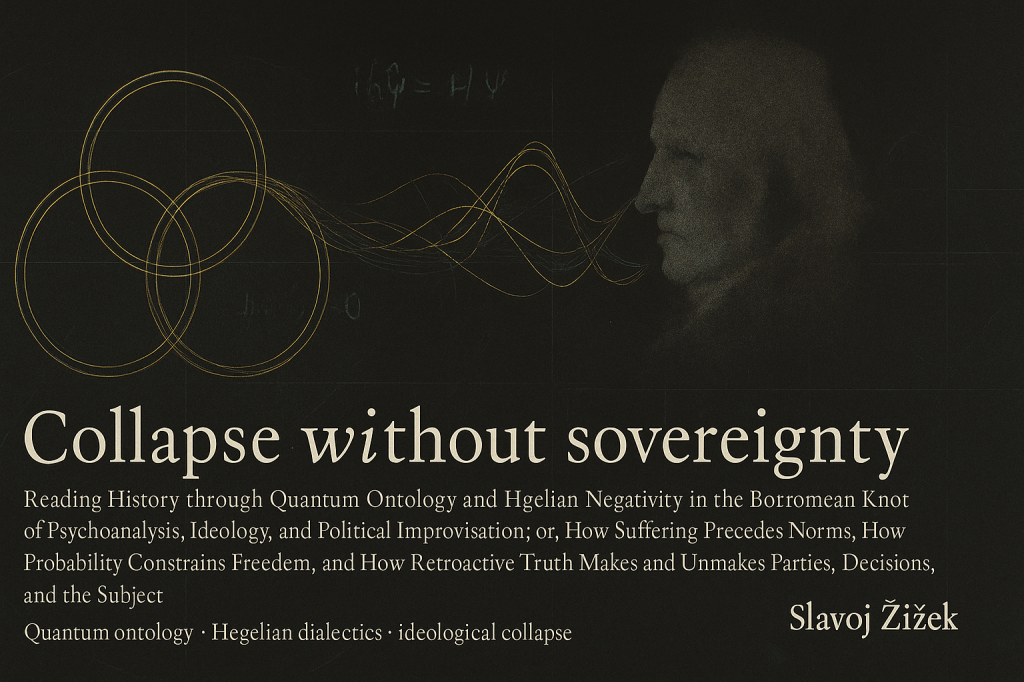
A certain relief, in Slavoj Žižek’s view, announces itself at the outset, not in the content of a new doctrine but in the fact that one can still form, across disciplines that typically repel one another, an honest connection. To approach quantum theory as ontology rather than a mere computational apparatus, and to bring its interpretive turbulence into conversation with Hegel’s logic of negativity and with the analytic resources of psychoanalysis, constitutes for Slavoj Žižek a three-way demand: the physical demand to take seriously the structure of contemporary theories and their contested interpretations; the dialectical demand to think contradiction not as logical error but as the motor of identity’s self-displacement; and the psychoanalytic demand to refuse the consolation of positive foundations where suffering and desire have not yet been processed into norms.
What becomes explicit in that triangulation, as Slavoj Žižek construes it, is not a synthetic worldview but a discipline of reading: a way to read events—scientific, historical, and political—by making their retroactive intelligibility part of the account rather than an embarrassment to be explained away. Slavoj Žižek’s wager is that philosophical labor does not consist in establishing a secure standpoint above physics, history, and ideology but in entering their disjunctive unity so that the moments of collapse, decision, and misrecognition can be grasped without being moralized, aestheticized, or reduced to the positivism of facts that never explain the facticity of their own emergence. That is the difficult joy Slavoj Žižek finds in the midst of a terrifying world: to have interlocutors on the scientific side who do not dismiss ontological questioning and, reciprocally, to have a philosophical ear trained to hear in an equation or an interpretive controversy not the raw material for metaphor but the demand to refine conceptual instruments.
Where the word critique still circulates with confidence marks, for Slavoj Žižek, precisely a problem. For the inherited sense in which critique secures its authority by presupposing a normative vantage point—this is unjust because justice, as we all know, requires X—confuses two orders. It elevates second-order reconstruction of norms into the first-order cause of indignation, as if the ethical energy to protest required an antecedent theory. As Slavoj Žižek reads them, the Frankfurt School at its best knew that the temporality runs the other way: one does not first take a position in the tribunal of reason and only then notice that bodies are starving, that racialized violence operates through administrative routines, that women’s lives are organized around the denial of their agency, that labor’s time is appropriated in the name of freedom. The primacy of suffering does not, for Slavoj Žižek, authorize a romantic cult of immediacy; it marks instead the priority of a negativity that refuses to be made transparent by moral theory. When critique is subordinated to the demand for positive grounds, it becomes a sermon.
When analysis is subordinated to the comfort of a final synthesis, it becomes scholasticism. The point, as Slavoj Žižek frames it, is neither to abandon critique nor to fetishize immediacy, but to recompose the relation between analysis and judgment so that the normative element is not assumed as transcendental furniture but wrested, precariously, from a struggle whose first datum is pain and rage—affects that can be mobilized in radically different directions, progressive or reactionary, emancipatory or fascistic. The scene of ideology is exactly the scene where these raw materials are appropriated, coded, and consummated. If a pseudo-populist ideologue can name, sometimes with disturbing accuracy, the frustrations produced by corporate predation, logistical domination, and social fragmentation, this accuracy is not yet truth; it is a preliminary capture of suffering that is then rerouted toward racism, misogyny, and paranoid community. What is at stake in a theory of ideology, on Slavoj Žižek’s account, is not the replacement of false representations by true ones, but the struggle over the very circuits through which suffering is made speakable, actionable, and binding.
Slavoj Žižek’s proposal to re-situate the critique of ideology within a Borromean configuration—Lacanian psychoanalysis, Hegelian dialectics, and quantum science—can sound esoteric unless one keeps firmly in view the practical problem it addresses. Psychoanalysis, for Slavoj Žižek, teaches that the subject is not prior to its signifiers; desire is structured, the unconscious speaks, and enjoyment is knotted with law rather than emancipated by its suspension. Hegel, in Slavoj Žižek’s reading, teaches that identity is the result of its own activity of self-negation; the concept realizes itself not by subsuming difference but by laboring through contradiction. Quantum physics, in the register in which it engenders ontological questions, insists that indeterminacy is not exhausted by ignorance and that the distribution of possible outcomes is law-governed even where no determinate value precedes measurement. None of these three replaces the others; the point is precisely that they constrain one another’s excesses.
Psychoanalysis without dialectical reason risks cultivating the singularity of symptoms as untouchable; dialectics without the real of enjoyment reduces contradiction to argumentative drama; and physics without philosophy reverts to the comfort of instrumentalism, calculate and shut up, as if the biggest question—what must reality be like for our best theories to be true?—could be quarantined as bad taste. The knot, as Slavoj Žižek imagines it, holds when one sees how a determinable field of possibilities (quantum superposition) can be both rigorously constrained (the distribution specified by Schrödinger dynamics) and yet undecidable with respect to which outcome will actualize without interaction; how a social situation can be both over-determined by structural antagonisms and yet open in the sense that no political calculus yields the event; how a subject can be both produced by signifying chains and liable to act in a way that is only readable after the fact as the act that made the situation what it retrospectively was.
Slavoj Žižek’s insistence that quantum physics is “more than” a method of calculation does not substitute philosophy for experiment; it takes seriously the manifold of interpretations that physicists themselves debate when they are not doing calculations but thinking about what their calculations mean. For Slavoj Žižek, the possibility that no single, univocal ontology lies beneath the formalism is not an argument against ontology; it is the beginning of ontological responsibility. It is precisely because the formalism prescribes a determinate evolution for the state vector that the concept of collapse acquires a peculiar status: neither a lawlike dynamics (in the usual accounts) nor a chaotic whim, but a point at which the precompositional manifold of possibilities yields an actuality that was constrained yet not deducible.
The interpretive field that runs from “collapse on observation” through “no collapse at all” (many-worlds) to objective collapse models reheats, in a high-tech register, philosophical problems that the dialectical tradition is, by Slavoj Žižek’s lights, equipped to parse: how to think contingency that is not indifferent chance, necessity that does not eradicate novelty, multiplicity that is not merely the optical effect of ignorance. When a physicist moves from “the wavefunction evolves unitarily” to “each branch is realized in a distinct universe,” Slavoj Žižek hears the seduction of a metaphysical plenitude that rescues determination from decision by distributing every possibility somewhere. When a philosopher romanticizes the pre-collapse amplitude structure as a lavish openness that is tragically petrified by the event of measurement, Slavoj Žižek hears the inverse seduction: the nostalgia for a space of pure creativity wronged by determination. What Slavoj Žižek’s dialectical ear demands is less moralization and more attention to form: the statistical lawfulness that makes possible a range of outcomes, the interaction that selects one, the retroactive intelligibility of the selection.
From that vantage, on Slavoj Žižek’s account, historical materialism ceases to be an edifice of laws and becomes once more a discipline of reading, where collapse names the point at which a field of antagonistic tendencies yields an outcome that is at once unsurprising in its general features, because the structure channeled it, and stunning in its concrete realization, because the specific path could not have been foreseen as the only path. The notion is easily confused with voluntarism if one imagines a subject surveying the possibilities from above and then heroically selecting one by sheer will.
Against that, Slavoj Žižek insists both on the trap-character of choices—agents never choose in a void; they choose under determinations they do not master—and on the irreducible retroactivity by which the meaning of a choice becomes visible only when its consequences reorganize the space of possibilities. This is why, for Slavoj Žižek, the hyperbolic notion of a sovereign subject who knows the historical situation transparently and moves with perfect timing is morally intoxicating, politically dangerous, and analytically false. The point is not to replace heroism with fatalism, as if outcomes were necessitated behind our backs; the point is to read the event as an index of a field’s inner tensions coming to a head at a localized site where the act binds them, and to acknowledge that the binding, when it works, shows us after the fact what all along was latent.
The Lenin example forces the matter with a clarity Slavoj Žižek regards as brutal. To say that the seizure of a revolutionary opening constituted a genuine intervention is not, for Slavoj Žižek, to celebrate its afterlives; to say that the truth of that intervention became legible in and through the despotism that consolidated afterwards is not to sanitize that despotism but to resist the consoling fantasy that the essence of the event lay forever elsewhere, uncontaminated by its actualization.
The dialectical reading Slavoj Žižek commends insists that Stalinism is not an accidental deviation that leaves Leninism in its pristine state; it is the retroactive self-exposition of potentials woven into the early conjuncture—potentials that could have been otherwise without, for that reason, being mere exterior contingencies. That Slavoj Žižek remains thereby a Leninist but more pessimistic is not, for Slavoj Žižek, a psychological confession but a methodological stance: the refusal to redeem an event by subtracting from it what it became, the refusal likewise to indict the event by declaring that what it became was always all that it was. The price of that refusal is to abandon the inverted comfort of having been right all along. The gain is the capacity, as Slavoj Žižek sees it, to think political action without halo, without the melodrama of pure beginnings, and without the cynicism that treats every beginning as merely the seed of domination.
The concept of retroactivity here is not, in Slavoj Žižek’s view, a literary flourish; it is the core of dialectical intelligibility. The act has to be repeated not because it failed the first time in an empirical sense, but because it misrecognized, structurally, what it was doing; only repetition can draw out the truth of the first act by changing the coordinates through which the act can be named. That is why, in Slavoj Žižek’s analysis, practices of emancipation so often have to turn their weapons against their own prior victories. It is also why politics cannot be indexed exclusively to programmatic clarity or organizational form.
The demand to choose between forming a new party and entering the left wing of a compromised party is a genuine dilemma, but the principled answer—one size fits all—is, for Slavoj Žižek, an alibi for avoiding the labor of reading the situation. In some conjunctures, the opening exists inside the compromised form; the task is to force a confirmation that seems impossible and to seize a municipal or regional lever that the apparatus thought it controlled. In other conjunctures, the very same apparatus has lost enough legitimacy that a new organizational form can mobilize a public more quickly than an internal factional struggle can. The only dogma, as Slavoj Žižek puts it, is that there is no dogma; the only principle is the refusal to let the adversary’s structure dictate the very grammar of one’s choices.
None of this, in Slavoj Žižek’s vocabulary, is opportunism in the vulgar sense of principle-free maneuver. The point is to bind a maximum of fidelity to emancipatory aims with a maximal refusal to fetishize means. To insist that one sticks to principles while acknowledging that a democratic mobilization may require, to take a deliberately provocative example, forms of social pressure that liberal theory abhors, is not to endorse cruelty but to remember that the formal purity of means can coexist very comfortably with material stagnation or regression. The ethical demand, as Slavoj Žižek construes it, is that the means remain accountable to the ends in a double sense: they must be judged by their effects on the living and they must be revisable in light of what they produce. The tactical corollary is that improvisation is not an aesthetic preference; it is the mode adequate to a world in which collapse points do not announce themselves with philosophical clarity.
Where a candidate who seems unthinkable to the establishment forces open a space in a city whose governance has been naturalized as a technocratic necessity, a leap may be warranted not because the candidate is the Messiah but because the opening itself is a resource. Where an emergent party in a parliamentary system, even before it has solidified, tempts the disaffected away from a calcified opposition, refusal to postdate one’s engagement until after the new party becomes respectable is, for Slavoj Žižek, a way of refusing to let procedural temporality decide substantive outcomes. One need not believe every optimistic poll or every celebrity endorsement to recognize a material fact Slavoj Žižek emphasizes: dissatisfaction with managed centrism has a way of discovering vehicles, and those vehicles, when they work, are rarely the ones that a rulebook would have selected in advance.
Bringing the physics back into focus is, for Slavoj Žižek, not an indulgence in analogy for its own sake. The talk of collapse matters because it names the moment at which an abstractly calculable spread of possibilities becomes an actuality that demands commitment and generates consequences. In quantum theory, as Slavoj Žižek reads it, the probability amplitude is not a pre-existing catalogue of hidden determinations; it is a structure that encodes in a law-governed way what may occur when a system is coupled to a measuring apparatus. The key is not whether one supplements the formalism with a metaphysics of branching worlds, mind-dependent collapses, or objective flashes; the key is that the probabilities are not arbitrary and the actualization is not deductive.
Politics, in Slavoj Žižek’s account, has its own version of that double bind. Structural analysis can specify the range of outcomes toward which a situation is tending, but no analysis can deduce the singular tipping points at which an organization, a strike, an insurgency, or a campaign binds disparate tendencies into a new actuality. Conversely, activism that treats indeterminacy as license for voluntarism—anything can happen if we just decide hard enough—is for Slavoj Žižek only the path from enthusiasm to defeat. The lesson Slavoj Žižek draws is harsh and, as Slavoj Žižek sees it, liberating: possibility is objective and constrained; actuality is singular and retroactively intelligible; the subject is neither master of the process nor its passive bearer but its implicated agent.
If one asks, then, what becomes of critique in this configuration, Slavoj Žižek’s answer is that its authority is neither waived nor enthroned; it is displaced to the scene where suffering precedes justification, where the wrong done to bodies, lives, and futures is not first of all a violation of a norm but an injury that forces norms to show their worth. Habermas’s charge against the early Frankfurt School—that it offered brilliant diagnoses without the positive normative foundations to ground them—marks a real anxiety Slavoj Žižek acknowledges: that in the absence of foundations, critique becomes a pose and politics a ressentiment theater. But the inversion is more dangerous in Slavoj Žižek’s eyes: to insist that critique must begin with the articulation of positive foundations is to ignore how norms acquire their content in history. Freedom is not a predicate discovered by reflection and only then applied to enslaved bodies; it is a labor that bodies undertake, which compels reflection to discover, redefine, and defend a content for freedom adequate to the demands raised from below. To say that the normative emerges through struggle is not, for Slavoj Žižek, to deny its universality; it is to deny that the universal is an object already sitting on the philosopher’s shelf, waiting for application.
The symmetrical danger, which Slavoj Žižek also underscores, is the pseudo-radicalism that converts the primacy of suffering into an anti-normative injunction. On this view, to name a wrong as racism, sexism, or class violence would already be to appropriate the singularity of pain; better to celebrate rage as such and leave it uncontaminated. But the repudiation of names is not neutrality; it is an abdication that leaves the field open to those who are eager to supply their own names. There is, in Slavoj Žižek’s understanding, no politics without articulation, no emancipation without the risky business of saying what is at stake and who the antagonists are.
The criterion is not the purity of immediacy; it is the material effect of the names: do they assemble a coalition that can act in solidarity, do they clarify the mechanisms of domination, do they open avenues of transformation that do not immediately re-inscribe subjection? In this respect, the ideologue who enumerates real grievances and then offers the interpretive shortcut—your humiliation is the immigrant’s fault; your insecurity is the feminist’s fault; your economic precarity is the climate activist’s fault—is not, for Slavoj Žižek, performing an intellectual mistake; he is performing a political operation that those committed to equality must counter not with superior statistics alone but with a re-organization of the field in which those statistics become action.
This is why, for Slavoj Žižek, the dialectical vocabulary of negativity should not be confused with rhetorical radicalism. Negativity is not an affect; it is a structural relation in which an identity becomes itself through what it cannot domesticate. To think the political with negativity is, in Slavoj Žižek’s sense, to accept that projects worthy of allegiance will harbor contradictions that cannot be wished away by moral enthusiasm, and that failure is not an anomaly but a constitutive possibility. Retroactive reading, in that sense, is not the morbid pastime of the disappointed; it is the discipline required to avoid rewriting history in the style of hagiography or prosecutorial briefs. When a revolutionary initiative degenerates into bureaucratic violence, one must neither absolve the initiative by treating the degeneration as an alien infection nor condemn the initiative by pretending that the degeneration was always already contained in it in the manner in which a seed contains a plant. The point, as Slavoj Žižek elaborates it, is to think determination without teleology: the ways in which structural constraints and strategic choices, international pressures and domestic antagonisms, organizational designs and charismatic leaderships, converge on an outcome that could have been otherwise, and yet was not otherwise.
At the level of contemporary strategy, this perspective produces, for Slavoj Žižek, an ethos rather than a recipe. Commit where an opening exists, but do not confuse the existence of an opening with the guarantee of success; respect principles, but do not deduce tactics from them as if politics were a geometry; cultivate democratic mobilization, but do not fetishize procedure such that living energies are sacrificed to rituals. If, in one city, a candidacy that alarms elites and delights neighborhoods appears, Slavoj Žižek counsels not to wait for national consensus; test whether the candidacy can be the site where otherwise dispersed antagonisms assemble. If, in another country, the traditional opposition mutates into a managerial echo of its adversary, and if a new party can crystallize widespread disaffection into organization, Slavoj Žižek urges not to insist that salvation must arrive through the old structure for the sake of continuity. The point is not that anything goes but that what goes depends on reading a conjuncture with a conceptual armature flexible enough to register novelty and strict enough to prevent self-intoxication.
Against the fantasy of linear progress punctuated by pure events, the physics–dialectics constellation underscores, in Slavoj Žižek’s hands, the recursive labor by which one learns from mistakes that could not have been avoided without the very experience of making them. In this register, pessimism names not a mood but a prophylactic against utopian simplifications; it guards against the romance of beginnings and the theology of redemption. To say that the collapse point reveals the truth of a process retroactively is to announce, in advance, a discipline of self-critique: after the act, read the act again, and change course without treating the change as betrayal. There is, for Slavoj Žižek, no other way to honor principles in a world whose laws are not theorems but the stubborn regularities of domination and the fragile regularities of solidarity.
This, finally, is why the entanglement of quantum discourse with political analysis is, in Slavoj Žižek’s view, not a category mistake but an attempt to think two recalcitrant facts together: that reality is not exhausted by its actualities (there is structured possibility), and that actuality cannot be derived from possibility without an interaction that changes the situation. The political version of interaction is organization; the measurement that yields an outcome is the act that binds a coalition, sets a slogan, occupies a square, wins a vote, authorizes a strike. The lawfulness of possibility keeps us from mystifying the act; the singularity of actualization keeps us from bureaucratizing it. To maintain both at once is difficult; it requires, as Slavoj Žižek emphasizes, a patience that is unspectacular, an appetite for reading that is unglamorous, and a courage that is not the bravado of certainty but the stubbornness to proceed without guarantees.
In the background, the dispute about whether critique must present its normative credentials in advance will persist. But Slavoj Žižek’s insistence that the normative dimension be made explicit only as the struggle itself compels it reflects a conviction about how normativity arises from conflicts in which the measure of justice is itself part of what is fought over. Freedom, in this light, is not the philosopher’s axiom applied to recalcitrant facts; it is the name that the oppressed give to their practice when they invent forms of living that no longer presuppose their subordination. The philosopher’s work, then, as Slavoj Žižek assigns it, is less to certify in advance the grounds of critique and more to keep open a register in which suffering is not silenced by its own representation, in which the naming of wrongs does not itself become the closure of their transformation, and in which the dialectical temporality of retroaction—where the truth of an act emerges through what it becomes—does not become an alibi for irresponsibility but the very form of responsibility.
To think with this knot, as Slavoj Žižek proposes, is to accept a risky responsibility. One must dare to follow scientific debates into their ontological implications without substituting metaphysics for physics. One must dare to mobilize dialectical categories without turning them into scholastic jargon. One must dare to read political conjunctures without mistaking one’s desire for their truth. If there is joy here, it is not the joy of mastery but the joy of not being alone—of discovering, in a landscape designed to isolate, that there are still languages adequate to the complexity of the world and still practices capable of transforming it. That joy will not save anyone. But, on Slavoj Žižek’s account, it can steady the hand that writes, the tongue that names, and the body that acts, when the moment arrives in which a constrained set of possibilities, long calculated, suddenly collapses into the singular actuality that will, for better and for worse, define what was done, who acted, and what they will have become.
 Simon Gros
Leave a comment