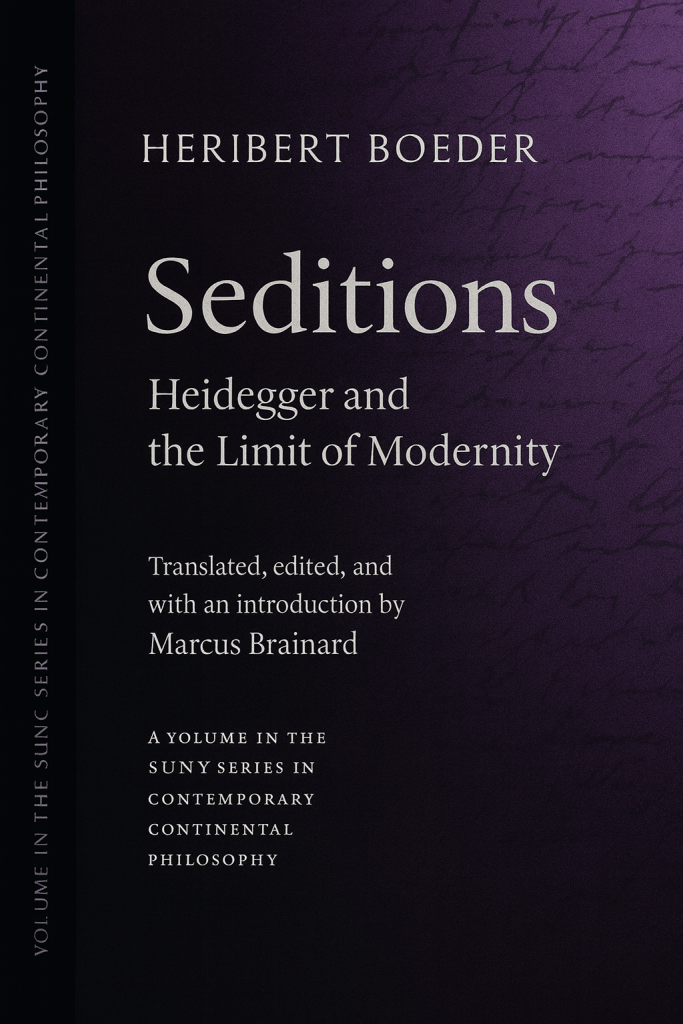
The title declares its method before a single argument is rehearsed. Seditions does not enlist Heidegger to prosecute modernity or recruit modernity to refute Heidegger; rather, it names a quiet but decisive departure staged by Heribert Boeder against the contemporary domestication of both Heidegger and “modernity,” a departure animated not by polemical novelty but by an older, more exacting allegiance to difference as the very element of knowledge. Marcus Brainard’s editorial introduction makes this point with exemplary severity: what passes for “difference” in much recent thought is a leveling rhetoric of similarity that abandons decision, dissolving knowledge’s discriminations into a pluralist fog. Boeder’s seditious gesture begins by refusing that fog; it restores difference where a judgment must be made for the sake of the whole—where one thought is excluded in favor of another because only the latter contributes to the construction of a totality. That this insistence on exclusion appears scandalous in a climate intoxicated with différance is, for Boeder, a diagnostic sign that we have misplaced philosophy’s ground. The sedition, then, targets neither Heidegger nor “modernity” but our era’s easy syncretisms; its first task is to recover the discipline by which difference is decided as a function of knowledge and not of taste.
The book’s opening essay, “Veritas seditiosa,” names this turn with a Latin compactness that avoids manifesto and melodrama. Echoing Erasmus’s wary phrase for Luther’s truth-as-sedition, Boeder characterizes his own separation as a reticent departure rather than a noisy revolt: a sed that becomes a seditio only insofar as it answers to “the most ancient of the ancient,” which awakens what is long begun in each epoch and refuses both nostalgic return and eschatological deferral. Sedition here is a discipline of listening to what has already been decisively achieved in thought and what still commands our assent once our self-assertions fall silent.
Brainard’s introduction frames the volume as a counter-reading of Heidegger precisely at the point where Heidegger’s history of being seems most irresistible. The danger, he suggests, lies in the slide from difference to similarity: from decisive alternatives to a tolerant coalition of contradictory principles that pleases a public content to know “a little about everything and at bottom nothing.” Against this syncretistic appetite, Boeder revives the thought of the either/or—an alternative decided in view of a whole whose parts are necessary, because their removal would disarticulate the totality. The work of philosophy is here understood as an architectonics of necessity, a construction in which positions are integral ratios rather than influences or flavors, and in which unity is purchased not by smoothing conflict but by arranging irreducible differences into a persuasive order.
That architectonic order is named logotectonic. The term condenses Boeder’s transposition of Heidegger’s late call for a poetizing thought into a disciplined building with ratios (ratio terminorum), where ratio signals at once “reason” and “proportion.” The shift is crucial. Instead of lamenting the “departure” of philosophical reason once its premodern divine ground is withdrawn, Boeder translates reason’s actuality into the field of the constructed ratio: we encounter reason not as an empty faculty but as an achieved proportionality of terms within a figure, and we learn reason by parsing works that realize such ratios. Thus the recovery of reason is neither a regression to metaphysics nor an edict against modernity; it is a constructive demonstration that rationality inheres in articulated wholes and their constituent ratios. This is the logotectonic promise: to exhibit, with as much severity as is still available to us, how a totality is composed, where its positions stand, and why only certain combinations “make all the difference.”
Boeder’s method turns on three “fundamental words”: epoché, totality, and ratio. The epoché in question is not Husserl’s theoretical bracketing but a cultivated reticence: a learned suspension of self-assertion that listens to what is already known, to the gift that precedes thinking. Boeder hears in Heidegger’s Gelassenheit a late, responsive piety, but he relocates releasement to the beginning of learning, where it can function as the enabling discipline for a renewed science of rational positions. Totality, in turn, does not mean an encyclopedic inclusion of everything; it names a closed whole composed only of necessary parts—parts that cannot be removed without disintegrating the whole’s unity. Finally, ratio is the smallest constructive unit, a triadic sequence of terms derived from Heidegger’s own formula—the destiny of the topic of thinking—and rendered as A (destiny), B (topic), C (thinking). A figure is a triple of such ratios ordered by strict rules; a type of reason is a family of figures; an epoch is the tripartite orchestration of types; and a totality is a completed architectonic in which the positions are not merely cataloged but proportioned.
Against the contemporary habit of narrating the history of philosophy as a continuous decline into the oblivion of being (or as an alternating progression of breakthroughs and erasures), Boeder proposes three totalities: history, world, and speech. These are not thematic rubrics but closed, rationally articulated wholes. The first corresponds to the totality of metaphysics understood as the history of reason’s works; the second to the architectonic of modernity, whose sense-explication is no longer philosophical reason but the triad of hermeneutic, technical, and apocalyptic standpoints; the third to the totality that emerges once both metaphysics and modernity have departed, a sphere in which our present is organized around speech in an anarchic, structuralist, and logotectonic constellation. Each totality has its own principle, its own tasks, and its own figures; moving between them is not a matter of influence but of crossing a limit that discloses a new present for thought.
Within history, Boeder’s analyses sharpen where Heidegger’s monumental unification threatens to obscure difference. The question “Why ‘Being of beings’?” is addressed not by imposing Heidegger’s question onto the tradition but by demonstrating, case by case, that the topic of thinking is not singular across epochs and positions. Aristotle’s being qua being is not Plotinus’s two hypostases; the principles that rule the first epoch (justice), the middle epoch (grace), and the final epoch (freedom) are not homogeneous; and the figure of conceptual reason cannot be collapsed into a single metaphysical project without erasing precisely the differences by which knowledge proceeds. The privilege of presence, so often invoked to indict metaphysics, is likewise questioned at its root: presence in and before philosophy is first of all a function of reason’s testimony—of rendering something present in speech by the witness who knows—rather than a physical or phenomenological invariant that metaphysics blindly absolutized. What Heidegger needed to project, given his task, cannot stand as a de jure history of reason; Boeder’s reticence insists on the plurality of topics, principles, and tasks that structure the whole.
The distinction of reason within history is decisive. Natural, mundane, and conceptual reason are not stages of one faculty but rival types constituted by their different relations to the configurations of wisdom that destiny bestows. Natural and mundane reason relate negatively—seeking either to impose a satisfaction with finitude or to produce a new human distinction by their own means—while conceptual reason shelters a configuration of wisdom by conceiving it in logic, thereby conferring on it the persuasive force truth requires. In Boeder’s topology, each type appears as a figure of three ratios with characteristic sequences; and the completion of an epoch is the fulfillment of a task set by wisdom, not the apotheosis of a single principle. Thus the end of metaphysics is not the exhaustion of a concept or the collapse into technology but an “end with distinction”: a departure in the certainty that the assigned tasks are accomplished. To acknowledge that end, and to leave metaphysics to its self, is the condition under which a present can open for later totalities.
Boeder’s world is the totality of modernity, not in the diffuse chronological sense of “the modern era,” but as a rationally ordered sense-explication whose dominant standpoints are hermeneutic, technical, and apocalyptic. What separates world from history is the absence of a principle of philosophical reason; in modernity, reason becomes groundless and tends to masquerade as thought, or to disperse itself into technique and prognostics. The apocalyptic core—Marx, Nietzsche, Heidegger—responds to an experience of expropriation (of power, will, knowledge) by projecting a distinction of man still to come: the communist society, the overman, the mortal. Yet this projection dissolves the present into a future that never arrives; it keeps the trace of wisdom as a demand without the gift of a present in which dwelling would be possible. The limit of modernity, then, is visible not in its scientific or hermeneutic wings but where the apocalyptic core reaches the boundary beyond which speech commences.
In The Limit of Modernity and Heidegger’s ‘Legacy’, Boeder names this boundary precisely. The limit is not the border between world and its own history but between the totalities of world and speech, and it announces itself as the failure of a modern present in which projected futurity could be realized without principle. The decisive insight is negative and liberating: because modern futurity cannot secure a dwelling present, it cannot claim supremacy over what comes after it; it cannot preempt the emergence of a new totality. At this point Boeder’s seditious fidelity to Heidegger clarifies itself. He honors the incisiveness of Heidegger’s limit-thinking, yet he declines to bind thought to the withdrawal of being as its final horizon. The legacy becomes an opening: once modernity is recognized as completed in its kind, reason can be restored as ratio without relapse into premodern theology or surrender to postmodern emancipation.
Speech is the name of that opening’s totality. It is not simply a sociological turn to language or a continuation of hermeneutics by other means; it is the sphere in which our present gathers after the closures of metaphysics and modernity. Boeder distinguishes within it the dimensions of anarchic, structuralist, and logotectonic reason. Anarchy here does not mean arbitrariness; it is a reason externally regulated by responsibility to “the other,” intensified in an intercorporeal register, and inclined—under the pressure of violence endemic to bodies—toward unmasking as emancipation. This submodern dimension simulates modernity’s core standpoints (Merleau-Ponty for Marx, Foucault for Nietzsche, Derrida for Heidegger) while sinking below their trace of wisdom and rejecting the very futurity that motivated their projections. The favored strategy is a slide into “mere difference” meant to destabilize orders of discourse, combined with a suspicion that totalizing thinking is totalitarian by nature. Boeder’s counter-claim is not an apologetics for totality but a redescription: totalities are rationally articulated wholes, and only a thought that can architectonically distinguish what belongs to them has the standing to judge their dangers.
The structuralist dimension of speech furnishes further resources for such judgment. Linguistics, semiology, structural anthropology, and psychoanalysis consolidate a disciplined attention to codes and relations that can, paradoxically, be recruited for logotectonic purposes. By adapting the relational categories (substantial, causal, relational) to modes of speech—instrumental, expressive, communicative—Boeder suggests that what structuralism purifies can be turned toward construction rather than critique alone. In this way the sphere of speech does not dissolve into the infinite postponements of signification; it becomes available for building, which is to say for the articulation of ratios that hold in the present. The point is not to enthrone language as First Science but to take seriously reason’s renewed interest in language after the departures of history and world.
On Reason’s Interest in Language sharpens this claim historically. The twentieth century’s enthusiasm for language, sweeping from Heidegger to Wittgenstein, has faded into a moralizing climate that forgets why modernity was destined to thematize language in the first place and why philosophy, in a different register, considers it at all. The answer cannot be an appeal to continuity (“since time immemorial”) but must distinguish the orders by which a discipline arises: through the systematic construction of a totality (as in ancient logic, ethics, physics), through a conceptual division of such a totality, or through a specialized proliferation detached from generic unity. Boeder retrieves the genealogical motives concealed under such continuities and returns the question of language to the topology of totalities, showing how different reasons—Parmenidean cognition, Augustinian confession of the topic, Kantian respect, Hegelian freedom—compose distinctive interests that cannot be collapsed into a single “linguistic turn.”
From within speech, Boeder revisits questions that have become clichés of our present. Is totalizing thinking totalitarian? The charge presumes that any construction of a whole must suppress difference in favor of domination. Boeder replies by distinguishing an architectonic exclusivity—exclusion for the sake of the whole’s necessity—from political coercion; the former attends to difference in its most exacting form (the either/or that makes or unmakes the totality), while the latter confuses logical determination with social force. By defending logotectonic construction against the caricature of “totalitarianism,” he does not deny the violence of systems; he relocates critique onto the plane where reasons and ratios can be judged by their positions and their contributions. If the contemporary project is to emancipate discourse by sliding into pure difference, Boeder suspects that such sliding ends in similarity—the very homogenization it claims to resist.
Europe and the Things of Dwelling, Action or/and Dwelling, and kindred essays proceed along the same axis. Dwelling cannot be a nostalgic origin restored by lyrical fiat, nor the utopian deferral of apocalyptic futurity; it must be enacted as a philosophical mode that honors completed tasks and selects among inheritances. Here the Boederian refusal of facile reconciliation becomes constructive: dwelling is not a placid acceptance of what is, but the judgment by which a logotectonic reason admits or excludes in order to sustain a present worthy of wisdom’s gift. In this sense the theme of dwelling is the ethical edge of the architectonic: it disciplines the temptation to abandon building for pathos and guards against confusing poetizing with dismantling.
The volume’s internal economy mirrors the topology it expounds. The History section traverses, among other sites, the dispute over presence and the internal difference of metaphysical reason; World moves from analyses of Dilthey and Heidegger to a rigorous account of modernity’s twilight; Speech surveys reason’s linguistic interests, the formation of submodernity, the social charge against totality, and the criteria by which contemporary art and European dwelling might be judged. It is crucial that these are not miscellanies of learned essays. Their sequence expresses Boeder’s development and the logotectonic labor of construction itself: each essay purifies a position, situates it in a figure, and measures its contribution to a whole. Brainard’s apparatus—glossaries, notes on sources, and the editor’s mapping of key terms—supports this labor not by softening the difficulty but by protecting the precision of the positions so that their differences can be seen and decided.
One of the book’s most striking strengths is the way it refuses both the historicist smoothness that makes metaphysics an undifferentiated saga and the postmetaphysical triumphalism that deems any talk of totality complicit with domination. In “Privilege of Presence?” Boeder unlocks the polemic by resituating presence as a function of testimony and reason rather than of objecthood; in “An End with Distinction” he grants to metaphysics a noble departure rather than a shameful failure; in “Twilight of Modernity” he describes the historical exhaustion of futurity without gloating over the rubble. These moves are not pieties; they are prerequisites for the very sedition the book enacts, because only after honoring the accomplished past does the present avoid becoming an arrested future.
The argument concerning submodernity is equally unsparing. Boeder resists the temptation to denounce “postmodernism” in generalities; he specifies its simulative character and its dependence on the very apocalyptic core it repudiates. Merleau-Ponty’s intercorporeality, Foucault’s genealogies, Derrida’s textual anarchy—these are intelligible as a sphere of speech that feeds on the residue of modernity’s sense-explication while denying the trace of wisdom that once oriented futurity. For this reason, submodernity can extend philosophy’s exteriorities without precipitating crisis, sustaining itself as an indefinitely expandable critique in which “more democracy” becomes an empty but unassailable slogan secured by the formal right of literature to say absolutely everything. Boeder’s point is not that such rights are trivial; it is that, absent a principle that would decide differences architectonically, rights degrade into procedures that perpetuate the They, and criticism exhausts itself in the production of “mere difference.”
If the charge of totalitarianism typically shadows any appeal to totality, Boeder meets it head-on by distinguishing totality from totalization and by relocating compulsion within submodernity’s own external regulation by “the others.” Anarchy governed from “outside” by responsibility to alterity can police discourse without ever granting the internal rule of a principle; thus it can be merciless toward principles while indulgent toward procedures—a configuration that explains both submodernity’s moralizing temper and its aversion to judgments that risk exclusion. Boeder’s remedy is not a return to the sovereignty of a single ground but a resumption of the work of building: the articulation of a present logotectonics in which reason is nothing other than ratios well-formed.
Seen from this vantage, the through-line of Seditions is not a polemic against Heidegger but a refinement of what his thought makes possible once its limit is respected. Boeder learns from Gelassenheit the primacy of listening, transforms poetizing into condensing and building, and renews epoché as the discipline that permits the gift of knowledge to be acknowledged before we attempt to think. He accepts Heidegger’s limit as marking the closure of modernity’s world, yet he refuses to enthrone withdrawal as philosophy’s last word. The result is not an “overcoming” of metaphysics or a headlong rush into ethics, politics, or culture, but the harder labor of demonstrating reason’s present actuality as ratio terminorum—as a constructive, testable articulation of positions within wholes.
The book’s scholarly texture matters. It belongs to SUNY’s Series in Contemporary Continental Philosophy; it collects essays from several decades, newly translated, revised, and prefaced by an introduction that is itself a substantial philosophical contribution. The editorial apparatus records where essays first appeared and how they have been reworked, situating the volume as both an archive and a new construction. The glossaries and indices are not conveniences but instruments aligned with Boeder’s insistence that differences be named and placed; they make it possible to follow the ratios, the figures, and the shifting senses of terms as they move across totalities.
Yet the formal strengths would be sterile were the substantive stakes not so immediate. Boeder’s insistence on dwelling is the clearest case. Against a contemporary fixation on bodies, codes, and performative self-overcoming, he contends that dwelling requires an acknowledgment of what has been decided—of tasks completed and tasks foreclosed—and a willingness to judge and exclude in order to preserve what is best. This is neither nostalgia nor severity for its own sake. It is the ethical correlate of logotectonic reason: the refusal to let a present be eroded by futures that never arrive or differences that cannot decide. Dwelling here is not the end of action but its condition; not the suspension of building but the form in which building can be sustained without violence to the whole.
On Reason’s Interest in Language returns, finally, to the shape of our current discourse. The distance between Heidegger and Wittgenstein has lost its urgency not because their questions are answered but because we have ceased to understand how language became the arena in which modernity disclosed itself. By retracing the destinies of cognition, topic, and destiny across Parmenides, Augustine, Rousseau, Kant, and Hegel, Boeder shows how each installed a different relation between reason and speech and how the modern displacement of principle produced both the linguistic revel and its moralizing sequel. The remedy is not to exit language, as if philosophy could find an extralinguistic refuge, but to build within speech the ratios through which differences can be decided.
If one wanted a single sentence for what this book accomplishes, one might propose: it demonstrates that philosophy after Heidegger is possible as a renewed practice of reason, provided we accept the closures of metaphysics and modernity, resist the temptations of submodern emancipation into similarity, and commit ourselves to the work of constructing totalities in which decisions can be justified in view of the whole. That work is, in Boeder’s exact sense, seditious. It breaks with a prevailing public that praises difference while forbidding exclusion; it risks judgment where judgment has been disguised as “openness”; it restores to philosophy the capacity to say what belongs and what does not, without nostalgia, without triumphalism, and without surrender to the pathos of dissolution.
To read Seditions is to undergo a pedagogical ordeal that is also a liberation. The ordeal lies in learning to hear again what has been decided before us, to accept that knowledge precedes thinking, and to be instructed by ratios whose rigor may initially feel alien in a culture that equates understanding with empathy and progress with expansion. The liberation comes when the architectonic begins to appear, when figures align, when totalities close without violence, and when the present gains weight as something other than a prelude to an endlessly deferred future. At that point, the book’s sedition no longer seems an affront to freedom; it becomes a preparation for dwelling, and with it a proof that reason—neither modern nor anti-modern, but other—can still be practiced.
In this sense, Seditions: Heidegger and the Limit of Modernity justifies its ambition. It proves that a renewed “science of positions” can be mounted without academic syncretism or moralizing; it confirms that the legacy of Heidegger’s limit is not resignation but an opening toward speech; it shows that difference, rigorously attended to, is the condition of knowledge rather than its dissolution into similarity. And it equips readers with an apparatus—conceptual, terminological, architectural—by which to judge our present without nostalgia and without cynicism. If, as Boeder insists, a totality’s “everything” comprises only the integral parts, the test of this book is whether it contributes to the construction of such a whole. It does. One can disagree with its judgments, contest its placements, revise its figures; but the standard by which such disagreement would be measured—an explicit, logotectonic articulation of what belongs—is precisely what the book has restored to us. That restoration is the true sedition, and it is difficult to imagine a more timely one.
 Simon Gros
Leave a comment