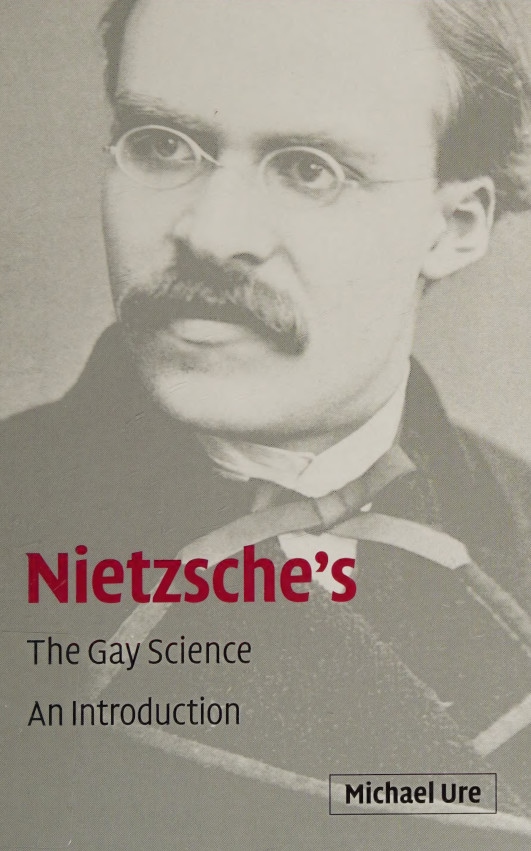
Michael Ure’s Nietzsche’s The Gay Science: An Introduction presents Nietzsche’s most intimate book as the staging ground for a philosophical experiment that is biographical without becoming anecdotal, therapeutic without slipping into self-help, and rigorously contextual without reducing aphorism to doctrine.
Ure’s point of departure is that The Gay Science is at once a philosophical autobiography and a decisive contribution to philosophy proper: a record of illness, convalescence, and recovered joy that also clarifies the fate of truth, the possibility of value after the death of God, and the form of self-cultivation that Nietzsche insists philosophy must become. The wager is that the book’s style—its numbered fragments, paratactic arrangements, swift descents into story and song—belongs to its philosophical content: it does not adorn a theory, it trains a disposition. What we encounter, in Ure’s telling, is a practice of thinking that attempts to cure a civilization of its own spiritual ailments by transforming the reader’s habits of attention, affect, and valuation. The Gay Science is, on this account, the laboratory in which Nietzsche’s major images—the death of God, eternal recurrence, amor fati, self-fashioning as a work of art—first crystallize as exercises rather than as theses; and Ure argues that only when we treat them as exercises do they take on their true philosophical weight.
The central interpretive claim is meta-philosophical: Nietzsche revives an ancient conception of philosophy as a way of life and, with it, the figure of the philosopher as physician. The Preface compresses a decade of self-experimentation into a short memoir whose explicit theme is the relation between health and philosophy, where philosophy is taken to be therapeutic in two senses at once. First, as symptom: philosophical systems are the indirect expression of health or sickness in those who devise them, and, historically, sickness has predominated. Second, as cure: a philosopher can also become diagnostician and practitioner, discerning which exercises elevate life and which merely petrify it. The Preface is thus both case history and clinical manual: Nietzsche’s own convalescence is meant to illuminate the way two millennia of European culture have mistaken certain illnesses (varieties of asceticism) for the highest health.
Ure sets this claim against the background of Nietzsche’s untimeliness. The free spirit books—Human, All Too Human, Daybreak, and The Gay Science—forsake the standard German philosophical styles of Nietzsche’s day in favor of aphorism, maxim, parable, confession, and dialogue; the sections are paratactically arranged and often resist any single unifying order beyond proximity. Rather than count against their philosophical import this form is the content: a writing that interrupts habit and obliges the reader to perform acts of self-interpretation. The notorious difficulty of extracting a “system” is not seen as a defect to be corrected by reconstruction but a function of a pedagogy oriented to address the reader’s character and not merely their assent. The “booby-trapped” text, as one famous formulation has it, does not deny philosophy; it redefines how philosophy works on a life.
Within this frame, Ure reconstructs the movement of Nietzsche’s self-therapy. In the earlier free spirit works Nietzsche had deployed ancient regimens—Cynic hardening, Stoic self-command, Epicurean moderation—alongside a cold scientific skepticism to overcome a Schopenhauerian weariness with life. The strategy was successful up to a point: a “tyranny of pain” could be countered, Nietzsche writes, by “a tyranny of pride” that refused pain’s conclusions. Yet the price of this medicine is visible in the metaphor Nietzsche later applies to himself: an “icing up in the midst of youth,” a dotage at the wrong time. What had been a cure showed its aftertaste as petrification; the calm achieved turned out to be a form of living death. It is this threshold—the recovery from the cure—that gives The Gay Science its ethos and its urgency.
The pivot is radical. The classical end of tranquillity (ataraxia, apatheia) and the modern scientific ideal of disinterested objectivity are re-diagnosed as masks of weakness. Health, in the post-classical sense distilled from The Gay Science, is not the absence of disturbance but the capacity to affirm disturbance; not the insulation of the self from fate but the intensification of a style able to transfigure fate into form. Thus the polemical edge of the reading: the ancient therapists now require therapy. Nietzsche’s slogans—“learn to love,” “become who you are”—are not romantic ornament but a countermovement against the civilizational contraction of eros and the moralization of prudence. The new physician of culture must treat the illnesses introduced by philosophy’s earlier physicians.
It follows that we read The Gay Science as a sustained recoil from two temptations that had previously been Nietzsche’s own: the ideal of Stoic hardness and the positivistic cult of “selflessness.” Science, which Nietzsche had valued for its capacity to cool passions and steady perception, now stands accused of offering the “stupidest” interpretation of the world when it absolutizes disinterest and evacuates significance; likewise, the moralized virtue of self-denial reveals itself as an “instinct for weakness” when it demands certainty and shrinks from the creative risk of valuation. Great problems, Nietzsche counter-claims, demand great love; only a thinking driven by an eros for its object can do the work philosophy requires after the collapse of metaphysical edifices. The point is to show that this does not collapse into anti-intellectualism but instead forces a revaluation of what intellectual seriousness entails once the old guarantees are gone.
This eros is given a name in the title. Ure insists on the medieval Provençal provenance of La gaya scienza: the gay science as the art of love poetry. Nietzsche, on this account, recovers the troubadour’s devotion—service to a higher, unattainable ideal—not to sanctify longing, but to reroute the energies of idealization into the fragile domain of appearance. Love, as practice, becomes philosophical askēsis: the cultivation of a taste capable of rejoicing in transience without demanding otherworldly compensation. This is why “one must learn to love,” and why the rhetoric of gaiety is not lightness but the “tragic joy” of consenting to a world without guarantees. Ure traces this move to Nietzsche’s explicit recollection of the gai saber and his claim, in Beyond Good and Evil, that European passion-love is of noble origin, a discipline in which reverent devotion displaces metaphysical craving.
The argument about eros is inseparable, in Ure’s reading, from the book’s most famous event. “God is dead,” announced under the rubric “New battles,” opens a war of spirits that Nietzsche both dramatizes and intensifies. Ure’s emphasis falls on the notion of horizon. The murder of God is not merely the cancellation of a proposition; it marks the collapse of the entire moral and metaphysical surround within which Europeans have oriented life for centuries. The madman’s parable becomes philosophically exact when read as a description of disorientation: “empty space” in place of landmarks, a sun eclipsed, the end of inherited justifications for suffering and obligation. If the shadows of God persist—morality without theology, metaphysics masquerading as science—that persistence is not a token of resilience but a symptom of fear. The event is “far too great and distant” for its meaning to be incorporated quickly; hence the task of defeating the shadows as well.
It is crucial that Nietzsche neither celebrates the collapse with glib cheer nor grieves with nostalgic pathos. The “new dawn” he sometimes invokes is conditional: it names the chance that a few free spirits might convert the catastrophe into a passage toward “great health,” while the many drift into the passive nihilism of the last men for whom the highest good is comfort. The dismantling of the Christian-metaphysical horizon thus creates a bifurcation: degeneration into satiated triviality on the one side fused with a rare intensification on the other. The Gay Science addresses itself to the latter possibility, showing what a philosophy would need to be if it were to orient life without recourse to transcendence.
From here, the analysis of eternal recurrence becomes decisive. By refusing the familiar alternatives—metaphysical thesis, cosmological hypothesis, or mere provocation—we treat the thought as a spiritual exercise: a repeated, total test of one’s capacity for affirmation. A demon announces that your life, down to its smallest detail, will recur “innumerable times.” This proposition can crush or transfigure, but only if it attains the status of conscience—if the question “do you want this again and again?” lies upon each action as the heaviest weight. In that case the thought functions not as a belief to be proved but as a discipline that reorganizes the will, reorders perception, and concentrates attention upon what is irreducibly one’s own.
The ethical content that follows is exactingly described: recurrence discloses our “ownmost conscience,” which decrees become who you are. The measure of a life becomes whether it bears one’s monogram, whether its shape is singular rather than a repetition of the average. To be forced to will the return of the non-singular is to be driven to despair; to be able to will the return of one’s form is to have achieved a kind of personal infinity, not by escaping mortality but by making a mortal life worthy of eternity’s seal. In this Nietzsche neither imitates the Stoic ascent to universality nor the Epicurean contraction of desire; he reverses the direction of ascent. The exercise fails to dissolve one’s particularity into reason’s impersonality; it intensifies singularity until it can answer for itself before the prospect of infinite repetition.
This reversal relies on an anthropology that Ure excavates from The Gay Science’s scattered remarks about consciousness. Consciousness is a late-born, socially useful surface; it evolved to register and communicate what is common, not what is singular. As such, when we translate our depths into consciousness we see primarily the average, the herd-like—precisely the aspect recurrence seeks to overcome. Hence thought must operate beneath and against consciousness’s leveling tendencies, teaching the self to detect and cultivate the phrases and subtle reliefs that belong to it alone. The discipline of recurrence is a counter-politics within the soul, a rebellion against the tyranny of the majority within.
Ure amplifies the point by connecting Nietzsche’s ideal of self-fashioning to a pre-Socratic sense of immortality: mortals inscribe themselves in a cosmos where only gods and stars are at home by producing works that deserve to endure. What Plato and the Christian tradition reserved for an otherworldly eternity—purification from the body, salvation beyond time—Nietzsche relocates into the artistry of a finite life. The eternal hourglass turns; the only available divinity is to form a life we would wish to recur. In this way, recurrence does not demands the denial of appearance but rather the intensified will to appearance: the creation of a pattern that can bear the weight of repetition.
A corollary of this ethic is the careful redescription of joy and pain. Already in Book I Nietzsche opposes the Stoic program of tranquilization with a counter-ideal: joy not as calm but as the capacity to pass through one’s own hell and find it voluptuous. Science—so often the ally of cooling and restraint—could become, Nietzsche suggests, the great giver of pain and therefore of “new galaxies of joy,” if it learned to attune itself to intensification rather than anesthesia. The ethics of The Gay Science is anti-Stoic without being merely hedonist; it sees in the greatest suffering the path to the highest affirmations, not because suffering purifies by punishment, but because only an affirmative style can transfigure the tragic into gaiety.
This is also why Epicurus undergoes revaluation. The earlier Nietzsche admired Epicurean regimen as a counter to metaphysical solace; the Nietzsche of The Gay Science, now diagnoses Epicurean modesty as a symptom of affliction. The calm surface that once seemed the sign of wise measure is reread as a fear of the sea’s depth; the happiness before the quieted ocean betrays an avoidance of the storm that alone can educate desire to affirm fate. Epicurean ataraxia is no longer the luminous middle way; it becomes one more variant of life’s shrinking, a refusal of the tragic amplitude that an affirmative philosophy must embrace.
These thematic redescriptions are tethered to The Gay Science’s internal rhetoric—its comedies and tragedies, prelude and appendix, its April-weather Preface that smells of thaw and promises the end of winter only by reminding the reader of winter’s closeness. The opening claim that modernity is on the verge of recognizing the comedy of existence (the purposelessness of nature) is not nihilism’s punchline but a staging cue: comedy must be the precondition for a new tragedy, that is, for a new moral horizon capable of restoring trust in life. The task is to write a tragedy without metaphysical guarantees, an orientation that confers purpose without transcendent purposefulness. Here too, the labor is literary: Nietzsche redeploys the ancient chreia and the Christian sermon alike, not trying to resurrect their content but redirecting their force.
The same dual fidelity—literary and philosophical—governs Ure’s account of “Shadows of God.” The parable of the madman is not to be read as atheism’s slogan, but as a spiritual topography: an eclipse whose rays will take centuries to arrive. The catastrophe, to be clear, is not the loss of belief as such; it is the exposure of an entire style of valuation that had organized meaning. Hence the double demand: to unlearn the comforts by which metaphysics disguised fear as knowledge, and to invent new horizons that can orient action without lying about the world. There’s the pitfall on both flanks: a relapse into surrogate metaphysics (including a positivism that worships certainty) or a slide into the contentment of last men. The physician of culture prevents both: not with new dogma but with the training of tastes, affects, and judgments capable of bearing truth without consolation.
From this vantage, Ure’s Nietzsche is precise about what science cannot do: it cannot create values; it cannot by itself supply ends. Its greatness lies elsewhere—in discovery, in method, in discipline—but the question of what life is worth and how it is to be formed falls outside its remit. If modern culture places upon science the metaphysical burden of providing orientation, it both overstates science and evades its own task. The creation of values is an aesthetic-moral labor, and The Gay Science is best seen as a pedagogy designed to reawaken that labor in a disenchanted world.
If this pedagogy is aristocratic, Ure neither denies nor romanticizes the fact. Nietzsche speaks, especially in the fifth book, of a “superabundant” or “great” health that is the preserve of few, and he allows the political consequence: a culture may be measured by whether it can cultivate higher types instead of mechanically protecting the many at the expense of the few. Ure is discriminating in drawing the division between a diagnosis of cultural leveling and any crude social doctrine; nevertheless, he rightly foregrounds the fact that The Gay Science does not disguise its elitism. Its ethic is addressed to those for whom the loss of transcendence is an opportunity to become more exacting about what a life can be.
It is in this context that the treatment of self-fashioning acquires its full philosophical resonance. To “become who you are” is not a given license for expressive individualism but an austere imperative: to transform contingency into a signature, accident into necessity, by composing a form that could withstand the test of recurrence. The artist of life must be “wiser than artists,” Nietzsche quips, because the canvas is not separate from the living; what artists do with pigment, philosophers of life must do with conduct, temperament, vocation, friendship, even through suffering. It forms an aesthetics of existence in the strict sense: the form is your biography.
The gain of Ure’s study is to show how these claims belong together without collapsing into a system. The unity is practical, not theoretical. It runs from the meta-philosophical conviction that philosophy is a medical art, through the revaluation of ancient therapies, the exposure of modern scientism’s limits, the erotic pedagogy of the gai saber, the event of the death of God and its horizons, to the exercise of eternal recurrence as the conscience of self-cultivation. The figure holding the whole together is the philosopher-physician who, by curing himself of disease and cure alike, discovers the regimen appropriate to an age after metaphysics. The Gay Science is the bedside manual and the patient’s chart.
One might be tempted to ask whether the promise of “tragic joy” is anything more than a refined stoicism or a veiled romanticism. The answer is that Nietzsche’s antidotes are inscribed within the very excesses that stoicism denied and romanticism absolutized. The stoic refuses tragedy by suppressing passion; the romantic worships tragedy by enthroning it. Nietzsche does neither. He keeps pain in play as the vestibule of intensification, and he disciplines excess through form and not through negation. The result is a conception of joy that neither anesthetizes nor intoxicates, but affirms. The demand that one learn to love is therefore neither sentimental nor mystical; it is the most stringent asceticism of all: to will the recurrence of what one did not choose, because one has made oneself equal to it.
At the level of exposition, Ure’s prose is notably lucid without flattening the text’s ambiguities. The art of an introduction in this series is to be useful to novice and scholar alike; Ure accomplishes this by refusing to simplify what makes Nietzsche’s book difficult, while constantly clarifying why the difficulty matters. He keeps the interpretive focus on the book’s distinctive form—its aphorisms, prelude of rhymes, appendix of songs—without lapsing into commentary on individual chapters; and he situates the free spirit books in the intellectual field that shaped them without making The Gay Science a mere echo of influences. The result is an introduction that earns its claim to be both the best entry point for new readers and a provocative summary for those who have long inhabited Nietzsche’s labyrinth.
If there is a single sentence that condenses Ure’s ideas about The Gay Science and its place in Nietzsche’s itinerary, it goes like this: philosophy, to be credible after the death of God, must renounce the fantasy of doctrinal peace and become a discipline of self-transformation capable of producing forms of life that can rejoice in truth’s inhospitality. The book teaches this lesson performatively. It disorients to orient; it denies consolation to force invention; it breaks in order to make; it makes in order to be able to break again. What begins as a memoir of illness becomes the matrix in which a reader might be enabled to recover. The promise surpasses happiness as comfort and gives the possibility that existence, with all its tragic conditions, can be affirmed without illusion—that one can, at last, step into the void.
In restoring this book to the center of Nietzsche’s project, Ure implicitly reframes Nietzsche’s later achievements. Thus Spoke Zarathustra no longer appears as a sui generis eruption; it is the next movement after the experiments of The Gay Science, the poetic elaboration of exercises first rehearsed in aphorism. Likewise, the later critiques of morality and the genealogies of ressentiment and ascetic ideal take their bearings from a therapeutic horizon set here: a new art of living to replace the old metaphysics, a tragic gaiety to overcome nihilism without denial. Ure’s given contribution is to make that horizon visible in the place where Nietzsche himself tried to see it first: in a life endangered by its own medicine, then saved by a new practice of philosophy.
What the book finally offers, then, is a rigorous demonstration that Nietzsche’s most “personal” writing doesn’t retreat from philosophy but rather stages its renewal. By tracing the delicate links between biography and doctrine, ancient therapy and modern crisis, rhetorics and ethics, Ure shows how The Gay Science becomes philosophy’s hinge in Nietzsche’s corpus: the site where the death of God is reckoned as existential event, where science is put back in its proper place, where eros is rehabilitated as a principle of cognition, where recurrence is turned from cosmos into conscience, and where the philosopher-physician discovers a regimen fit for today’s godless world. In doing so he returns to philosophy a task that modernity had forgotten how to undertake: avoiding to explain life from above, yet increasing its powers from within.
If one seeks an introduction that both honors the strangeness of Nietzsche’s gaiety and equips the reader to traverse it, one could hardly ask for more. Ure neither domesticates nor sensationalizes; instead he lets the book’s April weather blow through, bringing thaw and contradiction together, winter near and victory nearer, until the reader has learned, with Nietzsche, to prefer the perilous clarity of a sun that has no beyond to the comfort of shadows that no longer warm.
 Simon Gros
Leave a comment