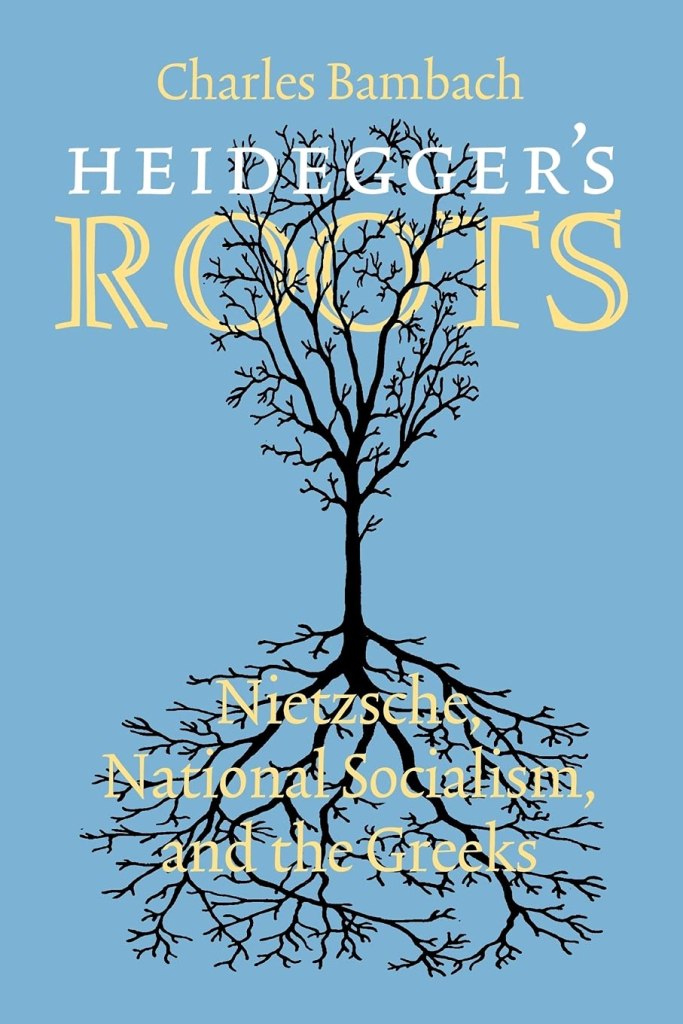
What Charles Bambach examines in Heidegger’s Roots: Nietzsche, National Socialism, and the Greeks is not yet another catalogue of incriminating biographical episodes nor a gesture of apologetic compartmentalization, but a tightly wound reconstruction of a discursive field—linguistic, philological, philosophical, and political—within which Martin Heidegger’s thinking from 1933 to 1945 was composed, staged, and made to resonate.
The book proceeds from a methodological refusal of the simplest question—was Heidegger a Nazi?—in favor of the more exacting (and therefore more perilous) inquiry: what kind of National Socialism did Heidegger seek to sponsor philosophically, how did this project structure his choice of interlocutors and texts, and to what extent did his signature vocabulary—Bodenständigkeit (autochthony, rootedness) and Selbstbehauptung (self-assertion)—carry an ontological charge that could be converted, with little friction, into a political metaphysic of Volk, homeland, and the Greek arche?
The wager of Bambach’s book is that reading Heidegger’s texts historically—paying attention to their occasions, to the rhetorical scenery of speeches, lectures, and memorials, and to the submerged polemics with other figures on the German right—makes visible a persistent grammar of belonging whose philosophical dignity is inseparable from a geo-political imaginary. The result is a description of Heidegger’s “roots” that is deliberately problematic, even convolutional: it is a story of a philosopher who aesthetically sacralizes the hut and the field path, but does so in order to authorize a vision of the West’s destiny that privileges a Graeco-German axis, transforming philology into fate and landscape into mandate.
Bambach’s preface is explicit about the shift in the problematic. Rather than measuring Heidegger against a flat list of party allegiances or personal disavowals, he proposes to “situate” the work within the generational context of post-World War I German right-wing thought, and, more pointedly, to focus on the way the terms Bodenständigkeit and Selbstbehauptung function as philosophical operators in the 1930s and early 1940s, drawing energy both from the Weimar cult of roots and from a myth of Greek beginnings.
His insistence is philological and temporal at once: a text from 1933 cannot be read as if it were 1938 or 1942; the same lexeme shifts valence as the war, the universities, and the ideological terrain shift; and the scholarly archive of interlocutors must include, alongside the canonical Greeks and German classics (Hölderlin, Hegel, Nietzsche), the ideologues and professors of the radical right (Baeumler, Krieck, Hildebrandt, and others) because their vocabulary saturates the horizon of legibility within which Heidegger is writing. The question becomes less politics in philosophy or philosophy in politics? than the more technical one: by what specific semantic and rhetorical relays do ontological claims about truth, earth, physis, and technē become, without remainder, a politics of soil, people, and historical mission?
The image-event that anchors Bambach’s reconstruction is the “hut.” The Todtnauberg cabin does not merely serve as scenery or biographical color; it operates as a dispositive that welds solitude, work, seasonal time, and a disciplined asceticism of language into a visible icon of rooted thinking. The much-cited radio address “Creative Landscape: Why Do I Stay in the Provinces?” (written autumn 1933; delivered March 1934) is thus not mere pastoral ornament but a programmatic paper in which the “gravity of the mountains,” the “hardness of their primeval rock,” and the “slow and deliberate growth of the fir trees” are transposed into a grammar of severity (Härte) and Schwere, a rhetoric of patience and resistance whose lexicon already belongs to the politicized pathos of the interwar right.
In Bambach’s reading, the speech stages a Hölderlinian Volksreligion of homeland, binding the German Volk to an archaic Alemannic soil while at the same time insinuating a private, Freiburg-style National Socialism that rejects crude biologism yet converts the earth into a principle of selection and rank. The hut is not merely a dwelling; it is a relay station where landscape becomes work and work becomes “mission,” such that what the peasant accomplishes with sled and shingles, the philosopher is to accomplish with concepts: to embed the course of thought in the temporality of a place, and thereby claim place as the silent authorization of thought’s rank.
This is why Bambach insists that the apparently “anti-political” topoi of field path, jug, cabinetmaker, meadow, or woodcutter—On the Origin of the Work of Art, the Hebel lectures, and later Gelassenheit—cannot be read as mere ethnographic color or nostalgic tableau. They are the melodic line of a deeper bass: a persistent thematization of earth and homeland which, in the 1930s, is articulated as Bodenständigkeit and presented as a necessary condition for any “originary” thinking, and which, precisely because it rejects the vulgar racism of Blut as metaphysically superficial, can claim the more spiritual rigor of an “autochthony” whose privilege is ontological, not biological. Thus, if “race-breeding” belongs to the metaphysics of subjectivity and domination, autochthony—rootedness in a unique soil and an originary relation to Greek inception—can be advanced as the non-biologistic ground of a German claim to determine the course of the West’s history of being. In Bambach’s formulation, this spiritualization does not neutralize the politics of exclusion; it refines them. A “politics of the arche,” rather than of blood, divides insiders from outsiders by proximity to the Greek beginning and to the native earth that is said to echo it.
No text concentrates these relays more compactly than the 1933 Rectorial Address, Die Selbstbehauptung der deutschen Universität. Bambach’s analysis insists on its palimpsestic structure: Plato beside Clausewitz, Fichte beside Schlageter, Nietzsche beside Hitler; a discursive surface whose layers are not reconciled so much as superimposed to produce an epideictic dizziness. Here Selbstbehauptung is not defined in a scholastic manner; it is performed through a cluster of cognates—Selbstverwaltung, Selbstbesinnung, Selbstbegrenzung—that gesture toward an active, martial will, and is then explicitly tethered to Nietzschean will-to-power and the “historical spiritual mission” of the German people.
The rector is seen not as a primus inter pares who tends collegial equilibrium but as a Führer whose headship gives the university a single will, so that “science” may be re-founded as philosophia, and philosophia as the organ that hears the command of destiny. It reaches administrative doctrine and forms a metaphysical dramatization of rank in which the university’s essence must be willed into power as the “will to the essence” of science converges with the will of a people that knows itself “in its state.” The rhetorical economy is Nietzschean through and through, but it is Nietzsche in Freiburg uniform: the arsenal of Wille, Kraft, Macht, Kampf, Gefahr, Not, Schicksal aligned to authorize a collective self-assertion under the sign of an inaugural rupture that is, at once, return to arche and preparation for decision.
What Bambach names the pastorale militans comes into sharp relief once the “Creative Landscape” address is read together with the Schlageter cult and with the early-1930s re-sacralization of hardness and sacrifice. The same lexicon that attaches to mountain and fir—Härte, Schwere, Urgestein—is made to bind language, landscape, fallen comrades, and Greek origin into a single circle of affinity. The hut’s measured solitude thus arches over a new program in which the Alemannic soil, the German language, and the Greek arche mutually mirror and legitimate one another, underwriting a politics of elevation through rootedness. The result is a Volks-liturgical hymn in which the “power of the old ground” is invoked as if it were simultaneously geological and philological: a ground on which one stands and a ground from which one speaks, both taken to be prior to, and superior to, any merely juridical or cosmopolitan construction of the political.
Bambach’s insistence on reading across genres—university speeches, classroom lectures, public addresses, condolence letters—proves decisive once the war has shifted the horizon of plausibility. The long semester of 1942/43, devoted to Parmenides, is not read as a regression back into antiquity but as a philosophical sortie aligned with the German struggle at Stalingrad: a synchronized double movement in which the “destiny of the West” is asked whether it can still take its bearings from a Greek beginning that would rescue it from decline.
The questions put to the Eleatic fragments—Is the Occident at an end? Are the inaugural potencies exhausted? Can the hidden power of arche be re-awakened?—are not academic. The battlefield and the classroom mirror one another because each is staged as a campaign over the interpretation of history as aletheia: a struggle about concealment and unconcealment in which the German-Greek alliance is cast as custodian of disclosure against the leveling domination of technē. When defeat becomes irreversible, the idiom turns elegiac without loosening its structure: Romanization is re-named as the larger arc of decline; Nietzsche’s radicalism is re-coded as another vector of nihilism; and the same autochthonic myth is transposed from political to ontological key, as if an inner emigration of semantics could preserve the privilege of rootedness while disowning the party’s machination.
Even here, Bambach’s claim is not that the politics evaporates. It is rather that the politics is redescribed as the ontology of earth—chthōn—and of nearness, so that Achilles’ words over Patroclus could be glossed as a meditation on “being hidden in Hades” and thereby turned into a figure for burial-as-belonging, where the ground shelters what arises and the homecoming of a people is coded as a return to the site of unconcealment. Such philological metaphors do real political work: they authorize a narrative in which war and mourning are sublimated into a metaphysics of place, the fallen soldier becoming the witness of a primordial reciprocity between earth and people. The “German mission” is not renounced; it is translated into a more rarefied register, purged of the crudities of race so that its exclusionary structure can be maintained under the sign of aletheia and arche.
The Greek hinge is essential to Bambach’s account. He engages the Athenian myth of autochthony—children of the earth who therefore claim a unique right to rule—and traces how Heidegger, while explicitly disavowing “race” as a calculus of subjectivity, reproduces its logic in spiritualized form: the “right” to speak for the West comes from being nearer to the first beginning. The preference for Athens over Jerusalem, physis over nomos, and for a narrowly construed Graeco-German genealogy over the ecumenical teachings of Hellenic and Hebraic traditions, is not an innocent historiographical decision, but a political ontology disguised as reception history. To say that Germany stands alongside Greece as co-combatant in the battle for essence is to articulate a standard of rank whose criterion is philological nearness to origin, measured in the idiom of earth and language. It is in this sense that Bambach’s reading renders autochthony as the nerve of the whole construction.
One sees then why the Rectorial Address, far from being an embarrassing aberration, functions in Bambach’s argument as a manifesto of method. The university is the laboratory in which Wissenschaft is purified into philosophia and fitted to the mission of the people, and where Nietzsche’s crisis-narrative—the death of God as the terminal formula of Western metaphysics—is adopted as the drama through which the present can interpret itself as threshold (Übergang). The language of danger and necessity, heroism and fate is not rhetorical surplus since it points to the idea that only a people that wills its essence through a leader can traverse decline by going back to the beginning. Thus the Humboldtian collegium gives way to a theology of command, and the logic of Selbstbehauptung condenses a set of decisions: against bureaucratic drift, against the liberal ideal of universal principles, against the urban cosmopolitanism of Weimar, and for a re-founding of knowledge on the terrain of origin. Bambach’s point is that these “decisions” are formalized in language rather than merely asserted as formal theses, so that the discourse itself functions as a rite of self-election.
Bambach’s chapters on the Nietzsche lectures elaborate the same structure under wartime pressure. Up through 1942, National Socialism is seen, in Nietzsche’s categories, as a possible counter-movement to the active nihilism of Anglo-American democracy and Soviet Communism—a way to organize modern energies without surrendering to the planetary will-to-dominion. The war then reveals the machine-truth of the regime, and the critique pivots: now National Socialism is read as another modality of machination. But the deeper pattern remains: the Graeco-German couple is maintained as the “secret Germany,” the mission recoded as ontological, and the typology of enemies—rootless technē versus autochthonic truth—remains intact. The consequence is not political evacuation but a semantic transposition that preserves the structure of ranking and exclusion under the sign of philosophy.
Bambach’s account does not end in 1945. He reads the postwar Memorial Address and the cycle of Hebel talks as the articulation of a “new autochthony,” in which the threat of rootlessness is blamed on the age’s calculative spirit and atomic technicity while the remedy is sought in a releasement that would let mortals “blossom in the ether” only insofar as they are first rooted in the native soil. The vocabulary is explicitly botanical—“we are plants”—and the diagnosis existentially generalized: displaced persons, agribusiness, demographic shifts, and Cold War dislocations are gathered into a single narrative of loss that can be “transformed into gift” by a tradition of faithful commemoration. The earlier militarized pathos is softened, but the structure persists: autochthony is again the condition for any genuine work; homelessness is again the danger that only a new relation to the homeland can cure. What has changed is the strategy of legitimation: political exaltation gives way to ontological pedagogy, but the same nearness to arche authorizes the same vocation.
It is tempting to ask whether Bambach does not, in exposing the metaphysical politicization of landscape, risk reproducing the very elevation he describes—granting to the rhetoric of earth a tighter coherence than it sometimes exhibits in practice. But the strength of his book is precisely its refusal to homogenize. He repeatedly marks Heidegger’s disagreements with “official” party doctrine—his rejection of biologism, of politicized “science,” of Rosenberg’s bureaucracy, of occultist kitsch—and nonetheless shows how a purer, “Freiburg” National Socialism could be advanced from within the language of origin, severity, sacrifice, leadership, and destiny. The hut is not the party office; the philological seminar is not the gauleiter’s platform. Yet both are disposed toward the same end: to reserve the West’s future for those who can claim the nearest proximity to the first beginning, and to figure that proximity as a relation to earth and speech, thus recoding racial exclusion as philological election. That this recoding is subtle only increases its reach.
The book’s hermeneutic wager—read historically, tracking interlocutors, following the words down into their rhetorical and political sediments—pays off especially when Bambach sets the celebrated pages against their occasions. Thus the peasant shoes in Origin of the Work of Art are not merely an anti-museum polemic; they are a cipher in a larger chain—soil, shelter, equipment, earth—by which the hidden source of beings (physis loves to hide) is made to reverberate with the claim that only a rooted people can gather the strife of earth and world into truth. Thus the attacks on “asphalt urbanism” and “cosmopolitan universalism” are not prejudices of taste; they map a consistent hostility to any political form that levels the “curvatures of the mountain path into the flattened boulevards of the metropolis.” Thus the invocations of poets and pre-Socratics are not mere erudite resources; they are instruments of rank assignment within a European space re-imagined as Mitteleuropa, with Germany as custodian of the arche against the Roman-Latin tendency to dominate via law, empire, and technique. In each case, Bambach’s method converts aesthetic topoi into political operators by showing where and how they are deployed in proximity to speeches, letters, battles, and curricular decisions.
One effect of this reading is to make the “ontological turn” after 1938 look less like a renunciation than a re-coding. Bambach does not deny real shifts; he charts them with care. But he insists that the continuity of structure—autochthony as criterion, Greek origin as measure, leadership as form, sacrifice as mood—persists through stylistic transformations. After the disillusionment with party machination, political autochthony recedes while ontological autochthony steps forward, but the claim of privilege remains: the task of saving the West still falls to those who can “bind themselves back to the gods” by returning to the earth of the homeland through the language that guards the beginning. In this way, the philosophy of being disseminates a politics of belonging without ever needing to pronounce it as policy.
What, then, is distinctive about Bambach’s contribution, given the “flood” of work on Heidegger and Nazism? It is not the accumulation of new archival scandal, nor the soothing division between early metaphysics and later poetry. It is the analytic threading of four lines that are usually kept apart: (1) a philology of Greek and German sources attentive to the Athenian myth of autochthony; (2) a rhetorical analysis of Heidegger’s own self-presentation (hut, field path, peasant lexicon) as a politics of style; (3) a contextualization of university speeches and lectures among the contemporary attempts to give National Socialism a philosophical ground; and (4) a long arc from 1933 to the late memorial addresses that shows the metamorphosis of the same structural commitments. The upshot is an interpretive map on which “the roots” are not an innocent metaphor but a program of selection, a means for deciding who may speak for the West by claiming to stand nearer to its source.
If one adds to this map Bambach’s insistent attention to the counter-voices—Bloch’s diagnosis of the pastorale militans, the philhellenism of the Weimar classicists, the debates among right-wing professors about the essence of science—what emerges is less an indictment than an anatomy: a way of seeing how the desire for origin, severe in its discipline and lyrical in its attachment to place, could become the grammar of a politics that outlives the uniforms and slogans by taking shelter in the very concepts with which philosophy thinks. That is why the book’s description feels deliberately problematic and complex. It does not permit the reader to rest in a snap judgment; it obliges one to follow how metaphors become mandates, how images become institutions, how philology transmutates into the perception of destiny. And it leaves us with a question that it knows it cannot simplify: whether a thinking of earth and origin can be redeemed from its twentieth-century complicities without renouncing the very criteria—of nearness, rootedness, and guardianship—by which it recognized itself as thinking.
Seen in this light, Heidegger’s Roots is not only an “essential reference” for debates about Heidegger’s politics; it is a case study in the migration of concepts across the halls of academic disciplines and into the blood-sea of the collective self-understanding. Its philosophical relevance is not in any esoteric exegesis of fragments but in the concrete demonstration that a grand vision of German destiny “rooted in the soil,” and privileging an originary connection to the Greeks, can be argued in the idiom of ontology and enacted in the space of the university, while inflecting the very criteria by which “the West” imagines its past and future. To mark this is already to complicate our pregiven conceptions. It is to concede that the elegies of aletheia, the polemics against Romanization, and the invocations of poets are not detachable ornaments but the very form in which a politics of autochthony continued to justify itself—first as revolution, then as recollection, always as vocation.
Bambach’s description is thus deliberately problematic because the object demands convolution: a merger of historical punctuality and conceptual continuity, of textual minutiae overlapping with local and geopolitical fantasies, of the peasant’s hut and the philosopher’s podium, of Stalingrad’s ice and Parmenides’ path. The result is not verdict but a map; not catharsis but a way of reading. If one takes that discipline seriously, one cannot easily undo what it discloses: that in Heidegger’s corpus between 1933 and 1945, the language of earth does not sit next to politics; it is a politics—the politics by which a people is told to hear its essence in the rustle of firs and the cadence of Greek, and to recognize in that hearing the law of its future.
 Simon Gros
Leave a comment