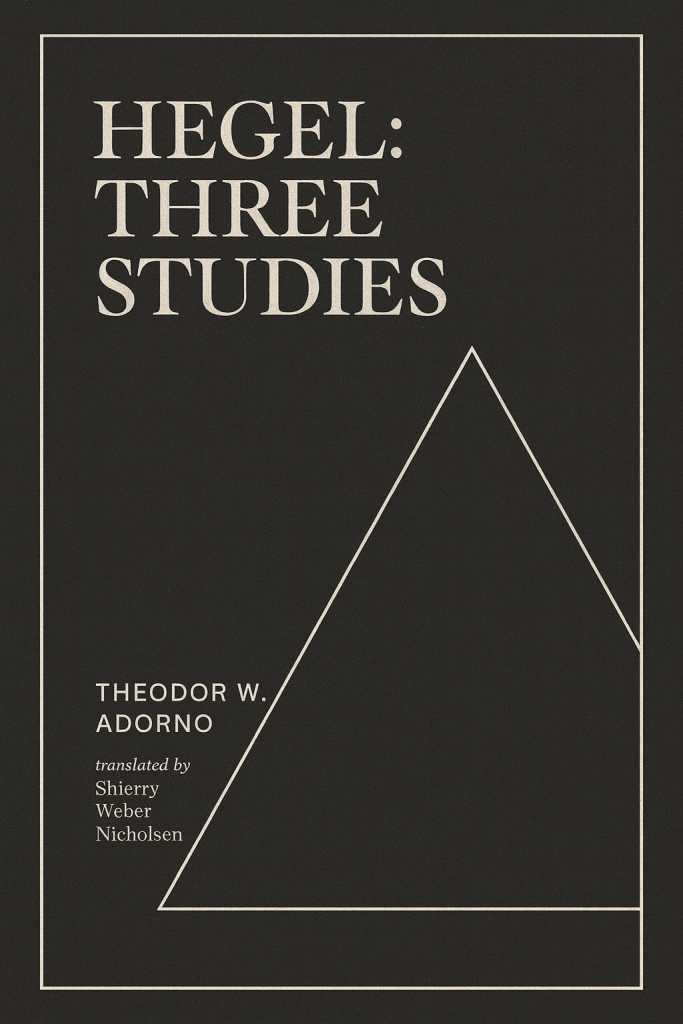
Theodor W. Adorno’s Hegel: Three Studies arrives in English as a carefully structured intervention into the legacy of German Idealism and into the present of critical theory. Appearing in the MIT Press translation by Shierry Weber Nicholsen, with an introduction by Nicholsen and Jeremy J. Shapiro, the volume collects three essays—“Aspects of Hegel’s Philosophy,” “The Experiential Content of Hegel’s Philosophy,” and “Skoteinos, or How to Read Hegel”—that Adorno originally composed between 1956 and 1963; the German text of the studies was issued by Suhrkamp (1963; 3rd ed. 1969). In the American edition the front matter marks the project’s portable architecture and its pedagogical ambition, identifying the translators, the editorial genealogy, and the series frame (Studies in Contemporary German Social Thought), while also recording Adorno’s own note that the work as a whole intends a preparation for a revised conception of the dialectic. The editorial record is not incidental: it situates Adorno’s return to Hegel within Frankfurt pedagogy and the ongoing dialogue with Max Horkheimer, while reminding the reader that the first study once appeared under the Minima Moralia watchword, Das Ganze ist das Unwahre—a maxim whose polemical force powerfully directs the volume’s critical gestures toward totality, identity, and reconciliation.
The three essays constitute neither a neutral survey nor a merely historical exercise. Adorno does not appraise Hegel from a critical distance secured by the contingencies of posterity. He expressly repudiates any commemorative appreciation that would pretend to adjudicate, from above, what remains “alive” and what is “dead” in Hegel. The question, he insists, is not what Hegel means for us, but what we mean in the face of Hegel: whether modern reason has not already regressed behind the ambition and risk of Hegel’s speculative project. It follows that the measure of Adorno’s reading is not academic equity or eclectic balance; it is Hegel’s claim to truth, met by immanent critique rather than by external correction. The result is a sustained effort to wrest from Hegel the elements of a dialectic that refuses ideological closure yet does not celebrate indeterminacy for its own sake.
Adorno’s starting point is uncompromising. Hegel cannot be recovered by extracting a set of “concrete” observations from an allegedly obsolete idealism; Hegel’s most capacious insights arise through his speculative posture, not in spite of it. The well-worn opposition between an abstract idealism and a richly empirical realism collapses in Hegel’s practice. In Adorno’s presentation, the speculative identity of the a priori and the a posteriori—rather than being an extravagant thesis—names the motor of Hegel’s critique of both rigid apriorism and naïve empiricism. Speculation, here, does not adorn a body of empirical findings; it generates the very intelligibility of social and historical antagonisms by submitting them to a labor of conceptual mediation that is itself historically and socially saturated. It is precisely because Hegel binds form and content in the labor of the concept that he can bring “infinitely more concreteness” into thought than approaches which—positivist or anti-positivist—rest on a dogma of immediacy.
This turns Adorno toward what he calls the experiential substance of Hegel’s philosophy. The phrase is exacting: he does not inventory “experiences” that happen to appear in Hegel; he isolates the mode in which Hegel’s philosophy becomes experiential—how it acknowledges that any critique adequate to its object must appropriate its object’s own mediations. Hegel’s project thus abolishes the rigid separation of the a priori and the empirical inherited from a long classical tradition through Kant; instead it compels philosophy to appeal to “material moments originating in the real life process of socialized human beings” as essential rather than incidental to the formation of concepts. This is not a romantic slide into the particular; it is the necessity of content that arises from the self-critique of a merely formal epistemology. Adorno is explicit: the turn to content is not a retreat from rigor but the result of epistemology’s own exhaustion when it seeks cogency without object. The speculative synthesis, as Hegel names it, is the form in which philosophy accepts a duty of concretion that science—under the banner of valid and watertight findings—prohibits, and that so-called new metaphysics disavows under a rhetoric of protecting “being” from “beings.”
“Aspects of Hegel’s Philosophy” gives this program its first sustained pressure. Adorno begins from the scandal of Hegel’s alleged affirmation: the equation of the rational and the real, the systematic identity of subject and object. At the level of ideology, this seems to accomplish reconciliation by decree. Adorno does not deny the scandal; he intensifies it. He proposes that Hegel’s system—under the guidance of its speculative identity—performs a critique of “what exists,” namely of positivity as such, more radical than Hegel’s critics allow. The paradox is central: as the system follows its own logic into untruth, this failure is not merely a failure of a thinker; it is an index of the reality that supplies the system’s content. Hegel’s “contempt for the facts” (the positivist caricature) becomes, in Adorno’s rendering, the expression of what the facts are actually like—contradictory, antagonistic, and hostile to the promise of reconciliation they nevertheless invoke. The world that claims to be justified is indicted as a “web of guilt,” and the dialectic’s vocation becomes the determinate negation of that positivity in and through its own categories.
This yields one of Adorno’s most consequential reframings: antagonistic totality. The point is not to celebrate totality in the manner of a restored metaphysics nor to reduce everything to a static “whole” that subordinates the parts without remainder. Rather, Adorno argues that Hegel’s true descriptive power lies in grasping a modern social reality that is total only by virtue of its contradictions. In that sense, the “system” becomes the concept of a society comprehensively organized by exchange, production, and domination, whose integration demonstrates the “primacy of the whole over the parts” not as harmony but as the impotence of each individual vis-à-vis an objective nexus. If Hegel’s reconciliation in right and state is false, it is because it announces as achieved what a radically socialized order has accomplished as coercion: a totality that lives from fragmentation and persists only in and through unresolved antagonisms. Adorno’s counter-intuitive claim is thus dialectical: the most infamous moments of Hegel’s Philosophy of Right derive from an honest consciousness of civil society’s insoluble contradictions, the recognition that no purely immanent movement of that society can overcome its antagonistic structure.
From here Adorno can specify the peculiar critical energy of Hegel’s identity-philosophy. The system’s own logic—as it presses its synthetic identity to the limit—forces a disclosure: nonidentity erupts within identity as the very truth of the object that identity seeks to sublate. The dialectic, thus understood, does not sponsor the pacifying synthesis beloved by caricature; it returns the subject to the object’s resistance. To name this resistance is to insist that the concept confront its object with the object’s own concept—its own rationality—and thereby expose reality’s pledge to death so long as reconciliation remains unreal. The determinate negation that results is not a negation from above; it is criticism housed within the immanent contradictions of social objectivity. In this sense, Adorno’s Hegel is “essentially negative”—but now negativity is no longer a mere method; it is a historical index of what social experience has become in the administered world: one-dimensional, quantifiable, and yet threaded by fractures that thought can neither ignore nor smooth away.
It is precisely on this terrain that Adorno develops his reading of Hegel’s “labor of the concept” (Arbeit des Begriffs). The power and scandal of Hegel’s speculative identity cannot be understood without recognizing that “labor” here is not a metaphor for mental exertion alone. It is the pressure of social labor—the structured activity through which objective spirit incessantly reproduces itself—that appears, in speculative logic, as the motor of conceptual movement. In other words: absolute spirit is not a supra-historical hypostasis; it is society interpreted at the level of its universality. Adorno’s inversion is as subtle as it is forceful. He does not simply “apply Marx to Hegel”; he displays how Hegel’s own speculative logic, read against the grain, shows the concept as the site where social labor and contradiction register themselves. This is why the dialectic can never be merely a technique; it is an index of the way in which objectivity’s antagonisms solicit conceptual transformation.
In the second study, “The Experiential Content of Hegel’s Philosophy,” Adorno translates that structural insight into a philosophical account of experience that neither collapses into empiricism nor evaporates into idealist formalism. He begins by specifying his object: not “content” in Hegel in the additive sense, but the attitude of thought to objectivity that Hegel’s practice models. What follows is an analysis of the Kantian inheritance—above all, of the synthetic a priori—that emphasizes the intrinsic instability of any form/content division that would anchor certainty in pure form. If the synthetic a priori is truly a priori, it cannot contain novelty; if it is truly synthetic, it requires the content that Kant relegates to contingency. Hegel’s advance is to insist that form and content are “essentially mediated by one another,” from which it follows that epistemology, as a purely formal enterprise, negates itself if it tries to secure cogency without object. The consequence is not skepticism; it is a philosophical turn toward content—toward the formulation of experiences in their necessity—that issues from epistemology’s own self-critique.
The stakes here are both speculative and historical. By abolishing the rigid a priori/a posteriori partition, Hegel obliges philosophy to accept the duty to incorporate “material moments” from the real life-process, not as illustrations but as constitutive of conceptual articulation. The move is the exact opposite of a retreat into immediacy. Adorno stresses that Hegel neither worships the given nor abandons critique to the claims of intuition. Instead, Hegel’s “Baconian” confidence in knowledge—his declaration that the “sealed essence of the universe” cannot withstand the spirit’s demand—becomes, in Adorno’s hands, the determination to refuse resignation to the tyranny of administered facts while acknowledging how those facts permeate, and deform, the possibility of intelligibility. The result is a speculative practice that treats experience as mediated through and through, and nonetheless maintains the hope that experience can be articulated without capitulating to the poverty of immediacy.
It is in this intensified sense that Adorno coins and secures “antagonistic totality” as the key to Hegel’s realism. The realism at issue is not an appeal to pure givenness; it is the acknowledgment that the logic of Hegel’s system is saturated by what society has become—a totality by virtue of contradiction—and that the dialectic’s negative force is the only honesty adequate to this situation. To say that “civil society is an antagonistic totality” is not to convert Hegel into a sociologist avant la lettre; it is to register the way in which the Science of Logic and the Philosophy of Right disclose, under pressure, that modern objectivity is a rationally administered and irrationally destructive integration of moments under the primacy of exchange and production. That the powerless individual becomes the truth of the system’s “primacy of the whole” signals less a reconciliation than the precise opposite: a diagnosis of unfreedom that the dialectic names without endorsing.
Adorno does not treat this as an exoneration. When the system, under its own maxim of identity, subordinates the particular to the universal and equates the real with the rational, it is committing a tour de force: it suspends the dialectic at precisely the point where the dialectic’s consistency would drive beyond what exists and thereby negate the thesis of absolute identity. Hegel’s own argument flirts with nonsense where it comes closest to society’s truth, and the resulting violence of unity shows why theodicy collapses into condemnation. But precisely here, Adorno detects a utopian ray: to indict the whole as untrue is also to preserve the demand—now explicitly denied by reality—that reconciliation be not merely ideational but embodied. That “what exists deserves to perish” (Adorno’s allusion to Faust) becomes, then, a metonym for determinate negation’s ethical pull: the world cannot be justified by concept or system, and the denial of justification is the negative index of a reconciliation still to be realized.
The third study, “Skoteinos, or How to Read Hegel,” is at once methodological and pedagogical. It bears the marks of Adorno’s Frankfurt seminars devoted to Hegel and Kant, and it takes up a problem that hides in plain sight: clarity. Against a Cartesian demand that truths be distinct, perspicuous, and under the sovereign control of a subject, Adorno argues that philosophical intelligibility cannot be identical with stylistic transparency, because the object to be thought—the dialectical, nonidentical, antagonistic—resists such presentation. Hegel’s texts, in this light, are “antitexts”: they refuse the false harmony of exposition, because “nothing can be understood in isolation, everything is to be understood only in the context of the whole,” while “the whole in turn lives only in the individual moments.” The literary medium necessarily fails such doubleness. Every sentence in Hegel thus becomes “unsuitable for that philosophy”—not because it is poorly written, but because no finite formulation can secure the simultaneity of whole and part that the matter demands.
This critique of clarity is not indulgence. It entails a positive account of reading: “simply looking on” (reines Zusehen) and “reading against the grain.” The reader must undertake a participatory following-through of Hegel’s movement, a “speculative ear” that tracks the curves of the argument as though they were musical lines, neither surrendering to vague empathy nor imposing preconceived schema. The text expects “productive imagination” of the reader, not as subjectivist license but as the correlate of the object’s mediated character. Language itself is double—expressive and communicative—and the demand to communicate dialectical truth without falsification confronts a paradox: to say clearly what does not lend itself to reification. Adorno’s defense of the obscure—of Skoteinos—is thus a defense of objectivity against a bad subjectivism that confuses intelligibility with procedural lucidity.
Adorno deepens this pedagogy by recalling H. G. Hotho’s portrait of Hegel lecturing in Berlin, his “metallic-empty voice” with a Swabian accent, his faltering starts and rigorous emphasis on each syllable, the laborious movement by which a thought circles its object, splits into distinctions, and compels re-unification. The point is not anecdotal. It is a figure of what Adorno elsewhere calls self-divestiture: the philosopher’s self effaces itself in the effort to present the object, the labor of spirit consuming its bearer as it tries to do justice to the nonidentical. In this sense, the style—its difficulty, its repetitions, its refusal of closure—is not a failure to communicate; it is the nearly impossible attempt to allow the concept to mimesis, to let it murmur with what Adorno calls Rauschen: the rustle in which language’s indistinct logic imitates the movement of the real.
What unifies the three studies, then, is not a doctrine but a stance. First, the refusal of an external critique that would treat Hegel’s system as an edifice from which portable elements can be salvaged. Second, the insistence that Hegel’s speculative ambition—its claim to overcome the division of form and content—must be read as a record of social antagonism. Third, the determination that reading Hegel requires neither capitulation to obscurity nor domestication into clear theses, but a discipline of mediated experience: a reading that learns from the text how to experience objectivity. Adorno’s formulations about the administered condition of modern life—its positivist reductions, its one-dimensional reason, its bureaucratic rationality—are not imported from elsewhere; they are teased from Hegel’s own logic, where identity, in attempting to be absolute, exposes nonidentity at its core. The result is a negative dialectic that preserves the experience of contradiction as the only fidelity to truth that does not turn truth into a technique of domination.
One measure of the book’s significance is its rejection of a false alternative. Adorno does not ask the reader to choose between Hegelian “system” and anti-systematic fragment. He insists that “system” itself, when read historically, becomes the symptom of a world-totality that has—“satanically,” as Adorno writes—become a system in the literal sense: a radically socialized society integrated through exchange and production. The point is not to endorse system, but to use its impossibility as philosophy’s truth. If the system, as untruth, indicts its object, then the only honest method is to let philosophy “disintegrate” at the point where reconciliation is claimed—so that the demand for reconciliation can be preserved, not in a fantasy of conceptual closure, but in the admission that reconciliation must be material, not merely ideal.
This refusal to resolve the dialectic leads directly to Adorno’s insistence on determinate negation. Negation that merely opposes is as empty as affirmation that merely subsumes. Determinate negation must intervene within its object, measuring reality by its own concept and thereby showing how “what is” is pledged to what it excludes. Thus Hegel’s logic—when read as the historical labor of the concept—makes room for the concrete, not by short-circuiting mediation but by following mediation to the point where the concept’s identity-claim cracks. That crack is not the triumph of difference for difference’s sake. It is the space in which experience can again name the pressure of the object—the social antagonisms that the concept cannot domesticate without lying. It is here, if anywhere, that Adorno finds in Hegel the negative resource for thinking beyond the administered world’s imperatives of control and utility.
Consequently, the ethical resonance of the book is not ornamental. To insist that the whole is untrue is not to celebrate fragmentation; it is to deny a legitimacy that reality has not earned. The essays’ unrelenting negativity sustains a norm—the possibility of reconciliation—that cannot be posited without violence and cannot be abandoned without cynicism. In this sense, Adorno’s Hegel is a teacher. He teaches neither an orthodoxy of doctrine nor a method of application; he teaches a form of negative experience: an attunement to the nonidentical that refuses to be reconciled prematurely and refuses the conversion of critique into administration. The pedagogy of “Skoteinos” is continuous with this ethos. It does not promise to make reading easy; it promises to prevent the “extraordinary exertions” that Hegel demands from being wasted. That promise is Adorno’s corrective to a culture that mistakes clarity for truth and equates understanding with administration.
One might worry that such a reading simply “Adornizes” Hegel, bending him toward Frankfurt concerns. The volume forestalls the charge by demonstrating, at every crucial juncture, that its claims arise from within Hegel’s own vocabulary and projects. When Adorno insists that the dialectic is not a method but a process in which subject and object are co-implicated, he is not imposing novelty; he is extrapolating from Hegel’s refusal of a pure given and of a pure subject. When he aligns the “labor of the concept” with social labor, he follows Hegel’s explicit insistence that spirit’s movement is not a gesture of a solitary subject but the life of a community whose objective forms persist “behind the backs” of individuals. The critique of clarity is likewise not a stylistic apology; it is a defense of Hegel’s fidelity to an object that resists presentation without remainder. And when Adorno labels civil society an antagonistic totality, he is clarifying, not importing, the Philosophy of Right’s frank acknowledgment of civil society’s irreconcilability. In each case, the “new conception of the dialectic” is not a departure from Hegel but a reading of his project under conditions that Hegel foresaw conceptually and that history has confirmed socially.
Nicholsen and Shapiro’s introduction places Adorno’s essays in the lineage of Frankfurt immanent critique and highlights the way Adorno—like Marcuse in Reason and Revolution, but with a later and sterner eye—rescues in Hegel a “dialectic of resistance” against the logos of domination. It also emphasizes the kinship between Adorno’s aesthetics and his hermeneutics of Hegel: the “speculative ear,” the mimesis of language’s Rauschen, and the role of imagination in a reading that remains answerable to objectivity. The introduction’s portrait of Adorno as a teacher—of texts that are “antitexts,” of seminars that might spend a semester traveling ten pages into the Phenomenology—renders palpable the paradox the essays ask the reader to inhabit: that clarity may demand indirection, that rigor may require patience with opacity, that the love of truth may forbid the comforts of quick understanding.
To describe Hegel: Three Studies as a “meditation” on Adorno’s philosophical evolution would be accurate only if one adds that the meditation’s object—Hegel’s speculative logic—dictates the form and impels the conclusions. It is Hegel who forces Adorno to say that philosophy cannot content itself with methods that keep objectivity at bay; it is Hegel who teaches that experience must be conceptually mediated without being conceptually annihilated; it is Hegel who allows Adorno to insist that reconciliation, if it is to be anything other than theodicy, must be historical, material, and non-coercive. The essays’ argumentative density, their refusal of simplification, their willingness to let the system collapse into judgment against the world—these are not Adorno’s idiosyncrasies. They are the dialectic’s own self-critique at a historical moment in which society has realized, as domination, the system Hegel could discern in concept. To hold fast to that self-critique without losing the right to hope—that is the ethos the book transmits.
For contemporary readers, the volume’s challenge is immediate. It opposes both the positivist reduction of knowledge to procedure and the fashionable resignation that declares all grand narratives dead. Adorno’s Hegel is neither a blueprint for political practice nor a museum piece of metaphysics. He is a resource for thinking under conditions in which reason “accommodates to what merely exists,” and for preserving the capacity to negate determinately: to let objects speak, to let concepts labor, to let experience be neither charismatic immediacy nor bureaucratic data but the mediated site where reconciliation would announce itself if it were possible. That it is not yet possible is the condition under which the whole remains untrue—and the reason the dialectic must be kept from becoming affirmation masquerading as critique. In this way, Hegel: Three Studies is not simply about Hegel; it is a model of how to inherit a philosophy without neutralizing its danger.
Adorno’s own preface sets the promise in sober terms. “Skoteinos,” he warns, does not illuminate Hegel’s main works by itself; it offers considerations of principle, and it refuses to relieve the reader of the effort of interpretation. That refusal is not a withholding. It is the ethical core of the project: not to waste the exertions Hegel requires. In an era that confuses accessibility with justice, Adorno’s wager is that the dignity of thought lies in its readiness to endure contradiction without converting contradiction into method or spectacle. The wager is steep; the gain is considerable. One learns to read Hegel as the record of what modern society has become, and as the negative promise of what it is not yet allowed to be.
If one had to compress the book’s contribution into a final sentence—one that honors its density without disfiguring it—the following might stand: Hegel: Three Studies shows that the only fidelity to Hegel today is to rescue within his philosophy that nonidentity which his system both generates and suppresses, and to preserve it as the medium in which experience can still refuse the world’s false reconciliation without renouncing the idea that reconciliation must be real. That fidelity is Adorno’s “revised conception of the dialectic.” Its rigor lies in not letting either Hegel’s idealism or our reality off the hook.
 Simon Gros
Leave a comment