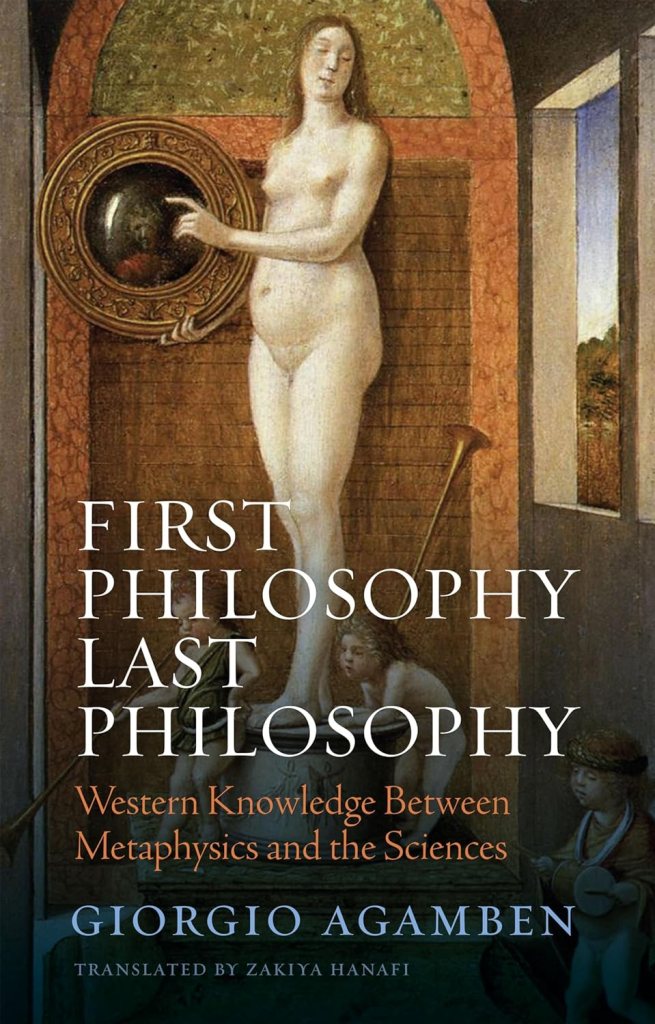
Giorgio Agamben’s First Philosophy, Last Philosophy: Western Knowledge between Metaphysics and the Sciences undertakes an archaeological inquiry into the very concept that once named philosophy’s primacy among the epistēmai. What appears, on the surface, as a historical reconstruction of a technical term becomes, under his method, a strategic analysis of how the West sought to secure the unity of knowledge in the face of its own proliferating divisions. The guiding thesis, stated with the clarity of a problem rather than the finality of a doctrine, is that what the tradition baptized as “first philosophy” functions, in practice, as a second or even last philosophy: not a self-sufficient sovereign court, but the boundary-work that presupposes physics and mathematics and then attempts to legislate their mutual articulations and limits. In this sense, metaphysics is constitutively relational; it claims primacy only by continuously differentiating itself from other theoretical practices and by adjudicating the order of reasons among them.
The paradox is that this primacy is purchased at the cost of an irreversible dependency: first philosophy becomes second to the very sciences it claims to ground, and in modernity even finds itself reduced to the labor of policing borders it no longer commands. Agamben does not treat this as a declension narrative; instead he shows that such secondarity already inhabits the Aristotelian articulation of the theoretical, where the delimitation of on hēi on is born in the very gesture of distinguishing it from phusikē and mathēmatikē. “First philosophy,” he argues, is a concept of “second philosophy,” because its identity arises through a differentiation from the other theoretical disciplines it nevertheless binds and measures.
The point of departure is Aristotelian. The discourse on ousia, already distributed between the Categories (which names ousia prōtē and deutera within an analysis of what is said without connection) and the Metaphysics (which secures to ti ēn einai and the question of first causes), installs a divided object under the name of unity. Being is said in many ways; the pros hen unity does not suppress multiplicity but gathers it analogically. Agamben insists that the decisive insight is not the plurality of ways of saying, but the fact that being must be said at all. Linguistic articulation—names, predications, the hupokeimenon that undergirds being-said—is therefore not an external accident. When Aristotle says that only ousia is separable “first according to language,” he indicates that ontological priority is inseparable from a priority of nomination: the name “human,” “god,” the deictic “this” of the primary substance. The implication is stark: the analysis of first philosophy belongs, from the beginning, to a logic of names, a semantics of predication, an economy of saying. The analogue that unifies “being” functions as a nexus of language and ontology; the “firstness” of first philosophy already arises as a result of partition—between noun and accident, name and predicate, that to which everything else is said on the supposition of the primary—so that primacy is structural, not chronological. This makes the later drama intelligible: theology and ontology are not external rivals; they are two forms of one and the same pros hen governance, and metaphysics, from its inception, bears the mark of an internal split.
This double structure becomes the fulcrum around which the Latin tradition will revolve when it receives Aristotle through the Arabic and late antique mediations. Agamben tracks the moment at which the name “metaphysics” itself is forged: Domenicus Gundissalinus introduces metaphysica in an environment where the discipline had long been called theologia, even as the book-title ta meta ta phusika functioned bibliographically. Gundissalinus installs the term with a telling oscillation: metaphysics is “third” after physics and mathematics in the ordo doctrinae, yet qua science of that which is before nature it is “first” in dignity and principle. Such posterior teaching and anterior being expose a structural circularity: the science that would certify the principles of the other sciences emerges after them in the learner’s order; firstness is thus not origin but jurisdiction over what is already in motion. The contradiction is not an authorial inconsistency but an index of the function metaphysics is designed to play: unifying knowledge by presupposing the partial sciences whose articulation it then governs.
From this vantage, the famous medieval opposition between Avicenna and Averroes over the subject of metaphysics appears not as a simple alternative—ens qua ens versus God and separate intelligences—but as a symptom of the deeper problem: how can a science be first if its very subject is divided between the most general (being qua being) and the highest (the divine)? Aquinas, Albert, John of Paris, and Duns Scotus grasp that the issue is not merely what metaphysics studies, but in what way its subject is assumed as known by a science. If God cannot be presupposed as known, metaphysics cannot take God as its subject propter quid; at best, it can treat divine things propter quia, from effects to their unknown cause, which entails that knowledge of beings as such precedes the ascent to God. Hence the curious doubling: a “philosophers’ theology” indistinguishable from metaphysics—because the divine is considered not as a separate object but as the principle of beings qua beings—coexists with the sacred theology of Scripture, which has God as subject. The result is a tiered architecture whose “firstness” is always in question, because each time metaphysics validates a science, it must become—for that time and in that case—a geometer, a physicus, a grammarian; the “metaphysical geometer” embodies the paradox of a science that is first only by following after.
Agamben’s most original move is to show how the medieval reworking of Aristotle slowly “slides” from being toward thing, from ens as a verbal participle to res and aliquid as transcendental names. Jean Buridan’s analysis is decisive here: if ens is the subject of metaphysics, ens in quantum ens must be taken not reduplicatively (as if all beings were its object) but specificatively, and in its material supposition: the term ens as a word, not a thing outside the mind. Under this logic, the subject becomes a semantic entity: ens read nominaliter as synonymous with “thing” or “something.” The transcendentalization of being thus proceeds by a semantic reconfiguration in which on hēi on becomes the objective correlate of an indeterminate representation, the “intelligible” understood as esse objectivum in the intellect. Ontology, at its early modern birth, names not real being as such but the objectivity of being-in-representation. The shift carries consequences: the distance between signification and denotation now furnishes the place where metaphysics does its work; the transcendental predicates articulate the status of meaningful terms independently of their supposition to any extra-mental thing. Where does that leave “firstness”? At best as a governance of meanings that must ceaselessly negotiate the threshold at which names fail to denote.
The archaeology of transcendental vocabulary confirms this. Already in the Logica modernorum, the problem of the “infinite name” or “indefinite name” forces an investigation into how far indeterminacy may be pushed before denotation vanishes. Res, aliquid, unum—the very exemplars of transcendental commonness—cannot be “made infinite,” precisely because their signified is already so general that the addition of negation cancels supposition. Here language’s own limit becomes the theater of metaphysics: the transcendental is the semantic scansion of a word’s meaningfulness where reference cannot be guaranteed. The scholastic distinction between significatio and suppositio becomes the hidden grammar of metaphysical claims. By reading the Peri hermeneias tradition (via Boethius) as the passage from words to things through the affections of the soul, Ockham and his successors install “concept” at the center of the triplex relation, but the problem is not thereby dissolved: signification exceeds denotation. Duns Scotus makes the point with crystalline bluntness: the quid nominis is more common than the quid rei. The signifier’s excess over any assigned signified—what a much later structuralism will rediscover—is not an anomaly but a condition; and the transcendental “thing,” situated in the gap between saying and supposing, is thus less a substrate than a semantic function.
In Agamben’s reconstruction, this semanticization is not a betrayal of ontology but the truth of its strategy. If metaphysics secures the unity of knowledge by controlling its names, then the dispute over its subject becomes a dispute over how names relate to what there is. Avicenna’s distinction between res and ens, reinterpreted by Aquinas as essence versus existence, originally targeted not that medieval opposition but the difference between what is the object of a true enunciation and what is affirmed to exist. The consequence is an anterior “uniduality” within intentionality itself: a split between being-said and being that precedes the later scholastic pair. Agamben’s claim is not genealogical pedantry; it is a diagnosis. Metaphysics is born as the effort to master this split; its history is the series of techniques by which the tradition circumscribed the excess of meaning over denotation in order to stabilize a “first” object for a discipline that must be transdisciplinary by design.
If one shifts from medieval semantics to the modern critique of metaphysics, the transcendental reappears under another signature, but it repeats the same strategic imperative. Kant’s Critique of Pure Reason distinguishes the “pure,” the a priori, and the “transcendental.” Pure concepts of the understanding have transcendental significance but cannot have transcendental use; deprived of sensible intuition, they are empty Gedankenformen. And yet reason inevitably falls prey to a “transcendental illusion” that treats subjective principles as determinations of things and thus posits a “transcendental object,” a bare something = X. Read through a medieval lens, “transcendental significance” and “use” mirror significatio and suppositio: the categories signify without denoting whenever no intuition is given. Kant’s own confession to Herz—on what ground does representation relate to an object?—objects the same ancient riddle in a new key. The answer is austere: there are no objects except those of possible experience; the noumenon is nothing but a boundary-concept that limits sensible cognition’s empire so that the understanding does not claim sovereignty outside its province. The queen of the sciences becomes guardian of a border: metaphysics has “nothing to think” where its own conceptual emptiness is the very guarantee that mathematics and physics may proceed “securely.” The paradox of primacy is here explicit: metaphysics both grounds the empirical—by delimiting its legitimate use a priori—and abdicates any substantive object; its objects are limits, not things.
Agamben’s reading neither celebrates nor laments this “euthanasia of philosophy” (Dilthey’s phrase). It extracts from it the rule of a civilization of knowledge: metaphysics serves the sciences precisely by exposing the null site from which they draw their norms of objectivity, and illusion becomes the transcendental condition of their disillusionment. The image of critique as a “stormy ocean” full of fogbanks that mimic lands is not merely rhetorical; it names the permanent susceptibility of reason to mistake meaning for denotation, to take the transcendental object for a thing, and thus to rekindle the very illusion the critique has neutralized. The modern point is therefore not merely that metaphysics cannot provide an object beyond experience, but that the labor of exposing this emptiness is what places the special sciences on their “secure course.” The inversion is complete: first philosophy governs as last philosophy, and it does so by maintaining an emptiness that is productive for the regional ontologies that science institutes.
From this arc it is intelligible why Heidegger’s intervention takes the form of an “overcoming” that both withdraws from and reinscribes metaphysics. Heidegger radicalizes the split: from the onto-theological duality that Agamben describes as inherent to Aristotle to the ontological difference between Being and beings. First philosophy, no longer the science of on hēi on (with or without the highest being), must be displaced by a thinking that turns back into the ground from which metaphysics sprang—the ground forgotten in the very act by which metaphysics represented beings as beings. Yet this overcoming does not annihilate metaphysics. So long as the human understands itself as animal rationale, it remains animal metaphysicum. The end of philosophy is not the end of thinking; it is the release of another task—“Clearing and Presence”—in which the question of Being, no longer figured under the representational logic of causa sui, is pursued as the opening that shelters presence. From Agamben’s vantage, this very displacement continues to register the undecidable torsion: if thinking must consider Being “without” beings to retrieve difference as such, it risks positing the open as an archi-transcendental “thing,” a One that again becomes the Ur-sache of presence. The circle is not vicious but diagnostic: the split the critique would repair reappears as soon as a new word—Lichtung, Offene—is offered to name the place of unveiling.
This is why Agamben closes the archaeology in the figure of the “metaphysical animal,” not to moralize but to register a historical anthropology of knowledge. If metaphysics names the incessant attempt to arbitrate the relation of being-said to being, then the human animal is the living site of that arbitration. The destinies of the sciences—geometry, physics, the human sciences that Dilthey once opposed to the natural—unfold within a fate that the West received from the Aristotelian division of the theoretical: metaphysics assigns the sciences as our moirai, our allotted regions, even as it reduces itself to a labor of delimitation. The “unity of knowledge” is thereby revealed as a normative project: not a given, but a ceaselessly negotiated settlement among differentiated identifications of an object and the forms of access appropriate to it. The point is not that unity is illusory; it is that unity takes the form of an institutionalized semantics.
The book’s middle chapters, where Agamben elaborates an “archaeology of the transcendental,” demonstrate how a strategic shift in the vocabulary of the schools produces structural consequences for the fate of philosophy. The introduction of transcendental terms in the thirteenth century, within investigations of how names can be “made infinite,” gives metaphysics a new province: the codification of meaningfulness at the threshold of reference. To say that res, aliquid, unum are convertible, always already maximally general, is to admit that negation cannot further them without destroying their supposition; the transcendental is the perfection of meaningful commonness before any quid rei. The doctrine then enters a dialectic with the sciences of the seventeenth century, in which “ontology” appears as ontosophia, a taxonomy of objective being in intellectu, triaging the intelligible from the aliquid and the ens reale. Agamben does not regard this as a loss of contact with reality; he regards it as a necessary reconfiguration under the pressure of the sciences’ success: once mathematics and physics secured their procedures and objects, “first philosophy” was compelled to relinquish the fantasy of founding them in order to secure the regimes of their legitimate speaking. That this would later be rewritten as a transcendental critique confirms the structural tendency that was present from the start.
In this light, the Kantian repertoire appears less as a rupture than as a decisive clarification. To call the categories “pure” is to position them as formal conditions for any experience whatsoever; to call them “transcendental” is to confine them to significance without use absent intuition. The unavoidable illusion by which reason hypostatizes the mere “something in general” gives a name—transcendental object = X—to a structure already in play in the medieval practice of discoursing about res a reor, the thing considered in the register of saying rather than res rata, the thing considered as posited in reality. As Agamben stresses, reading Kant alongside Ockham makes visible the linguistic nerve of the Critique: the categories signify, but they do not denote unless tied to the manifold; the error is to mistake the transcendental’s “mere” (bloss) significance for an ontic reference. That this illusion is “natural and unavoidable” secures precisely the persistence of the problematic: the critique must never end because the temptation to convert signification into supposition never ends. The “queen of a shadow realm” becomes the logic of limits; far from rendering philosophy superfluous, this assigns it the most demanding of tasks—to preserve the intelligibility of the sciences by defending them against their own metaphysical overreach.
Heidegger’s diagnosis of the onto-theological structure, when placed back against the Aristotelian and medieval materials, acquires a specific function in Agamben’s narrative. By showing that metaphysics, “as the representation of beings as beings,” inevitably doubles itself into ontology and theology, Heidegger does not merely critique an historical configuration but names the price of representation as such: Being is not experienced but is rendered in the form of a highest being or a universal beingness; the god of metaphysics—causa sui—is therefore the conceptual figure of this representational ground. Agamben records the turn toward an overcoming not to announce a clean break, but to underscore the structural persistence of the split: if the difference between Being and beings is to be thought as Austrag, a mutual “circling,” then metaphysics remains, in some sense, the condition to be transformed rather than erased. Thus the animal metaphysicum cannot simply abandon metaphysics without abolishing the very activity by which it articulates its world. The wager is more subtle: to “go back into the ground” of metaphysics is to risk changing the human essence, not by exiting thought but by metastasizing its object.
Agamben’s concluding gesture—brief but decisive—sketches what this transformation might entail when one looks not for a new doctrine but for another ethos of language. The experience that corresponds to the gap between signification and denotation—the very space in which metaphysics had installed its transcendental scaffolding—is neither an ineffable night nor a mystical extremity. It is an ethical register in which language is no longer oriented by intentionality toward objects but lives as rhythm and scansion of a doing, a poiēsis. Philosophy becomes last not because it comes temporally after the sciences, nor because it renounces rigor, but because it exposes itself to the non-intentional speech that undergirds all saying and therefore all scientific discourse. In such an exposure, the sciences do not lose their objects; they gain the condition of a form-of-life that no longer needs to imagine a sovereign firstness to be secure. The metaphysical animal endures, but the figure of its metaphysics is altered: sovereignty gives way to accompaniment; foundation to stewardship; pros hen governance to a practice of attention at the border where meaning risks converting itself into false denotation.
What emerges from this archaeology is not a new hierarchy but a diagnosis: Western knowledge coheres because philosophy has functioned as a permanently provisional adjudicator of the relations among its disciplines. The price of this coherence has been a constant oscillation between the assertion of primacy and the acknowledgment of secondarity. Agamben’s account refuses both nostalgia and triumphalism. It declines nostalgia by showing that metaphysics never enjoyed the absolute sovereignty that later ages ascribed to it; its “firstness” was always the regulatory fiction required to police division. It declines triumphalism by denying that the modern critique dissolved metaphysics into science; rather, critique installed metaphysics at the threshold, assigning it the unglamorous labor of limiting and legitimating. The queen survives as a boundary-keeper. Hence the suggestive title: First Philosophy, Last Philosophy. First, because without it the sciences lack a principle of unity; last, because its office persists only insofar as physics, mathematics, and their descendants have already claimed their regions. This condition has held since Aristotle named the theoretical as primary and partitioned it by merē; it will continue to hold so long as the human remains the animal that speaks, for whom being is always mediated by being-said.
The strength of Agamben’s work lies in the way it turns technical disputes—over pros hen unity, over the subject of metaphysics, over the meaning of in quantum, over the difference between res a reor and res rata—into symptoms of a profound institutional logic. The reader encounters not merely a sequence of theses but a continuous demonstration that what we call “metaphysics” has been the West’s technique for handling the necessary excess of language over things. When Buridan insists that ens must be read in material supposition, when Scotus differentiates quid nominis from quid rei, when Aquinas separates the ways of saying ens from what can be affirmed to exist, when Kant introduces the transcendental object as a placeholder for unity of apperception—these are not scholastic niceties; they are the precise instruments by which a culture disciplined its discourse so that science could be possible at all. That the same culture then returns, in Heidegger, to question the representational ground of this discipline only confirms how deep the operative split runs. There is nothing accidental in the fact that every attempt to heal it—be it by installing God or emptiness, Being or clearing—produces a new name with a new risk of reification.
One can object that such an account risks dissolving metaphysics into philology or philosophy of language. Agamben forestalls the objection by refusing to choose: the philological is internal to the metaphysical because the first philosophy is always already an analysis of how on is said. His careful recourse to Aristotle’s linguistic determinations, to Boethius’s mediation, to Ockham’s semiotics, to the Latin translators of the Arabic inheritance, all serve to show that semantics is not an external tool but the immanent medium of first philosophy’s claims. The result is not reduction but clarification: without the discipline of names, there is no discipline of beings, and without the discipline of beings, the names lose their purchase. The circle—language to being and being to language—is the only map we have; the work of first/last philosophy is to keep drawing it, knowing that every mapping tends to mistake its legend for the terrain.
If there is a programmatic implication here, it is modest and exacting: philosophy should relinquish the fantasy of an absolute beginning and accept the office of accompaniment. Not because it lacks force, but because its force is custodial—attuned to the places where sense outruns reference and where the sciences, tempted by their own successes, overstep. In such a practice, the most “metaphysical” of our gestures—the attempt to think Being as such—will persist, but as an ethical care for the thresholds of speech rather than an imperial claim to govern from above. Agamben’s archaeology, precisely because it ends without a new doctrine, amounts to a rigorous re-situation of philosophy’s dignity: not first in rank, but first in vigilance; not last in value, but last in the order that keeps the sciences from forgetting the groundless ground on which they stand. That “ground,” as Heidegger warned, risks becoming another Ur-sache whenever it is named; yet naming is inescapable for the animal that speaks. The work, then, is endless and necessary: to name without enclosing, to delimit without dominating, to accompany without usurping. That is the ethos of a last philosophy that remains, in the only sense that matters, first.
First Philosophy, Last Philosophy is a parsimonious yet generative reconfiguration of what metaphysics has meant and can still mean. Its archaeology discloses, beneath historical quarrels, a constant: first philosophy maintains the unity of Western knowledge by shaping the very conditions under which names can legitimately address things. That unity, fragile and polemical, is nonetheless a unity; and if it has reached a breaking point in our time, this is not because metaphysics has failed, but because the sciences now require more from their boundary-keeper than the old rhetoric of foundations can provide. Agamben’s book offers a different rhetoric—quiet, analytic, exacting—in which the strength of metaphysics is measured by its capacity to remain empty where emptiness is needed, and to let speech pass into work as a form of life rather than a sovereign decree. In that emptiness, first philosophy finds, at last, its place.
 Simon Gros
Leave a comment