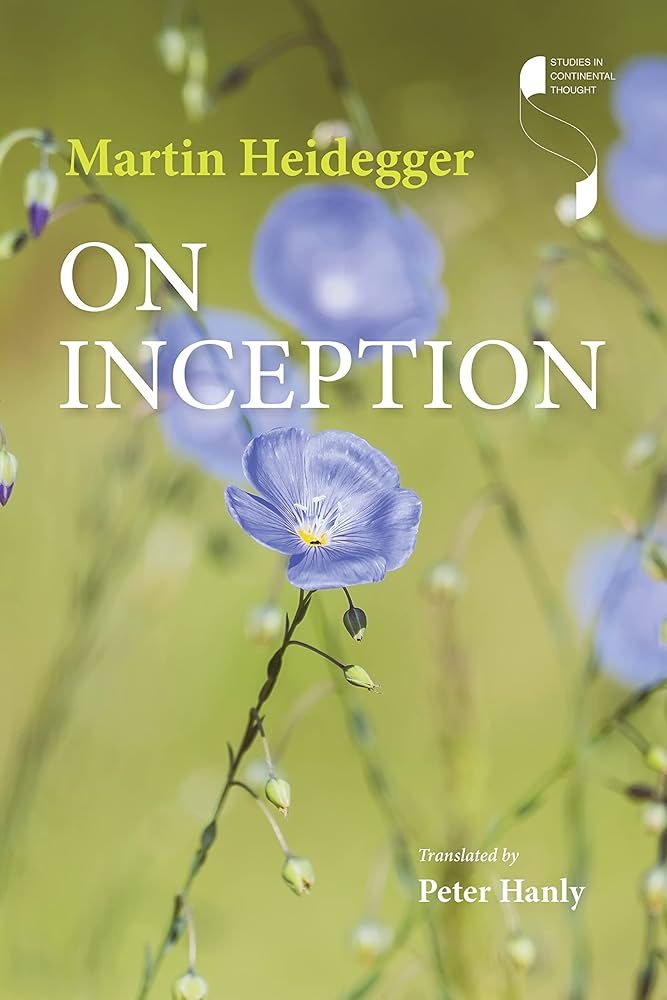
On Inception does not offer itself as a book to be read and then set aside; it withholds itself as a path into a more originary beginning—Anfang—whose essence is not a point on a line but the ninality of a letting-begin. The text that English names On Inception—the translation of Über den Anfang (GA 70)—belongs to the neighborhood of those inceptual treatises that also bear the names Contributions to Philosophy (Of the Event), The Event, and The History of Beyng. Yet the belonging here is not archival, not the adjacency of volumes on a shelf, but the co-belonging in the same attunement: the attempt to think beyng—Heidegger’s estranged spelling that breaks the automatism of “being”—as Ereignis, as event, as enowning, as the appropriative happening that grants the Da of Da-sein and thereby lets world and things, gods and mortals, earth and sky, come into their clearing. If such thinking is attempted, inception is not a past date to be retrieved, nor a first principle to be proved; inception must be thought inceptually, as the incepting of beyng itself. This book thinks that, asks for that, and continuously calls the reader into a listening that would be sufficient to remain within that call.
That listening is not an inner mood only; it is a way of standing within language. The book’s sentences, sometimes gathered into numbered sequences, sometimes given as outlines and thwarted definitions, are words that attempt to say the inceptual. Saying is here not the dress of a concept but the movement of a path. The words proceed by advancing and withdrawing, saying and unsaying, because the matter at issue—beyng as event—grants itself as clearing-with-withdrawal. The translation keeps to the sobriety of event for Ereignis, and to beyng for Seyn, not to indulge neologism but to force the reader out of the well-worn paths where “being” means presence and “event” means a happening among happenstances. In this sobriety the text teaches: presence is the derivative; the primary is the giving-withholding of the clearing as site, Stätte, wherein anything like presence or absence can occur at all. To think beyng is thus to think event, and to think event is to learn the measure of inception, which is not origin as ground but the grounding that grounds by ab-grounding—Ab-grund—the refusal of a ground that could be possessed, the withholding that is the mode of giving.
The book speaks of inception not as the first in a series but as the inceptive: the way beyng essences (west) as event. When the thinking of beyng is constricted into presence, “beginning” immediately becomes a chronological or logical first. But the inceptive beginning is older than chronology, more primordial than any deduction. It is that which lets a chronology be, that which opens the Da as the between in which mortals can be addressed and can respond. In this sense, On Inception is not content with exposing metaphysics as the history of presence; it seeks to effect a displacement—sober, restrained, without pathos—wherein thinking learns to comport itself to the inceptive, learns the Verhaltenheit (held-backness, restraint) adequate to the Wink (hint) by which beyng, as event, addresses. The book’s rigor is the rigor of this restraint.
To say that beyng occurs as event is not to say that being is “dynamic,” as if a metaphysical predicate had been modernized. It is to say that beyng cannot be secured as an object, cannot be collected under a concept, cannot be stabilized as presence, because the very site in which such securing would take hold is itself granted and withheld by the event. The name event—Ereignis—is itself a saying that enacts a de-propriation of the subject and object schema: it names the appropriating that appropriates Da-sein into its own, and thereby frees Da-sein for the belonging that gathers earth and sky, mortals and divinities, in a world. This gathering is not a synthesis performed by a subject; it is the propriation through which the between—Zwischen—is granted. Hence inception: insofar as event appropriates, it is inceptive; and insofar as inception incepts, it is event. The thought that thinks this is necessarily transitional in the strict sense—Übergänglichkeit—not because it is halfway to a system, but because it always stands at the crossing where a first inception (Greek thinking as aletheia) might be recollected and an other inception (the inceptive of beyng as event) might be prepared. The book dwells at this crossing without claiming possession of either shore.
Much of the text’s movement turns toward the Greeks—not to extract theses, not to old doctrines, but to listen back to that first inception which still addresses thinking when it can be silent enough to hear. Heraclitus, Parmenides, Anaximander: names that here name not authorities but dispatches from the inceptive region where truth was experienced as unconcealment. Parmenides’ saying that thinking and being belong together is not heard as a metaphysical identity-principle but as a hint of the co-belonging in which thinking is appropriated into the openness that lets beings be. Heraclitus’ logos is not taken as an early subject of logic; it is the gathersaying that lets a world hold together before representational calculation has made of world a stock of objects. Anaximander’s measure, the justice of time, the sending-back of beings into what is owed—these are more than archai for a doctrine but resonances of a measure no longer audible when truth is leveled into correctness. Yet On Inception does not idolize Hellenic inception. It sees the turn—the Kehre already at work within the first inception—where truth is displaced toward the correctness of seeing and being becomes presence: Plato’s idea, Aristotle’s ousia. The book refrains from accussation, and it witnesses the destining—the Geschick—by which metaphysics becomes the destiny of the West, and witnesses it in order to keep open the question of whether an other inception can be prepared.
Preparation is not program. The book refuses both activism and quietism. It speaks instead of readiness—Bereitschaft—and of a bearing—Austrag—that can endure the weight of the ungrounded ground. Readiness is not taken as a human property first and then applied to beyng; it is already granted by the event that claims Da-sein into its clearing. Thus the text’s insistence on Anfang does refrains from producing the heroic figure of a founder who leaps and inaugurates. The “leap”—Sprung—is named often, but never as a romantic flight. It is the letting go of metaphysical compulsion, the sudden loosening of the will to secure presence. It can neither be willed nor engineered; it can be prepared for in comportment, be prayed for (the book does not fear this word), but it arrives only as what is sent—Geschick—and even then only in the manner of a hint. The leap is not the achievement of an individual; it is the sudden release wherein thinking is no longer the measure of beyng, but beyng, as event, becomes the measure of thinking.
Because the matter at issue is such, the language must be. The book writes in a diction that is at once austere and intimate. The English carries beyng to estrange the day’s ear, to go beyond jargon decoration and to block the reflex by which “being” is heard as the most general of beings or as the presence of what is. It keeps event to ward off both the technical and the sentimental. It lets inception retain its strangeness, so that it does not drop immediately into the trusted slot of “origin.” And it crowds the page with hyphenings, compounds, held-back phrases, because the ordinary expression does not let the event say itself; it collapses immediately into representation. Such language is beyond a mannerism, it becomes the discipline of a thinking that knows it cannot rush to clarity without betraying the matter. Clarity comes, but as the brightness of a clearing and not the brightness of a spotlight. One does not simply “understand” the book as one understands a theorem; one stands under it, as under a sky opening to weather the day, and this standing-under is already the appropriate understanding.
The book’s outlines are inceptual maps. They trace, in spare series, the regions in which the thought must dwell if it is to be addressed by inception. They name Greek inception as aletheia, they mark the turning to presence with Plato and Aristotle, they follow the long history wherein being becomes presence, ground, objectivity, subjectivity, value, will to power, standing-reserve. They indicate the danger that accompanies this history: Machenschaft, machination, the total calculability of beings as resources, the technological commandeering of earth into stock. But even here the book’s sobriety prevails. It does not stupify by setting “technology” on one side as an enemy and “poetry” on the other as a savior. It says only that the essence of technology is not itself technological, and that within the grip of machination there is nevertheless the hint, the Wink, of another measure. That hint does not promise rescue; it demands preparation. Preparation is described with few words and much reserve: silence that is not muteness, speaking that is measured, gratitude that is not sentimentality, “prayer” as a standing in readiness before what alone can grant inception. These are not moral injunctions; they are names for how Da-sein belongs to event when it is not claiming itself as lord.
In this belonging, site—Stätte—matters. The book speaks of the site which is not taken as a location but as the place, the Da, where the fourfold—earth and sky, mortals and divinities—can be gathered. The gathering does not fuse nor homogenize; it lets each be in its own in the belonging-together. The site is not constructed; it is granted as the there of Da-sein, and it can be neglected, abandoned, desecrated, but never replaced by a site that we would produce. If On Inception thinks the site, it also thinks the abyss—Ab-grund—not as a terrifying nothing but as the way in which grounding grounds by withholding the graspable ground. The ground that can be had is not the ground we need; the ground that grounds occurs as the abyssal, as the non-objectifiable giving of steadiness when steadiness is the power to stand in the sway of withdrawal. In the abyss, thinking is taught its limit—not its limit as a boundary against which it crashes, but its limit as the measure that frees it from the compulsion to mastery. The abyss is not a simple object of knowledge; it is the manner of the event’s granting. To stand-within this abyssal grounding is the very strength of the inceptual stance.
The book also thinks the time of inception. It does not divide time into past, present, future and assign inception to the earliest past. Rather it hears the future—Zu-kunft—as the coming-toward (zukommen) of that which has always already addressed, a coming that needs recollection—Er-innerung, the bringing-into-inner—if it is to be heard. The text’s insistence that thinking-ahead and thinking-back co-belong is not a paradox but the temporal essence of inception: the beginning is always to come because it has always already been granted. “Always already” does not here conceal a dialectical trick; it names the co-origin of granting and receiving. To think inception is to correspond to the coming that has been and the having-been that still comes. Thus “history of beyng” is not a ledger of dates but the name for the ways in which event has destinally granted and withheld itself. The destiny—Geschick—that sends metaphysics is not a fated necessity that crushes freedom; it is the measure by which freedom can be what it is: standing within what is sent, in such a way that the sending is not exhausted in one manner but can be otherwise. Otherwising is not our project, as if a political program could legislate the other inception; it is a possibility that can be prepared, sheltered, awaited. The text shelters this awaiting without myth and without despair.
It is in this sheltering that the translation’s decisions matter. To keep event rather than minting “enowning,” to risk beyng rather than normalizing “being,” to hold to inception rather than “beginning” or “origin”—these are decisions that preserve the text’s inceptual pressure. They prevent the assimilation of Heidegger’s saying to a conceptual apparatus already at hand. They slow the reader, and this slowing is not an inconvenience but the first service to the matter: if the inceptive gives itself only under the veil of withdrawal, haste will never meet it. The translator’s sobriety in not smoothing over the book’s syntactic held-backs, its unresolved gestures, its outlines that remain outlines, serves the reader who would be readied. For On Inception is not a treatise that delivers content; it is a school of listening that asks the reader to risk an unlearning of the metaphysical ear.
If the book turns repeatedly toward Greece, it also turns toward the age that names itself modern. It names nihilism not as a mood but as the end-form of the will to presence, where value replaces truth and where the measure is the will’s own enhancement. It names machination not as the work of malice but as the destinal shape by which beings are leveled into availability. It names the planetary as the insistent sameness of the calculable across the globe. These namings are not a critique from the outside; the book does not stand above the age. It stands within the same destining, and precisely because of this interiority, it does not confuse diagnosis with mastery. It points, rather, to that inconspicuous path—unscheinbar, scarcely visible—by which even in the darkest danger there is a turning. The turning—Kehre—here is not a reversal we perform; it is the quiet shift in which our comportment loosens and we are able to let be what beckons without our grasp. Such letting is neither acquiescence nor impotence; it is the highest readiness, the restraint that keeps the clearing clear, the refusal to clutter the site with projects of self-assertion.
Truth—Wahrheit—accordingly is not adequation, not the correctness of representation, though correctness has its place in the handling of beings. The book stays with the Greek hint that truth is unconcealment, aletheia, but it refuses every temptation to picture unconcealment as sheer openness without withdrawal. Unconcealment is always with concealment; the clearing opens by simultaneously sheltering the hidden. The event gives only by withholding, and this co-belonging is not a defect; it is the essence of the giving. Therefore the longing for total transparency that animates metaphysics (and today’s data cult) is shown to be the highest untruth: not because it lies, but because it cannot abide the concealment that belongs to the truth. The ethical consequence implied by this is not a moral code but a comportment: patience, reserve, the ability to let what does not immediately present itself nevertheless bear upon us. In this letting, gratitude—Dank—and even prayer—Gebet—can name modes of standing within the measure of what exceeds our making.
One hears in such sentences a tone that, in other contexts, would be called theological. On Inception does not institute a theology. When it names the divine, it names not a highest being but the pole of the fourfold by which the holy is possible. The holy is not a domain among others; it is the open of measure where measure measures us before we measure. If the book intimates a piety, it is the piety of thinking as gratitude for the event’s grant. Gratitude does not repay; it gives thanks. The thanks is the saying that says only so much as would not obstruct the hint. Thus the work’s many formulations that end just short of a conclusion, its refusal of a last word, its speaking of perhaps and maybe where metaphysics would speak of necessity and proof. This measured uncertainty is not a weakness; it is the most exact strength, the strength to remain within the unmasterable.
Because the matter is so severe, the book does not indulge apocalyptic fantasies. It does not set an hour for the arrival of the other inception. It does not prophesy a new age. It keeps to the sobriety that knows the other inception as that for which one can only ready oneself. Readiness is not idle. It has its work: the clearing of speech, the formation of thinking that no longer demands guarantees, the cultivation of a style that does not shriek at the abyss but learns to step there. The step is not a stride; it is a standing-still that is a step, the quieting of what is noisy in us so that we can hear what addresses. The address—Anrede—is not a message from elsewhere; it is the event’s own beckoning, the hint of inception in the midst of a day. The philosophical sobriety of On Inception consists in not making of this a mystery-religion. It remains philosophy, but philosophy unbound from the compulsions that have bent it since Plato: not a love of wisdom as possession, but a standing in love with the granting that leaves us dispossessed and thereby free.
On Inception says by unsaying, and it says first of all the demand that saying itself must learn. It says that the other inception demands a language neither of explanation nor of obscurity, but of the measured word whose strength is its restraint. It says that the seizing of beings in representation is not the highest form of truth, and that a more originary truth holds sway in the interplay of unconcealment and concealment. It says that in the co-belonging of thinking and beyng, thinking is not sovereign but appropriated; and that the appropriation—Ereignis—is the event that makes thinking possible. It says that “history” is the name for the sendings of this event, and that to be “historical” is to stand within a sending not as its victim or its master but as its responder. It says that the first inception, Greek, is not to be copied, but can be recollected as a hint, and that the other inception is not to be erected, but can be prepared as a readiness. It says—and in its saying performs—that the work of philosophy is not mainly to argue but to attune.
The attunement—Stimmung—is not equal to the aesthetic. It is the primal readiness by which Da-sein belongs to the world’s opening. In the book one hears the call to a sober courage: to endure the lack of a ground that could be possessed; to remain without the certainties that the metaphysical ear demands; to refuse the cheap consolations of novelty; to re-learn the near, the inconspicuous, the inconspicuousness of the near that is easily overlooked by a gaze trained on the spectacular. “Nearness” is not spatial only; it is the intimacy of the event’s hint. What is nearest is often what we most lack: the measure that holds us to what we are—mortals—those who can die, those whose mortality is not a limit to be overcome but the opening to the holy. The book’s thinking of mortality is not lamentation; it is the guard that keeps the path clear. Mortality prevents the temptation to eternity as endless presence, and returns time to its inceptive. Thus the reader is asked not to transcend finitude, but to carry it rightly.
Within the cluster of late works, this book holds the place of the determinative question: what is the sense of inception when beyng is thought as event? Contributions to Philosophy lays out the sixfold, names the shapes of the crossing where the other inception can be sensed. The History of Beyng composes the outlines of the epochal sendings. The Event concentrates the saying of Ereignis as the enowning that appropriates. On Inception takes up the first word and makes it most extreme: beginning, but as ninality; origin, but as granting; first, but as always already to-come. Taken together, the cluster could be read as a sequence; On Inception resists this, because the inceptive is not sequential. It does not come first and pass away. It is the staying of the beginning, the staying in which staying becomes the arriving of what comes. If one tries to circumscribe this with concepts, it slips away. The book, knowing this, gives words not to enclose but to point.
Pointing—Weisung—is the form of this writing. It leaves much unsaid, not because it is deficient, but because what is to be said cannot be said all at once without becoming untrue. The unsaid is not a given remainder that future scholarship will fill in; it is the shelter left deliberately for the event’s coming. In that shelter, the reader is asked to practice: to hold back, to hearken, to question without narrowing, to say a little and mean much. The book’s density is not obscurity but compression: it gathers nearness into words so that nearness can be kept. In this way, the reader is changed; not converted to a doctrine, but converted in stance. Philosophy becomes different: not the exposition of systems, not the critique of arguments, but the keeping of the clearing. This keeping is work; it is also joy, the joy of not having to own what cannot be owned, the joy of standing in what gives.
If one seeks scholarly payoffs, they are not absent. The book refines the terms by which we read the Greeks anew, by refusing to impose interpretations and by freeing the ear to hear aletheia, logos, noein, moira, as words still speaking. It provides a grammar by which mediaeval and modern metaphysics can be traced as the different modes of the same destiny of presence. It offers a hearing for Nietzsche that does not reduce him to psychology or to prophecy, but locates him at the climax where the will to presence is named in its truth. It offers—without program—a way of reading poetry and art as places where the clearing clears, if only sometimes, if only for the few. It sharpens the distinction between theology and what here can be said of the divine; it releases theology to its own task by refusing to pretend to do it. It suggests an ethics without moralism, a politics without programs—to say that is to risk being misunderstood, and the book accepts the risk. It does not design institutions; it calls for a posture that could make any institution humane: restraint, measure, gratitude, the hearing of the near.
The question of language returns, and rightly, for the other inception will, if it comes, be a different saying. On Inception does not invent a language for its own sake; it lets the matter dictate the saying. That matter comes to speech best in words that carry their German resonance even in English: beyng, event, inception, site, abyss, sending, gathering, clearing, withholding, belonging-together, recollection, thinking-ahead, leap, ground, ab-ground. Each is a knot in a net of sense. None can be defined without the others. The reader who demands definitions first will be disappointed. But the reader willing to move among them, to let their inter-saying ring, will find that the sense thickens without hardening into a block. Such thickening is precisely the work the book performs.
The age is brusque. It asks for utility. The book answers with utility of another kind: it keeps a place clear for a beginning that our uses would otherwise trample. To keep such a place is not a refusal of use; it is a refusal of the totalizing of use. Within that cleared place, work can become work again and not merely production; speech can become speech again and not merely information; thinking can become thinking again and not merely calculation. These are not “applications” of the text; they are the gentle naturalness that grows when the clearing is not filled with noise. The naturalness is not naïve; it is the maturation of restraint. The book asks whether we can mature in this way. It makes no prediction. It grants the question and leaves it with us.
In that leaving, On Inception has already done more than most: it has put the reader in question. The question is not “do you agree?” but, rather: can you stand within the inceptive such that your very agreeing and disagreeing are changed? The reader might bristle—this sounds like abdication. It is not. It is the free-est stance, because it is the one in which freedom is no longer the sovereignty of the self but the being-free for what comes. The courage needed is quiet. The book models it by refusing every clamor. It whispers—Wink—and by this whisper it asks for hearing. The hearing that answers will not be the same in everyone; destiny does not distribute itself evenly. Yet nothing in the book licenses elitism. The “few” of whom it sometimes speaks are not a class; they are the ones who happen to hear and to be readied. Anyone can be the few; no one can choose to be so by will alone.
One can, nevertheless, choose the path: to take up the book, to slow down, to let its words weigh, to return, to begin again, to let the beginning be the guide. If one does, one discovers that the supposed hermetic opacity shades into a luminous reserve. The light is not a floodlight; it is the day’s light in a forest clearing. It is enough to see what is near. Nearness is enough. The will to far horizons, to total vision, to the overview that subjugates, is set aside, and in its place the eye learns the grain of the wood, the weather’s small movements, the measure of a step. The philosophical flavor here is not decoration; it is the taste of a different nourishment. After long years of metaphysical diet, thinking tastes this and recognizes what it had forgotten to hunger for.
On Inception can, then, be described in words that would ordinarily be reserved for a book notice: it is from the period before and during the second war; it belongs to the series of inceptual treatises; it deals with beyng as event; it thinks inception not as origin but as inceptive granting; it ranges over the Greek first inception and prepares for the other inception; it is dense, difficult, severe, and essential. Yet each of these words—so easily said—only becomes true under the discipline the book itself instills. Without that discipline, the words repeat the vocabulary of Heidegger without touching the matter. With the discipline, the words become a path. The reviewer’s craft, in this case, is not to summarize but to point. The pointing is already, if done rightly, a participation in what the book makes possible.
If one asks what remains after the reading, the answer is paradoxical and plain. What remains is less and more. Less: fewer certainties, fewer theses, fewer conclusions. More: a greater measure, a steadier step, a wider patience, a keener hearing for the hint of the inceptive in the ordinary. The ordinary—once the clearing is kept—becomes the most difficult. The simplest thing—speaking a word, making a gesture, deciding a task—becomes charged with the responsibility of keeping the near near, of not sliding back into the compulsions of presence. This responsibility is not heavy; it is light as air and heavy as earth. The book does not dramatize it. It sets it down quietly and walks on.
This walking-on is the reading’s final gift. The path is not owned by the text; it is our path, if we will take it. The beginning is not behind us; it is always at hand, if we will be handed over to it. The event does not happen elsewhere; it occurs in the clearing where we already are, if we will let it be. To let it be is not to do nothing; it is to do what is needed: to speak because silence has ripened into a word, to be silent because the word has not ripened, to act because measure demands, to refrain because measure forbids, to thank because the grant has arrived, to wait because the grant withholds. Such measure is difficult. The book does not hide this. It encourages not by promising success but by keeping failure from becoming despair. The failure to keep the clearing clear, the relapse into presence, the inevitable reassertions of mastery—these are part of the sending. Even these can be borne if the inceptive is not forgotten. Recollection—Er-innerung—is the carrying of what has been granted into the inner where it can guide without becoming an idol.
The language of On Inception, finally, is itself a beginning. It is not the last word; it is not even the first in the old sense. It is the inceptive saying that lets us start. It says only as much as will let the event’s hint stay audible. It denies us both despair and triumph. It leaves us with a task: to keep the site open, to guard the clearing, to hearken to the hint. That task is not foreign to philosophy; it is philosophy brought back to its own, released from service to presence, freed for service to what grants. In that service, philosophy can become what the Greeks intimated but what a long history obscured: not possession of wisdom, but dwelling with the measure that lets wisdom be possible. The dwelling is modest. The book, in its severity, is modest too. It does not impose itself. It stands at the edge of the clearing and waits. Those who come, come. Those who pass by, pass by. The book has time because inception is time’s own beginning.
To take up On Inception is thus to step—quietly, deliberately—into a different relation to beginning. One does not seize a concept; one is seized by a call. One does not master a doctrine; one is mastered by a measure. One does not conclude; one begins, and in beginning begins again. The review that would be equal to such a book can only mirror it: pointing, holding back, letting the near be near. If therein there is more than a given picturesque, it is not spice added from outside; it is the taste of the matter itself once the palate has been renewed. And the renewal is what the book effects—not by argument, not by persuasion, but by standing within the clearing long enough that the day’s light becomes the measure of sight. Then one sees, and in seeing does not seize. Then one speaks, and in speaking does not exhaust. Then one is silent, and the silence is not empty but full of the event’s hint. In such standing the review ends where the book begins: with inception as inception, the beginning that is the giving of the there, the event as the incepting of beyng, the simple, difficult truth to be kept.
 Simon Gros
Leave a comment