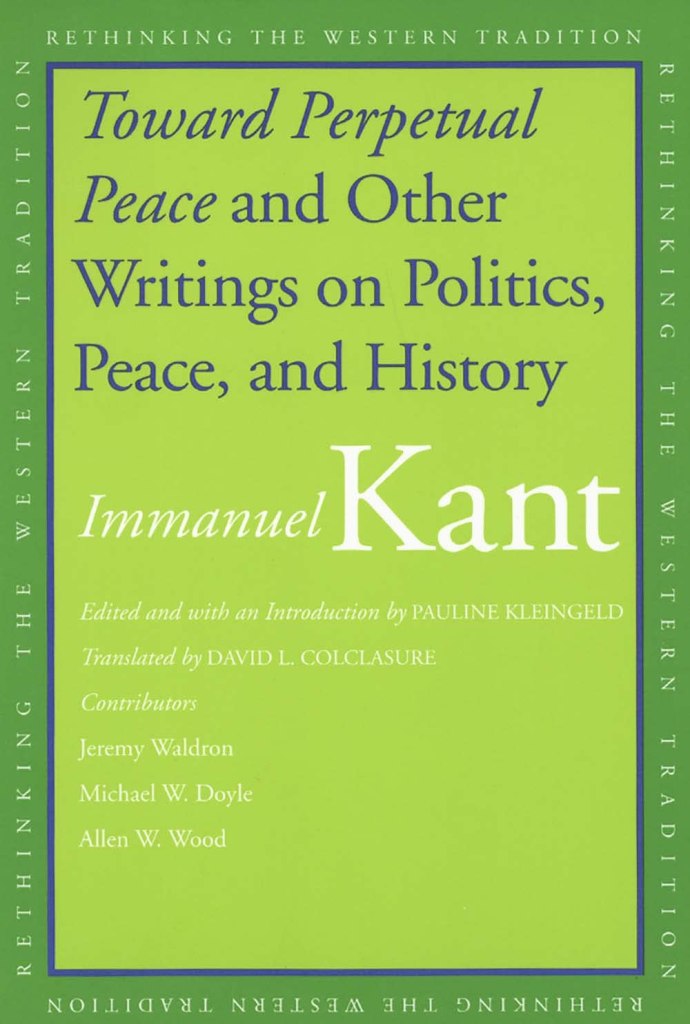
Toward Perpetual Peace and Other Writings on Politics, Peace, and History by Immanuel Kant, edited by Pauline Kleingeld and translated by David L. Colclasure, offers one of the most comprehensive and systematically contextualized presentations of Kant’s political writings currently available in English. It is a volume that not only assembles Kant’s most significant interventions in political and historical philosophy—texts that span from his early essays on enlightenment and universal history to his late reflections on international order and cosmopolitan right—but also situates them in relation to both their eighteenth-century background and their enduring influence on contemporary debates in political theory, international relations, and moral philosophy. The combination of newly translated texts with interpretive essays by leading scholars such as Jeremy Waldron, Michael W. Doyle, and Allen W. Wood ensures that the volume serves not only as a historical collection but also as a resource for ongoing philosophical and political questioning.
At its center is Kant’s essay Toward Perpetual Peace: A Philosophical Sketch (1795), one of the most influential works in modern political thought. Here Kant attempts to demonstrate that peace is not merely the suspension of hostilities or the balancing of powers but a juridical and moral condition requiring institutional realization at multiple levels. He insists that “real peace” cannot exist where wars are simply postponed by truces, where conquest determines boundaries, or where power dictates the terms of international relations. Genuine peace, by contrast, requires that states organize themselves according to republican constitutions, that they enter into a voluntary league of states to regulate their external relations, and that a category of cosmopolitan right be established to govern interactions between individuals and states across borders. In formulating these principles, Kant links the idea of peace directly to his broader critical system: just as the Critique of Pure Reason sought to establish the conditions for knowledge, and the Groundwork the conditions for moral obligation, so Toward Perpetual Peace seeks to define the conditions for a rightful political order that can secure freedom externally as law.
Kant’s definitive articles for perpetual peace—including the abolition of standing armies, the prohibition of conquest by inheritance or purchase, and the rejection of national debts intended for war—reflect his conviction that peace requires a transformation in political culture. War-readiness institutionalized in standing armies, for example, is interpreted not as a means of security but as a perpetuation of hostility that makes war inevitable. The implications of these claims extend beyond the eighteenth century: they anticipate critiques of militarism, nationalism, and the permanent-war economy that continue to resonate in modern scholarship and international politics. In insisting that republics, by virtue of their representative structure and separation of powers, are less inclined to war than despotic states, Kant introduces a thesis that has become one of the most debated claims in political science, often referred to as the democratic peace hypothesis.
The volume demonstrates that Kant’s political thought cannot be reduced to Toward Perpetual Peace alone. His earlier essays—Idea for a Universal History from a Cosmopolitan Perspective, An Answer to the Question: What is Enlightenment?, and Conjectural Beginning of Human History—provide the framework within which his later political theory must be understood. In these works, Kant articulates the concept of “unsocial sociability,” the tension between human beings’ inclination to live together and their simultaneous tendency toward conflict and competition. This antagonism, he argues, serves as a mechanism by which nature drives humanity toward progress: it forces the development of talents, institutions, and eventually political orders that reconcile individual freedom with social coexistence. The historical process, while not free of violence or regression, is interpreted teleologically as a gradual unfolding of humanity’s rational predispositions. Thus, Kant’s political philosophy is inseparable from his philosophy of history, since the possibility of perpetual peace must be understood as both a normative requirement of reason and an eventual outcome of historical development.
Kleingeld’s introduction clarifies this systematic connection by emphasizing that Kant’s conception of right is inherently cosmopolitan. The duty to enter into a state and obey its laws is not grounded in consent or utility but in the necessity of reconciling each individual’s external freedom with that of all others under universal laws. This leads to a view of the state as a moral requirement of reason, rather than a contingent product of contract or convenience. Yet because the principle of right is universal in scope, it cannot stop at national boundaries. International and cosmopolitan right are necessary extensions of the same rational principle: states must regulate their relations according to laws that secure their external freedom, and individuals must have a recognized legal status in their dealings with foreign states. In this respect Kant’s writings anticipate modern debates on international institutions, human rights, refugee protection, and the regulation of transnational threats that operate outside state authority.
The interpretive essays included in the volume deepen these themes in complementary ways. Jeremy Waldron’s essay on Kant’s theory of the state underscores the rigor of Kant’s position on political obligation: individuals have a moral duty to obey the laws of their state, even if the state acts unjustly, because the alternative is the return to a state of nature where disputes are settled by force. This insistence on legal order as preferable to anarchy reflects Kant’s prioritization of stability and right over the uncertainty of resistance. Waldron notes the tension this creates for modern democratic theory, which often seeks to justify resistance and civil disobedience in the face of injustice. Yet Kant’s position illustrates the seriousness with which he takes the idea of law as a necessary condition of freedom, even when imperfectly realized.
Michael Doyle situates Kant within the field of international relations, focusing on his claim that republican constitutions make states more inclined toward peace. Doyle’s analysis connects this claim to empirical studies that suggest democracies rarely go to war with each other. Kant’s reasoning is that citizens, who must bear the costs of war in both lives and resources, are less likely to support conflict than rulers who can externalize its burdens. Doyle shows how this normative insight has become a central hypothesis in political science, while also noting the limitations and complexities of applying it in a modern context where democracies have engaged in wars with non-democratic states. The essay highlights Kant’s lasting relevance to the study of how domestic political structures influence international behavior.
Allen Wood’s essay examines Kant’s philosophy of history, which has often been overshadowed by his epistemology and ethics. Wood argues that Kant’s teleological view of history is not to be read as a prediction but as a regulative principle that allows moral agents to interpret human development as oriented toward justice and peace. By presenting progress as a rational hope rather than an empirical certainty, Kant provides a framework that motivates action without claiming knowledge of the future. Wood emphasizes that Kant’s philosophy of history is essential to his political theory, since the normative prescriptions of right would be incoherent if their realization were empirically impossible. The historical account provides the assurance that progress, while not guaranteed, is at least possible, and that efforts toward peace are therefore meaningful.
Taken together, these scholarly contributions illustrate the systematic character of Kant’s political philosophy. His theory of the state, his conception of international and cosmopolitan right, and his philosophy of history all form parts of a unified framework in which peace is not an accidental byproduct of power relations but the rational end of human political existence. The essays also highlight the tensions within Kant’s position: his rejection of revolution alongside his critique of despotism, his defense of a voluntary league of states alongside his acknowledgment that only a stronger federation could secure perpetual peace, and his teleological view of history alongside his recognition of the persistence of conflict. These tensions, rather than undermining his thought, demonstrate the complexity of his attempt to reconcile moral ideals with political reality.
This edition, by bringing together Kant’s key texts with careful translation and interpretive essays, provides a resource for scholars and students across philosophy, political theory, law, and history. It demonstrates that Kant’s reflections on politics and peace, far from being confined to the concerns of the eighteenth century, continue to inform debates on democracy, international institutions, globalization, and the regulation of violence. By presenting peace as both a normative imperative and a political project requiring institutional form, Kant establishes a framework that remains a critical point of reference for thinking about the possibilities and limits of global order.
 Simon Gros
Leave a comment