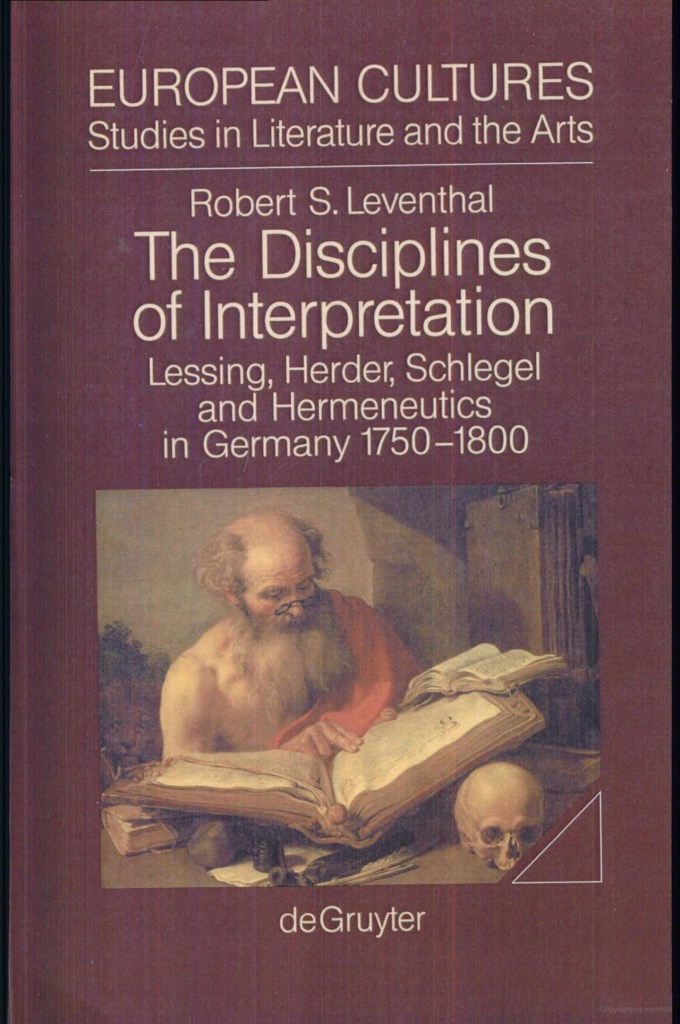
Robert S. Leventhal’s The Disciplines of Interpretation: Lessing, Herder, Schlegel and Hermeneutics in Germany, 1750–1800 is a genealogy of interpretive reason at the precise historical moment when “reading” ceases to be a private virtuosity and becomes a structured practice, an institutional technology, and a self-questioning mode of historical knowledge. Published by Walter de Gruyter in 1994 as part of the European Cultures series, the volume situates eighteenth-century German hermeneutics at the crossing of philology, criticism, theology, and philosophy, turning a scattered repertoire of methods into disciplines with rules, sites, and pedagogies. Its wager is that hermeneutics emerges not as a timeless philosophical universal, but as a historically determined configuration that displaces the sovereign subject with a field, a code, and a system of texts to be governed by learned practices.
The book opens from a methodological vantage point that is frankly archaeological. Reacting to Gadamer’s universalizing claim for hermeneutics, Leventhal follows a Foucauldian impulse, asking when and why “hermeneutics in the modern, philological sense” arose as a dominant modality of encountering others and texts, and what institutional forms made such encountering both teachable and regulative. Rather than projecting a continuous tradition from Plato to Heidegger, the Preface insists on discontinuity, emergence, and the concrete technologies—seminars, journals, philological institutes—through which interpretation acquired social force. The volume thus “graphs” an ascent of hermeneutics as historical practice, not merely as theory, and binds that ascent to the book-reading world of the late Enlightenment. The large architecture of the inquiry mirrors this thesis: from “Writing the Emergence of Hermeneutics” and “Semiotic Interpretation” through Lessing’s critical breakthroughs, Herder’s textual hermeneutics and discourse-analytic reflections on Wissenschaft, to the institutionalization of philology and Schlegel’s hermeneutic philology, and finally to a coda “On Incomprehensibility,” where the very limits of understanding are thematized as positive conditions of reading.
Leventhal first reconstructs the Enlightenment model of understanding as a semiotic economy secured by rhetoric and the theory of ideas. In this regime the “transparent book” is the medium through which the interpreter ascends from signs to the mental content that subtends them; the task is to master grammar, logic, rhetoric, and genre so as to eliminate “obscure passages.” The rhetoric of inventio/dispositio/elocutio and the ideational view shared across the Leibniz–Locke–Wolff horizon together sustain a distinction between thought and word, res and verba, content and expression. Leventhal’s close reading shows how this distinction anchors an entire pedagogy in which language is merely the instrument of thought, and interpretation is a didactic art of restoring clarity. Against this background, the book’s protagonists do not simply add refinements; they transform the very object of reading from discourse and book to text and textuality, and in so doing they alter who or what counts as the “subject” of interpretation.
Lessing marks the first decisive rupture. Leventhal returns to the Fragmentenstreit, Ernst und Falk, and above all Nathan der Weise not to excavate dogmatic theses but to show a strategic redescription of scriptural authority by way of performance. The injunction to read Holy Scripture as one reads Livy—lies die Bibel nicht anders als du den Livius liesest—is not a trivial leveling; it is the lever by which Lessing secularizes hermeneutic authority, relocates truth-claims in historical practice, and insists that interpretive conflict is constitutive rather than lamentable. In Leventhal’s account, the Ring Parable is not an allegorical ornament but a political technology: narrative as an instrument for circumnavigating surveillance and coercion, a medium of “hermeneutic intervention” in which application is inseparable from action. The parable binds interpreter and power—the bond between Nathan and Saladin—by historicizing “truth” and turning reading into a performative strategy of ethical-political address. The result is that Lessing, often excluded from canonical histories of hermeneutics for failing to produce a systematic theory, reappears as the decisive figure whose practice renders such systematization both possible and suspect. And this practice is public: Leventhal links Lessing’s innovations to the formation of a bourgeois public sphere in which criticism becomes an affair of publicity rather than court or church, displacing “representative” institutions with print-mediated debate.
With Herder, the book pivots from the performative to the textual. Herder’s scattered but relentless reflections on language and reading unsettle the Enlightenment’s ideational transparency at its core. Language is not a neutral vehicle for preformed ideas; it is the form of the sciences themselves, a reservoir and organizing matrix in which the very stuff of experience is articulated. In Leventhal’s retelling, Herder’s critique of Condillac’s fiction of “reciprocal commerce” and of Rousseau’s prelinguistic reflection exposes the necessity of a third term—the Merkwort—whereby difference and articulation become possible. The “supplement” is not an addition to an origin; it is the condition under which there is any origin to speak of. Herder thus deconstructs the res/verba divide and reinscribes rhetoric at a deeper level: perception, reception, and expression exist on a continuous plane, such that even the most primitive cognition is already structured as a kind of proto-discourse, a vorbuchstabieren of consciousness. In Leventhal’s phrase, vital speech and criticism are always already caught in a double axis: a dialogical, hermeneutic confrontation with the Other (revivifying the “dead letters”) and a structural-reflexive axis in which the interpreter’s own standpoint and horizon are implicated in the very process of understanding.
This refounding of language supports Herder’s critique of metaphysics and his articulation of a small science of the human that privileges analysis while unmasking the pretensions of foundational method. Against the early Kant’s logical construal of being, Herder insists on being as an empirical, sensible certainty presupposed by consciousness—demonstrable by no formal deduction—and concludes that “human being” precedes philosophical system. The turn is from metaphysical proof to a new philosophical discourse whose coherence lies in dismantling the subject as the locus of representation and reason. This new discourse also refashions Wissenschaft: Herder contests the fetish of system and the codification of living knowledge into dead compendia, even as he concedes the necessity and utility of methodological formations. In Leventhal’s reading, Herder’s pedagogy of reading—at once self-appropriation and unconscious impression—lays bare a double rhetoric: emancipation through reflective appropriation and socialization through the subtle coercions of exemplary models. The student becomes a writer by continuing what the discipline has prescribed. And the late-Enlightenment topos of reciprocity—government and sciences influencing one another—names not a benign symmetry but the very economy by which discourse organizes itself into a horizontal social field.
The decisive hinge of Leventhal’s narrative is institutional: philology becomes a discipline. The Göttingen Seminar under Christian Gottlob Heyne did not merely teach grammar and Textkritik; it organized interpretation as the center of study, reconfigured the classroom from disputation to seminar, and installed the written Aufsatz as a pedagogical instrument and professional threshold. Through Göttingen’s Royal Society, learned journals, and a vast library, the seminar radiated across Europe, forming elites for universities, Gymnasien, and bureaucracies; its graduates occupied posts from Hanover and Berlin to Denmark, Sweden, Holland, and England. The institutional model spread: Erlangen (1777), Helmstedt (1779), Halle (1787), and, paradigmatically, Berlin (1809/10). Leventhal names this cluster—the abrupt emergence of institutes between roughly 1775 and 1785—the moment at which philology becomes modern: no longer an auxiliary to theology or law but an independent, comprehensive historical investigation of cultures through textual analysis and interpretation. In programmatic terms, philology now centers on hermeneutics as much as on grammar and emendation; it makes historical understanding the core of criticism, and with Humboldt it provides the blueprint for the modern research university, where the seminar, reflection, and interpretive method define the relation between disciplinary institutes and the society of sciences.
Friedrich Schlegel provides the theory of this practice by historicizing aesthetic culture and drafting the first explicit outlines of hermeneutic philology. In Über das Studium der griechischen Poesie, Schlegel’s “rehabilitation” of the moderns proceeds not by normatively enthroning antiquity but by demonstrating how modernity itself emerges within a philological, historical self-relation. Leventhal then turns to the 1797 notebooks Zur Philologie, the only actual outline of a hermeneutic-philological discipline in Schlegel’s hand. Here Schlegel refuses the application of philosophy to philology—“whenever a philosopher applies philosophy to philology and history, the product is only philosophy”—and relocates application itself as the hinge of interpretation: categories are neither intrinsic to the material nor deducible from method; they are won from other readings within a tradition of reading. What results is a shift in the center of gravity: not subject but field; not intention but code; not author but the “system of texts,” the discursive order that demands cyclical, critical study. In this view, the philologist is not a sovereign knower but a “historical subject,” already staked out in advance by the field and its codices, and hermeneutics becomes a technology for governing a system of knowledge.
The concluding meditation on “incomprehensibility” radicalizes these claims. Where Enlightenment interpretation treated dunkle Stellen as deficits to be eliminated by method, Schlegel’s account of Unverständlichkeit renders opacity intrinsic to texts and to the historical density that emerges in reading. Incomprehensibility is no longer a failure but a sign that words “have a life of their own,” that reading must guide us toward an openness to what cannot be appropriated. Irony—oscillating between fragment and system—becomes not an ornament but the very movement of modern writing, and the interpreter’s task is not to restore a prior transparency but to navigate the traffic of discursive communication. The book’s last pages make explicit what its architecture has enacted all along: the displacement of the grounding subject by a historical-discursive field in which interpretation is both critique and institution, both reading and the pedagogy of reading.
By threading Lessing’s performative hermeneutics, Herder’s linguistic-textual revolution, the Göttingen model of scholarly organization, and Schlegel’s reflexive philology into a single arc, Leventhal restores the concreteness of “interpretation” as a practice that is at once theoretical, ethical-political, and institutional. The book’s central achievement is to show how disciplines of interpretation are not merely intellectual styles but social forms: they prescribe modes of apprenticeship, organize archives and seminars, redistribute authority from authors to corpora, and install “application” as a collaborative, historically situated labor. In this sense hermeneutics is neither an abstract method nor a private art; it is a public, rule-governed, and contested way of making meaning in history—one that accepts incomprehensibility not as a scandal but as the condition of a modernity that reads itself.
 Simon Gros
Leave a comment