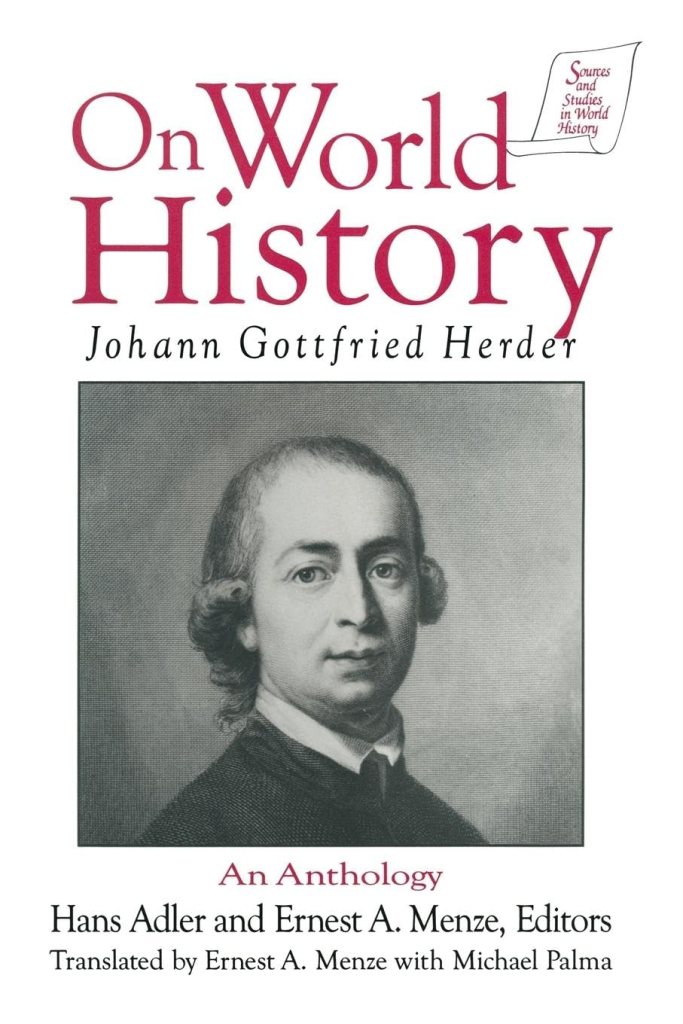
Johann Gottfried Herder on World History: An Anthology presents Herder’s lifelong wager that history becomes intelligible only when narrated as the becoming of humanity—not a thin abstraction but a living principle that binds language, climate, custom, belief, and art into a single, ever-unfinished text. The editors, Hans Adler and Ernest A. Menze, organize thirty-eight selections to let that wager unfold with philological precision and philosophical ambition, pairing newly translated materials with a thorough, line-by-line revision of T. Churchill’s 1800 Ideen translation so that Herder’s diction and cadence can do their own argumentative work. Roughly one third of the texts appear here in English for the first time; the remainder are newly re-rendered, preserving tone and phrasing while freeing Herder from the period limitations of Churchill’s English. The result is not merely an anthology but a critical architecture for reading world history as Herder conceived it: a disciplined, genetical inquiry into how what is has become, how the present is indebted to the past and, in turn, binds the future to its promises and failures.
The editorial frame opens with Kevin Reilly’s foreword situating Herder as a neglected progenitor of world history who widened the archive of the past beyond the statecraft of Europe to include folk song, myth, and the historicity of scripture itself. Reilly’s point is exact: for Herder, neither Providence without philosophy nor event without principle suffices; the only organizing idea capacious enough is humanity, whose plurality of forms—Indian and Chinese art, Native American myth, Greek poetry, the Hebrew Bible—must be read together if the historical tapestry is to be seen at all. In this sense, Reilly notes, modern world historians are Herder’s heirs: compelled by abundance to choose the largest canvas in order to see anything clearly.
Adler and Menze’s introduction then executes a double task: it returns Herder to his intellectual moment and, at the same time, shows how that moment becomes legible as an origin of our own. We meet Herder in Königsberg, drawn to Kant before the Critiques and to Hamann’s corrosive critique of rationalist system-building; what Herder absorbs from both is the imperative to think historically rather than dogmatically. History, for him, is a genetical order: the present owes its existence to the past, and the future will be beholden to the present. This is why, after Riga and the programmatic Journal of my Travels (1769), he can envisage nothing less than a “universal history of the foundation of the world”—a demand not for total knowledge but for a method that binds singular matters (a rite, a law, a verse, a tool) into a moving whole.
The four-part composition of the volume mirrors that method. Part I gathers principal reflections on history and historiography—early pages from Critical Groves; entries from the Journal; the bracing question whether one must “know the end” of history to write it; a miniature meditation on nemesis; and compressed inquiries into “ancients and moderns,” “history,” and “expectations for the coming century.” These are not occasional pieces but ground-clearing operations: they articulate how a history of art becomes a “system” without ceasing to be history, how causation can be inferred without metaphysical overreach, and how the historian’s obligations to believe and examine are held in tension rather than dissolved.
Part II insists that mythology is not the prehistory of reason but one of its historical forms. “Monuments of the Distant Past” and “The Earliest Documents of Humankind” teach readers to treat myth, scripture, and ritual as archives of perception rather than mere repositories of data. The upshot is methodological: sources do not merely contain facts; they show us how different human collectives—ancient Hebrews no less than archaic Greeks—organized experience before the concept of “history” stabilized. That insistence will later license the book’s most daring juxtapositions across cultures.
Part III—drawn largely from the Ideen and newly re-translated or revised here—unfolds Herder’s philosophical anthropology: chapters on the character of humankind; the term and concept Humanität; reason as predisposition; the non-rational powers (besides reason) that make us human; the system of spiritual powers; and the conjecture that the present condition of humanity is a “link between two worlds.” It then turns outward across climates and regions—North Polar peoples, the Asian “spine of the earth,” temperate-zone cultures, African peoples, island societies of the tropics, and the Americans—before asking what counts as an “origin” of humankind when the only surviving witnesses are written sources. Throughout, anthropology, geography, and philology are yoked to an anti-teleological claim: developments are lawful without being linear; difference is constitutive rather than defective; and any notion of progress must be tested against the grain of climate, custom, and language. The editorial apparatus makes visible the textual basis for this reconstruction, aligning the Suphan edition of Herder’s Sämtliche Werke with Churchill’s Outlines to show where revision, retranslation, or supplementation was required.
Part IV gives what the title promises: reflections on world history in motion, by way of exemplary constellations—China, India, the Asian states, Babylonia and Assyria, the Hebrews, Egypt, Greece (language, mythology, poetry, arts), the Germanic and Slavic peoples, and a culminating turn “Toward a Culture of Reason in Europe,” followed by a terse concluding commentary. The movement is deliberately stop-and-go: Herder advances, pauses to abstract a principle, returns to particulars, and only at the end hazards conclusions restricted to a European sphere. The point is not to furnish a magisterial historia magistra vitae, but to educate historical sense by making readers feel how universality must be earned from particulars—and how Humanität names both the measure and the task.
Because the history to be read is world history, the book’s internal pedagogy is also ecumenical. Herder’s pages on China admire administrative meritocracy and moral pedagogy and yet ask whether obedience without intellectual adulthood produces a mummified polity; on India he registers gentleness, tolerance, and poetic antiquity, while chastising European predation; on Africa he asks readers to bracket prejudice and to see climate and history as co-authors of form; on the Americas he esteems an innocence and hospitality betrayed by conquest even as he tries to name the durable patterns that make peoples comparably intelligible as peoples. Crucially, the Near East and Mediterranean are treated not as a Greco-Roman prologue to Europe, but as zones of transmission and transformation, where Hebrew scripture, Phoenician trade, Persian statecraft, Egyptian monumentality, and Greek measure converge and collide—an itinerary that permits Herder, finally, to distinguish the fragile equilibrium of Greek forms from the Roman genius for organization, law, and domination. The anthology’s selections, by breadth and friction, stage these judgments without smoothing their edges, thereby exposing the reader to Herder’s method as much as to his verdicts.
Adler and Menze are keen to keep the philology honest. Their List of Sources shows the anthology’s backbone in Suphan’s Sämtliche Werke, with careful cross-reference to Churchill where Herder’s own scaffolding in the Ideen requires it. Where necessary, they draw on modern critical editions (for example, the Critical Groves and Old Testament writings) to correct transmission errors or recover contexts. Their translation practice makes two conspicuous, principled choices: first, they sometimes retain Herder’s syntactic amplitude rather than sanding it down to contemporary “clarity,” on the conviction—echoing Milan Kundera’s maxim—that the author’s style is the supreme law of translation; second, they register historical coloration in key terms (e.g., rendering Morgenland as “the Morn”) to preserve conceptual nuance without exoticism. The upshot is a Herder whose voice is recognizably eighteenth-century yet newly readable as an interlocutor in present debates about universal history, de-Eurocentring the canon by widening what counts as a historical source and how such sources may be interpreted.
One strength of the volume is that it never allows “world history” to harden into a taxonomy. The introductions to Parts I–IV continually remind readers that the unity history aspires to must be argued into being: the German semantic shift from Historie to Geschichte marks a conceptual wager as much as a lexical one. In that light, Herder’s anti-dogmatic theology—his insistence that even the synoptic Gospels are historical documents of first-century Judaism—does not secularize piety so much as historicize it, allowing scripture to be read with the same tools as poetry or law. The choice disenchants without diminishing: Providence retains meaning only when mediated by a philosophy of history, and philosophy retains warrant only when kneeling before plurality.
The book also functions as a compact intellectual biography. We see the Königsberg student and Riga preacher, the Bückeburg superintendent and Weimar polemicist, the prize-winning author of On the Origin of Language and the unrelenting critic of narrow rationalism: a career spent assembling an international “public” of letters because the institutions of public reason were not yet his to command. In that sense, the anthology’s very form rehearses Herder’s thesis: institutions are later than practices; practices are later than words; words are later than perceptions. To learn to read earlier forms on their own terms is, therefore, to learn to treat others—and our own past—with Humanität.
That intellectual labor is matched by an editorial and translational consortium that deserves naming. Hans Adler, professor at the University of Wisconsin–Madison and current president of the International Herder Society, brings decades of scholarship in literature, philosophy, and the history of aesthetics to the task. Ernest A. Menze, Professor Emeritus of History at Iona College and a founding member of both the International Herder Society and the World History Association, adds a lifetime’s work on modern Germany and Herder in particular. Michael Palma, poet and translator of Gozzano and Valeri, co-edits the English with an ear trained by practice in lyric precision. Their combined biographies illuminate the book’s balance of philological scruple, historical range, and stylistic tact.
Finally, the anthology is not shy about its own historicity. It belongs to the Sources and Studies in World History series and bears the imprint of a publication history (first issued by M. E. Sharpe in 1997, republished by Routledge) that tracks the institutionalization of world history as a field. By placing Herder alongside world-history classics, the series effectively argues that the discipline’s broadening archive—ecology, gender, maritime networks, Southeast Asia—requires a philosophical counter-archive to remind us why such additions are not merely additive. A “father of world history” must be read not piously but usefully, and this book is the best contemporary path to doing so: it gives us Herder’s words where we can still disagree with them, and his method where we cannot afford to forget it.
To read this volume, then, is to be inducted into Herder’s discipline: to become suspicious of abstractions that outrun their evidence; to learn to see myth and scripture as historical; to feel climate, language, and law as co-authors of form; to weigh universality against the density of locality; and to accept that world history is not the totalization of particulars but the fragile art of discerning order without denying difference. In its architecture, sources, voice, and scruple, Johann Gottfried Herder on World History: An Anthology makes that art palpable. It is as close as we have to Herder’s own workshop, and it invites us—scholars of philosophy, literature, and history alike—to continue the experiment he began: a world history whose measure is Humanität, and whose instrument is a patient, plural, and exacting historical sense.
 Simon Gros
Leave a comment