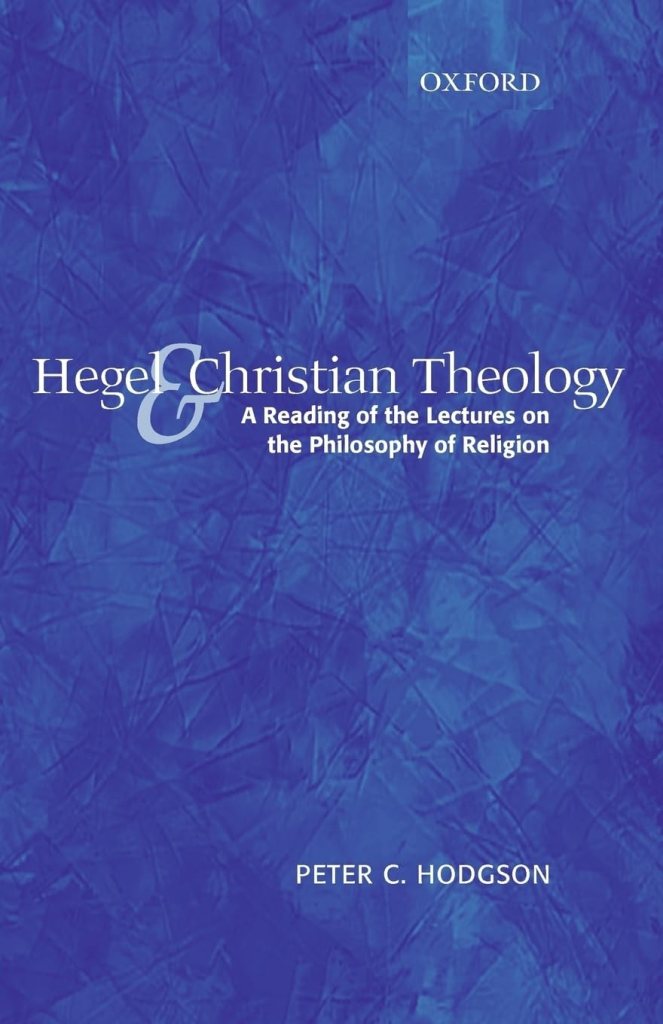
Peter C. Hodgson’s Hegel and Christian Theology: A Reading of the Lectures on the Philosophy of Religion unfolds as a sustained act of philosophical midwifery: it draws the speculative life‑blood from the critical edition of Hegel’s four Berlin lecture series (1821, 1824, 1827, 1831) and lets it circulate anew through the capillaries of contemporary theology. The book appears in tandem with the re‑issue of the trilingual critical text that Hodgson himself helped bring to birth; accordingly, it treats those lectures not as a living manuscript, one whose internal revisions and shifting emphases become clues to Hegel’s restless labour of thought. From first to last Hodgson insists that the text’s deepest impulse is theological, that Hegel’s notorious dialectic is driven by the question of God, and that the whole performance should be read as a speculative reconstruction—rather than a dissolution—of Christian doctrine.
Against the background of Enlightenment critique, romantic historicism and nineteenth‑century scepticism, Hodgson first locates Hegel’s project in what he calls the “philosophical theology of spirit.” The Logos of classical metaphysics is here re‑imagined as Geist, an eternal yet ever‑mobile process of self‑disclosure whose essence is energetic relationality rather than inert substance. To speak of God, therefore, is to speak of the spiral whereby Spirit “streams out to the finite flashes of light of individual consciousness and then gathers itself up out of finitude”. The divine being is not locked in transcendental seclusion; it is the very drama of self‑othering and return. Hodgson follows this leitmotif through the lectures, showing how it allows Hegel simultaneously to absorb Kant’s critique of metaphysics and to escape the anthropological reductionism of Feuerbach: Geist is both subject and substance, absolute intersubjectivity whose concrete self‑realisation is world‑history.
The exposition moves with the rhythm of Hegel’s own tripartite architecture. First comes the conceptual overture in which Hegel defends philosophy of religion as theology in scientific dress, insisting that any genuine cognition of God must dare to think the infinite in the mode of concept rather than flee to the caves of private feeling or historical antiquarianism. Hodgson’s commentary highlights the polemic against Schleiermacher’s turn to Gefühl: for Hegel, “a dog would then be the best Christian” if religion were nothing but dependence; true piety is the freedom of thinking spirit.
The text then turns outward to the immensely ambitious survey of determinate religions. Hodgson tracks Hegel’s repeated attempts—re‑arranged in every cycle of lectures—to plot a phenomenology of religion that begins with nature‑worship and culminates in Christianity, noting both the conceptual brilliance and the historiographical strain of the enterprise. Hegel’s scheme oscillates between a philosophy of history and what Hodgson aptly calls a “geography of religions”; yet in its finest moments it already intimates a pluralist horizon, for the logic that elevates Christianity to consummation also prohibits final closure.
The culminating movement is the speculative redescription of Christian faith itself. Hodgson brings formidable exegetical precision to Hegel’s reconstruction of the Trinity: God is not three numerically distinct substances but infinite personality, a living play of relational moments whose unity is love. The classical predicates—eternity, omnipotence, omniscience—are retained only as they are re‑anchored in the dynamic self‑differentiation of Father, Son and Spirit. Creation is treated as the ekstasis of absolute spirit into space‑time; the Fall as the tragic estrangement whereby finite consciousness discovers itself; reconciliation as the cruciform fulcrum where God owns finitude and negation within the divine life; resurrection as the transition from the sensible immediacy of Christ to the pneumatic community; and the Church as the laboratory of freedom whose vocation is ever threatened by the temptation to ossify into mere positivity. In a remarkable passage Hodgson lingers over Hegel’s anxiety that even the community of Spirit may “pass away,” a warning that presses contemporary readers to resist both nostalgic orthodoxy and facile post‑religious triumphalism.
The final chapters marshal Hegel’s resources for current theological controversies. Hodgson singles out six contested sites—spirit, wholeness, narrative, Christ, community, pluralism—and shows how Hegel’s dialectic can re‑poise each tension. Spirit dissolves the false alternative of heterodoxy versus orthodoxy by redefining being itself as relational energy; wholeness transposes the rivalry of totality and infinity into an open, self‑correcting unity; narrative rescues theology from static concepts without surrendering rational rigor; Christ discloses redemption as the identity of divine and human in the medium of negation; community reframes freedom as reciprocal recognition; pluralism opens Christianity to dialogical self‑surpassal among the religions without erasing its concrete particularity.
Throughout, Hodgson measures Hegel’s daring against both its historical context and its ongoing fecundity. He concedes that Hegel’s data were often second‑hand and that Islam is strikingly absent, yet he argues that the dialectical method itself urges a future‑oriented openness: were Hegel alive today he would likely be “a religious pluralist and a partisan of freedom movements” . The book ends by urging theologians—and philosophers—neither to canonise Hegel nor to discard him, but to practise the same speculative audacity he exemplified: the courage to risk conceptual thinking for the sake of faith’s truth, and the humility to let every synthesis be broken again by experience. In doing so, Hodgson secures for Hegel a place alongside Schleiermacher and Kierkegaard as one of the indispensable interlocutors for any theology that would face modernity and post‑modernity without retreat.
 Simon Gros
Leave a comment