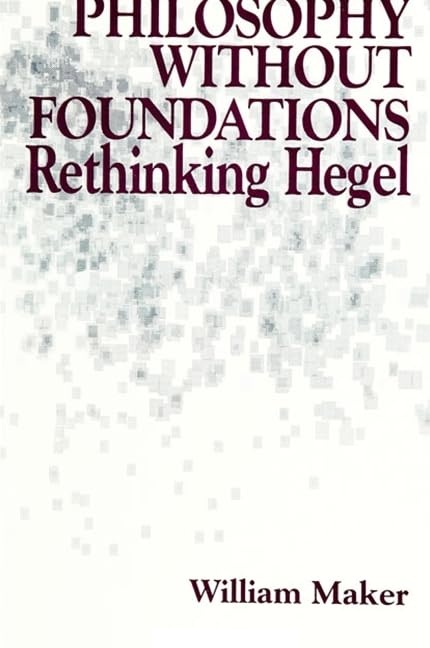
Philosophy without Foundations: Rethinking Hegel by William Maker is an unrelenting philosophical treatise that boldly seeks to dismantle the inherited caricatures of Hegel as a metaphysical absolutist and dogmatic systematizer by rereading him through the prism of contemporary antifoundationalist critique.
In a rigorous and sustained engagement with both the tradition of German Idealism and the prevailing crises in late twentieth-century philosophical discourse, Maker does not merely offer a revisionist Hegel. Rather, he unfolds an argument of philosophical reconstruction: Hegel’s system, far from being a relic of foundational metaphysics, is itself an internally developed, radical critique of foundationalism, and as such, it prefigures and surpasses many of the insights typically associated with postmodern and post-analytic thought. With precise argumentation and conceptual density, Maker advances the provocative thesis that Hegel is the philosopher of autonomous reason precisely because he is the philosopher of the impossibility of epistemological foundations. His system is neither metaphysical in the traditional sense nor foundational in the Cartesian-Kantian schema—it is systematic because it is dialectical, and it is dialectical because it begins with and remains faithful to the insight that thought can only legitimate itself through its own immanent critique.
Central to this work is a deep analysis of the philosophical stakes of antifoundationalism. Maker opens by surveying the philosophical terrain marked by the collapse of traditional epistemology, a landscape shaped by Nietzsche’s genealogical critique, Heidegger’s destruction of metaphysics, Derrida’s différance, Rorty’s neopragmatism, and Gadamer’s hermeneutics. All of these thinkers are united by a rejection of the Cartesian project—the quest for certain foundations, for an autonomous subject that could, through self-reflection, access universal conditions of cognition. According to this antifoundationalist vision, knowledge is perspectival, situated, mediated by historical and linguistic contexts, and irreducibly finite. The ‘framework of givenness’—the inevitable contextual embedding of all claims to knowledge—is understood not as a regrettable limitation, but as the ineluctable condition of human cognition. From this perspective, the very notion of philosophy as a systematic science seems untenable, even dangerous: such a claim is seen as an exercise in authoritarianism, a covert theological absolutism cloaked in rational discourse.
It is precisely this framework that Maker seeks to upend by a return to Hegel—but a Hegel rethought and reinterpreted. Against both defenders and critics who have assumed that Hegel’s system entails the very metaphysical and epistemological dogmas that antifoundationalism opposes, Maker demonstrates that Hegel’s conception of system is itself an alternative to foundationalism. The Phenomenology of Spirit, far from establishing a new edifice of dogmatic knowledge, is read as a radically immanent critique of the entire project of epistemological grounding. It deconstructs every attempt at founding knowledge by demonstrating, from within, the self-defeating logic of any supposed foundational standpoint. For Hegel, philosophical science begins not by securing a foundation, but by losing every ground and undergoing the labor of self-loss through contradiction and negativity. Thus, Maker argues, the dialectical process is not an ascent to the Absolute conceived as a transcendent totality, but rather the unfolding of immanent critique that generates its own necessity. Hegel’s system is not a closure but an opening—a space where rational autonomy can emerge, not as a presupposition but as a result.
Maker’s Hegel is thus an antifoundationalist thinker avant la lettre, and this reinterpretation has momentous consequences. First, it dissolves the dichotomy between modernity and postmodernity that structures so much contemporary philosophical discourse. The postmodern critique of foundationalism, on Maker’s view, is not an external rupture with the Enlightenment project but an internal consequence of its own self-critique, which Hegel had already initiated. Second, this reading recasts the modern philosophical project not as the failed attempt to secure reason on indubitable grounds, but as the unfolding realization that reason legitimates itself only through its capacity to negate and transform its own conditions. Far from being authoritarian, such a conception of reason is inherently emancipatory, since it denies any fixed point of authority and demands that all claims to validity be exposed to the test of immanent critique.
Crucially, this does not mean that all truth claims are equally valid or that relativism triumphs. On the contrary, Maker insists that Hegelian systematic philosophy provides a form of objectivity that is neither metaphysical nor foundational. Objectivity, in Hegel’s sense, is not correspondence to a given reality nor coherence within a self-enclosed paradigm, but rather the achievement of self-conscious reason that has traversed and negated the false appearances of immediacy. This conception of truth is historical, dialectical, and above all, mediated—it emerges not from foundational insight but from the transformative process of reason becoming what it is through the overcoming of its own limitations. In this way, Hegel offers a model of rationality that is neither absolutist nor arbitrary—a model that remains critical without collapsing into nihilism, that preserves normativity without reverting to metaphysics.
Maker’s argument is elaborated through a penetrating series of chapters that address both internal questions in Hegel interpretation and external debates in contemporary philosophy. From the critique of postmodernism and the analysis of transcendental arguments, to the deconstruction of Marxist misreadings and the engagement with hermeneutics, the book traverses a wide field while remaining focused on its central claim: Hegel’s system, properly understood, is a unique form of systematic antifoundationalism. In this respect, the work functions not only as a defense of Hegel’s relevance but as a meta-philosophical intervention into the nature of philosophical practice itself. Philosophy, for Maker, is not a discipline that begins with axioms and proceeds deductively to conclusions, but a dynamic process of conceptual transformation in which every beginning must justify itself through its unfolding.
The consequence of this argument is not simply an updated Hegel, but a renewed conception of philosophy. In an age where philosophical discourse is often torn between the Scylla of relativism and the Charybdis of dogmatism, Philosophy without Foundations offers a third way: a path that does not begin with certainty but with self-questioning, not with authority but with critique. It returns us to Hegel not as a figure of closure, but as the thinker who made the closure of philosophy impossible by showing that reason, if it is to be free, must be grounded not in something external, but in its own restless, dialectical activity. For those who believe that philosophy can still matter—that it can speak to our deepest concerns about truth, freedom, and community—Maker’s book is both a challenge and an invitation: to rethink Hegel, and through Hegel, to rethink philosophy itself.
 Simon Gros
Leave a comment