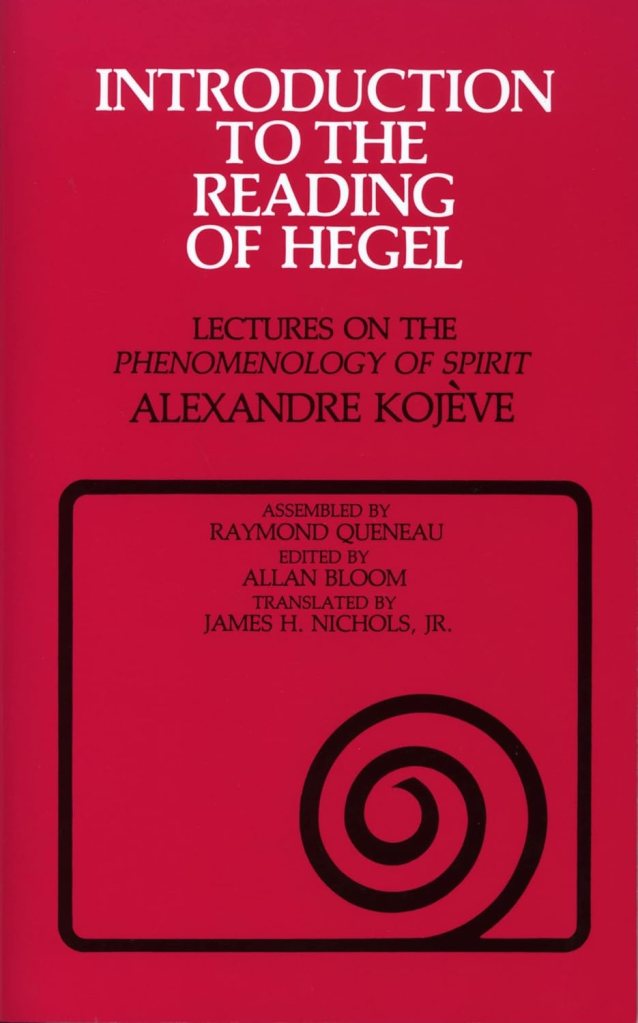
Introduction to the Reading of Hegel: Lectures on the Phenomenology of Spirit stands as one of the twentieth century’s rare philosophical milestones, a work that both revived and reoriented an entire French understanding of Hegel’s magnum opus. Born in the ferment of pre‑World War II Paris, these lectures—delivered by Alexandre Kojève between 1933 and 1939 at the École des Hautes Études—were assembled by Raymond Queneau and brought to Anglophone readers by Allan Bloom’s incisive editorship and James H. Nichols’s carefully calibrated translation. Kojève’s aim was nothing less than to expose Hegel’s Phenomenology as the living engine of modern thought and to show how, in Hegel’s dialectic of Master and Slave, we discover the “origin” of human self‑consciousness—its birth in the struggle for recognition and its unfolding through work, history, and the attainment of absolute knowledge.
Kojève’s Introduction to the Reading of Hegel: Lectures on the “Phenomenology of Spirit” is more than a set of classroom notes; it is an intellectual seismograph recording the deepest tremors of twentieth‑century philosophy. Edited by Allan Bloom, assembled from the 1933–39 Paris lectures by Raymond Queneau, and rendered into an exacting English by James H. Nichols Jr., the volume stages a four‑way conversation among lecturer, compiler, editor, and translator, each imprinting the text with his own rigor while allowing Kojève’s voice to prevail. The resulting book reads not as an “introduction” in the didactic sense but as a philosophical totality, compacting within its pages Kojève’s claim that the only adequate prolegomenon to Hegel is the dramatic reenactment of Hegel’s own dialectic.
Bloom’s introductory meditation already positions the work as a decisive moment in modern thought, insisting that “contemporary concerns are best understood in the permanent light of Hegel’s teaching” and praising the lectures for turning scholarship into a living inquiry that dissolves the sterile opposition between academic erudition and existential urgency. On Bloom’s reading, Kojève’s six‑year line‑by‑line exegesis substitutes patient textual fidelity for fashionable speculation, thereby restoring Hegel to a centrality from which both positivists and avant‑garde dilettantes had excluded him. The book is therefore doubly pedagogical: it teaches Hegel and, at the same time, teaches how to read.
The architecture of the English edition preserves the pulse of the original seminar. A brisk “In Place of an Introduction” opens onto summaries of the first six chapters of the Phenomenology, segues into yearly course synopses, and culminates in extensive transcript‑chunks devoted to eternity, time, and the figure of the Wise Man. The table of contents is itself a diagram of Kojève’s hermeneutic ascent from “Sentiment of Self” through “Philosophy and Wisdom” toward a post‑historical standpoint where “the Structure of the Phenomenology” can finally be surveyed in retrospect . Nichols’ translator’s note reminds us that barely half of the French text made it into this version, yet even in its abridged form the book radiates the compression of six thousand pages of marginalia into six hundred pages of distillate.
Kojève’s guiding wager is that the Phenomenology is not a chronicle of abstract stages but the existential biography of Spirit, and that the biography can be retold only from the vantage point of its completion. Hence the lectures begin where most commentaries end: with the insistence that Hegel’s ultimate theme is the philosopher’s own capacity to know himself, a capacity inseparable from the possibility of absolute wisdom . At the heart of that possibility lies the dialectic of Desire and Recognition. Kojève’s reconstruction of § A, Chapter IV (“Autonomy and Dependence of Self‑Consciousness”) dissects the inaugural combat in which nascent humans stake their animal life on the demand to be recognized as persons. One combatant—willing to “go all the way” in risking death—creates himself a Master; the other, recoiling before death, becomes a Slave . From that asymmetry springs the entire edifice of history: the idle Master trapped in sterile enjoyment and the laboring Slave who, through work, negates nature, transforms the world, and finally fashions himself as autonomous subject.
Kojève’s genius is to show that the truth of Self‑Consciousness does not reside with the self‑satisfied lord but with the trembling bondsman whose forced labor externalizes human form in artifacts and institutions. Work, he writes, is “an auto‑creative act” that raises the Slave from subjection to freedom and installs technology, art, and law as sediments of human negativity in the world . By exposing the Master’s dependence on slavish production, Kojève anticipates Marx’s critique of surplus value, yet he simultaneously exceeds Marx by insisting that work’s deepest yield is not material wealth but the very language (Logos) through which Being is revealed.
From the Master‑Slave germ Kojève unfolds a panoramic history that terminates, audaciously, with Napoleon’s cannon at Jena. Only when Hegel hears “the sounds of that battle,” Kojève argues, can he recognize that the dialectic has synthesized its antagonists into the citizen of a “universal and homogeneous State” and that philosophy may legitimately claim to be absolute knowledge . Bloom pinpoints this as Kojève’s most “striking feature”: the insistence that history, properly understood, is complete, leaving post‑historical humanity to inhabit a rational order without further world‑transforming tasks.
Yet Kojève does not end in complacency. He foresees the risks of a world devoid of struggle—risks he dramatizes in the notorious “Note on Japan.” Here post‑historical life bifurcates into an American path of material plenitude and a Japanese path of formalized “snobbery,” both trajectories threatening a re‑animalization of humankind even as they preserve, in strangely aestheticized rites, the empty form of freedom . The specter of “Japanization” guards Kojève’s system against self‑congratulation, breaking the serenity of the “eternal present” with an admonition that Spirit, if it is to remain human, must perpetually detach form from content, even when creative negation gives way to ritual repetition.
In the final lectures, Kojève turns from the historical slave to the post‑historical Wise Man, a figure who no longer changes the world but contemplates its finished totality under the concept of Science. The Wise Man stands outside the temporal succession he narrates and yet, paradoxically, owes his standpoint to the world‑making labor of generations; time itself becomes the category he both transcends and interiorizes. The circle thus closes: philosophy achieves the self‑knowledge it always sought, but only because the violent, working, desiring animal has written its history into the texture of reality.
Throughout, Kojève’s prose—preserved through Nichols’ scrupulous renderings of technical terms like aufheben as “overcome” or “do away with,” and coinages such as “thingness” for Dingheit—embodies the very process of abstraction it describes . The commentary is alternately lyrical, sardonic, and forensic, weaving Marx, Aristotle, Christianity, and Heidegger into a single argumentative thread that justifies Hegel’s claim to absolute wisdom all while holding that claim under relentless scrutiny.
To read this book, then, is to traverse the complete arc of the Hegelian Spirit from bestial appetite to speculative repose, reenacted in a Parisian lecture hall and refracted through the intellectual crises of modern Europe. It is to feel the heat of a battle fought not only at Jena but in every classroom where students risk the death of opinions for the life of thought. And it is to confront the unsettling prospect, announced with Kojève’s calm audacity, that philosophy’s owl may already have taken its final flight at dusk—and left us, in the long twilight, to decide whether we will repeat its wisdom, abolish it, or, impossibly, begin anew.
 Simon Gros
Leave a comment