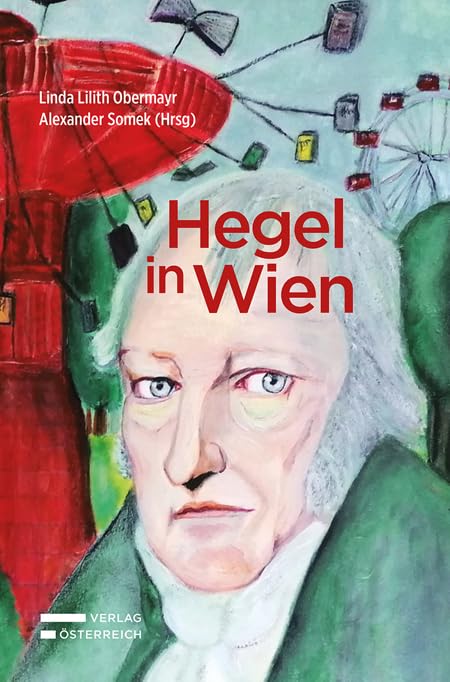
Hegel in Wien: Eine Ringvorlesung zu Hegels Rechtsphilosophie am Wiener Juridicum, edited by Linda Lilith Obermayr and Alexander Somek, is a monument of commemorative and exegetical scholarship that embodies not merely a retrospective academic gesture toward the bicentennial of the first publication of Grundlinien der Philosophie des Rechts (1821), but also the reactivation of the speculative core of Hegel’s mature political philosophy within the contemporary juridical and philosophical framework of a late modern European university. The volume documents the 2021–2022 winter-semester lecture series held at the Juridicum of the University of Vienna, a ring of philosophical reflection that functions itself as an institutional echo chamber of Geist’s self-recognition in and through the law.
The collected essays unfold as secondary commentary and as constitutive nodes in a reengagement with Hegel’s Rechtsphilosophie, where the legal form becomes the exemplary site through which speculative reason mediates ethical life (Sittlichkeit) and universal freedom. The volume does not treat Hegel’s legal philosophy as a mere artifact of historical jurisprudence but as a still-pulsating organism, whose dialectical movements continue to shape, constrain, and provoke legal and moral consciousness in the present. It thus situates Grundlinien not in a conceptual mausoleum but at the threshold of its own renewal.
Obermayr and Somek inaugurate the collection by staging the paradoxical encounter between Rossini’s bel canto opera and the “Hegelfieber” at the Viennese Juridicum, thereby rendering audible the melodics of speculative reason and the cultural atmosphere from which Hegel’s juridical thinking emerged. This aesthetic-theoretical overture functions as a hermeneutic key: Hegel’s thought, like opera, is a staging of spirit’s drama, a movement from abstraction toward concrete universality.
Tatjana Sheplyakova interrogates the concept of the Idea of Right, articulating its ontological rather than merely doctrinal status: in Hegel, the law is not a positive system external to freedom but the mode in which freedom becomes actual, which is to say, becomes law. Kristin Albrecht and Folko Zander further radicalize this reading by focusing on abstract right, not as an incomplete stage but as a condition of possibility for legal subjectivity. Its abstraction is not a defect but a necessary moment of universality, which must negate itself in the emergence of moral consciousness and ethical life.
Obermayr’s essay on the Krankheit dieser Zeit—the moral illness of modernity—develops Hegel’s critique of subjectivist morality as symptomatic of a broader fragmentation of the ethical whole. Morality in Hegel’s framework is not mere individual conscience but a socially mediated structure of recognition, which in its degeneration, reveals itself as inadequate to the task of embodying freedom. Alexander Somek’s contribution follows this movement from morality (Moralität) to ethical life (Sittlichkeit), and in doing so confronts what he calls the “riddle” of Hegel’s Rechtsphilosophie: how the universal becomes immanent without dissolving into the particular, how institutions instantiate norms without succumbing to mere positivism.
Alfred J. Noll examines the notion of bürgerliche Gesellschaft, not in the sociological sense of civil society as a pluralistic realm of freedom, but in its Hegelian complexity as a contradictory structure: the site where needs, labor, and family converge in a mediated universality, and where the inner antagonisms of bourgeois freedom become both visible and unresolvable without recourse to the state. Andreas Gelhard turns this problematic inward, to the bureaucratization of education and its reflection in Hegel’s thought: the formation of juridical consciousness through institutionalized examinations reveals not merely a pedagogy of knowledge but a reproduction of rational authority.
Christoph Bezemek and Thomas Meyer analyse the architecture of the Hegelian state, not as a monolithic sovereign but as the embodiment of ethical life in its rational organization. Their analyses foreground the state as the culmination of freedom’s dialectical path, where right is no longer external but immanent to the will. Jakob Rendl’s discussion of international law (Völkerrecht) challenges the limits of this immanence, as the state encounters the other in a space beyond ethical totality—thus opening the question of whether Hegel’s framework can encompass a cosmopolitical horizon or remains tethered to a statal metaphysics.
Frank Ruda’s intervention, titled Sich entschließen (“to resolve oneself”), brings to the fore the subjective act of decision as a site of radical freedom and necessity. In Hegel, the act of willing is not a spontaneous eruption but the determinate negation of indeterminacy, a moment in which the universal inscribes itself in the singular. Finally, Stefan Iordanescu’s contribution on Weltgeschichte (world history) closes the volume by situating legal and political philosophy within the broader speculative logic of history, understood not as chronological sequence but as the unfolding of reason through contingency.
The project of Hegel in Wien thus reanimates Hegel’s Rechtsphilosophie not through doctrinal fidelity or historicist reconstruction but through speculative participation in the text’s own self-becoming. The contributions exemplify beyond an academic symposium and show the performative repetition of the concept, in which thinking legal order becomes itself a legal act, and interpreting Hegel becomes part of Hegel’s system. By situating Vienna not merely as a geographical locus but as a philosophical event—a stage on which Hegel’s speculative jurisprudence is recast within the contours of postmodern constitutionalism, European legal crisis, and global ethical disarray—the editors and contributors affirm that Hegelian legal philosophy remains not only legible but necessary.
This volume is indispensable for jurists, philosophers, and political theorists who seek not a doctrine to be memorized but a thought to be lived—a thought in which the law is not the limit of freedom but its truth. Hegel in Wien is not a commentary on a classic text; it is the living echo of a text that continues to think us.
 Simon Gros
Leave a comment