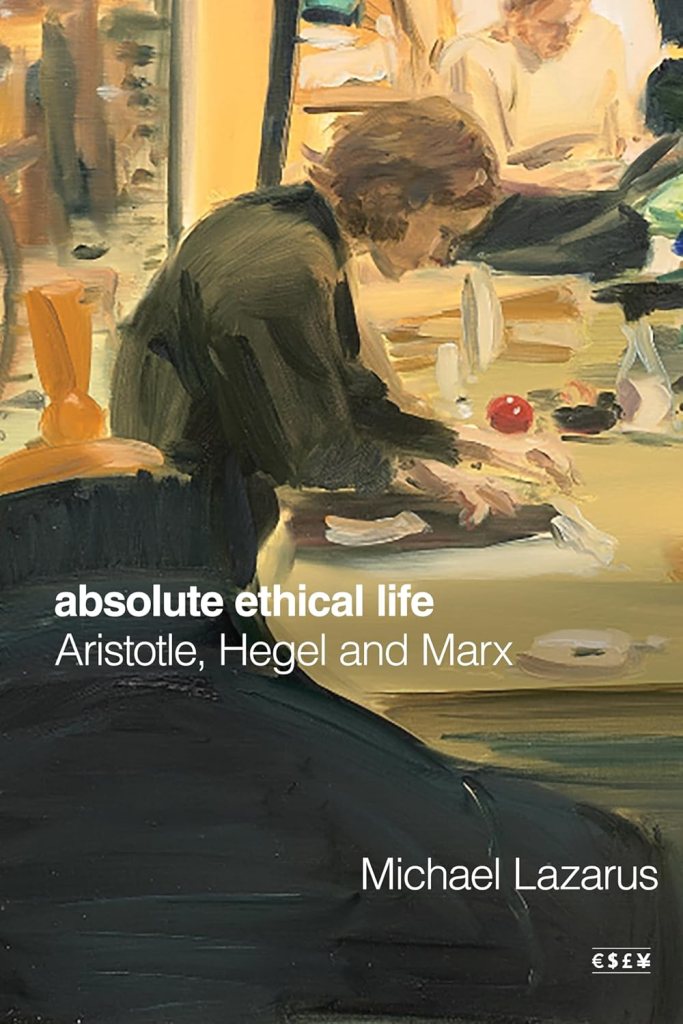
In Absolute Ethical Life: Aristotle, Hegel and Marx, Michael Lazarus offers an unparalleled reconstruction of Karl Marx’s critique of capitalism as a deeply ethical project—one whose normative depth and philosophical ambition have often been overlooked or mischaracterized. This book resolutely breaks from reductive readings of Marx as a narrowly economic thinker or an ideologue of deterministic historical materialism. Instead, Lazarus repositions Marx within the tradition of ethical and political philosophy inaugurated by Aristotle and radicalized by Hegel, demonstrating that Marx’s central theoretical contribution—the value-form theory—is not merely an abstract economic model, but a historically determinate critique of capitalist life as a misrecognition of freedom, an alienation of rational agency, and a barrier to collective human flourishing.
The book begins by tracing the normative undercurrents of Marx’s unfinished Capital, particularly its notoriously challenging first chapter on the commodity and the value-form. Rather than rewriting or simplifying the entry-point into Marx’s conceptual universe, Lazarus undertakes a painstaking exegesis that reveals how Marx’s categories are not economic descriptors but philosophical determinations—critical diagnoses of the abstract forms of social mediation that structure modern life. The commodity, money, capital, and wage-labour are more than mere economic facts; they are historically specific forms of social being that encode relations of domination and alienation, abstracting away from the very freedom and mutual recognition they ostensibly mediate.
What emerges from Lazarus’s reconstruction is a vision of Marx’s critique as grounded in a form of ethical life, Sittlichkeit, that has been foreclosed under capital. By carefully unfolding Marx’s immanent method of critique, Lazarus reveals how capitalism constitutes a distorted totality in which the ends of human flourishing are subordinated to the endless accumulation of abstract value. In this context, Marx’s theory of value is not a revival of the Ricardian or Lockean labour theory of value, but an inversion and surpassing of it: a “value theory of labour” that articulates labour not as a physiological substance but as an abstract, social form of life. Labour becomes a real abstraction: it produces value not only in commodities but in the very structure of social relations, and thus alienates human beings from their capacities as rational, purposive, and social agents.
To situate this critique philosophically, Lazarus places Marx in dialogue with Aristotle and Hegel, arguing that all three share a commitment to a conception of the human being as a political and ethical animal—one whose flourishing is realized only within historically and socially structured institutions that mediate individual and collective agency. From Aristotle, Marx inherits a teleological vision of the good life (eudaimonia) grounded in rational activity and political association. From Hegel, he inherits the speculative method and the conception of ethical life as the concrete universal in which subjective freedom is realized through institutions of mutual recognition. But Marx radicalizes both: the polis of Aristotle and the rational state of Hegel are shown to be historically specific forms that cannot survive the contradictions of capital. For Marx, ethical life can only be realized through the abolition of the value-form and the emancipation of social labour from its commodified, fetishized condition.
The titular concept—“absolute ethical life”—thus represents a philosophical horizon, a regulative ideal that arises immanently from Marx’s dialectical critique. Drawing on Gillian Rose’s recovery of Hegelian speculative reason, Lazarus argues that Marx’s critique of political economy is at bottom a critique of modern reason’s failure to recognize itself in the social forms it creates. The metaphysical grandeur of the value-form—its ability to act “as if” independent of human will—is shown to be both a symptom of alienation and a clue to its supersession. Marx’s thought thus calls for a social form in which the mediation of labour, value, and social being is no longer estranged from the ends of human life, but becomes the very medium of its realization. This is ethical life in the absolute sense: not a reversion to premodern virtue ethics, nor an abstract moral injunction, but a historically situated, dialectically mediated form of collective freedom.
Lazarus’s work is also a confrontation with the misreadings and evasions of Marx’s ethical thought in the modern tradition. Against Hannah Arendt’s disdain for Marx’s absorption of the social into the economic, and against Alasdair MacIntyre’s failed attempt to assimilate Marxism into Aristotelian virtue ethics, Lazarus demonstrates that Marx was always a thinker of the social—Gesellschaftlichkeit—in the richest philosophical sense. His categories—alienation, abstract labour, social reproduction, the fetishism of commodities—are not empirical descriptors but the dialectical determinations of a social ontology, a mode of being whose historical specificity is inseparable from its normative content. To overlook the ethical stakes of these categories is to reduce Marx to a caricature: an economistic fatalist or an idealist heretic. To grasp them, by contrast, is to rediscover Marx as a thinker of emancipation, of social freedom, of human dignity wrested from the petrified logic of capital.
Absolute Ethical Life is a challenge to contemporary political theory, which too often brackets capitalism as a neutral backdrop rather than a historically specific mode of social domination. Lazarus insists that any viable conception of modern life—whether democratic, republican, post-structuralist, or ecological—must reckon with the determinations of value. The book does not offer a blueprint for revolution or a nostalgic return to Marxist orthodoxy; it offers something more dangerous: a philosophical claim that we have not yet begun to take Marx seriously. In reviving the idea that critique is inseparable from ethical life, and that the future is immanent in the contradictions of the present, Lazarus renews the promise of philosophy itself. This is not just a book about Marx, Aristotle, or Hegel—it is a profound meditation on the conditions of freedom, the form of the good life, and the imperative to think, once again, the unity of the rational and the real.
 Simon Gros
Leave a comment