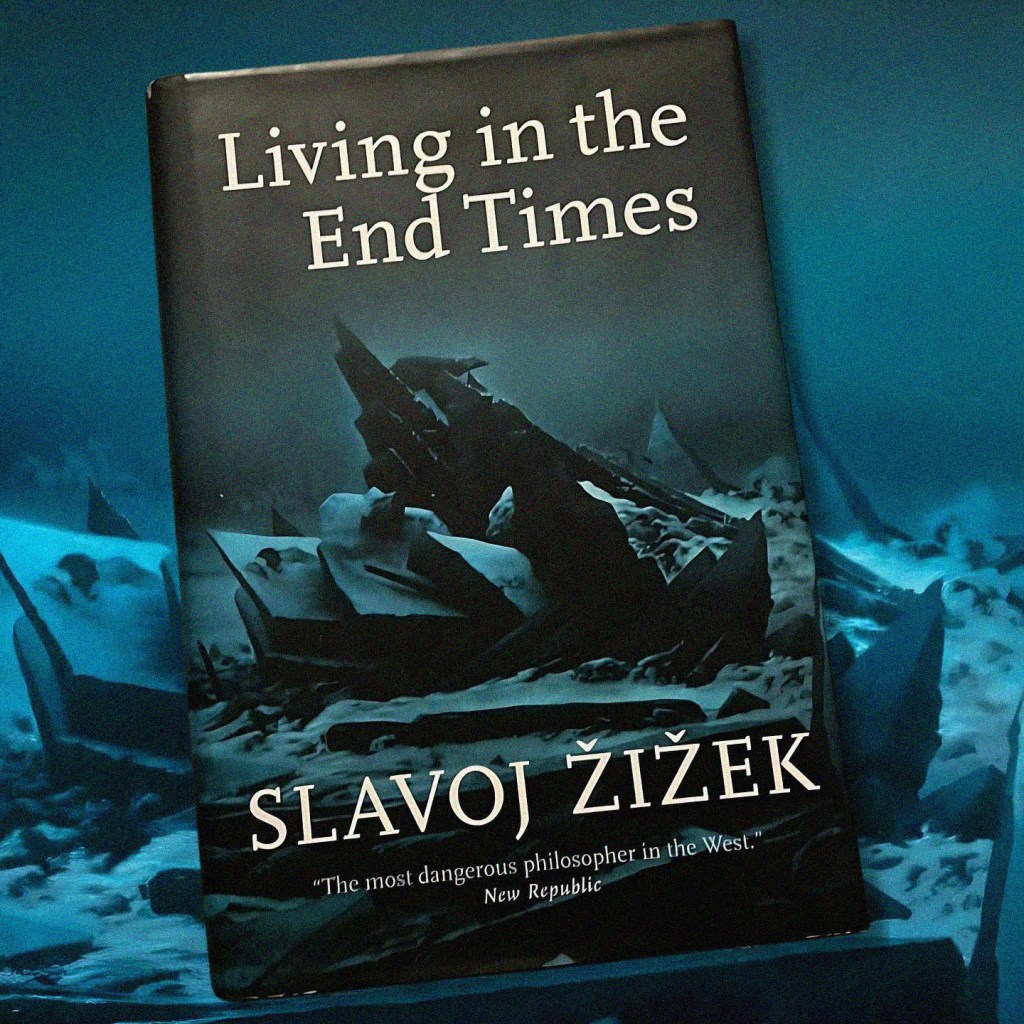
In Living in the End Times, Slavoj Žižek plunges us into the vertiginous space where the collapse of global capitalism converges with the apocalypse of our collective imagination. From the first pages, Žižek insists that there can be no more illusions: the “four riders of the apocalypse”—the ecological meltdown, the internal imbalances of the market system, the unleashed powers of the biogenetic revolution, and the widening chasm of social divisions—are galloping inexorably toward us. He frames our civilization’s predicament not merely as a forthcoming economic crisis but, more directly, as the end of a world order so totalizing that its dissolution feels like the collapse of reality itself. Only by confronting annihilation in all its guises can we hope to find a spark of rebirth; yet Western society, he argues, is trapped in the ritualized stages of grief, mistaking denial for stability, rage for rebellion, bargaining for political reform, depression for passive withdrawal, and finally mistaking resignation for acceptance.
Žižek’s account of denial unmasks the comforting fantasies that prop up liberal capitalist common sense. In our insistence that “the market will self-correct,” in the blockbuster films that imagine technocratic salvation, and in the New Age platitudes promising transcendence without sacrifice, we cultivate an ethical anesthesia. We gloss over the fact that the same system boasting unprecedented wealth generation depends on “mafia-mining” in the Congo, where millions have perished so that our smartphones might sparkle in our palms. Here, Žižek’s blend of psychoanalysis and historical materialism reveals the sinister pleasure we take in our disavowal: to laugh at the absurd excesses of global capitalism is to seal our own subjection to it. This laughter, he warns, is ideology at its purest form—an ironical distance that binds us more tightly to the very system we believe we scorn.
When anger finally erupts—through protest encampments, through jihadist terror, through populist uprisings—it resembles a collective psyche in meltdown. Žižek shows how rage against injustice quickly splinters along sectarian lines, offering no coherent alternative to the capitalist order it attacks. Theologico-political movements, from evangelical crusades to radical Islamist militancy, exemplify the second stage of grief wrought on a global scale. They lash out with fundamentalist zeal, seeking vengeance for injuries sustained, but in doing so they unwittingly reinforce the very divides they claim to transcend. Žižek’s searing critique of this cycle of resentment challenges us to ask whether any movement fueled by hatred can ever deliver genuine emancipation, or whether it simply paves the way for yet another tyrannical order.
It is in bargaining that Žižek finds the most insidious form of capitulation: the half-hearted reforms, the tinkering with neoliberal regulations, the fetishistic appeals to sustainability that leave the fundamentals of capital untouched. Here Marx’s critique of political economy is summoned back to life, as Žižek traces how every attempt to “green” capitalism, to introduce welfare-state counterbalances, or to regulate corporate excess ends up strengthening the system’s resilience rather than undermining it. We offer concessions—carbon taxes, financial transaction levies, corporate social-responsibility initiatives—only to discover that the economic machine absorbs these concessions as ballast, spinning faster on its own axis. The bargaining stage, Žižek contends, is the trap of false hope, where a longing for incremental change masks the impossibility of any future within the existing coordinates of capital.
When these cures fail—and they must, for the terminal crisis of capitalism is not a cyclical recession but a one-way journey toward collapse—depression sets in. Žižek explores the psychic trauma induced by the realization that no policy, no social movement, no technological fix can avert the gathering storm. The collective psyche recoils into withdrawal, a “neuronal trauma” in which individuals, numbed by ecological despair and economic precarity, retreat into online lives, consumer distractions, or spiritual escapism. Yet this stage is not merely pathological: Žižek argues that only by traversing the abyss of depression can a subject become capable of genuine agency. It is in the void of possibility that the ground for spontaneous, unorthodox responses emerges, though most of us turn instead to the anesthetizing comforts of the status quo.
Finally, in acceptance, Žižek does not offer sanguine resignation but rather a militant re-engagement with reality. Drawing on Mao’s paradoxical enthusiasm for chaos—“If there is great disorder under heaven, the situation is excellent”—he proposes that the only way out of this impasse is a leap into the unknown. Here Žižek locates the embryonic forms of a new communist culture, strewn across literary utopias, subversive art, and grassroots experiments in solidarity economics. He conjures Kafka’s collective of mice, the outcast heroes of the old television series Heroes, and the community-building visions of radical filmmakers as signposts toward a possible reinhabitation of our world. Acceptance, in Žižek’s idiom, is a revolutionary fidelity to freedom, a readiness to embrace the impossible event that will shatter the capitalist totality.
In a sweeping afterword written expressly for the second edition, Žižek widens his lens to encompass the labyrinthine webs of WikiLeaks, the opaque power dynamics of the Chinese Communist Party, and the bewildering proliferations of digital surveillance. No corner of contemporary life escapes his scrutiny: he interrogates the Kafkaesque rituals of secrecy that prop up the PRC’s party-state apparatus, the paradoxes of transparency in the age of information leaks, and the emergent cybernetic imaginaries that promise posthuman futures while coded by corporate logic. This leaves almost no subject untouched, binding the epic narrative of capitalism’s twilight to the countless flashpoints of our century: from the data-mined subjugation of social media users to the gene-edited potentials of “designer children.” It is a record of our era’s delirium, composed in the ragged breathless voice of a thinker in hyperdrive.
Reviews have hailed Žižek as “the most dangerous philosopher in the West” and celebrated his “fierce brilliance” and “scintillating” prose. He is lauded as the intellectual heir of Derrida for our troubled times and praised for weaving together psychoanalytic and historical materialist theories with panache. To read Living in the End Times is to be immersed in an encounter that is at once exhilarating and disquieting: Žižek never avoids, never consoles; he provokes, unsettles, and demands that we rethink every assumption about freedom, democracy, nature, and the social bond.
Yet Žižek’s provocations are not gratuitous. As one reader observes, this is a work that “provides all the unpleasant truths which we have never longed to hear”—from corporate-financed war crimes in the Congo to the hidden libidinal currents that underlie even the most seemingly benign ideologies. In Žižek’s hands, the grotesque and the sublime are inseparable: the same dialectical lens that illumines the horror of capitalist exploitation also reveals the uncanny jouissance that sustains it. His theoretical virtuosity—calling upon Marx, Hegel, Kant, Lacan, and Badiou in rapid succession—aims not to dazzle but to equip us with the concepts necessary to apprehend our predicament and to act.
Living in the End Times is not a prognostication but a call to thinking. Žižek insists that truth must be lived, not taught, and that only a terrified awareness of our own role in sustaining the global order can ignite the courage to revolt. As he reworks Paul’s admonition—our struggle is not against flesh and blood but against the spiritual wickedness of this world order—he urges us to seize the moment when capitalist nihilism can be transmuted into a new collective subjectivity. Whether one emerges from these pages exhilarated or enraged, comforted or terrified, the fact remains: Žižek has given us a philosophical work that will haunt our dreams and challenge our every waking thought.
 Simon Gros
Leave a comment