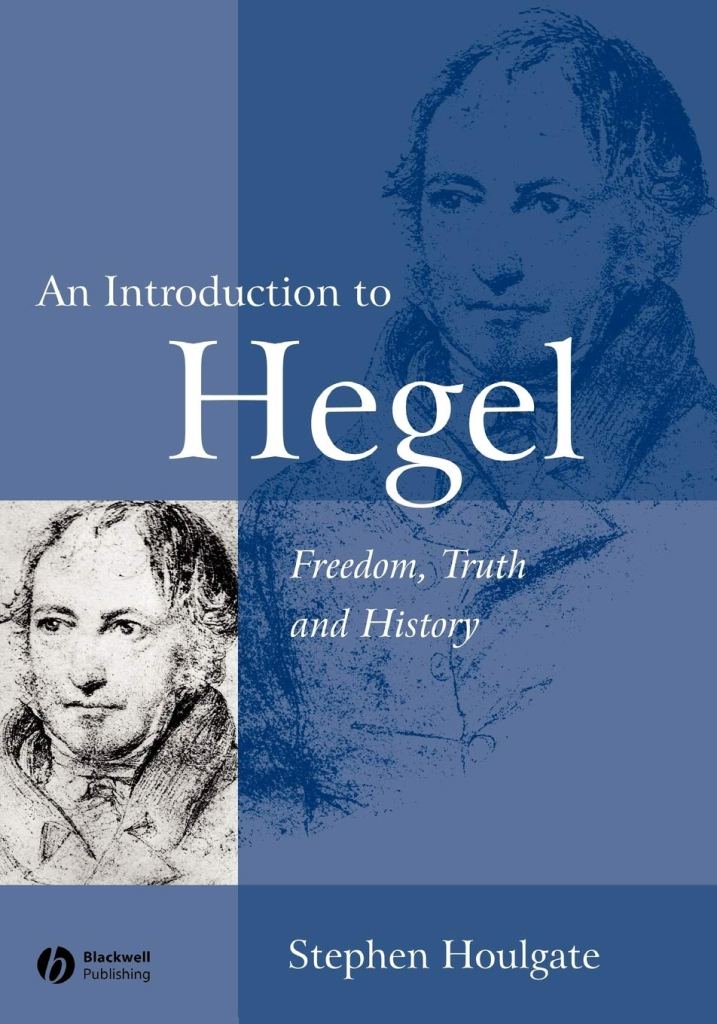
Stephen Houlgate’s An Introduction to Hegel: Freedom, Truth and History is more than a survey of one of modern philosophy’s most demanding thinkers but a comprehensive, conceptually rigorous, historically grounded, and systemically faithful reconstruction of the architecture and dynamism of G.W.F. Hegel’s philosophical system. More than an introduction in the superficial pedagogical sense, Houlgate’s work invites us to traverse the dialectical self-unfolding of speculative thought, and carefully examines Hegel’s notoriously difficult terrain with philosophical sympathy, scholarly erudition, and a fidelity to the inner necessity of Hegel’s thinking that is rarely matched in the secondary literature.
Against the widespread view that the Hegelian system is a fossil of German Idealism, whose conceptual scaffolding collapsed under the weight of its own historical anachronism, Houlgate proposes a forceful rejoinder: Hegel’s philosophy is not a metaphysical relic but a living, viable intellectual enterprise whose value lies precisely in its presuppositionless character and its immanent treatment of freedom as the self-grounding truth of spirit.
The work is a deeply reflective engagement with the core themes of Hegel’s mature philosophy. It provides a systematic, yet accessible, account of Hegel’s conceptual edifice by following the internal movement of his thought as it unfolds across history, logic, nature, spirit, politics, art, and religion. Far from being a mere summary or exegesis, Houlgate’s work is a robust defense of the continued philosophical significance of Hegel’s thought, with particular attention to its relevance in understanding freedom and truth in a historically mediated world.
The book begins by emphasizing the historical dimension of philosophical thought, tracing how concepts are never static or unconditioned, but always emerge within particular civilizational configurations. Houlgate stresses Hegel’s deep historicism, his insistence that even the most abstract categories of logic are sharply implicated in the evolution of human consciousness and self-understanding. This historical embeddedness, however, does not collapse into relativism, for Hegel maintains that freedom—understood as self-determination—is the ultimate telos of history. Houlgate reconstructs this argument by contrasting Hegel’s position with both Kant’s transcendental idealism and Kuhn’s theory of paradigms, showing that for Hegel, the unfolding of thought is both historically situated and progressively revelatory of reason’s own inner structure.
With Houlgate’s interpretation the idea of presuppositionless thinking becomes central, which he claims is essential to Hegel’s method. Being more than naive empiricism it shows the radical philosophical project: a thinking that generates its own categories immanently rather than relying on external foundations. Houlgate follows Hegel in asserting that true philosophical thinking must be self-grounding and dialectical, unfolding the necessity of each concept through its own immanent contradictions. The Science of Logic, Hegel’s magnum opus, is accordingly read as the exposition of the inner development of pure thought from indeterminacy (being) to absolute conceptuality (the Idea), not as a metaphysical system but as the movement of becoming.
The Phenomenology of Spirit is treated as a crucial transitional work that traces the development of natural consciousness toward philosophical self-consciousness. Houlgate dedicates substantial attention to its most famous episodes, such as the master-slave dialectic, the unhappy consciousness, and the progression through reason and spirit to absolute knowing. He highlights how these stages embody increasing levels of freedom, culminating in the philosophical standpoint in which consciousness becomes fully aware of its own conceptual activity. This movement, Houlgate argues, is the experiential grounding for the more abstract system of logic, nature, and spirit in Hegel’s Encyclopaedia.
Houlgate gives special emphasis to Hegel’s long-neglected Philosophy of Nature, challenging the widespread dismissal of it as speculative or pseudoscientific. Houlgate carefully defends Hegel’s speculative insights into gravity, mechanics, and biology, stressing that Hegel’s project is not to compete with empirical science but to reflect on the conceptual presuppositions that underlie it.
The Philosophy of Spirit—especially subjective and objective spirit—is treated as the sphere in which the freedom revealed in nature becomes conscious and institutionalized. Houlgate discusses Hegel’s account of individuality, sociality, rights, and ethical life, engaging with criticisms that Hegel’s theory paves the way for authoritarianism. On the contrary, Houlgate argues that Hegel’s vision of the rational state, as articulated in the Philosophy of Right, is a nuanced theory of freedom, balancing the claims of the individual, civil society, and the state. True freedom, for Hegel, is not the arbitrary will of the isolated subject, but the realization of rational autonomy within the structures of ethical life.
Art, religion, and philosophy—what Hegel calls absolute spirit—are treated by Houlgate not as mere ornaments atop the edifice of spirit, but as essential expressions of human wholeness. Art gives sensuous expression to spirit, religion renders it in representation, and philosophy alone brings it to conceptual self-consciousness. Houlgate provides a rich interpretation of Hegel’s aesthetic theory, especially the transition from symbolic and classical to romantic art, and explains why Hegel considers art to be in a certain sense “dead” in modernity. Religion, particularly Christianity, is treated as the historical vehicle through which the truth of spirit—its infinite worth and freedom—is intuited and revered.
Importantly, Houlgate does not present Hegel as a thinker of closure or finality. While Hegel sees his system as the culmination of philosophical development, Houlgate insists that this culmination is the self-conscious openness of spirit to itself—an open totality in which contradictions are not eliminated but mediated. This applies not only to logic or history but to the living actuality of philosophical thinking itself. Philosophy, for Hegel and for Houlgate, is the activity of thought understanding its own freedom and finitude, never reducible to dogmatic statements or rigid systems.
Throughout the book, Houlgate is committed to showing that Hegel remains a vital thinker for contemporary debates on truth, relativism, nature, freedom, and historical consciousness. He rejects the caricature of Hegel as an obscurantist metaphysician or apologist for authoritarianism, presenting instead a thinker of radical freedom, critical reflection, and self-determining reason. Hegel’s dialectic, far from being an archaic method, is portrayed as an ongoing labor of conceptual mediation—a process that enables us to grasp the necessity and development of our own thought and the structures of the world it inhabits.
Throughout the book, Houlgate remains attentive to the historicity of categories. He follows Hegel in maintaining that philosophy is not ahistorical speculation but the rational comprehension of one’s own time in thought. He offers a sustained reflection on the evolution of concepts from antiquity to modernity, showing how categories such as substance, causality, or individuality transform not arbitrarily, but in accordance with the inner logic of freedom’s self-realization. His careful comparison with Kant—particularly the difference between Kantian formalism and Hegelian speculative rationality—clarifies the stakes of Hegel’s claim: not to impose structure onto the world, but to show that the world itself is the unfolding of conceptual life.
An Introduction to Hegel: Freedom, Truth and History is not just a summary or primer on Hegelian philosophy—it is a sustained and passionate philosophical engagement with Hegel as a living interlocutor. It opens Hegel’s thought to new readers while challenging specialists to reconsider their assumptions. By foregrounding freedom, presuppositionlessness, and historical consciousness, Houlgate presents a Hegel for our time: a philosopher of self-transcending reason, deeply attuned to the unfolding truth of human freedom in nature, society, and thought.
Stephen Houlgate himself, Professor of Philosophy at the University of Warwick, brings to this edition decades of engagement with Hegelian scholarship. As President of the Hegel Society of Great Britain, Houlgate stands at the forefront of Hegel studies, and in this revised classic he offers an indispensable guide to all who seek to grasp the enduring import of Hegel’s vision of freedom, truth, and history. For anyone determined to venture into the Phenomenology or Science of Logic with their own critical faculties sharpened, this introduction remains, in T. Butler-Bowdon’s words, “the best introduction to Hegel around,” one that demonstrates why Hegel’s thought remains a living, challenging, and presuppositionless enterprise for our time.
 Simon Gros
Leave a comment