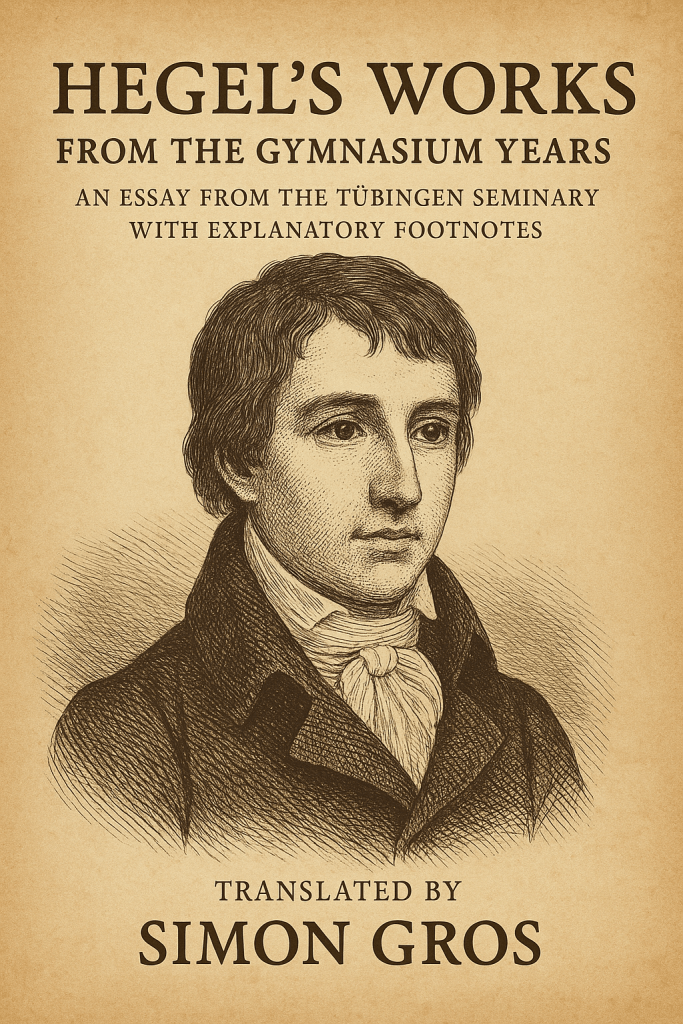
Contents:
Works from the Gymnasium Years: An Essay from the Tübingen Seminary (1785–1788)
Conversation Between Three Persons
Some Remarks on the Representation of Magnitude
On the Religion of the Greeks and Romans
On Some Characteristic Differences Among the Ancient Poets
From a Speech Given at Graduation Upon Leaving from the Gymnasium
On Some Benefits We Gain from Reading the Classical Greek and Roman Authors
An Essay from the Tübingen Seminary
(1785–1788)
Conversation Between Three Persons
1785, May 30
Antonius: Have you thought about the plan I laid before you? Are you now resolved?
Octavius: I have considered it and weighed it thoroughly. Should the execution proceed as successfully as the plan is wisely and prudently arranged, then something magnificent would be accomplished.
Lepidus: I found it the same.
Octavius: But now? Let us also determine the details and track down the obstacles that will stand in our way.
Antonius: After long reflection, I have found no particular difficulties.
Octavius: But I have. I will lay them before you. Will the free Romans submit to our rule? Will Brutus, will Cassius, will the others who helped slay the noble Caesar remain quiet? Will Sextus Pompeius be easily appeased?
Antonius: Oh, Octavius, no such scruples! Believe me, I have lived longer in the world, have more experience than you. Do you think that even a spark of patriotism still burns in them? Not at all. Through luxury and excess they have been so debased from the grandeur of soul of their ancestors that they no longer care about freedom. Only recently, after Caesar’s murder, when Brutus and Cassius stood on the rostrum and inflamed the people with hatred against great Julius to such a degree that they nearly laid hands on his sacred corpse in their fury—how much rhetoric did I need to shift their tone? Like feathers, they let themselves be blown this way and that. The soldier is already used to shedding the blood of citizens as well as of enemies, and he is on our side. With the common rabble it takes but a few words, a little grain or money, and some public spectacles.
Lepidus: I will take care of that item.
Octavius: You are entirely right, Antonius. That objection is now removed. But a Brutus, a Cassius, is far above the rabble’s sphere.
Antonius: Oh, they have lost all weight, all affection, all prestige through Caesar’s murder and my speech. The people are on our side. What, then, can they undertake? And until now they have been quiet.
Octavius: I received letters scarcely four hours ago stating that they are secretly preparing for resistance, fearing something from us. I meant to bring you the news immediately, but you were neither at the Capitol nor at home.
Antonius: I was at my country estate. That Brutus and Cassius are arming for war does not greatly trouble me. We are as much warriors as they. We must only be vigilant, unite our forces, and therefore immediately summon our legates and tribunes.
Octavius: But beyond them there are still many enemies who, though they wear friendliness on their faces, hide venomous daggers in their hearts. These should be removed from our path.
Antonius: Rightly said, my Octavius. We discussed this in our last meeting, named most of them, and swore them to death. Here, I have written them down. Read it.
Octavius (reads through and suddenly exclaims): Cicero too?
Antonius: Yes, Octavius. In the last meeting we resolved that each of us may choose someone he would gladly send to the realm of the dead. Cicero was my mortal enemy. His speeches and letters prove it all too clearly. And Lepidus even gave up his own brother.
Lepidus: Yes, I did.
Octavius: I can never revoke my given word, but the man pains me greatly.
Antonius: Here, Lepidus, read it too. My uncle Lucius appears on the list at your request. So we are balanced. Each of us has sacrificed a man dear to him for our common good. But let us now turn to another matter, namely, the division of the lands.
Octavius: That point, I think, we should let rest for now. Only after the subjugation of Brutus and Cassius shall we resolve it. But we must seriously consider countermeasures against these enemies.
Antonius: I suggest that you and I leave Rome, assemble our army, and then march upon them in their provinces. Lepidus can secure the city. Do you approve?
Octavius: Yes, entirely.
Lepidus: I also agree. I shall depart immediately and take the necessary steps.
(Lepidus exits.)
Antonius: There! Now he is gone, that simple man. Now I can speak more freely with you, Octavius. Should we let that barren head one day take part in ruling the world?
Octavius: It was you who drew him into this alliance. Now it can likely no longer be changed. I believe he has proven himself a good soldier in many places.
Antonius: Believe my words, I have come to know him. The man has no merits of his own, no intellectual faculties. He can only carry out orders well. Like a dead machine, he must be set in motion by others. Believe me, had he no powerful friends, it would never have occurred to me to admit him. We need him now, but I think, once we have reached the end of our course, once we are secure enough, we will rid him of his unearned honors, feed him on husks, or remove him entirely, and we will enjoy the harvest that he sowed and reaped for us.
Octavius: I leave that to your discretion. Let us speak further on this matter only after the successful completion of our designs. But now, Antonius, we must be cautious. Closer and more terrifying storms gather over our heads. Let us therefore quickly put ourselves into good order, so that we may defy the approaching, soon raging, tempest with courage.
Antonius: Yes, let us do so. I have a few matters to settle before our departure. Perhaps we shall speak again this evening. Until then, farewell.
(He exits.)
Octavius alone:
Foolishness left first, and then arrogance followed. What Antonius said about Lepidus is not untrue, but Antonius is proud, power-hungry, voluptuous, cruel. Once our enemies are defeated and Lepidus set aside, Antonius—proud of his deeds and experience—will want to lead me, a younger man, according to his own will. But he will not find in me a Lepidus. My unenslaved neck is not accustomed to bowing beneath the condescending gaze of a master. He will wallow in pleasures. I shall allow it for a time and remain silent. But when his body and soul are weakened and he stands in contempt, then shall I raise my head, show him my true greatness, and then—aut Caesar, aut nihil. Either he shall humble himself in the dust before me, or I shall prefer death to a life of disgrace.
(He exits.)
¹ Brutus and Cassius: Marcus Junius Brutus and Gaius Cassius Longinus were the principal conspirators in Julius Caesar’s assassination (15 March 44 BC). After the murder, they fled Rome and organized resistance against Caesar’s heirs, ultimately facing defeat at the Battles of Philippi in 42 BC.
² Sextus Pompeius: The youngest son of Pompey the Great, Sextus held Sicily and commanded a powerful naval force after Caesar’s death. He was a significant obstacle to the Second Triumvirate until his defeat in 36 BC.
³ Roman populace and games: In the late Republic, large grain distributions (annona) and lavish spectacles (gladiatorial shows, chariot races) were used to secure popular favor; such measures often pacified citizens and undermined political dissent.
⁴ Lepidus: Marcus Aemilius Lepidus (c. 89–13 BC) joined Mark Antony and Octavian (the future Augustus) to form the Second Triumvirate in November 43 BC. Though initially powerful, he was soon sidelined and relegated to Africa.
⁵ Proscription lists: The triumvirs employed proscription (published lists of enemies to be executed and whose property was confiscated) as a means to eliminate opposition and fill state coffers; notable victims included Cicero and other prominent senators.
⁶ Cicero: Marcus Tullius Cicero (106–43 BC), renowned orator and statesman, vocally opposed Antony. He was proscribed and executed in December 43 BC; his hands and head were displayed in the Roman Forum.
⁷ Division of lands: Following the assassination, conspirators debated redistributing Roman territories among themselves; such land divisions were a common method to reward veterans and secure allegiances, but were deferred until rivals were subdued.
⁸ Octavius (Octavian): Gaius Octavius Thurinus (63 BC–AD 14), Julius Caesar’s adopted son and heir. After forming the Second Triumvirate, he gradually outmaneuvered Antony and Lepidus to become Augustus, Rome’s first emperor.
⁹ “Aut Caesar, aut nihil”: Latin for “Either Caesar or nothing,” this motto became associated with Octavian’s ambition to consolidate supreme authority; it reflects his determination to claim singular power rather than share it under the triumviral arrangement.
¹⁰ Historical setting (May 30, 1785): Though this dialogue is dated “May 30, 1785,” it dramatizes events of 43 BC—shortly before the establishment of the Second Triumvirate in November 43 BC—and reflects late-18th-century Gymnasium exercises in classical rhetoric and historical reconstruction.
Some Remarks on the Representation of Magnitude
May 14, 1787
Everyone experiences daily—though they may not pay attention to it—that magnitude is a relative concept, i.e., that we measure all magnitudes according to a customary or the nearest available standard of measurement. From this general experience, many particular everyday phenomena can be explained. That we perceive a room that is not high as longer than another of the same length and width but greater height, comes, I believe, from nothing else. The nearest standard for measuring the length and width of a room is its height; when the height is small, and thus contained often within the length, we take it to be larger. In a higher room, by contrast, our standard of measure is not as often repeated in the length and width, and therefore it appears smaller to us by a natural effect. For the same reason, a vertically standing object—e.g., a rod—may appear shorter than when lying horizontally; in the former position we have no intermediate objects for comparison, while in the latter there are many that we can compare it to.
It should only be noted here that in both cases, the object must not lie too far from the eye; for a distant horizontal object appears smaller to us due to an optical observation, because the so-called visual angle is smaller, while an upright object appears larger for the opposite reason. This is also the reason that, in clear weather, the moon appears farther away when rising—because of the abundance of comparable, intermediate objects—than when it stands directly overhead, although we usually perceive it as larger at moonrise, which can be explained by the abundance of vapors that refract the rays.
But such illusions occur not only with distances; we can observe the same with time. The duration of a journey seems to pass much more slowly when we are on our way to a destination than on the return trip. Also afterward, the same feeling remains with us, because the representations of the many objects along the way cannot be united into one general representation, but we must think of the journey as a series of representations, if we are to properly recall it. From books, on the other hand—especially those that are not historical in content—there often remain only general impressions, although this may vary greatly depending on one’s faculties and inclinations.
(Meiners, Letters on Switzerland, Vol. 1, Letter VI, p. 371.)
When, apart from the lofty peaks of the highest mountains, the whole surrounding landscape is covered in night, the illuminated summits appear much lower than usual and at the same time as close as if they bordered the nearest valley.
¹ The relativity of magnitude reflects early insights into psychophysics, anticipating later work by Ernst Weber and Gustav Fechner: we judge size not in absolute terms but by comparing dimensions to familiar standards (e.g., height—“the nearest standard”—serves as a unit repeated mentally when assessing a room’s length and width).
² When a rod stands vertically, we lack adjacent objects at comparable height for reference, so it appears shorter; lying horizontally, it aligns with other horizontal surfaces (floorboards, tables), making it seem longer.
³ The “visual angle” is the angle subtended by an object at the eye’s nodal point; a distant horizontal object yields a smaller visual angle and thus appears diminished, whereas a nearer upright object subtends a larger angle and seems larger.
⁴ Atmospheric refraction near the horizon—caused by denser air and vapors—makes the rising moon’s image slightly magnified (the so-called “moon illusion”), even though its true angular size remains constant; intervening objects (trees, buildings) further reinforce its apparent proximity and scale.
⁵ The subjective dilation of time on a journey—where the outbound leg feels longer than the return—is a cognitive effect studied in modern psychology: novel stimuli (“representations of the many objects along the way”) prevent forming a unified memory, so duration is recalled as segmented and lengthy.
⁶ Christoph Meiners (1747–1810), author of Briefe über die Schweiz (Letters on Switzerland), combined travel observations with philosophical commentary; his Letter VI (Vol. 1, p. 371) describes nocturnal mountain views under moonlight, noting perceptual distortions when only peaks are illuminated.
⁷ In clear night conditions, with valleys shrouded in darkness, illuminated mountaintops lose depth cues (lack of shadowed bases), so they appear lower and closer—as if adjacent to the nearest valley—due to diminished contrast and absence of foreground references.
On The Religion of the Greeks and Romans
August 10, 1787
As for the religion of the Greeks and Romans, they followed the path common to all nations. The idea of a deity is so natural to man that it has developed among all peoples. In their infancy, in the primitive state of nature, they imagined God as an all-powerful being who governed them and all things merely at will. They shaped their conception of him after the rulers they knew—fathers and patriarchs of families—who had absolute control over the lives and deaths of their subordinates, whose commands they obeyed blindly, even when unjust or inhuman, and who, as men, could become angry, act hastily, and regret their actions. Just so did they imagine their deity, and the conceptions of the majority of people in our much-praised enlightened age are no different. Misfortune—both physical and moral evil—they viewed as punishment from the deity and concluded that they must have knowingly or unknowingly offended it by actions that displeased it, thus incurring its wrath.
To appease this wrath, they offered gifts, the best of what they had—first fruits, even the dearest things, their children. These people had not yet understood that those evils were not real evils, that happiness and unhappiness depended on themselves, and that the deity never sends misfortune to the detriment of its creatures. Nor did they consider that the highest being is not won over by gifts from humans, and that humans can neither increase nor diminish its wealth, power, or glory. But how were they to offer those sacrifices? Since they saw that only substances dissolved in smoke rose to the clouds—and since they believed the deity dwelled there—they let their offerings rise up to it in the smoke of fire. This is the origin of sacrifices, which among the Greeks and Romans, as among the Israelites, constituted a main part of worship.
People, who can conceive of everything only through sensual representations, soon made bodily images of the deity out of clay, wood, or stone—each according to the ideal they had of the most awe-inspiring being. Hence the grotesque shapes and figures of the gods among primitive peoples without a sense of beauty or the arts. It was necessary that each give their god a special name. When multiple tribes united for a common purpose or otherwise intermingled, each retained its own god. But to make their union firmer, they had their respective deities also enter into a society and placed them all in one location, where the entire people worshipped them together. Greece and Rome had their Pantheon, and each city again had its own patron god. The fact that these nations were a mixture of many different peoples is the chief reason for their multitude of deities and for the diverse myths and tales concerning them.
Polytheism was further encouraged by the belief that the god, whose power they conceived as limited, was not strong enough to govern the whole universe alone. So they assigned the rule of each element, various tasks, and so forth to a particular god. They personified elements, lands, and other great objects, attributing their effects and changes to these as freely acting beings. It is also well known that they transferred meritorious heroes to the dwelling place of the gods after death and honored them like the gods themselves.
This great confusion in mythology was greatly increased by the efforts of scholars to discover the meaning of each myth. Special places were selected for the erection of images of the gods, and temples were built, all of which acquired great sanctity because people believed the god resided there. Heights and groves were particularly preferred, no doubt because their appearance was already awe-inspiring, and their apparent nearness to the sky made them seem especially suited as abodes of the gods—also because the soul of a solitary and deeply sensitive person is nowhere more enraptured than at the sight of a vast expanse, where one can take in a great portion of the beautiful creation at once, or in the stillness of dark forests, where it becomes ecstatic, begins to dream, and truly believes itself to see apparitions or a divinity.
A man filled with fear about something interprets all surrounding circumstances in that light and is frightened by everything. So too were those unenlightened people, full of imagination and fearful of their god, firmly believing that he directly caused all changes in nature and thereby revealed his will to them, and thus interpreted every unexpected event as such a revelation. A superstitious Greek, for example, would not cross the road if a weasel had run across it; he would consult an augur if a mouse had gnawed his sack of flour. Even in our time, people interpret the appearance of a comet as foretelling the death of a monarch, or the cry of an owl as announcing a person’s death.
Connected with this was the desire of men to look into the fates of the future. They believed that the gods, on whom they were dependent, might well lift the veil slightly and announce future events through signs or through human intermediaries who were thought to have closer contact with them.
All these tendencies were noted by the wiser and more cunning individuals, who were chosen to serve the deity. They saw that no means governed the people so readily as religion. Since it gave them the best opportunity to serve their own desires and passions, or even to work for the public good, by taking advantage of this obedience, they encouraged those inclinations, bound the imagination, and gave it direction and occupation through elaborate sensual ceremonies. Against all assaults of reason, they shielded themselves by connecting all their actions to religion, thereby sanctifying them. They partially removed the images of the gods from the public eye and access of the multitude, and by this secrecy bestowed upon them greater dignity and sublimity, allowing the imagination freer play. Through the oracles, the priests held influence over all important matters. In Greece, they were one of the bonds by which the jealous and divided city-states were held together and united in common interests.
Thus arose the religions of all peoples—so also the religion of the Greeks and Romans. Only when a nation reached a certain stage of culture could men of enlightened reason emerge among them, attain better concepts of the deity, and communicate them to others. From that point are also most of the writings we possess from antiquity. The earlier ones are valuable, at least from the standpoint of the history of humanity. They call upon us always to venerate a providence whose commands are not arbitrary but wise, directing all things with kindness and benevolence.
Correct understanding of the state of popular religion cannot, however, be gleaned precisely from the poets. They treated religion and the history of the gods as poets, each according to his purpose; only the common opinions had to serve as a basis. And this popular belief regarding the attributes and governance of providence remained nearly the same at all times. The common people of all nations ascribe sensual and human qualities to the deity and believe in arbitrary rewards and punishments. These notions, however, are the strongest restraint on their passions; the reasons of philosophy and a purer religion are not effective enough against them.
The wise men of Greece and their followers, on the other hand, show in their writings far more enlightened and exalted concepts of the deity, especially with regard to the fate of human beings. They taught that the deity gives everyone sufficient means and strength to attain happiness, and that the nature of things is such that true happiness is achieved through wisdom and moral goodness. On these principles, most agreed; only in their speculations about the primal being of the deity and other matters incomprehensible to man did they devise very different systems. From these perspectives, many aspects of religion, of which I have mentioned only a few, will appear neither so incomprehensible nor so ridiculous when we consider that human beings with the same faculties as ourselves, through unequal development and misguided direction of those faculties, strayed into such errors.
The manifold striving of these people to discover truth convinces us how difficult it is to reach a truth that is pure and untouched by error. It shows how man often remains halfway there, sometimes ventures further, sometimes strays from the right path, and often, deceived by a misleading semblance, seizes a shadow instead of reality. Both their failed and successful efforts are already-experienced lessons for us, from which we can profit without having been exposed to the same dangers. We can gather what is good and useful, and avoid their missteps.
From their history, we learn how common it is, through habit and tradition, to regard the greatest nonsense as reason, and shameful follies as wisdom. This should make us attentive to our inherited and perpetuated opinions, to examine even those against which doubt or suspicion has never crossed our minds—perhaps they are entirely false or only half-true. It should awaken us from the slumber and inactivity that so often make us indifferent to the most important truths. If these experiences have taught us to consider it possible, even likely, that many of our convictions may be errors—and many of those of others who think differently may be truths—we will not hate them, nor judge them uncharitably. We know how easy it is to fall into error and will therefore seldom attribute such errors to malice or ignorance, and thus become ever more just and humane toward others.
¹ The conception of a deity modeled on human rulers—fathers and patriarchs—is rooted in anthropomorphic projection: early societies, lacking abstract theology, imagined gods with familial authority and emotional volatility, mirroring the absolute power of clan heads and kings.
² Interpreting misfortune (illness, disaster) as divine punishment reflects a “retributive theology,” common in both ancient and pre‐Enlightenment thought, whereby suffering is seen as the direct consequence of moral failings or offended deities.
³ Offering “first fruits” and children as sacrifices derives from agrarian rites: giving the best of one’s harvest demonstrated piety, while child sacrifice—though less widespread—occurred in certain ancient Near Eastern cultures (e.g., Carthaginian “Moloch” worship) and influenced Mediterranean practices.
⁴ The practice of burning offerings to send “substances dissolved in smoke” to the sky is attested in both Greek and Roman rituals (e.g., libations and holocausts), under the belief that the visible vapors carried gifts to the gods dwelling in heavenly realms.
⁵ The Pantheon (Greek: pantheion, “of all the gods”) in Rome was the temple dedicated to every god, originally built by Marcus Agrippa (27 BC) and rebuilt by Hadrian (c. AD 126). Local patron deities—“genius loci”—protected individual cities and households, leading to a multiplicity of cults within a single polity.
⁶ Polytheism in Greece and Rome emerged partly from combining the religious traditions of diverse tribes and colonies. By assigning specific domains (e.g., sea to Poseidon, war to Ares), the Greeks personified natural forces as independent divine agents, reflecting a decentralized cosmology.
⁷ Deification of heroes—such as Hercules or Aeneas—resulted in cultic honors (hero cults) whereby mortals who performed extraordinary feats were venerated posthumously. These “semi‐divine” figures blurred the boundary between human and god.
⁸ Temple placement on heights (acropoleis) or in groves (nemesia) is explained by the ancients’ sense of liminality: elevated sites appeared closer to the sky—home of the gods—while secluded groves fostered an atmosphere conducive to ecstatic worship and oracular revelation.
⁹ Interpreting everyday occurrences (a weasel crossing the road, a mouse gnawing food) as omens exemplifies the ancient art of divination; augurs read the will of the gods through observing birds, animals, and other signs (haruspicy, extispicy).
¹⁰ The “moon illusion”—where the rising moon appears larger against the horizon than at zenith—combines atmospheric refraction with contextual cues from intervening landscape, leading to a perceptual enlargement despite constant angular size.
¹¹ Consulting oracles (Delphic Pythia, Sibylline prophecies) was a central feature of Greek religion: priests interpreted cryptic responses delivered by human intermediaries believed to be inspired by the gods, guiding civic and military decisions.
¹² Priestly elites maintained power by monopolizing rituals and prophetic knowledge. By restricting access to sacred images and venerable rites, they enhanced the sanctity of cults, using mystery and secrecy to command obedience and unify fragmented city‐states.
¹³ As Greek culture matured—through figures like Hesiod and later philosophers—more speculative and ethical conceptions of the divine emerged. Authors such as Xenophanes and Plato critiqued anthropomorphic deities, fostering intellectual currents that sought a transcendent, rational principle.
¹⁴ Poets (Homer, Hesiod) wove mythological narratives shaped by local traditions and oral lore, not aiming at systematic theology. Their literary portrayals reflect popular beliefs rather than doctrinal accuracy, so one cannot deduce precise religious practices from poetic texts alone.
¹⁵ The “providence” attributed to deities was understood as a moral force ordering the cosmos and human affairs. While popular religion emphasized arbitrary will, philosophical schools (Stoics, Academics) developed a more consistent notion of divine reason (logos) guiding events benevolently.
¹⁶ Greek thinkers—such as Xenophon, Plato, and later Stoic and Epicurean writers—articulated elevated views of the divine: Plato’s Form of the Good, Stoic pantheism, and Cicero’s De Natura Deorum propose that gods possess perfect wisdom and justice, enabling human flourishing through moral virtue.
¹⁷ The struggle to attain a “pure” conception of truth underscores early epistemological reflexivity: Greeks and Romans recognized the pitfalls of tradition and superstition, yet lacked systematic methods (later developed in modern science) to eliminate error completely.
¹⁸ Habits and inherited opinions can perpetuate false beliefs; many customs persist unexamined through social inertia. Hegel’s warning anticipates the Enlightenment critique of “prejudices” and calls for continual self‐scrutiny of accepted doctrines.
¹⁹ If one accepts that convictions can be erroneous, sympathetic understanding follows: recognizing that others’ beliefs may stem from context and limited information reduces moral judgment and promotes tolerance, a core Enlightenment value.
On Some Characteristic Differences
Among the Ancient Poets
August 7, 1788
In our time, the poet no longer has such an expansive sphere of influence. The famous deeds of our ancient, and even of our more recent, Germans are neither interwoven with our constitution nor preserved in memory through oral tradition. We learn of them only from history books, often of foreign nations, and even this knowledge is limited to the more educated classes. The tales that entertain the common folk are fantastic legends, which are neither connected to our religious system nor to actual history. Moreover, the ideas and culture of the social classes are now so disparate that a poet of our time could hardly hope to be universally understood or widely read. Thus, our great German epic poet’s wise choice of subject matter has not brought him into so many hands as would have occurred if our public institutions were Greek in character. One part of the audience has already distanced itself from the system on which the whole poem and its individual parts are based; another is too consumed by the concerns of increasingly numerous comforts and needs of life to find time or inclination to elevate itself and approach the ideas of the higher classes. What interests us now is the poet’s art—not the subject itself, which often leaves an opposite impression.
A particularly striking quality of the works of the ancients is what we call simplicity, which is more felt than precisely defined. It essentially consists in the fact that the writers portray the image of the thing faithfully, without seeking to make it more engaging through subtle details, learned allusions, or a slight departure from truth in order to render it more brilliant or attractive, as is commonly demanded today. Every emotion—even a complex one—they express simply, without distinguishing its manifold components as the understanding might, and without dissecting what is obscure. Moreover, the entire system of their education and cultivation was such that each person acquired their ideas through direct experience, and they did not know the cold book-learning that impresses only dead symbols upon the brain. With everything they knew, they could still say:
“How? Where? Why?” — they had learned it.
Thus each necessarily had a unique mental form and a system of thoughts of their own; they had to be original. We, on the other hand, are taught from youth onward a ready-made vocabulary and set of signs for ideas, and they rest in our minds without activity or use. Only gradually, through experience, do we come to know our store of knowledge and to associate actual meaning with the words—words that, for us, already function like molds shaping our ideas, with predetermined scope and limitation, and relations through which we are accustomed to see everything.
Here lies, incidentally, a chief advantage of learning foreign languages: we come to learn how to group or separate concepts more freely. From this modern mode of education it follows that, in some people, the sequences of accumulated ideas and learned words run parallel to one another without ever forming a unified system—often without even touching or intersecting.
Another characteristic feature of the ancients is that their poets especially depicted the outward, sensory phenomena of visible nature, with which they were intimately familiar—whereas we today are more informed about the inner mechanisms of forces, and in general know more about the causes of things than about how they appear. Among the ancients, everyone became familiar with the occupations of other classes through everyday life, without intentionally setting out to study them. Therefore, technical terms had not become common. Although we, too, have words to describe fine nuances in the changes of visible nature, they have become part of vulgar language or regional dialects.
In general, one sees immediately in the works of the ancients that they surrendered themselves calmly to the flow of their thoughts, creating their works without regard for an audience; whereas in modern works it is evident that the author composed them with the consciousness that they would be read, and almost with the idea that they were conversing with their readers.
We also see that in the still-prevailing forms of poetry, circumstances determined the direction of the genius of the original inventors. Nowhere is this influence so clearly seen as in the history of dramatic poetry. Tragedy originated in crude festivities held in honor of Bacchus, accompanied by singing and dancing (cf. Tibullus II.1.57; Horace, Ars Poetica, v. 220). From the reward given at these events, it took its name. At first, only one performer interrupted these festivities by recounting ancient divine myths. Aeschylus was the first to introduce two actors, to build a proper stage—where previously a hut (skēnē) made of branches had sufficed, partitioned into multiple chambers to allow different scenes. The audience had to move from one to the other. This was avoided with the construction of a proper stage, and subsequent poets maintained the unity of place, a rule they only rarely sacrificed to achieve greater poetic beauty (e.g., Sophocles in Ajax, v. 815 ff.). From its first true inventor, the language of tragedy also acquired that solemn dignity which has distinguished it ever since. It is evident from this how the unique form of Greek tragedy, especially the special function of the chorus, developed.
Had the Germans refined themselves gradually without foreign influence, their spirit would certainly have taken a different course and produced native German drama—instead of borrowing the form from the Greeks. Comedy had a similar origin in the rustic farces (phallic plays) of countryfolk and in the Fescennine verses of the Romans (cf. Aristotle, Poetics, Chapter II, §4; Horace, Epistles II.1, v. 139ff., and Wieland’s note thereupon). Nature itself taught even the most uncultured people a kind of primitive poetry, out of which art gradually developed what refined nations now call poetry.
Among the Athenians—of whom Juvenal said, natio comoeda est—this genre naturally flourished, whereas the serious Romans were less inclined to appreciate subtle comedy.
Only these two genres of dramatic poetry were known to the ancients. Some hybrid forms, invented to accommodate the overly adorned tastes of certain audiences (kat’ epikairian poiountes tois theatais, Aristotle, Poetics VII, §13), seem not to have endured for long.
¹ Greek educational context: Late‐18th-century German Gymnasiums taught students to value originality by combining direct observation of life with study of classical texts. Ancient poets learned through immersion in civic rituals, oral tradition, and daily social experience rather than reliance on rote memorization of abstract vocabulary.
² Simplicity in archaic poetry: Greek and Roman poets such as Homer and Virgil prioritized faithful representation of events and emotions over elaborate rhetorical ornamentation. Modern critics contrast this with neoclassical and Romantic tendencies to amplify or embellish with learned allusions.
³ “How? Where? Why?”: This line alludes to Epicurean and Stoic emphases on understanding causes and natural phenomena through direct inquiry. Classical authors often invoked questions of causality in their expository passages (e.g., Lucretius, De Rerum Natura).
⁴ Preformed vocabulary: In 18th-century pedagogy, students often memorized word lists and grammatical paradigms (e.g., Latin “Golden Ass” style manuals) before grasping their semantic depth. Hegel criticizes this method for stifling intellectual initiative.
⁵ Value of foreign languages: Learning Greek, Latin, or modern European tongues (French, English) helped students recognize that translation requires grouping and parsing concepts differently, rather than importing a fixed mental ledger of ready-made terms.
⁶ Technical terminology: Ancient poets knew crafts and social roles—farmers, blacksmiths, sailors—by lived experience; they used everyday language rather than specialized technical jargon, which modern specialists may obscure by disciplinary terminology.
⁷ Audience awareness: Classical authors composed primarily for performance or patronal favor but did not write with a mass audience in mind; modern poets, in contrast, often tailor style and content expressly to appeal to critics and literate readers.
⁸ Origin of Greek tragedy: Early Athenian festivals to Dionysus (the City Dionysia) featured dithyrambic choral performances. The shift from choral myth recitation to dramatized dialogue occurred when Thespis introduced an actor (hypokrites) opposite the chorus (c. 6th century BC). Aeschylus later added a second actor, creating conflict-driven dialogue.
⁹ Bacchic festivities and the term “tragedy”: The Greek word tragōidia (“goat song”) likely refers to prizes (goat skins) awarded to choral choruses at Dionysian festivals. Horace (Ars Poetica 220) and Tibullus (II.1.57) allude to these ritual origins.
¹⁰ Aeschylus (c. 525–456 BC): Considered the father of tragedy, he formalized dialogue between actors and chorus and constructed the early stage (skēnē) that evolved into classical theatre architecture. Before his innovation, performances used temporary, branch-built booths to signify scene changes.
¹¹ Unity of place: Classical dramatists adhered to Aristotle’s precept (in Poetics VI–XIV) that tragedy should observe unities of action, time, and place. Sophocles’ Ajax (beginning around line 815) is noted for largely maintaining a single setting, with minimal departures for dramatic effect.
¹² Chorus function: In Greek tragedy, the chorus provided narrative commentary, moral reflection, and emotional resonance, distinguishing the form from later dramatic conventions.
¹³ German drama and Greek influence: During the 18th century, German playwrights (e.g., Lessing, Lessing’s Hamburg Dramaturgy) consciously modeled tragedies and comedies on classical precedents. Native folk‐drama traditions existed, but institutionalization of the stage followed Hellenistic templates.
¹⁴ Roman Fescennine verses: Early Roman comedic forms (e.g., fescennina carmina) comprised ribald, improvisatory dialogue performed at rural celebrations, often preceding Plautus’ adaptation of Greek New Comedy. Aristotle (Poetics II.4) and Horace (Epistles II.1.139 ff.) discuss these rustic origins.
¹⁵ Juvenal (c. late 1st/early 2nd c. AD): In his Satires (Satire 3.147), he quips “natio comoeda est” (“the people are born to be comic actors”), reflecting Athenian dominance in comedic performance, contrasted with Roman gravitas that prized serious genres over subtle satire.
¹⁶ Hybrid dramatic forms: Some Hellenistic adaptations (e.g., satyr plays, menippean satire) merged elements of tragedy and comedy to suit specific audiences. Aristotle’s Poetics VII.13 terms these κατ’ ἐπίκαιριον (“occasional” compositions), whose reliance on topical ornamentation often limited their longevity.
From a Speech Given at Graduation
Upon Leaving from the Gymnasium
So great is the influence of education on the entire well-being of a state! How strikingly we see, in the case of this nation, the dreadful consequences of its neglect. If we consider the natural capacities of the Turks and then compare them to the coarseness of their character and their achievements in the sciences, we will come to recognize and properly value our own great fortune—that Providence caused us to be born in a state whose prince, convinced of the importance of education and of the widespread benefit of the sciences, has made both a principal focus of his high concern, and has erected for his glory enduring and unforgettable monuments which even the most distant future generations will admire and bless.
Among the most eloquent and personally meaningful proofs of these excellent sentiments and this zeal for the welfare of the fatherland are the institutions of this school, which are founded upon the noble idea of educating useful and capable members for the needs of the state. That these institutions have been perfected in every possible way and maintained at all times in a flourishing state, we owe—after Karl—especially to you, most venerable men. Your tireless efforts must be revered with the deepest gratitude by anyone who holds the happiness of his country dear. Especially at this moment, we above all others have the most urgent reasons to surrender our hearts entirely to feelings of thankfulness toward the noble patrons and overseers of this institution.
Thanks to you for the invaluable and countless benefits that have been bestowed upon us from our earliest youth through your grace in this house, consecrated to the sciences and to education. Special thanks for the most gracious acceptance into the higher institutions intended for our further development, where, under your wise leadership and benevolent oversight, we now continue and complete our path on a new road. Here it is also our duty to publicly express our deepest gratitude to you, dearest teachers. Thank you for your instruction in all that is worth knowing, for your guidance in all that is good and noble. Thank you also for your fatherly correction of our many faults. Forgive us, venerable guides of our youth, for our transgressions against your admonitions—aimed always at our good—whose wisdom the inexperienced youth does not always know how to appreciate.
And you, best friends and fellow students, who still walk upon the same path that we, in part together with you, have now just completed—be assured that we already now begin to realize, though too late for what has passed, how every inattentiveness to the warnings of our teachers and superiors bears harmful consequences, and that we shall become ever more convinced of this truth as our experience and understanding mature.
The awareness of the importance of your vocation will continually renew your courage, and will gradually kindle a love for your occupation, which will reward you with a pleasure and happiness more profound, genuine, and enduring than the finest inventions of the senses could ever provide. Let us together resolve firmly to make ourselves worthy, through diligence and good conduct, of this care and these benefits. Give thanks with us to the most benevolent Being that He gave us precisely these teachers and these educators. Let us ask Providence to bless and reward their efforts; may it strengthen their powers and health, and let their years reach the furthest bounds of human life.
¹ The “Turks” refers to the Ottoman Empire, long perceived in 18th-century Central Europe as a rival power whose lack of formal educational institutions was thought to produce martial prowess but limited scientific or literary advancement.
² “Karl” denotes Duke Karl Eugen of Württemberg (1728–1793), under whom the Duchy invested heavily in schools, the University of Tübingen, and the Hohe Karlsschule in Stuttgart, aiming to foster a learned bureaucracy and enlightened citizenry.
³ The “institutions of this school” are the Stuttgart Gymnasium Illustre (founded 1677), reformed and endowed under Karl Eugen. Its curriculum combined classical languages, mathematics, and sciences to train future civil servants and professionals for the state.
⁴ “You, most venerable men” addresses the school’s directors and senior professors (e.g., Preceptors Hopf, Cleß, and Löffler), whose administrative and pedagogical oversight kept the Gymnasium’s standards high.
⁵ “Higher institutions intended for our further development” alludes to the next stage of education in Württemberg: notably the University of Tübingen for theology and philosophy, and the Hohe Karlsschule for advanced studies in law, medicine, and military sciences.
⁶ “Dearest teachers” encompasses the Gymnasium’s faculty across all subjects, whose instruction in Latin, Greek, mathematics, natural philosophy, and rhetoric shaped graduates’ intellectual formation.
⁷ The “fatherly correction of our many faults” refers to the Gymnasium’s disciplinary system, which combined moral exhortation, regular examinations (percurrus, Hebdomad), and private admonitions to cultivate virtuous character.
⁸ “Best friends and fellow students” signifies the fifth- and seventh-class peers continuing their studies together; these classmates often formed lifelong intellectual networks in Württemberg’s administrative and academic circles.
⁹ The “higher institutions” and “occupation” underscore the expectation that graduates would enter civil service, the clergy, or professional careers, roles deemed critical to the state’s well-being and stability.
¹⁰ The closing invocation of Providence reflects late-18th-century Protestant piety in Württemberg, where state leaders and educators alike viewed divine blessing as essential to sustaining educational reforms and civic prosperity.
On Some Benefits We Gain From
Reading the Classical Greek and Roman Authors
May the joyful consciousness of much accomplished good, and the peaceful retrospect on years past—the reward of a life marked by deeds—the delightful fruits of their efforts, now partly ripened and partly still in bloom, and the blessings of all the upright, sweeten for them the burdens of increasing years, and with the brightest serenity may they look forward to the eternity that recompenses all.
The esteem in which the ancient Greek and Roman writers have been held with nearly equal strength throughout all centuries—though admittedly not always for the same reasons—makes them necessarily significant for us. If they possessed no merits other than those once recognized in them, if they had no other use than that which was long made of them, they would likely only draw our attention in the way an old but useless armory might.
But without some intrinsic worth, they could hardly have maintained their place in our age, which finds them particularly well suited for intellectual formation, for the following reasons.
First, they are especially useful in enabling us to gather the concepts that constitute the material processed by the other powers of the soul. Even a modest familiarity with these works and personal experience show that these authors consistently drew their depictions from nature itself and reported only observations they had gathered firsthand. The study of their constitutions and educational systems shows us even more clearly how far removed their knowledge was from what Lessing in Nathan the Wise called the dead bookishness that stamps the brain with lifeless symbols—the sum of meaningless words with which our minds are filled from youth, and from which, for the most part, our system of thought is composed. The form of their intellectual development necessarily imprinted itself on their writings. Their descriptions of both visible and moral nature are for this reason more vivid and more immediately graspable.
In their abstract inquiries—whether moral or metaphysical—we find that their path of speculation always proceeds from experience, draws conclusions from observation, and builds further upon them. Moreover, due to the distinctive character and trajectory of their culture—which was only minimally influenced from without—they necessarily viewed things from different relational perspectives, and expressed these in their language. They thus had concepts we cannot possess, for we lack the corresponding words. Even if we happen upon such a relation or analogy by chance, the impression, for want of a word, is too fleeting for us to fix the vague concept in our minds.
In this respect, language is for us a limited collection of fixed concepts, through which we model everything we perceive or notice. One essential benefit of learning foreign languages is precisely this enrichment of our concepts—especially when the culture of the people who speak the language differs from our own. The ancients, and above all the Greeks—who are principally meant here, since Roman writings, considered apart from their content, are mostly imitations of the Greek—possessed in their language a remarkable wealth of terms for expressing visible changes in natural objects and phenomena, the subtlest shades of difference, and above all the various modifications of emotions, states of mind, and character.
Our language also has a considerable stock of such words, but it would be far richer were not many of them considered provincial or vulgar, and thus banned from the language of polite society and the books it reads. Attempts to translate such concepts into our own language give rise to a more precise examination of the subtleties of meaning, and to a more accurate usage of words. It is self-evident how such study of distinctions sharpens the understanding and strengthens intellectual acuity.
Beyond this, the ancient writers from the flourishing epochs of their nations’ cultures offer the great advantage of forming taste. Taste, in general, is the feeling for the beautiful. Already this is gain enough: the sensitive power of the soul is thereby awakened and strengthened. Genuine expression of feeling always touches the heart and awakens sympathy—which, under the pressures of modern life, is so often suppressed. And where could we expect better models of beauty than from a nation in which everything bore the stamp of beauty, where the aesthetic faculties had every occasion to flourish, and where sages and heroes made offerings to the Graces?
With regard to history, their historians are extremely valuable relics. They are of particular interest to us in two respects: first, in terms of historical craftsmanship, in which probably no nation surpassed them, and only a few matched them. The causes, motives, and course of events always unfold before our eyes in a perfectly natural manner. The characters and passions of the individuals involved reveal themselves through their actions, without the need for the historian to underline their traits. At the same time, the whole is conveyed in the noblest simplicity, both in expression and in thought.
Second, they are important with respect to the history of humanity. We see the human spirit develop in very specific conditions and circumstances. From the sequence and character of the extant writings, we can abstract a complete history of their culture, and illuminate many phenomena elsewhere as well. For example, many aspects of the culture, habits, morals, and customs of the Israelite people—which have had and still have such influence on us—can be explained and rendered more comprehensible by comparison. For the human spirit has always, in general, remained the same; only its development has been variously modified by the diversity of conditions.
Finally, since—as has already been said—the works of the ancients are particularly suited for acquiring concepts, we can see how highly suitable they are as a preparation for the study of philosophy. Through them, one already acquires a stock of abstract ideas and a thinking power that is at least somewhat exercised—especially since they contain, in many areas of this science, at least the seeds and first principles that have only more clearly been articulated and developed in modern times. The many contradictions among the ancient philosophers, particularly in their speculations on the practical part of philosophy, have at the very least made it easier to find the middle way where truth lies.
These are my remarks on some of the advantages offered by the study of the ancients. In more than a few places, they will likely lack proper precision and completeness.
This is neither the place, nor am I capable of saying much about what the more mature person finds in them in terms of content—one who can compare their observations with his own experiences and judge the various views and systems of happiness which mankind has pursued, observed, or himself partly lived through.
¹ Lessing’s critique of “dead bookishness”: In Nathan the Wise (c. 1779), Gotthold Ephraim Lessing contrasts genuine, lived understanding with rote learning of vocabulary. Hegel invokes this to emphasize that Greek and Roman authors wrote from direct experience, rather than merely assembling lifeless terms.
² Minimal external influence on classical culture: The Greek polis and early Roman Republic developed relatively in isolation until Hellenistic and Roman expansions. Consequently, their thinkers forged original philosophical, literary, and political concepts that do not always have exact linguistic equivalents in modern European languages.
³ Greek richness in descriptive vocabulary: Ancient Greek poets and philosophers (e.g., Homer, Pindar, Plato) possessed specialized terms—phaino (appear), eidolon (image), pneuma (breath/spirit)—to capture nuanced phenomena. Latin writers often adopted and Latinized these Greek terms, but Hegel notes that Romans, lacking comparable native nuance, primarily imitated Greek models in style and expression.
⁴ Provincial and vulgar terms in modern German: In late-18th-century German, many precise descriptors (e.g., bineinanderfließen “to flow into one another,” schlagfertig “ready witted”) existed first as regional dialect terms or lower-class speech before being codified into high-style literature. Translating classical concepts forced careful lexical selection and clarified semantic boundaries.
⁵ Offerings to the Graces: The Charites (Greek: Χάριτες) or Graces—goddesses of charm, beauty, and creativity—received votive offerings (poetic, visual, and ritual dedications) from artists and patrons. Hegel suggests that ancient society cultivated an aesthetic sensibility pervasive in both public and private life, with temples, festivals, and monuments reinforcing a “stamp of beauty.”
⁶ Classical historiographical simplicity: Historians like Herodotus, Thucydides, and Livy prioritized clear narrative and cause-and-effect reporting. Thucydides’ History of the Peloponnesian War and Livy’s Ab Urbe Condita present characters through actions—e.g., Pericles’ funeral oration (Thucydides 2.34–46)—without overt moralizing, achieving a “noblest simplicity” praised by later critics.
⁷ Comparative cultural analysis: By examining Greco-Roman texts alongside Hebrew scripture (e.g., Exodus, Kings, Chronicles), one can trace parallels in legal codes, covenantal religion, and literary motifs (e.g., the ascent-and-descent narrative). Hegel anticipates modern comparative philology and cultural history by noting that the “human spirit … remained the same” despite differing environmental conditions.
⁸ Ancient philosophy as pre-philosophical groundwork: Pre-Socratic fragments (e.g., Heraclitus, Parmenides) contain nascent ideas about being and change; Socratic dialogues introduce ethical inquiry; Epicurean and Stoic schools offer competing moral systems. Studying these “seeds” aids in navigating modern philosophical debates and finding a “middle way” between extremes (cf. Aristotle’s concept of the Golden Mean in Nicomachean Ethics).
 Simon Gros
Leave a comment